



Community hub
Recent from talks
Contribute something
Nothing was collected or created yet.
Chip (CDMA)
View on WikipediaIn digital communications, a chip is a pulse of a direct-sequence spread spectrum (DSSS) code, such as a pseudo-random noise (PN) code sequence used in direct-sequence code-division multiple access (CDMA) channel access techniques.
In a binary direct-sequence system, each chip is typically a rectangular pulse of +1 or −1 amplitude, which is multiplied by a data sequence (similarly +1 or −1 representing the message bits) and by a carrier waveform to make the transmitted signal. The chips are therefore just the bit sequence out of the code generator; they are called chips to avoid confusing them with message bits.[1]
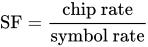
The chip rate of a code is the number of pulses per second (chips per second) at which the code is transmitted (or received). The chip rate is larger than the symbol rate, meaning that one symbol is represented by multiple chips. The ratio is known as the spreading factor (SF) or processing gain:
Orthogonal variable spreading factor
[edit]
Orthogonal variable spreading factor (OVSF) is an implementation of code-division multiple access (CDMA) where before each signal is transmitted, the signal is spread over a wide spectrum range through the use of a user's code. Users' codes are carefully chosen to be mutually orthogonal to each other.
These codes are derived from an OVSF code tree, and each user is given a different code. An OVSF code tree is a complete binary tree that reflects the construction of Hadamard matrices.
See also
[edit]References
[edit]- ^ Maral, Gérard; Bousquet, Michel (2002). Satellite Communications Systems. John Wiley and Sons. ISBN 978-0-471-49654-0.
External links
[edit] | This article about wireless technology is a stub. You can help Wikipedia by expanding it. |
Chip (CDMA)
View on GrokipediaFundamentals
Definition
In the context of code-division multiple access (CDMA) systems, a chip is the fundamental pulse unit representing the smallest element in a direct-sequence spread spectrum (DSSS) code, typically taking binary values of +1 or -1 to modulate the carrier signal.[4] This binary representation enables balanced phase-shift keying (PSK) modulation, where each chip corresponds to a phase shift in the transmitted waveform.[4] The waveform of a chip is a rectangular pulse with duration , defined as the reciprocal of the chip rate, which determines the temporal resolution of the spreading code.[5] Sequences of these chips collectively form pseudorandom noise (PN) patterns or orthogonal codes, which multiply with narrowband data signals to expand their bandwidth and enable multiple access in CDMA environments.[6] The term "chip" was formalized in CDMA contexts through standards like IS-95 in the 1990s, which specified chip-based spreading for commercial cellular networks.[7]Relation to Data Symbols
In code division multiple access (CDMA) systems, a chip serves as the fundamental spreading element, distinct from a data symbol or bit, which acts as the primary information carrier. Each data symbol is modulated by a spreading code to produce a sequence of multiple chips, thereby expanding the original narrowband signal into a wider bandwidth waveform.[8] This hierarchical relationship ensures that the chip level handles the fine-grained spreading process, while the data symbol level preserves the core message content.[5] The spreading factor (SF), defined as the number of chips per data symbol, quantifies this expansion and directly influences system performance. By replicating each symbol across SF chips, the process increases the signal's occupied bandwidth by a factor of SF relative to the original data rate, while simultaneously reducing the power spectral density to spread the energy over a broader frequency range. This trade-off enhances resistance to interference and supports multiple access by allowing user signals to share the same spectrum without significant overlap in correlated detection.[8] For instance, in wideband CDMA systems like UMTS, an SF of 64 means each data bit is represented by 64 chips, enabling up to 64 orthogonal channels within the same time-frequency resource for user separation.[9] This configuration balances data rate and capacity, as higher SF values accommodate more simultaneous users but reduce individual throughput.[10] The use of chips in this manner causes the transmitted CDMA signal to resemble wideband noise to any receiver lacking the correct spreading code, thereby providing inherent interference rejection through decorrelation at the despreading stage.[11] The chip duration is shorter than the data symbol duration, allowing the rapid sequence of chips to mask the underlying information from unintended recipients.[5]Spreading Process
Direct Sequence Multiplication
In direct sequence spread spectrum code division multiple access (DSSS-CDMA), the spreading process begins with the multiplication of the baseband data signal by a spreading code to expand the signal bandwidth. The data signal typically takes values of corresponding to binary phase-shift keying (BPSK) modulation, where each symbol represents a bit over a duration . This data signal is multiplied by the spreading code , which consists of a sequence of chips, each of duration , to produce a wideband signal before carrier modulation.[12] The transmitted signal is mathematically expressed as where is the transmit power, is the carrier frequency, and the factor normalizes the average transmit power to . The spreading code is defined as , where are the chip values, is a rectangular pulse of duration , and the sum is over one or more symbol periods. This multiplication operation spreads the narrowband data spectrum across a much wider bandwidth determined by the chip rate .[13][12] At the receiver, despreading recovers the original data by multiplying the received signal with a synchronized replica of the spreading code . Since for the chip values , this operation collapses the signal bandwidth back to the original data rate, yielding after low-pass filtering and integration over . The synchronization ensures minimal distortion, allowing effective rejection of narrowband interference and multipath effects.[12] The primary effect of direct sequence multiplication is bandwidth expansion from the data bandwidth to approximately the chip rate , enabling multiple access in CDMA systems (with further details on in the Chip Rate Calculation section). This spreading provides a processing gain in decibels, where the spreading factor quantifies the interference suppression capability, typically ranging from 10 to 30 dB in practical systems.[14][12]Chip Rate Calculation
The chip rate in a code-division multiple access (CDMA) system is defined as the reciprocal of the chip duration , expressed as , where each chip represents the shortest modulated pulse in the direct-sequence spread spectrum (DSSS) waveform.[15] This rate is significantly higher than the data bit rate , typically by a factor equal to the spreading factor , such that ; the spreading factor determines the length of the spreading code applied to each data bit, enabling multiple access while providing processing gain.[16] The chip rate directly influences the system bandwidth occupied by the DSSS signal. For a DSSS waveform, the null-to-null bandwidth of the main spectral lobe approximates , reflecting the sinc-squared shape of the power spectral density centered at the carrier frequency, with sidelobes extending further but containing minimal power.[15] In practice, the occupied bandwidth scales with to fit regulatory spectrum allocations, often using pulse shaping to confine the signal within the assigned channel (e.g., approximately 1.25 MHz for a chip rate near 1.23 Mcps).[17] Several factors guide the selection of in CDMA systems. Higher chip rates enhance system capacity by supporting greater processing gain within a given bandwidth, allowing more simultaneous users before interference limits are reached.[16] Shorter chip durations improve multipath resolution in rake receivers, enabling the separation of delayed signal paths spaced by at least (e.g., 0.814 μs resolution at 1.2288 Mcps), which mitigates intersymbol interference in multipath environments.[18] Additionally, must comply with regulatory spectrum limits to avoid adjacent channel interference and ensure efficient use of licensed bands.[17] As an illustrative example, consider a voice channel with kbps and : the resulting chip rate is kbps = 1.2288 Mcps, as employed in early CDMA standards like IS-95 to balance capacity and bandwidth efficiency.[16]Code Types
Pseudonoise Sequences
Pseudonoise (PN) sequences are deterministic binary sequences that approximate the statistical properties of random noise, functioning as chip-level spreading codes in code-division multiple-access (CDMA) systems. They are generated using linear feedback shift registers (LFSRs) initialized with primitive polynomials over the finite field GF(2), which produce sequences with maximal periods and pseudo-random characteristics.[19] Among PN sequences, m-sequences represent a core type, characterized by a length chips, where denotes the LFSR degree or polynomial order, allowing the period to synchronize with typical CDMA frame durations. Gold codes, widely adopted in CDMA for their expanded set of usable sequences, are constructed by taking the bitwise XOR of two decimated m-sequences from a preferred pair, also yielding length .[20][21] PN sequences exhibit several key properties that enhance their utility in CDMA. Balance ensures an equal (or nearly equal, differing by one) number of +1 and -1 symbols over the full period, promoting uniform power distribution. Run distribution is also balanced, with runs of consecutive identical symbols following a specific pattern—for instance, in an m-sequence of length 31, there is one run of length 5, two of length 4, and so on up to sixteen runs of length 1—mimicking random binary noise. The defining feature is their ideal autocorrelation, which peaks sharply at zero shift for synchronization while remaining low at other shifts to suppress multipath and interference. The autocorrelation function is given by where are the sequence chips. For m-sequences, and for ; Gold codes display a comparable three-level autocorrelation profile, with out-of-phase values bounded near -1/N.[20][19][22] In CDMA applications, PN sequences enable cell and sector identification by assigning unique offsets or indices to base stations, distinguishing transmissions across the network. They also serve for user-specific scrambling, where the sequence modulates the spread signal to separate users and diminish inter-cell interference by randomizing the composite waveform, thereby improving overall system capacity.[23][7]Orthogonal Codes
Orthogonal codes in CDMA systems are families of binary sequences designed such that the inner product between any two distinct codes is zero, ensuring mutual orthogonality and enabling efficient user separation without interference in synchronous environments.[24] This property is fundamental for channelization, where each code multiplies the data symbols to spread the signal across the chip duration. A prominent example is the Walsh-Hadamard code family, derived from Hadamard matrices of order , where the rows of the matrix serve as the orthogonal codes.[25] These matrices consist of entries limited to +1 and -1, and their rows (or columns) exhibit perfect orthogonality, with the inner product of distinct rows equaling zero.[24] The Hadamard matrices are generated recursively, starting from the base matrix H_1 = {{grok:render&&&type=render_inline_citation&&&citation_id=1&&&citation_type=wikipedia}}. Higher-order matrices are constructed using the rule: which doubles the size while preserving orthogonality.[24] For instance, yields two codes: [1, 1] and [1, -1], and this process continues to produce matrices like (order 64) for longer codes. Each code in the set has a length equal to the matrix order, typically matching the spreading factor (SF) in CDMA, where the SF determines the number of chips per data symbol.[25] In CDMA applications, a unique Walsh code is assigned to each user or channel on the forward link, allowing the base station to maintain synchronous transmission and exploit orthogonality to distinguish signals.[24] This assignment spreads the data over SF chips, with the code length ensuring that despreading with the correct code recovers the original symbol while others yield near-zero output due to the zero cross-correlation.[26] However, this orthogonality is sensitive to multipath propagation and asynchronous channels, where timing offsets lead to non-zero cross-correlations and interference, degrading performance.[24] Such limitations are mitigated through the application of pseudonoise scrambling codes, which randomize the phase and restore effective separation by breaking the alignment in delayed paths.[24] A representative example is found in the IS-95 standard, where 64 Walsh codes from an Hadamard matrix support up to 64 channels per base station, with each code being a 64-chip sequence at a chipping rate of 1.2288 Mcps.[25] Code 0 is reserved for the pilot channel, while codes 8 through 63 handle traffic channels, assuming synchronous conditions with negligible multipath delays for full orthogonality.[26] This setup enables multiple access within the 1.25 MHz bandwidth, though real-world multipath requires additional techniques like rake receivers for mitigation.[24]Orthogonal Variable Spreading Factor
Code Tree Structure
Orthogonal Variable Spreading Factor (OVSF) codes extend the concept of fixed-length orthogonal codes, such as Walsh codes, by organizing them into a binary tree structure that supports varying spreading factors (SF) while preserving orthogonality among assigned codes.[27] In this tree, each level corresponds to a specific SF, where the root at level 0 has SF=1, and subsequent levels double the SF (e.g., level 1: SF=2, level 2: SF=4, up to level 9: SF=512 in downlink WCDMA systems).[27] The structure ensures that codes can be generated recursively to accommodate different data rates without losing mutual orthogonality when properly assigned. The code tree is constructed starting from the root code C_{ch,1,0} = {{grok:render&&&type=render_inline_citation&&&citation_id=1&&&citation_type=wikipedia}}.[27] At each subsequent level, every non-leaf code branches into two child codes: for a parent code of length SF/2, the children are formed as and , where the negation applies element-wise (replacing +1 with -1 and vice versa).[27] For example, from the root [28], the level-1 codes are and ; at level 2 (SF=4), these branch to codes such as [1,1,1,1], [1,1,-1,-1], [1,-1,1,-1], and [1,-1,-1,1].[27] This recursive process maintains orthogonality with respect to ancestor codes in the tree. The OVSF tree is fundamentally based on Hadamard matrix constructions, which generate orthogonal sets of fixed length, but adapted into a tree to enable variable lengths up to the maximum SF.[29] At level , the tree contains codes, each of length , forming a complete binary tree with depth up to .[29] Visually, the tree resembles a balanced binary diagram where the root branches left to the repeated child and right to the negated child, with each path from root to leaf defining a unique code; for instance, a depth-3 tree would show 8 terminal codes branching from intermediate nodes at SF=2 and SF=4.[27] A key property of the code tree is that orthogonality is guaranteed between any two codes only if neither is an ancestor of the other in the tree, preventing their simultaneous use on the same branch to avoid interference.[27] Codes at the same level are mutually orthogonal, akin to rows in a Hadamard matrix of order , but codes at different levels on the same branch exhibit correlation, necessitating careful assignment to preserve system performance.[29]Rate Adaptation Mechanism
The rate adaptation mechanism in OVSF-based CDMA systems utilizes channelization codes of varying lengths derived from the OVSF code tree to support flexible data rates while maintaining orthogonality. A higher data rate is accommodated by assigning a shorter code with a lower spreading factor (SF), which spreads each data symbol over fewer chips, thereby increasing the effective bit rate; conversely, lower data rates employ longer codes with higher SF, spreading symbols over more chips. For instance, in WCDMA systems, an SF of 4 enables data rates up to 384 kbps in the downlink, while an SF of 256 supports lower rates such as 7.95 kbps for adaptive multi-rate (AMR) speech services.[30][31] When required data rates do not align precisely with the discrete SF levels available in the OVSF tree, rate matching adjusts the coded bit stream through symbol repetition or puncturing to fit the physical channel capacity. Repetition duplicates selected bits to pad the stream when the transport channel rate is below the physical channel rate, whereas puncturing systematically removes bits (subject to a puncturing limit to avoid excessive error rates) when the transport channel rate exceeds it; these operations occur after channel coding and before multiplexing onto the physical channel. The rate-matching attribute, assigned by higher layers, determines the extent of adjustment via algorithms that calculate bits to add or remove per radio frame.[32] Orthogonality among variable-rate users is preserved by strategically assigning codes from unused branches of the OVSF tree, ensuring no newly assigned code is a direct ancestor or descendant of an existing code, which would otherwise correlate the spreading sequences and introduce intra-cell interference. This assignment policy minimizes cross-user interference but can lead to code tree blocking, where a high-rate user's allocation of a low-SF code occupies a branch, preventing multiple low-rate users from using its descendant high-SF codes and thus reducing overall system capacity.[33][34] This mechanism enables efficient spectrum utilization in scenarios with asymmetric traffic loads, such as bursty data alongside constant voice streams, and facilitates multiplexing of diverse services like speech and packet data within 3G CDMA standards like UMTS.[30]System Applications
Evolution in CDMA Standards
The concept of chips in spread spectrum techniques originated in military applications during the 1940s. However, the formalization of chips in commercial CDMA systems occurred with Qualcomm's development of the IS-95 standard in 1993, which introduced a fixed chip rate of 1.2288 Mcps using Walsh orthogonal codes for channelization and pseudonoise (PN) sequences for scrambling to enable multiple access in 2G cellular networks.[35] This standard, also known as cdmaOne, marked the first widespread deployment of chip-based spreading in mobile telephony, supporting voice services with bit rates up to 13 kbps and data up to 14.4 kbps while improving capacity over earlier analog systems. The evolution progressed through enhancements in the late 1990s, with IS-95A and IS-95B revisions adding data capabilities while retaining the 1.2288 Mcps chip rate and fixed Walsh-PN structure for backward compatibility.[36] Concurrently, the Wideband CDMA (WCDMA) standard, adopted as part of the Universal Mobile Telecommunications System (UMTS) in 1998 by the 3rd Generation Partnership Project (3GPP), introduced a higher chip rate of 3.84 Mcps to support variable data rates up to 2 Mbps, incorporating Orthogonal Variable Spreading Factor (OVSF) codes for flexible rate adaptation alongside scrambling codes.[37] This shift enabled multimedia services in 3G networks, with WCDMA's wider bandwidth (5 MHz) compared to IS-95's 1.25 MHz facilitating higher throughput and better spectral efficiency. In parallel, the CDMA2000 family emerged as an evolutionary path from IS-95, standardized by 3GPP2, with initial 1x revisions maintaining the 1.2288 Mcps rate for voice and low-rate data, while later 3x modes increased it to 3.6864 Mcps for enhanced capacity.[38] The 1x EV-DO (Evolution-Data Optimized) variant, deployed around 2000, optimized the 1.2288 Mcps chip rate for high-speed packet data up to 2.4 Mbps downlink, focusing on asymmetric internet access.[39] However, as 4G networks advanced, CDMA-based technologies were largely phased out in favor of Orthogonal Frequency-Division Multiple Access (OFDMA) in Long-Term Evolution (LTE), with major carriers completing CDMA shutdowns by the early 2020s to reallocate spectrum.[40] A pivotal milestone was the International Telecommunication Union's (ITU) standardization of IMT-2000 in 1999, which approved five radio transmission technologies (RTTs), including direct-sequence spread spectrum (DSSS) variants like CDMA2000 and WCDMA, mandating chip-based spreading for global 3G interoperability and services up to 2 Mbps.[41] Post-2010, the rise of OFDMA in LTE and 5G accelerated CDMA's decline, as it offered superior scalability for broadband data without the interference limitations of chip-synchronized multiple access.[42] As of November 2025, new CDMA deployments are minimal worldwide, with most networks decommissioned in developed regions, though chip-based 3G systems persist for maintenance in select developing areas such as parts of Africa to support legacy voice and basic IoT applications where 4G/5G infrastructure lags.[43]Performance Metrics
In CDMA systems, the processing gain , equivalent to the spreading factor , is given by , where is the chip rate and is the information bit rate. This gain enhances the effective signal-to-noise ratio (SNR) by a factor of against additive white Gaussian noise and multiuser interference, as the despreading process collapses the signal energy while spreading the interference across the bandwidth. The system capacity, measured in terms of the maximum number of simultaneous users , is fundamentally tied to the chip rate through the approximation , where represents the spread bandwidth and is the required bit energy-to-noise spectral density ratio for target error performance (typically 4–7 dB for voice services). Higher chip rates thus expand , allowing greater user support before interference limits the system, though practical capacities are reduced by factors like voice activity and sectorization. The near-far problem, where nearby users overpower distant ones at the receiver, is mitigated through tight power control that equalizes received powers across users, combined with chip-level despreading that provides the full processing gain to suppress residual interference from non-matched codes. This ensures that despread signals from all users arrive at comparable levels post-correlation, preventing capture effects and maintaining equitable capacity allocation.[1] For multipath propagation, the chip rate determines the temporal resolution via the chip duration ; when is less than the channel delay spread, the rake receiver can resolve distinct paths separated by at least one chip interval and coherently combine them to harvest diversity gains, potentially improving SNR by up to the number of resolvable paths (often 3–6 in urban environments). Insufficiently high merges paths, reducing this benefit and degrading performance. In practical deployments like WCDMA, a chip rate of 3.84 Mcps yields an approximate 5 MHz occupied bandwidth and supports 128–512 users per cell, varying with spreading factors (from 128 for voice to 512 for low-rate data) and loading factors (typically 50–80% to limit interference rise).[44][45]References
- Spreading: Chips and Symbols. • A chip is the shortest modulated signal in a DS-CDMA system. • Chip rate signal bandwidth. • A symbol is spread over multiple ...