



Community hub
Recent from talks
Contribute something
Nothing was collected or created yet.
Chithram
View on Wikipedia
| Chithram | |
|---|---|
 | |
| Directed by | Priyadarshan |
| Written by | Priyadarshan |
| Produced by | P. K. R. Pillai |
| Starring | |
| Cinematography | S. Kumar |
| Edited by | N. Gopalakrishnan |
| Music by | Songs: Kannur Rajan Background Score: Johnson |
Production company | Shirdi Sai Creations |
| Distributed by | Shirdi Sai Release |
Release date |
|
Running time | 160 minutes |
| Country | India |
| Language | Malayalam |
| Budget | ₹44 Lakhs[1] |
| Box office | ₹3.5–4 crore[a] |
Chithram (transl. Picture) is a 1988 Indian Malayalam-language screwball comedy film written and directed by Priyadarshan. The film was produced by P. K. R. Pillai under his production house Shirdi Sai Creations, and stars Mohanlal, Ranjini, Nedumudi Venu, Lizy, Poornam Viswanathan, Sreenivasan, M. G. Soman, Sukumari, Maniyanpilla Raju, and Shanavas, while Thikkurissy Sukumaran Nair makes a cameo appearance. The songs were composed by Kannur Rajan and film score by Johnson. Mohanlal won the Kerala State Film Award - Special Jury Award for his performance in this film as Vishnu.
Chithram was released during a Christmas weekend on 23 December 1988. Made on a budget of ₹44 lakh, the film grossed around ₹4 crores at the box office, becoming the highest-grossing Malayalam film at its time.[1][2]
Plot
[edit]Kalyani is the daughter of a wealthy NRI Ramachandran Menon who resides in the United States. Kalyani, brought up in Madras by her father's friend Purushothaman Kaimal, falls in love with another man and decides to marry against the wishes of her father. When her boyfriend finds out that she will be disinherited, he ditches her at the altar. Then her father writes a letter that he decides to approve her husband and wants to spend a fortnight's vacation with his daughter and son-in-law in his estate near a tribal community where Menon is the chief. As her father is already ill and because this may be his last vacation, Kalyani and Kaimal want to make it as happy for him as possible. They decide to hide the fact that her boyfriend dumped her.
Kaimal then sees Vishnu who played a trick on a foreigner by telling a lie to him that his brother cannot swim. When the foreigner jumps into the river, Vishnu runs off with his clothes. The foreigner questions and asks Kaimal about his clothes, and Kaimal gets slapped. Kaimal then goes to Vishnu and confronts him for stealing the clothes. Vishnu states his urgent need for money and Kaimal hires Vishnu to play the part of the husband for 14 days. Meanwhile, Kalyani's cousin Bhaskaran Nambiar who is the caretaker of the estate was expected to inherit Menon's estate and property when Kalyani was disinherited, is determined not to let go without a fight. He knows that Vishnu is not Kalyani's husband and makes various botched attempts to prove this.
Initially, Vishnu and Kalyani do not get along and keep bickering. But as time passes, Kalyani sees Vishnu's heart as he tied the mangalasutra around her neck, just in time before her father came (Bhaskaran informed him that she didn't have the mangalasutra around her neck). Kalyani eventually develops an affection towards Vishnu and hopes to marry him for real. A couple of days later, they have a mysterious visitor who claims to be a relative of Vishnu.
Finally, it is revealed that Vishnu is actually an escaped convict from jail who is sentenced to death and the visitor turns out to be the prison warden. Vishnu's past is shown in flashback and he was a freelance photographer who was married to a woman named Revathy, a mute dancer. They also had a child. Vishnu discovers that a man was visiting his wife when he was not around and begins to suspect her. Coming home one day he finds the man there and tries to attack him. Revathy dies in the scuffle, and Vishnu discovers that the man is actually her brother who is a naxalite. He tells Kalyani that he escaped prison to make money for the surgery of his child.
On the last night of Vishnu's stay at the house, he asks Jail Warden, is it possible for him to live, as he started to like life again. The warden does not reply to this question, as he is helpless regarding this. After a happy fortnight, Kalyani's father returns to the US. The final scene shows the warden taking Vishnu to jail, where his execution awaits him, with Kalyani watching him leave. This film ends with Vishnu and Kalyani waving goodbye.
Cast
[edit]- Mohanlal as Vishnu[3]
- Ranjini as Kalyani, Vishnu's Love Interest [3]
- Nedumudi Venu as Adv. Purushothama Kaimal, Kalyani's Uncle [3]
- Poornam Viswanathan as Ramachandra Menon, Kalyani's Father (voice by Narendra Prasad)[3]
- Sreenivasan as Bhaskaran Nambiar, Kalyani's Cousin [3]
- M. G. Soman as Jail Superintendent [3]
- Lissy as Revathy, Vishnu's Deceased Wife
- Jagadish as Vishnu's Friend
- Maniyanpilla Raju as Murugan, Nambiar's Helper[3]
- Sukumari as Subhadra, Ramachandra Menon's Sister and Bhaskaran Nambiar's Mother
- Unni Mary as Bhaskaran Nambiar's Sister
- Shanavas as Raveendran (Ravi), Kalyani's Ex-Lover
- Chandraji as Kattumooppan
- Soorya as Mooppan's Daughter
- Bobby Kottarakkara as Krishnankutty Nair, Marriage Broker
- Thikkurissy Sukumaran Nair as Varma, Revathy's Father (Cameo)
- K. B. Ganesh Kumar as Revathy's Brother (Cameo)
- Innocent as Money Lender (Cameo)
Soundtrack
[edit]| Chithram | ||||
|---|---|---|---|---|
| Soundtrack album by | ||||
| Released | 1987 | |||
| Recorded | 1987 | |||
| Genre | Film soundtrack | |||
| Label | Ranjini Cassettes[4]
Satyam Audios | |||
| Producer | P. K. R. Pillai | |||
| Kannur Rajan chronology | ||||
| ||||
The film's songs were composed by Kannur Rajan and lyrics penned by Shibu Chakravarthy. M. G. Sreekumar sang most of the songs in the film. Carnatic music singer Neyyattinkara Vasudevan was a guest singer. The classical Krithis like "Nagumomu" and "Swaminatha" featured in the film gained a mass popularity. Playback singer Sujatha Mohan also sang in the film, marking her return after years of sabbatical. Mohanlal sang two songs "Kaadumi Naadumellam" and "Aey Monnu". The songs were released by the label Ranjini Cassettes. Chithram was the last Malayalam film to release the song tracks in LP Record until 2022.[5]
| No. | Title | Singer(s) | Notes |
|---|---|---|---|
| 1 | "Eeran Megham" | M. G. Sreekumar | Raga: Madhyamavati |
| 2 | "Paadam Pootha Kaalam" | M. G. Sreekumar | |
| 3 | "Nagumomu" | Neyyattinkara Vasudevan, M. G. Sreekumar | Traditional keerthanam by Tyagaraja Raga: Abheri |
| 4 | "Doore Kizhakkudhikkin" | M. G. Sreekumar, Sujatha | |
| 5 | "Aey Moonnu" | Mohanlal | Traditional folk music |
| 6 | "Paadam Koyyum Munpe" | Sujatha | |
| 7 | "Paadam Pootha Kaalam (Pathos)" | M. G. Sreekumar | |
| 8 | "Swaminatha" | M. G. Sreekumar | Traditional Keerthanam by Muthuswami Dikshitar Raga: Nattai |
| 9 | "Kaadumi Naadumellam" | Mohanlal, Sujatha, Chorus |
Reception
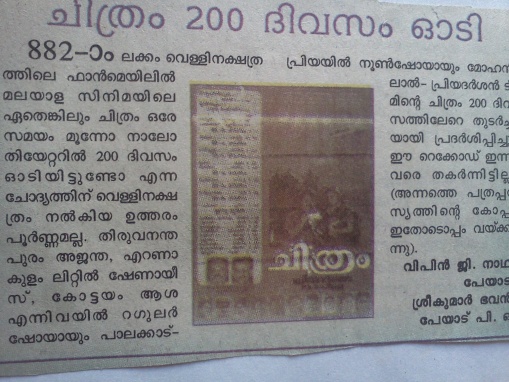
[edit]Chithram was released during a Christmas weekend on 23 December 1988. Upon release, it broke all existing records in Malayalam cinema until then.[6] Released in 21 A class theatres, Chithram ran for 50 days in 16 release theatres, 100 days in 6 theatres, 150 days in 5 theatres, 200 days in 4 theatres, 225 days in 3 theatres and 300 days in 2 theatres.[7] It had a theatrical run of more than 400 days in Little Shenoys (Ernakulam).[8] It completed 366 days run with regular shows in two theatres—Little Shenoys (Ernakulam) and Ajanta (Trivandrum),[9] and 200 days in four theatres—Little Shenoys (Ernakulam), Ajantha (Trivandrum), Asha (Kottayam), and Priya (Palakkad).[10] Made on a budget of ₹0.44 crore, the film grossed around ₹4 crore at the box office, becoming the highest-grossing Malayalam film of its time.[1][2][11] The film was a success in Tamil Nadu also.[12]
Accolades
[edit]Remakes
[edit]| Alludugaru (1990) Telugu |
Pyar Hua Chori Chori (1991) Hindi |
Rayaru Bandaru Mavana Manege (1993) Kannada |
Engirundho Vandhan (1995) Tamil |
|---|---|---|---|
| Mohan Babu (Vishnu) |
Mithun Chakraborty (Vijay Kumar) |
Vishnuvardhan (Vishnu) |
Sathyaraj (Kannan) |
| Shobana (Kalyani) |
Gautami (Radha) |
Dolly (Suma) |
Roja (Radha) |
| Chandra Mohan (Anand) |
Anupam Kher (Jhun Jhunwala) |
Dwarakish (Shyam) |
Janagaraj (Manikandan) |
| Jaggayya (Ramachandra Prasad) |
Shafi Inamdar (Raja Saab) |
C. R. Simha (Ramachandra Rayaru) |
Kalyan Kumar (Viswanathan) |
Notes
[edit]- ^ Chithram's reported grosses vary between ₹3.5 crore (Mangalam[1]) – ₹4 crore (Malayala Manorama[2])
References
[edit]- ^ a b c d "'Chitram' still a mystery for Mani Ratnam". Mangalam Publications. 16 December 2016. Archived from the original on 17 November 2018. Retrieved 17 November 2018.
- ^ a b c Sreedhar, Sajil (11 April 2025). "Mohanlal: The star who blends acting brilliance with box office might". OnManorama. Retrieved 5 June 2025.
- ^ a b c d e f g Rajan, Silpa (12 November 2021). "#FilmyFriday: Chithram: Vishnu's golden rule to life is 'living in the moment'". The Times of India. Retrieved 6 April 2022.
- ^ "Chithram Malayalam Film Audio Cassette". Mossymart. Retrieved 26 June 2025.
- ^ K., Krishnachand (18 January 2023). "After 'Chitram', vinyl records to make a comeback in Mollywood through 'Marakkar'". The New Indian Express. Retrieved 26 June 2025.
- ^ "Malayalam-DVD-Chithram-Mohanlal".
- ^ "'ചിത്രം' എന്ന ബോക്സ്ഓഫിസ് വിസ്മയത്തിന് 31 വയസ്സ്". ManoramaOnline (in Malayalam). Retrieved 31 July 2022.
- ^ "Milestones in Mohanlal's career". Sify. 21 May 2005. Archived from the original on 19 July 2019.
- ^ "Chithram 366 days report" (Document) (in Malayalam). Vellinakshatram.
- ^ "Chithram 200 days report" (in Malayalam). Vellinakshatram. Archived from the original on 19 July 2019.
- ^ "10 Mollywood films that ran for the longest time". The Times of India.
- ^ "Thamizh Talkies: Union of stars". The New Indian Express. 23 September 2019. Retrieved 22 November 2022.
- ^ "Film Critics Awards Complete List From 1977 Till 2012". Kerala Film Critics Association. 17 October 2020.

External links
[edit]Chithram
View on GrokipediaDevelopment
Pre-production
Priyadarshan developed the screenplay for Chithram as an original screwball comedy, incorporating rapid-paced dialogue, mistaken identities, and escalating farcical scenarios characteristic of the genre's Hollywood origins in films like those of the 1930s and 1940s. The central premise revolves around a woman enlisting a carefree stranger to masquerade as her husband in order to shield her dying father from the truth of a broken engagement, weaving humor with underlying motifs of deception, personal redemption, and the pressures of familial loyalty. This narrative structure allowed Priyadarshan to blend lighthearted absurdity with emotional depth, distinguishing it from his prior works while building on his established style of ensemble-driven comedies.[1] The film entered pre-production under producer P. K. R. Pillai's Shirdi Sai Productions, with planning focused on a modest budget of ₹44 lakh to accommodate elaborate comedic sequences without exceeding mid-1980s Malayalam industry norms for non-star-driven projects. Script refinements emphasized character-driven conflicts, such as the impostor's integration into a dysfunctional household, to heighten thematic tensions around truth and obligation. These preparations aligned with a compressed timeline, enabling completion ahead of the film's targeted Christmas release on December 23, 1988.[4][2]Casting
Mohanlal was cast in the lead role of Vishnu Inder Nair, capitalizing on his proven comedic timing honed through earlier films and budding synergy with director Priyadarshan, whose joint projects had already demonstrated commercial viability in Malayalam cinema by the late 1980s.[5] This selection aligned with Mohanlal's track record as a box-office magnet, having starred in over 100 films by 1988, many of which emphasized light-hearted narratives that drew audiences through his versatile humor.[6] Ranjini was chosen for the pivotal female lead of Kalyani, marking one of her early prominent roles in Malayalam after debuting in Tamil cinema, with Priyadarshan opting for her to inject a novel dynamic opposite Mohanlal's established persona.[7] Supporting roles featured veterans like Nedumudi Venu as Kaimal and Poornam Viswanathan as Ramendra Menon, selected for their ability to infuse dramatic gravity and familial authenticity, balancing the film's comedic elements with nuanced emotional layers derived from their prior acclaimed character work.[8] The casting process proceeded without notable controversies, prioritizing actors whose past successes empirically supported the project's appeal to diverse viewer demographics.[2]Synopsis
Plot summary
Kalyani, the only daughter of wealthy non-resident Indian businessman Ramachandran Menon, raised in Kerala by her father's close friend and lawyer Adv. Purushothama Kaimal after her mother's death, falls in love with and plans to marry Shahnawaz despite her father's disapproval.[9] Menon, learning of the relationship while hospitalized abroad with a severe heart condition, dispatches Kaimal to prevent the wedding, which he successfully halts just before the ceremony.[2] Devastated but determined to shield her father from further worry, Kalyani agrees to Kaimal's plan to present her as married upon visiting Menon, prompting Kaimal to hire Vishnu, a charming but destitute petty thief in need of quick cash, to impersonate her husband for the duration.[9] The trio travels to the United States, where Vishnu's carefree antics and fabricated backstory initially convince the bedridden Menon of the union's happiness, allowing him a moment of peace.[10] Contrary to expectations, Menon recovers rapidly and insists the young couple relocate to his palatial Kerala home for an extended stay, ensnaring Vishnu and Kalyani in a web of escalating comedic deceptions amid Kaimal's eccentric household, including his bumbling nephew Gopi and meddlesome relatives.[2] As forced proximity fosters genuine affection between Vishnu and Kalyani, romantic tensions arise, complicated by Vishnu's evasive behavior and Kalyani's growing suspicions.[9] Revelations unfold when Vishnu discloses his tragic past: years earlier, in a fit of rage during an altercation, he killed a man who had assaulted his then-girlfriend Revathi, resulting in a murder conviction and his subsequent flight from justice, leaving their infant son in an orphanage.[11] Despite their mutual love, Vishnu chooses to surrender to authorities to atone, facing imprisonment that separates him from Kalyani, who pledges unwavering loyalty and resolve to await his potential release or appeal.[9][11] The narrative culminates in Vishnu's departure for court, underscoring the irreversible fallout of his concealed history amid the household's sorrowful farewell.[2]Production
Filming
Principal photography for Chithram occurred in 1988, with the production utilizing locations across Kerala to reflect the film's setting in authentic regional environments.[7] The shoot emphasized efficient scheduling to accommodate lead actor Mohanlal's concurrent commitments in multiple films during that period. Cinematographer S. Kumar handled the visual aspects, employing techniques suited to the comedy's rapid pacing and indoor-outdoor sequences.[8] No major logistical disruptions were reported, though director Priyadarshan incorporated on-set improvisations, including a prank on Mohanlal to elicit natural reactions amid tight timelines.[12]Soundtrack
The soundtrack of Chithram consists of nine songs composed by Kannur Rajan, with lyrics by Shibu Chakravarthy.[13][14] M. G. Sreekumar rendered vocals for the majority of the tracks, including solo renditions and duets that blend melodic folk and semi-classical influences to underscore the film's comedic timing and sentimental moments.[14] Other singers include Sujatha Mohan, Mohanlal, Neyyattinkara Vasudevan, and ensemble chorus elements.[14][13] The tracks feature rhythmic interludes tailored for sequence synchronization, such as the upbeat "Doore Kizhakkudikkum" duet amplifying light-hearted interactions and the contemplative "Eeran Megham" providing emotional respite amid narrative tension.[13] Semi-classical compositions like "Nagumo" and "Swaminaadha Paripaalaya" draw from Carnatic ragas, integrating seamlessly into reflective scenes and demonstrating Rajan's fusion of traditional elements with film-specific pacing.[15] These songs' structured melodic progressions, recorded in 1988, supported the film's auditory appeal by repeating motifs that reinforced character dynamics without overpowering dialogue.[14]| Track No. | Title | Singer(s) |
|---|---|---|
| 1 | Eeran Megham | M. G. Sreekumar |
| 2 | Paadam Pootha Kaalam | M. G. Sreekumar |
| 3 | Doore Kizhakkudikkum | M. G. Sreekumar, Sujatha Mohan |
| 4 | Kaadumee Naadumellam | Mohanlal, Sujatha Mohan, Chorus |
| 5 | Nagumo | M. G. Sreekumar |
| 6 | Swaminaadha Paripaalaya | M. G. Sreekumar |
| 7 | Additional interludes | Various (including Neyyattinkara Vasudevan) |