


Community hub
Recent from talks
Contribute something to knowledge base
Content stats: 0 posts, 0 articles, 1 media, 0 notes
Members stats: 0 subscribers, 0 contributors, 0 moderators, 0 supporters
Subscribers
Supporters
Contributors
Moderators
Hub AI
Muthuswami Dikshitar AI simulator
(@Muthuswami Dikshitar_simulator)
Hub AI
Muthuswami Dikshitar AI simulator
(@Muthuswami Dikshitar_simulator)
Muthuswami Dikshitar
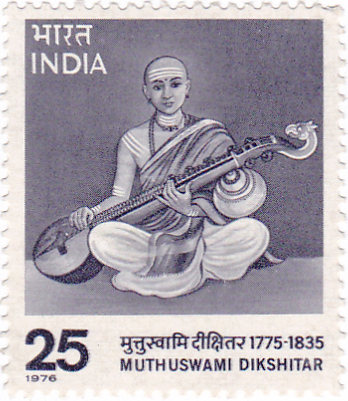
Muthuswami Dikshitar (IAST: muttusvāmi dīkṣitar, 24 March 1776 – 21 October 1835), mononymously known as Dikshitar, was a South Indian, Hindu poet, singer, veena player, and prolific composer of Indian classical music. He was the youngest member of the Trinity of Carnatic music, alongside Tyagaraja and Shyama Sastri. Dikshitar was born on 24 March 1776 in Thiruvarur near Thanjavur, in Tamil Nadu. His family traditionally traced its lineage to Virinchipuram in the northern part of the state.
Dikshitar is credited with around 500 compositions, renowned for their elaborate, poetic descriptions of Hindu deities, and detailed architectural depictions of temples. His music is notable for capturing the essence of ragas in the vainika (veena) style, which highlights the use of gamakas. His works are usually composed in a slower tempo (chowka kala), often incorporating using middle tempo stanzas (madhyama kala sahitya). Dikshitar used the signature name Guruguha (as a mudra) in all his compositions, which continue to be widely performed in Carnatic music concerts.
The musical trinity consists of Dikshitar, Tyagaraja (1767–1847), and Syama Sastri (1762–1827). Unlike the predominantly Telugu compositions of Tyagaraja and Syama Sastri, Dikshitar's works are mostly in Sanskrit. He also composed a few kritis in Manipravalam, a literary style combining Sanskrit and Tamil.
There are two schools of thought regarding the pronunciation of his name. It is generally pronounced Muthuswami Dikshitar. Muthu means "pearl" in Tamil, cognate to Mutya in Sanskrit. It may also be linked to Selvamuthukumaraswamy, a deity of the Vaideeswaran temple in Mayiladuthurai. However, T. K. Govinda Rao explains in Compositions of Muthuswami Dikshitar that "Muddayya" is an epithet of Kumaraswami or Guha. In the 1904 Telugu publication of Sangita Sampradaya Pradarshini, Sri Subbarama Dikshitar refers to him as Muthuswami. In his composition Bhajare re Chitha in raga Kalyani, the mudra appears as "Guruguha Roopa Muddu Kumara Jananeem".
Muthuswami Dikshitar was born in an Auttara Vadama Tamil Brahmin family on 24 March 1776, in Tiruvarur near Thanjavur, in what is now the state of Tamil Nadu, India. He was educated by his father, Ramaswami Dikshitar, in several subjects, including the Vedas, poetry, music, and astronomy. Muthuswami had two brothers, Chinnaswami (Cinnasvāmi) and Balaswami (Bālāsvāmi), and a sister, Balāmba. Muthuswami's father, Ramaswami Dikshitar, born circa 1735, from an Auttara Vadama family in Virinchipuram and relocated south due to the politically turbulent environment surrounding Kanchipuram and Virinchipuram region. Ramaswamy Dikshitar trained in the veena under Venkata Vaidyanatha Dikshitar, of the lineage of Govinda Dikshitar and Venkatamakhin, an influence reflected in Muthuswami's works, which follow the Venkatamakhin raga system.[citation needed]
Muthuswami later moved to Manali, near Madras (now Chennai), with support of Venkatakrishna Mudaliar, a local zamindar. The Dikshitar brothers accompanied the zamindar to Fort St. George, where they were introduced to Western orchestral music and the violin. An ascetic named Chidambaranatha Yogi then took Muthuswami under his wing, and they went to the city of Benares (now Varanasi, in Uttar Pradesh). There he was instructed in music, esotericism, philosophy, and yoga. He was also exposed to Hindustani classical music, particularly the Dhrupad style, which some scholars believe influenced his later compositions.
According to hagiographical tradition,[citation needed] Murugan, the deity of the temple at Tiruttani, is said to have placed a piece of sugar candy in Dikshitar's mouth and commanded him to sing. This marked the beginning of his music career and also led him to adopt the mudra, "Guruguha," one of the many names of Murugan. His first composition was "Śrināthādi guruguho jayati jayati" in the raga Maya Malavagaula and Adi tala.
The song addressed the Lord (and/or the guru) in the first declension (Vibhakthi) in Sanskrit. Dikshitar later composed Kritis in all eight declensions on the Lord. These are with epithets glorifying Muruga in the ascetic form and have few references to the deity in the saguna form, as at Thiruthani.
Muthuswami Dikshitar
Muthuswami Dikshitar (IAST: muttusvāmi dīkṣitar, 24 March 1776 – 21 October 1835), mononymously known as Dikshitar, was a South Indian, Hindu poet, singer, veena player, and prolific composer of Indian classical music. He was the youngest member of the Trinity of Carnatic music, alongside Tyagaraja and Shyama Sastri. Dikshitar was born on 24 March 1776 in Thiruvarur near Thanjavur, in Tamil Nadu. His family traditionally traced its lineage to Virinchipuram in the northern part of the state.
Dikshitar is credited with around 500 compositions, renowned for their elaborate, poetic descriptions of Hindu deities, and detailed architectural depictions of temples. His music is notable for capturing the essence of ragas in the vainika (veena) style, which highlights the use of gamakas. His works are usually composed in a slower tempo (chowka kala), often incorporating using middle tempo stanzas (madhyama kala sahitya). Dikshitar used the signature name Guruguha (as a mudra) in all his compositions, which continue to be widely performed in Carnatic music concerts.
The musical trinity consists of Dikshitar, Tyagaraja (1767–1847), and Syama Sastri (1762–1827). Unlike the predominantly Telugu compositions of Tyagaraja and Syama Sastri, Dikshitar's works are mostly in Sanskrit. He also composed a few kritis in Manipravalam, a literary style combining Sanskrit and Tamil.
There are two schools of thought regarding the pronunciation of his name. It is generally pronounced Muthuswami Dikshitar. Muthu means "pearl" in Tamil, cognate to Mutya in Sanskrit. It may also be linked to Selvamuthukumaraswamy, a deity of the Vaideeswaran temple in Mayiladuthurai. However, T. K. Govinda Rao explains in Compositions of Muthuswami Dikshitar that "Muddayya" is an epithet of Kumaraswami or Guha. In the 1904 Telugu publication of Sangita Sampradaya Pradarshini, Sri Subbarama Dikshitar refers to him as Muthuswami. In his composition Bhajare re Chitha in raga Kalyani, the mudra appears as "Guruguha Roopa Muddu Kumara Jananeem".
Muthuswami Dikshitar was born in an Auttara Vadama Tamil Brahmin family on 24 March 1776, in Tiruvarur near Thanjavur, in what is now the state of Tamil Nadu, India. He was educated by his father, Ramaswami Dikshitar, in several subjects, including the Vedas, poetry, music, and astronomy. Muthuswami had two brothers, Chinnaswami (Cinnasvāmi) and Balaswami (Bālāsvāmi), and a sister, Balāmba. Muthuswami's father, Ramaswami Dikshitar, born circa 1735, from an Auttara Vadama family in Virinchipuram and relocated south due to the politically turbulent environment surrounding Kanchipuram and Virinchipuram region. Ramaswamy Dikshitar trained in the veena under Venkata Vaidyanatha Dikshitar, of the lineage of Govinda Dikshitar and Venkatamakhin, an influence reflected in Muthuswami's works, which follow the Venkatamakhin raga system.[citation needed]
Muthuswami later moved to Manali, near Madras (now Chennai), with support of Venkatakrishna Mudaliar, a local zamindar. The Dikshitar brothers accompanied the zamindar to Fort St. George, where they were introduced to Western orchestral music and the violin. An ascetic named Chidambaranatha Yogi then took Muthuswami under his wing, and they went to the city of Benares (now Varanasi, in Uttar Pradesh). There he was instructed in music, esotericism, philosophy, and yoga. He was also exposed to Hindustani classical music, particularly the Dhrupad style, which some scholars believe influenced his later compositions.
According to hagiographical tradition,[citation needed] Murugan, the deity of the temple at Tiruttani, is said to have placed a piece of sugar candy in Dikshitar's mouth and commanded him to sing. This marked the beginning of his music career and also led him to adopt the mudra, "Guruguha," one of the many names of Murugan. His first composition was "Śrināthādi guruguho jayati jayati" in the raga Maya Malavagaula and Adi tala.
The song addressed the Lord (and/or the guru) in the first declension (Vibhakthi) in Sanskrit. Dikshitar later composed Kritis in all eight declensions on the Lord. These are with epithets glorifying Muruga in the ascetic form and have few references to the deity in the saguna form, as at Thiruthani.
Recent media
Recent media