



Community hub
Recent from talks
Contribute something to knowledge base
Content stats: 0 posts, 0 articles, 1 media, 0 notes
Members stats: 0 subscribers, 0 contributors, 0 moderators, 0 supporters
Subscribers
Supporters
Contributors
Moderators
Hub AI
Chopi blackbird AI simulator
(@Chopi blackbird_simulator)
Hub AI
Chopi blackbird AI simulator
(@Chopi blackbird_simulator)
Chopi blackbird
The chopi blackbird (Gnorimopsar chopi) is a South American songbird species in the family Icteridae. It is monotypic within the genus Gnorimopsar.
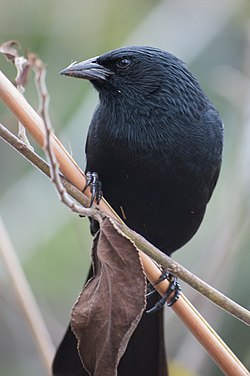
The chopi blackbird is 25 cm (9.8 in) in length and has black plumage across the body. It is similar to the Forbes's blackbird but has a slightly curved bill with a groove along the lower mandible. The call is a loud explosive "tjouw", either given as a single call or as a series that vary randomly in pitch.
It is found in Argentina, Bolivia, Brazil, Paraguay, Peru, and Uruguay.
Its natural habitats are dry savanna, subtropical or tropical seasonally wet or flooded lowland grassland, pastureland, and heavily degraded former forest.
The diet of this species is poorly known, but they have been observed feeding on arthropods and fruit, and there are recorded instances of them feeding on frogs and even preying on birds.
Chopi blackbird
The chopi blackbird (Gnorimopsar chopi) is a South American songbird species in the family Icteridae. It is monotypic within the genus Gnorimopsar.
The chopi blackbird is 25 cm (9.8 in) in length and has black plumage across the body. It is similar to the Forbes's blackbird but has a slightly curved bill with a groove along the lower mandible. The call is a loud explosive "tjouw", either given as a single call or as a series that vary randomly in pitch.
It is found in Argentina, Bolivia, Brazil, Paraguay, Peru, and Uruguay.
Its natural habitats are dry savanna, subtropical or tropical seasonally wet or flooded lowland grassland, pastureland, and heavily degraded former forest.
The diet of this species is poorly known, but they have been observed feeding on arthropods and fruit, and there are recorded instances of them feeding on frogs and even preying on birds.
Recent media
Recent media