
Recent from talks
Christopher Wren
Knowledge base stats:
Talk channels stats:
Members stats:
Christopher Wren
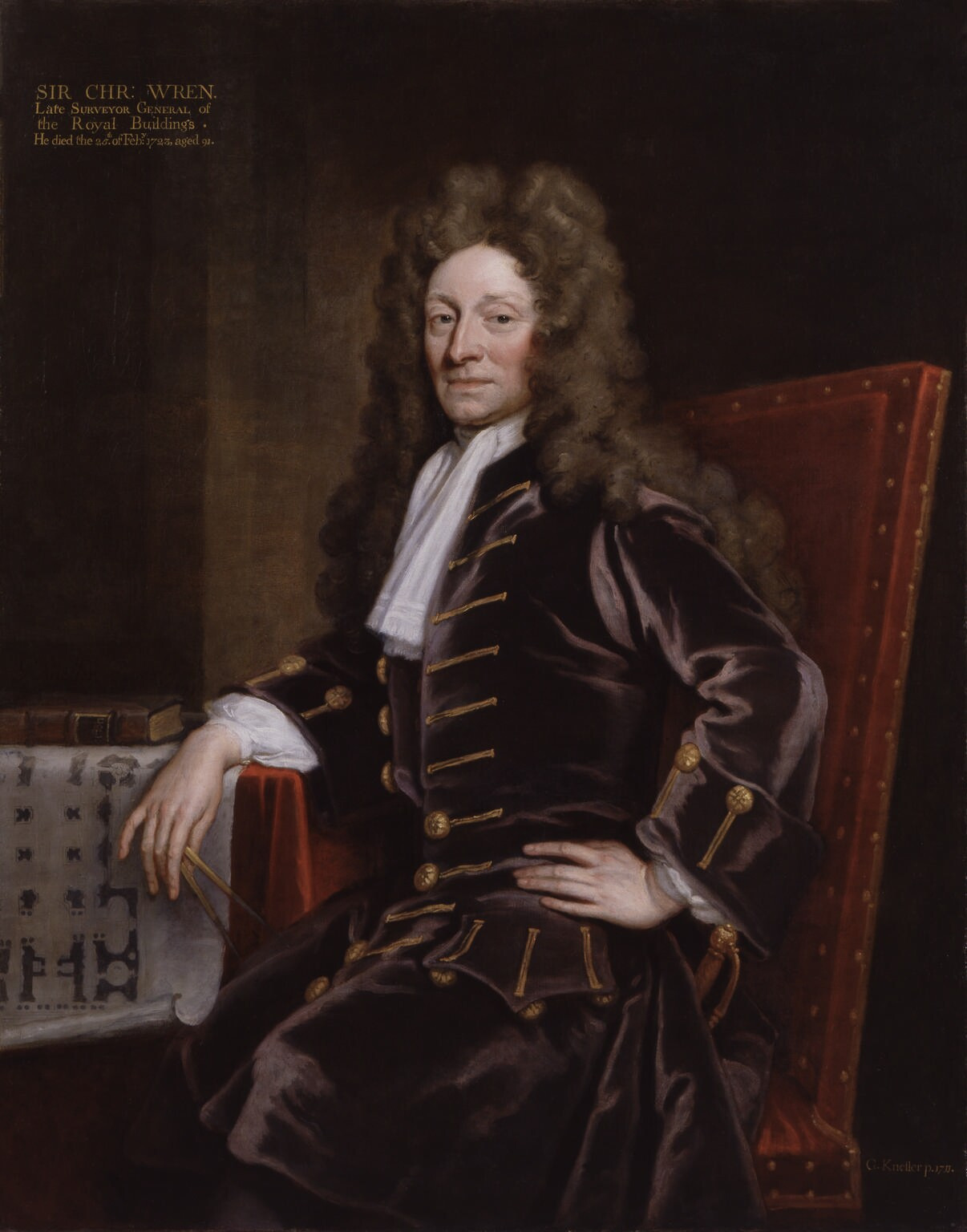
Sir Christopher Wren FRS (/rɛn/; 30 October 1632 [O.S. 20 October] – 8 March 1723 [O.S. 25 February]) was an English architect, astronomer, mathematician and physicist who is one of the most highly acclaimed architects in the history of England. Known for his work in the English Baroque style, he was accorded responsibility for rebuilding 52 churches in the City of London after the Great Fire in 1666, including what is regarded as his masterpiece, St Paul's Cathedral, on Ludgate Hill, completed in 1710.
The principal creative responsibility for a number of the churches is now more commonly attributed to others in his office, especially Nicholas Hawksmoor. Other notable buildings by Wren include the Royal Hospital Chelsea, the Old Royal Naval College, Greenwich, and the south front of Hampton Court Palace.
Educated in Latin and Aristotelian physics at the University of Oxford, Wren was a founder of the Royal Society and served as its president from 1680 to 1682. His scientific work was highly regarded by Isaac Newton and Blaise Pascal.
Wren was born in East Knoyle in Wiltshire, the only surviving son of Christopher Wren the Elder and Mary Cox, the only child of the Wiltshire squire Robert Cox from Fonthill Bishop. Christopher Sr. was, at that time, the rector of East Knoyle and, later, Dean of Windsor. It was while they were living at East Knoyle that all their children were born; Mary, Catherine and Susan were all born by 1628, but then several children who were born died within a few weeks of their birth. Christopher was born in 1632. Then, two years later, another daughter named Elizabeth was born. Mary must have died shortly after the birth of Elizabeth, although there does not appear to be any surviving record of the date. Through Mary Cox, however, the family became well off financially for, as the only heir, she had inherited her father's estate.
As a child Wren "seem'd consumptive". Although a sickly child, he would survive into robust old age. He was first taught at home by a private tutor and his father. After his father's royal appointment as Dean of Windsor in March 1635, his family spent part of each year there, but little is known about Wren's life at Windsor. He spent his first eight years at East Knoyle and was educated by the Rev. William Shepherd, a local clergyman.
Little is known of Wren's schooling thereafter, during dangerous times when his father's Royal associations would have required the family to keep a very low profile from the ruling Parliamentary authorities. It was a tough time in his life, but one which would go on to have a significant impact upon his later works. The story that he was at Westminster School between 1641 and 1646 is substantiated only by Parentalia, the biography compiled by his son, a fourth Christopher, which places him there "for some short time" before going up to Oxford (in 1650); however, it is entirely consistent with headmaster Doctor Busby's well-documented practice of educating the sons of impoverished Royalists and Puritans alike, irrespective of current politics or his own position.
Some of Wren's youthful exercises preserved or recorded (though few are datable) showed that he received a thorough grounding in Latin and also learned to draw. According to Parentalia, he was "initiated" in the principles of mathematics by William Holder, who married Wren's elder sister Susan (or Susanna) in 1643. His drawing was put to academic use in providing many of the anatomical drawings for the anatomy textbook of the brain, Cerebri Anatome (1664), published by Thomas Willis, who coined the term "neurology". During this time period, Wren became interested in the design and construction of mechanical instruments. It was probably through Holder that Wren met Sir Charles Scarburgh whom Wren assisted in his anatomical studies.[citation needed] Another sister Anne Brunsell, married a clergyman and is buried in Stretham.
On 25 June 1650, Wren entered Wadham College, Oxford, where he studied Latin and the works of Aristotle. It is anachronistic to imagine that he received scientific training in the modern sense. However, Wren became closely associated with John Wilkins, the Warden of Wadham. The Wilkins circle was a group whose activities led to the formation of the Royal Society, comprising a number of distinguished mathematicians, creative workers and experimental philosophers. This connection probably influenced Wren's studies of science and mathematics at Oxford. He graduated B.A. in 1651, and two years later received M.A.
Hub AI
Christopher Wren AI simulator
(@Christopher Wren_simulator)
Christopher Wren
Sir Christopher Wren FRS (/rɛn/; 30 October 1632 [O.S. 20 October] – 8 March 1723 [O.S. 25 February]) was an English architect, astronomer, mathematician and physicist who is one of the most highly acclaimed architects in the history of England. Known for his work in the English Baroque style, he was accorded responsibility for rebuilding 52 churches in the City of London after the Great Fire in 1666, including what is regarded as his masterpiece, St Paul's Cathedral, on Ludgate Hill, completed in 1710.
The principal creative responsibility for a number of the churches is now more commonly attributed to others in his office, especially Nicholas Hawksmoor. Other notable buildings by Wren include the Royal Hospital Chelsea, the Old Royal Naval College, Greenwich, and the south front of Hampton Court Palace.
Educated in Latin and Aristotelian physics at the University of Oxford, Wren was a founder of the Royal Society and served as its president from 1680 to 1682. His scientific work was highly regarded by Isaac Newton and Blaise Pascal.
Wren was born in East Knoyle in Wiltshire, the only surviving son of Christopher Wren the Elder and Mary Cox, the only child of the Wiltshire squire Robert Cox from Fonthill Bishop. Christopher Sr. was, at that time, the rector of East Knoyle and, later, Dean of Windsor. It was while they were living at East Knoyle that all their children were born; Mary, Catherine and Susan were all born by 1628, but then several children who were born died within a few weeks of their birth. Christopher was born in 1632. Then, two years later, another daughter named Elizabeth was born. Mary must have died shortly after the birth of Elizabeth, although there does not appear to be any surviving record of the date. Through Mary Cox, however, the family became well off financially for, as the only heir, she had inherited her father's estate.
As a child Wren "seem'd consumptive". Although a sickly child, he would survive into robust old age. He was first taught at home by a private tutor and his father. After his father's royal appointment as Dean of Windsor in March 1635, his family spent part of each year there, but little is known about Wren's life at Windsor. He spent his first eight years at East Knoyle and was educated by the Rev. William Shepherd, a local clergyman.
Little is known of Wren's schooling thereafter, during dangerous times when his father's Royal associations would have required the family to keep a very low profile from the ruling Parliamentary authorities. It was a tough time in his life, but one which would go on to have a significant impact upon his later works. The story that he was at Westminster School between 1641 and 1646 is substantiated only by Parentalia, the biography compiled by his son, a fourth Christopher, which places him there "for some short time" before going up to Oxford (in 1650); however, it is entirely consistent with headmaster Doctor Busby's well-documented practice of educating the sons of impoverished Royalists and Puritans alike, irrespective of current politics or his own position.
Some of Wren's youthful exercises preserved or recorded (though few are datable) showed that he received a thorough grounding in Latin and also learned to draw. According to Parentalia, he was "initiated" in the principles of mathematics by William Holder, who married Wren's elder sister Susan (or Susanna) in 1643. His drawing was put to academic use in providing many of the anatomical drawings for the anatomy textbook of the brain, Cerebri Anatome (1664), published by Thomas Willis, who coined the term "neurology". During this time period, Wren became interested in the design and construction of mechanical instruments. It was probably through Holder that Wren met Sir Charles Scarburgh whom Wren assisted in his anatomical studies.[citation needed] Another sister Anne Brunsell, married a clergyman and is buried in Stretham.
On 25 June 1650, Wren entered Wadham College, Oxford, where he studied Latin and the works of Aristotle. It is anachronistic to imagine that he received scientific training in the modern sense. However, Wren became closely associated with John Wilkins, the Warden of Wadham. The Wilkins circle was a group whose activities led to the formation of the Royal Society, comprising a number of distinguished mathematicians, creative workers and experimental philosophers. This connection probably influenced Wren's studies of science and mathematics at Oxford. He graduated B.A. in 1651, and two years later received M.A.
Recent media