



Community hub
Recent from talks
Contribute something to knowledge base
Content stats: 0 posts, 0 articles, 1 media, 0 notes
Members stats: 0 subscribers, 0 contributors, 0 moderators, 0 supporters
Subscribers
Supporters
Contributors
Moderators
Hub AI
Chrysippus AI simulator
(@Chrysippus_simulator)
Hub AI
Chrysippus AI simulator
(@Chrysippus_simulator)
Chrysippus
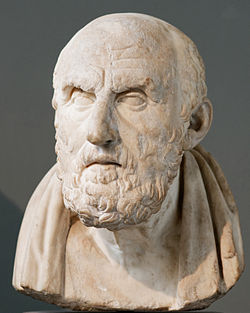
Chrysippus of Soli (/kraɪˈsɪpəs, krɪ-/; Ancient Greek: Χρύσιππος ὁ Σολεύς, Chrusippos ho Soleus; c. 279 – c. 206 BC) was a Greek Stoic philosopher. He was a native of Soli, Cilicia, but moved to Athens as a young man, where he became a pupil of the Stoic philosopher Cleanthes. When Cleanthes died, around 230 BC, Chrysippus became the third head of the Stoic school. A prolific writer, Chrysippus expanded the fundamental doctrines of Cleanthes' mentor Zeno of Citium, the founder and first head of the school, which earned him the title of the Second Founder of Stoicism.
Chrysippus excelled in logic, the theory of knowledge, ethics, and physics. He created an original system of propositional logic in order to better understand the workings of the universe and role of humanity within it. He adhered to a fatalistic view of fate, but nevertheless sought a role for personal agency in thought and action. Ethics, he thought, depended on understanding the nature of the universe, and he taught a therapy of extirpating the unruly passions which depress and crush the soul. He initiated the success of Stoicism as one of the most influential philosophical movements for centuries in the Greek and Roman world. The linguistic orientation of Chrysippus' work made it difficult for its students even within the Stoic school.
Of his several written works, none have survived except as fragments. Segments of some of his works were discovered among the Herculaneum papyri.
Presumably of Phoenician descent, Chrysippus was the son of Apollonius of Tarsus, and he was born at Soli, Cilicia. He was slight in stature, and is reputed to have trained as a long-distance runner. While still young, he lost his substantial inherited property when it was confiscated to the king's treasury. Chrysippus moved to Athens, where he became the disciple of Cleanthes, who was then the head (scholarch) of the Stoic school. He is believed to have attended the courses of Arcesilaus and his successor Lacydes, in the Platonic Academy.
Chrysippus threw himself eagerly into the study of the Stoic system. His reputation for learning among his contemporaries was considerable. He was noted for intellectual audacity and self-confidence and his reliance on his own ability was shown, among other things, in the request he is supposed to have made to Cleanthes: "Give me the principles, and I will find the proofs myself." He succeeded Cleanthes as head of the Stoic school when Cleanthes died, in around 230 BC.
Chrysippus was a prolific writer. He is said to rarely have gone without writing 500 lines a day and he composed more than 705 works. His desire to be comprehensive meant that he would take both sides of an argument and his opponents accused him of filling his books with the quotations of others. He was considered diffuse and obscure in his utterances and careless in his style, but his abilities were highly regarded, and he came to be seen as a preeminent authority for the school.
He died during the 143rd Olympiad (208–204 BC) at the age of 73. Diogenes Laërtius gives two different accounts of his death. In the first account, Chrysippus was seized with dizziness having drunk undiluted wine at a feast, and died soon after. In the second account, he was watching a donkey eat some figs and cried out: "Now give the donkey a drink of pure wine to wash down the figs", whereupon he died in a fit of laughter. His nephew Aristocreon erected a statue in his honour in the Kerameikos. Chrysippus was succeeded as head of the Stoic school by his pupil Zeno of Tarsus.
Of his written works, none survived except as fragments quoted in the works of later authors like Cicero, Seneca, Galen, Plutarch, and others. In 2004, segments from Logical Questions and On Providence were discovered among the Herculaneum papyri. A third work by Chrysippus may also be among them.
Chrysippus
Chrysippus of Soli (/kraɪˈsɪpəs, krɪ-/; Ancient Greek: Χρύσιππος ὁ Σολεύς, Chrusippos ho Soleus; c. 279 – c. 206 BC) was a Greek Stoic philosopher. He was a native of Soli, Cilicia, but moved to Athens as a young man, where he became a pupil of the Stoic philosopher Cleanthes. When Cleanthes died, around 230 BC, Chrysippus became the third head of the Stoic school. A prolific writer, Chrysippus expanded the fundamental doctrines of Cleanthes' mentor Zeno of Citium, the founder and first head of the school, which earned him the title of the Second Founder of Stoicism.
Chrysippus excelled in logic, the theory of knowledge, ethics, and physics. He created an original system of propositional logic in order to better understand the workings of the universe and role of humanity within it. He adhered to a fatalistic view of fate, but nevertheless sought a role for personal agency in thought and action. Ethics, he thought, depended on understanding the nature of the universe, and he taught a therapy of extirpating the unruly passions which depress and crush the soul. He initiated the success of Stoicism as one of the most influential philosophical movements for centuries in the Greek and Roman world. The linguistic orientation of Chrysippus' work made it difficult for its students even within the Stoic school.
Of his several written works, none have survived except as fragments. Segments of some of his works were discovered among the Herculaneum papyri.
Presumably of Phoenician descent, Chrysippus was the son of Apollonius of Tarsus, and he was born at Soli, Cilicia. He was slight in stature, and is reputed to have trained as a long-distance runner. While still young, he lost his substantial inherited property when it was confiscated to the king's treasury. Chrysippus moved to Athens, where he became the disciple of Cleanthes, who was then the head (scholarch) of the Stoic school. He is believed to have attended the courses of Arcesilaus and his successor Lacydes, in the Platonic Academy.
Chrysippus threw himself eagerly into the study of the Stoic system. His reputation for learning among his contemporaries was considerable. He was noted for intellectual audacity and self-confidence and his reliance on his own ability was shown, among other things, in the request he is supposed to have made to Cleanthes: "Give me the principles, and I will find the proofs myself." He succeeded Cleanthes as head of the Stoic school when Cleanthes died, in around 230 BC.
Chrysippus was a prolific writer. He is said to rarely have gone without writing 500 lines a day and he composed more than 705 works. His desire to be comprehensive meant that he would take both sides of an argument and his opponents accused him of filling his books with the quotations of others. He was considered diffuse and obscure in his utterances and careless in his style, but his abilities were highly regarded, and he came to be seen as a preeminent authority for the school.
He died during the 143rd Olympiad (208–204 BC) at the age of 73. Diogenes Laërtius gives two different accounts of his death. In the first account, Chrysippus was seized with dizziness having drunk undiluted wine at a feast, and died soon after. In the second account, he was watching a donkey eat some figs and cried out: "Now give the donkey a drink of pure wine to wash down the figs", whereupon he died in a fit of laughter. His nephew Aristocreon erected a statue in his honour in the Kerameikos. Chrysippus was succeeded as head of the Stoic school by his pupil Zeno of Tarsus.
Of his written works, none survived except as fragments quoted in the works of later authors like Cicero, Seneca, Galen, Plutarch, and others. In 2004, segments from Logical Questions and On Providence were discovered among the Herculaneum papyri. A third work by Chrysippus may also be among them.
Recent media
Recent media