Hubbry Logo
Chu–Han ContentionChu–Han ContentionMain
Open search
Chu–Han Contention
Community hub
Chu–Han Contention
logo
8 pages, 0 posts
0 subscribers
Be the first to start a discussion here.
Chu–Han Contention
Chu–Han Contention
from Wikipedia
Chu–Han Contention

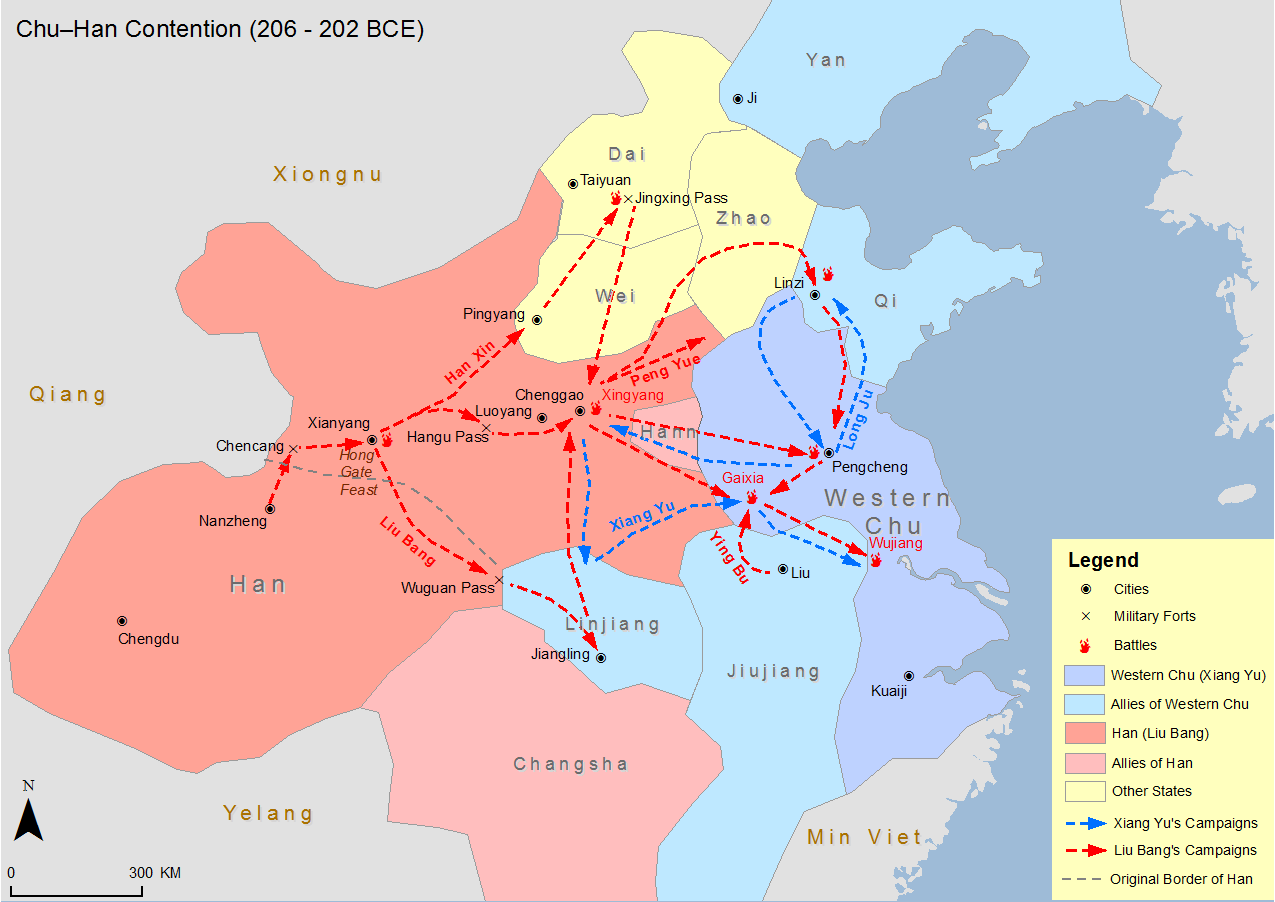
Territories and troop movements of the Chu–Han Contention
Date206–202 BCE
Location
China
Result Han victory
Belligerents
Han
Commanders and leaders
Chu–Han Contention
Traditional Chinese楚漢戰爭
Simplified Chinese楚汉战争
Transcriptions
Standard Mandarin
Hanyu PinyinChǔ Hàn zhànzhēng
Bopomofoㄔㄨˇㄏㄢˋㄓㄢˋㄓㄥ
IPA[ʈʂʰù xân ʈʂân.ʈʂə́ŋ]
Yue: Cantonese
JyutpingCo2 Hon3 zin3-zang1

The Chu–Han Contention (楚漢相爭), also known as the Chu–Han War (楚漢戰爭), was an interregnum of civil wars in Imperial China between the fall of the Qin dynasty in 206 BCE and the establishment of the Han dynasty in 202 BCE.

After the Qin dynasty was overthrown, the empire was divided into the Eighteen Kingdoms ruled by enfeoffed rebel leaders and surrendered Qin generals according to arrangement by Xiang Yu, the hegemon warlord. Due to dissatisfaction among the rebels, wars and rebellions soon broke out, most prominently between two major powers – Xiang Yu and Liu Bang, who were the rulers of the Western Chu and Han kingdoms, respectively. Other kingdoms also waged war against Chu and Han and among themselves, but these were largely insignificant compared to the Chu-Han conflict. The wars ended with a total victory to Liu Bang at the Battle of Gaixia, during which Xiang Yu committed suicide after losing all his men in a last stand. Having subdued all rival contenders, Liu Bang subsequently proclaimed himself emperor of the newly established Han dynasty.

Background

[edit]

Towards the end of the Warring States period, the western state of Qin conquered the other six states – Hán, Zhao, Yan, Wei, Chu and Qi – and unified China under the Qin dynasty in 221 BCE, and King Zheng of Qin declared himself the First Emperor of China. After his untimely death during the fifth imperial tour in 210 BCE, the chief eunuch Zhao Gao conspired with chancellor Li Si to install the incompetent Prince Huhai as the new emperor, forcing the suicide of the then-heir apparent Prince Fusu and purging anyone deemed disobedient in the Qin court. Due to Huhai's corrupt rule, a massive uprising led by Chen Sheng and Wu Guang broke out in Dazexiang (modern day Yongqiao District, Anhui) in 209 BC, and lasted five months until Qin forces finally managed to crush the rebellion with a hastily organized army of penal troopers.

Although the Dazexiang uprising had failed, other rebellions erupted consecutively over the next three years. The leaders of these rebellions were either pretenders of the former six states conquered by Qin, their supporters who sought to revert China back to the political order of a pre-Qin federacy, or simply opportunists who exploited the chaos. Among them, the most notable one was Xiang Yu, who descended from an aristocrat family of Chu generals and initially followed the rebellion of his uncle Xiang Liang, wanting to revive the Chu state with the exiled King Huai II as its nominal ruler. Another notable Chu rebel leader was Liu Bang, a rural sheriff from Pei County who had formed his own rebel group with his associates, many of who like Liu were local civil servants within the Qin bureaucracy before the rebellion. Liu Bang, who came from a grassroots background, had initially joined the Xiang Liang, but quickly became a rebel leader on-par with the Xiang Clan within the Chu camp due to his personal charisma and willingness to befriend anyone as allies.

In August 208 BC, Xiang Liang, the supreme commander of the Chu rebels at the time, was defeated and killed in action at Dingtao by Zhang Han, a Qin general responsible for crushing the Dazexiang rebellion. In the fallout, Xiang Yu and Liu Bang relocated King Huai II from Xuyi to a new capital in Pengcheng (彭城; present-day Xuzhou, Jiangsu). In September, King Huai II ordered all the Chu leaders to attack different Qin fronts, promising them that anyone who first invaded Guanzhong, the heartland of the Qin dynasty, can lawfully claim the whole region as fief under the title "King of Guanzhong". Xiang Yu was assigned to the northern front initially as a deputy general under Song Yi, who took over the late Xiang Liang's post as supreme commander, but he soon mutinied and killed Song under the accusation of treasonous cowardice. Xiang Yu then led an outnumbered Chu forces to a surprise victory over Zhang Han's forces at the Battle of Julu, and after the battle controlled nine commanderies in the former Liang and Chu territories.

Fall of Qin dynasty

[edit]

While the bulk of the Qin forces were up north fighting Xiang Yu at Julu, Liu Bang led his forces west into the Guanzhong region via the Wu Pass, facing minimal resistance along the way due to his clever use of diplomacy, bribery and surprise attacks against the demoralized Qin defenders. By October 207 BCE, his army had overcome the last significant resistance in Lantian and arrived at the outskirts of the Qin capital Xianyang. Meanwhile in the Qin royal court, Zhao Gao had committed treason by forcing King Huhai to commit suicide, and installed another prince Ziying as a puppet ruler. Ziying, however, hated Zhao Gao intensely and soon plotted with eunuchs to have him assassinated and his three clans exterminated. With Liu Bang's forces approaching unopposed, Ziying decided to surrender the capital, bringing an end to the Qin dynasty. Liu Bang treated Ziying respectfully and entered Xianyang peacefully, forbidding his troops from harming civilians and looting the capital, citing that the Qin people were also victims of the empire's tyrannical rule and thus should not be punished unjustly. He then publicly proclaimed that all harsh Qin laws were to be abolished except strict punishments for murder, harm and theft, earning him the love from Qin citizens. His deputy Xiao He also had all the Qin code of law, archives and government documents collected and relocated for preservation.

However, when Xiang Yu eventually arrived as well, he immediately besieged and captured the Hangu Pass garrisoned by Liu Bang's troops out of frustration that Liu Bang had the easier route and stole all the glory. Liu Bang was then pressured into ceding the Guanzhong region to Xiang Yu despite the earlier agreement between them. When Liu Bang personally visited to pay respect and apology, Xiang Yu also attempted to assassinate him at the Feast at Swan Goose Gate under the advise of Fan Zeng, but Liu Bang escaped thanks to his humble courtesy and Xiang Yu's indecisiveness when confronted by Liu Bang's brother-in-law Fan Kuai. Xiang Yu then entered Xianyang allowing his troops to pillage and plunder the city, ordered the burning of the Epang Palace, and had all the surrendered Qin royalties executed. Later, Xiang Yu forced Liu Bang to accept the enfeoffment of the remote, underdeveloped Bashu region (present-day Sichuan Basin), which was then used mainly as penal colonies for exiled criminals. After lobbying by Liu Bang's friend Zhang Liang, a Hán aristocrat widely respected among the rebels for previously attempting to ambush and assassinate the First Emperor in 218 BC, Xiang Yu reluctantly added the better developed Hanzhong Basin to Liu Bang's fiefs, arguing that it now fulfilled the promise of "King of Guanzhong" as Hanzhong was connected to the region via mountain passes within the Qinling Mountains. As Liu Bang's forces relocated into the new fief, Xiang Yu had his troops following them as "escort", and Liu Bang resorted to burning the gallery roads behind his convoy as a precautionary measure to prevent being attacked in the rear and as a diplomatic gesture of accepting Xiang Yu's arrangement to never return again.

Xiang Yu then divided the former Qin Empire into numerous regional states collectively known as the Eighteen Kingdoms, each ruled by either a rebel leader or a surrendered Qin general, with the Kingdom of Chu being the hegemon holding the nominal suzerain power over the other kingdoms. Xiang Yu also honoured King Huai II with a higher title, "Emperor Yi of Chu", and declared himself "Hegemon-King of Western Chu". Shortly after that, he exiled the figurehead Emperor Yi to Chen County (郴縣, present-day Chenzhou, Hunan), and secretly ordered his ally Ying Bu, the King of Jiujiang, to intercept and assassinate the emperor along the way.

Initial stages

[edit]
Trident polearm, Han dynasty

Xiang Yu's arrangement of the Eighteen Kingdoms sowed significant dissatisfaction among the anti-Qin rebels as it was marred by cronyism, with many rebel leaders who were either not favored by Xiang Yu or merely absent during the appointment (as they were garrisoned far away from Guanzhong) receiving little to no fiefs at all. His enfeoffment of the Guanzhong region (which rightfully should have been Liu Bang's) to three surrendered Qin generals Zhang Han, Sima Xin and Dong Yi (collectively known as the Three Qins), who were widely seen as traitors by the Qin people after the sacking of Xianyang, essentially destabilized three of the Eighteen Kingdoms from the start. Moreover, the instigated assassination of Emperor Yi, and Xiang Yu's personal arrogance over battlefield prowess and lack of respect for those deemed beneath him further added to the dissents.

Rebellions in Qi, Zhao and Yan

[edit]

Merely six months after Qin dynasty's collapse, Tian Rong, a Qi state noble and rebel leader, was unhappy with how the Qi territories had been split among three kingdoms – Qi, Jiaodong and Jibei, collectively known as the Three Qis – and himself not receiving anything due to grudges with Xiang Yu, so he waged war against the other kingdoms. He killed Tian Shi, the King of Jiaodong, and Tian An, the King of Jibei. Tian Du, the King of Qi, was defeated by Tian Rong so he fled and joined Xiang Yu. Tian Rong gained control of the Three Qis and became the ruler of the Qi territories.

Tian Rong contacted Peng Yue, a grassroots rebel leader who also didn't go to Guanzhong to be enfeoffed and ended up with his territory claimed by Xiang Yu, and formed an alliance against Xiang Yu. At the same time, he sent troops to support Chen Yu, who had started a rebellion in the former state of Zhao. In 205 BCE, Chen Yu defeated Zhang Er, the King of Changshan, and seized control of his kingdom. Chen Yu then installed Zhao Xie, the King of Dai, as the new ruler of the Zhao territories.

Upon learning of the rebellions in Qi and Zhao, Xiang Yu led his forces north to deal with the rebels. Meanwhile further in the north, Zang Tu, the King of Yan, killed Han Guang, the King of Liaodong, seized the latter's lands and proclaimed himself the ruler of the Yan territories.

Han conquest of the Three Qins

[edit]

While Xiang Yu was away and busy dealing with the northern rebellions, Liu Bang, who was never happy with the fiefs forcefully appointed to him, seized the opportunity to attack the Three Qins' territories in Guanzhong. During the few months settling in Hanzhong, Liu Bang's deputy Xiao He discovered a talented military commander named Han Xin, and convinced Liu Bang to make him the grand marshall. Han Xin proposed a strategy of pretending to reconstruct the previously burnt gallery roads in order to draw the Three Qins' attention towards the mountain passes south of Xianyang, while his main forces secretly took a western detour to invade Guanzhong through Chencang (present-day Baoji, Shaanxi) and surprise the Three Qins. The plan was a huge success and Han Xin defeated the hastily regrouped Zhang Han, the King of Yong, in two consecutive battles.

Riding on the tide of victory, Liu Bang proceeded to conquer Longxi (the area in present-day eastern Gansu located west of Mount Long), Beidi (northeastern Gansu and Ningxia) and Shang (around present-day Yulin). He also sent his men to retrieve his family in Pei (present-day Xuzhou, Jiangsu) and bring them to him from territories controlled by Western Chu.

Upon receiving news of Liu Bang's attacks, Xiang Yu sent an army to Yangjia (陽夏; present-day Taikang County, Henan) to block Liu Bang's forces; he also appointed Zheng Chang as the King of Hán to help him cover his flank.

Battle of Pengcheng

[edit]

In 205 BCE, after conquering the Three Qins in the Guanzhong region, Liu Bang advanced to the east of Hangu Pass to prepare for an attack on the Henan region. Sima Xin, the King of Sai, Dong Yi, the King of Di, and Shen Yang, the King of Henan, surrendered to Liu Bang. Zheng Chang, the King of Hán, refused to submit to Liu Bang, so Liu Bang sent Hán Xin to attack and defeat him. Liu Bang then replaced Zheng Chang with Hán Xin as the new King of Hán. Zhang Er, the former King of Changshan, joined Liu Bang after losing his domain to Zhao Xie and Chen Yu.

In April–May 205 BCE, Liu Bang attacked Henei with help from Wei Bao, the King of Western Wei. When Liu Bang received news that Xiang Yu had ordered the assassination of Emperor Yi, he held a memorial service for the emperor and accused Xiang Yu of committing regicide, using this incident as political propaganda to justify his war against Xiang Yu.

In May–June 205 BCE, Xiang Yu defeated Tian Rong at Chengyang (城陽; around present-day Ju County, Shandong). Tian Rong was killed while retreating to Pingyuan (around present-day northwestern Shandong). Although the Kingdom of Qi had surrendered, Xiang Yu still allowed his troops to plunder and loot the Qi territories. Tian Rong's younger brother, Tian Heng, made Tian Rong's son Tian Guang the new King of Qi, and continued to put up resistance against Xiang Yu.

Meanwhile, Liu Bang had mustered an army of about 560,000 with support from the kings who had surrendered to him. In September–October 205 BCE, the Chu capital, Pengcheng (彭城; present-day Xuzhou, Jiangsu), fell to a coalition force led by Liu Bang. When Xiang Yu received news that Liu Bang had occupied Pengcheng, he led 30,000 troops to retake Pengcheng. Liu Bang was caught off guard and his army suffered heavy casualties and his family members were captured by Chu forces. After the battle, Liu Bang lost his territorial gains in Chu and the support of his allies.

Battle of Jingsuo

[edit]

After their defeat at Pengcheng, the strength of the Han forces decreased drastically. Liu Bang's family members were captured by Xiang Yu's forces and kept as hostages. Many of the kings who had surrendered to Liu Bang earlier defected to Xiang Yu's side after Liu Bang's defeat. The rulers of Qi and Zhao also requested to make peace with Xiang Yu.

Upon reaching Xiayi (下邑; east of present-day Dangshan County, Anhui) which was guarded by his brother-in-law, Liu Bang reorganised his troops for a retreat. Meanwhile, Han Xin led reinforcements from Guanzhong into central China and defeated a Chu army between Jing County (京縣) and Suo Village (索亭), both in present-day Henan.[1] He also put down a rebellion by Wang Wu and Cheng Chu – former Qin generals – and Shen Tu, the magistrate of Wei, and captured their base at Waihuang (外黃; in present-day Minquan County, Henan).[2] He and Liu Bang reorganised the Han army and established strong Han garrisons in Xingyang and Chenggao. Han Xin also developed his plan to conquer northern China, with the aim that Xiang Yu would be too distracted by Liu Bang and his bases of Xingyang and Chenggao to properly counter Han Xin in the north, nor could he endanger his line of retreat by marching past Xingyang and Chenggao into Guanzhong.

Liu Bang then sent a messenger to meet Ying Bu, the King of Jiujiang, to persuade Ying Bu to support him. In November 205 BCE, after Han Xin's victory at the Battle of Jingxing, Ying Bu agreed to join Liu Bang and rebelled against Xiang Yu. Upon learning about it, Xiang Yu sent Long Ju to attack Ying Bu.

In July–August 205 BCE, Liu Bang named his son Liu Ying as his heir apparent and put him in charge of Yueyang (櫟陽; present-day Yanliang District, Xi'an). Shortly after, Han forces conquered Feiqiu (廢丘; present-day Xingping, Shaanxi), which was guarded by Zhang Han, who committed suicide after his defeat.

On another front, Ying Bu was unable to resist Long Ju's attacks so he gave up on his domain in Jiujiang and joined Liu Bang.

Northern front

[edit]

Battle of Anyi

[edit]

In 205 BCE, Wei Bao left Liu Bang on the pretext of visiting an ill relative and secretly returned to his domain. He pledged allegiance to Xiang Yu and rebelled against Liu Bang. Liu Bang sent Li Yiji to persuade Wei Bao to surrender but Wei Bao refused, so Liu Bang ordered Han Xin to attack Wei Bao.

Wei Bao stationed his army at Puban (蒲阪; present-day Yongji, Shanxi) and blocked the route to Linjin (臨晉; present-day Dali County, Shaanxi). Han Xin tricked Wei Bao into believing that he was planning to attack Linjin, while secretly sending a force from Xiayang (夏陽; present-day Hancheng, Shaanxi) to cross the river and attack Anyi (安邑; present-day Xia County, Shanxi).

In October–November 205 BCE, Wei Bao personally led an attack on Han Xin but lost the battle and was captured. When he surrendered, Liu Bang accepted his surrender and appointed him as a general. Within the same month, Han Xin attacked the Kingdom of Dai with support from Zhang Er, the former King of Changshan, scored a decisive victory, capturing the Dai chancellor Xia Shuo.

Battle of Jingxing

[edit]

After achieving victory over the Kingdom of Dai, Han Xin and Zhang Er attacked the Kingdom of Zhao at Jingxing Pass. Zhao Xie, the King of Zhao, and his chancellor, Chen Yu, led an army of 200,000 to resist the Han forces. Li Zuoche, a Zhao general, proposed a plan to trap Han Xin within ten days: he would lead 30,000 men to disrupt Han Xin's supply route and block his return route, while Chen Yu would defend the frontline firmly and prevent Han Xin from advancing. Chen Yu refused to follow Li Zuoche's plan.

The evening before the battle, Han Xin sent 2,000 horsemen, each carrying a flag of the Han army, to station near the Zhao camp. The next morning, Han Xin feigned defeat in a skirmish with Zhao forces and lured them to follow him, while his 2,000 men took advantage of the situation to capture the weakly defended Zhao camp. Meanwhile, the Zhao soldiers retreated after failing to conquer Han Xin's fort, and were surprised to see that their camp had been occupied by Han forces when they returned. The Zhao army fell into chaos and Han Xin seized the opportunity to launch a counterattack and scored a victory. Chen Yu was killed in action while Zhao Xie and Li Zuoche were captured.

Battle of Wei River

[edit]

In 204 BCE, after the Kingdom of Yan had surrendered to him, Liu Bang made Zhang Er the new King of Zhao. Xiang Yu constantly sent his forces to attack the Kingdom of Zhao, but Han Xin and Zhang Er managed to hold their ground. Xiang Yu then turned his attention towards Xingyang, where Liu Bang was stationed. Liu Bang was forced to retreat to Chenggao, but he eventually abandoned Chenggao and headed north of the Yellow River to where Han Xin was. In a surprise move, Liu Bang seized control over the troops under Han Xin's command and ordered Han Xin to attack the Kingdom of Qi.

Just as Han Xin was preparing to attack Qi, Liu Bang sent Li Yiji to persuade Tian Guang, the King of Qi, to surrender. However, Liu Bang had not informed Han Xin about what he had sent Li Yiji to do. Meanwhile, Tian Guang had decided to surrender to Liu Bang so he had pulled back his forces from Lixia (歷下; present-day Jinan, Shandong). However, as Han Xin did not know that Tian Guang had the intention of surrendering, he followed Kuai Tong's advice and launched an attack on the retreating Qi forces, conquering Lixia and attacking the Qi capital Linzi. Tian Guang thought that Li Yiji had lied to him to distract him from Han Xin's attacks, so he had Li Yiji boiled alive. Then, he retreated to Gaomi and requested aid from Xiang Yu. In the meantime, Han Xin conquered Linzi and continued to pursue the retreating Qi forces to Gaomi.

Xiang Yu sent Long Ju to lead 200,000 troops to help Tian Guang. After Han Xin defeated Long Ju in battle, Long Ju was advised to focus on strengthening his defences and getting Tian Guang to rally support from the fallen Qi territories. However, Long Ju decided not to heed the advice, and insisted on attacking Han Xin. On the night before the battle, Han Xin sent his men to dam the Wei River (濰水; in present-day Weifang, Shandong) with sandbags.

The next morning, after a skirmish with Chu forces, Han Xin feigned defeat and retreated to lure the enemy to follow him. After about a quarter of the Chu forces had crossed the river, Han Xin signalled to his men to open the dam. Many Chu soldiers drowned and Long Ju was isolated with only a fraction of his forces. Taking advantage of the situation, Han Xin launched a counterattack. Long Ju was killed in action and the rest of the Chu forces disintegrated as Han Xin continued pressing the attack. Tian Guang fled while Han Xin pursued the retreating Chu forces to Chengyang (城陽; near present-day Ju County, Shandong).

After his victory, Han Xin swiftly took control of the Qi territories and sent a messenger to Liu Bang, requesting that Liu Bang make him the new King of Qi. At the time, Liu Bang was under attack by Xiang Yu in Xingyang and was eagerly awaiting reinforcements from Han Xin. Initially, he was furious when he received Han Xin's request. However, he eventually acted on the advice of Zhang Liang and Chen Ping, and reluctantly approved Han Xin's request. At the same time, Xiang Yu felt worried after losing Long Ju, so he sent Wu She to incite Han Xin to rebel against Liu Bang and declare himself king. However, despite Kuai Tong's urging, Han Xin refused to betray Liu Bang. Han Xin later organised an army to move southward and attack Xiang Yu.

Battle of Chenggao and the Treaty of Hong Canal

[edit]

On the southern front, Liu Bang's forces started building supply routes from Xingyang to Aocang (敖倉; northwest of Xingyang, Henan). In 204 BCE, after sustaining losses from Chu attacks on the routes, Liu Bang's forces ran short of supplies so Liu Bang negotiated for peace with Xiang Yu and agreed to cede the lands east of Xingyang to Xiang Yu. Xiang Yu wanted to accept Liu Bang's offer, but Fan Zeng advised him to reject and use the opportunity to destroy Liu Bang. Xiang Yu changed his mind, pressed the attack on Xingyang and besieged Liu Bang's forces inside the city. Liu Bang heeded Chen Ping's suggestion to bribe Xiang Yu's men with 40,000 catties of gold for them to spread rumours that Fan Zeng had betrayed Xiang Yu. Xiang Yu fell for the ruse and dismissed Fan Zeng.

In late 204 BCE, while Xiang Yu was away suppressing the rebellion in Qi, Li Yiji had advised Liu Bang to use the opportunity to attack Xiang Yu. Liu Bang's forces conquered Chenggao and defeated the Chu army led by Cao Jiu near the Si River. Liu Bang's forces advanced further until they reached Guangwu (廣武; present-day Guangwu Town, Xingyang, Henan). Chu forces led by Zhongli Mo were trapped by Han forces at the east of Xingyang. Following Han Xin's victory at the Battle of Wei River, the Chu forces' morale fell and they ran short of supplies months later. Xiang Yu had no choice but to request to make peace with Liu Bang and release Liu Bang's family members, whom he had been holding hostage. Xiang Yu and Liu Bang then agreed to a ceasefire at the Treaty of Hong Canal, which divided China into east and west under the Chu and Han domains respectively.

End of the war

[edit]

In 203 BCE, while Xiang Yu was retreating eastward, Liu Bang, acting on the advice of Zhang Liang and Chen Ping, renounced the Treaty of Hong Canal and ordered an attack on Xiang Yu. He also requested assistance from Han Xin and Peng Yue to attack Xiang Yu simultaneously from three directions. However, as Han Xin and Peng Yue did not mobilise their troops, Liu Bang was defeated by Xiang Yu at Guling (固陵; south of present-day Taikang County, Henan) and forced to retreat and reinforce his defences. At the same time, he sent messengers to Han Xin and Peng Yue again, promising them land and titles if they joined him in attacking Xiang Yu.

Battle of Gaixia

[edit]

In December 203 BCE, Liu Bang, Han Xin and Peng Yue attacked Xiang Yu from three directions. Running low on supplies, Xiang Yu and his forces found themselves surrounded by Han forces in Gaixia (垓下; southeast of present-day Lingbi County, Anhui). Han Xin ordered his troops to sing Chu folk songs to create the impression that Chu territories had surrendered to Han forces and now many Chu men had joined the Han side. The morale of Xiang Yu's forces plummeted and many of his soldiers deserted.

Xiang Yu attempted to break out the siege and was left with only 28 men when he reached the northern bank of the Wu River (烏江; near present-day He County, Anhui). He made a last stand and managed to slay hundreds of Han soldiers in hand-to-hand combat before he was eventually overwhelmed and ended up committing suicide by slitting his own throat.

Aftermath

[edit]

After Xiang Yu's death, the rest of the Chu forces surrendered to Liu Bang, and China was unified under Liu Bang's rule. Liu Bang granted Peng Yue, Ying Bu and Han Xin the titles of King of Liang, King of Huainan and King of Chu respectively. Months later, at the urging of his followers and vassals, Liu Bang declared himself emperor and established the Han dynasty as the ruling dynasty in China. The imperial capital was at Luoyang but later moved to Chang'an (present-day Xi'an, Shaanxi), just across the Wei River from the old Qin capital Xianyang. Liu Bang made his wife Lü Zhi empress and his son Liu Ying crown prince.

Although Liu Bang initially handsomely rewarded those who helped him become emperor, he gradually became suspicious of them and started to doubt their loyalties. Han Xin was demoted from King of Chu to Marquis of Huaiyin in late 202 BCE, and was subsequently arrested and executed by Empress Lü in 196 BCE for allegedly plotting a rebellion with Chen Xi. In the same year, Liu Bang believed rumours that Peng Yue was also involved in the plot, so he demoted Peng Yue to a commoner, and Peng Yue and his family members were subsequently executed by Empress Lü. Upon hearing about what happened to Han and Peng, Ying Bu rebelled but was defeated and killed. Most other kings and lord Liu Bang appointed at the empire's founding were also subsequently deposed, killed or forced into exile, with their fiefs being given to extended members of the Liu royal family. This however would later led to the political domination of Empress Lü after Liu Bang's death and the subsequent Lü Clan disturbance, which was only quelled after the few surviving founding lords banded together to purge the Lü clan in 180 BC.

Cultural references

[edit]

See also

[edit]

References

[edit]
Revisions and contributorsEdit on WikipediaRead on Wikipedia
from Grokipedia

The Chu–Han Contention (206–202 BC) was a series of interconnected civil wars in ancient China that followed the collapse of the Qin dynasty, primarily between the forces commanded by Xiang Yu, a Chu noble and military leader who styled himself Hegemon-King of Western Chu, and Liu Bang, a former minor official who founded the Han dynasty after emerging victorious. This four-year struggle resolved the power vacuum created by Qin's fall in 209 BC, amid widespread revolts against its tyrannical rule, with Xiang Yu initially dominating through decisive victories like the Battle of Julu but ultimately failing due to strategic missteps and loss of broader support.
Xiang Yu's campaign began with the destruction of Qin's capital at in 206 BC, after which he divided the realm into eighteen kingdoms among rebel leaders, reserving the fertile eastern territories for Chu while assigning Liu Bang the remote region; Liu Bang, however, seized the strategic plain against Xiang's directives, igniting direct conflict. Key engagements included Liu's early defeats at Pengcheng in 205 BC, where Xiang's cavalry routed Han forces, and subsequent Han recoveries through alliances and maneuvers led by generals like , who captured key northern territories and orchestrated the flanking at the in 203 BC. The contention highlighted contrasting leadership styles: Xiang's reliance on personal valor and punitive measures, which eroded loyalty, versus Liu's emphasis on administrative talent, amnesty policies, and logistical superiority, enabling Han to mobilize larger armies over time. The wars concluded with the in 202 BC, where Han forces under Liu Bang encircled Xiang Yu's depleted army, prompting Xiang's famous lament and suicide by the Wu River after breaking through to slay Han officers in a final stand; this victory allowed Liu Bang to consolidate control, proclaim himself Emperor Gaozu, and establish the Han dynasty's capital at , initiating over four centuries of rule that defined imperial China's bureaucratic and cultural frameworks.

Historical Background

Collapse of the Qin Dynasty

The Qin dynasty's collapse was precipitated by a combination of oppressive Legalist policies, including stringent laws, exorbitant taxation, and massive labor demands for projects such as the Great Wall and the , which engendered widespread resentment among the peasantry and eroded administrative legitimacy. These burdens intensified after the death of in 210 BCE during a tour of eastern territories, as his ambitious centralization efforts—while enabling unification—overstretched resources and alienated subjects without institutional safeguards for succession. Eunuch Zhao Gao exploited the power vacuum by forging Qin Shi Huang's testament, sidelining the designated heir Crown Prince Fusu and installing the younger Huhai as Qin Er Shi in 210 BCE; Zhao orchestrated the suicides of Fusu and General Meng Tian, purged rivals like Chancellor Li Si (executed in 208 BCE), and manipulated court politics through purges that destabilized governance. Qin Er Shi's ineffective rule, marked by continued extravagance and Zhao's self-serving control, further alienated officials and the military, culminating in Zhao's assassination by Ziying (a nephew of Qin Shi Huang) in 207 BCE, after which Ziying briefly assumed the throne but could not stem the tide of rebellion. The spark for mass uprisings ignited in late summer 209 BCE when heavy rains delayed a contingent of 900 conscripts led by low-ranking officers and Wu Guang en route to defend against northern nomads; fearing execution for tardiness under Qin's draconian laws, they mutinied at Dazexiang in commandery, rallying locals with the slogan asserting that "kings, marquises, and nobles are all made from the common people" and establishing a short-lived state. This revolt rapidly proliferated to commanderies like Wei, Zhao, and , as opportunistic local elites and disaffected soldiers joined, overwhelming Qin garrisons and fracturing central authority by 208 BCE. The dynasty's inability to coordinate responses amid internal purges enabled rebels to capture key cities, forcing Ziying to surrender the capital in late 207 BCE and marking the effective end of Qin rule.

Emergence of Liu Bang and Xiang Yu

Liu Bang, originating from a peasant background in Pei County (modern Jiangsu Province), rose through minor bureaucratic roles under the Qin dynasty, serving as a pavilion chief responsible for local policing, convict escorts, and maintaining order over approximately ten households. In 209 BCE, following the outbreak of the Dazexiang Uprising led by and Wu Guang against Qin's harsh demands, Liu Bang mobilized supporters by freeing chained convicts and exploiting local grievances, capturing Pei County by 208 BCE and declaring himself its lord. His pragmatic leadership, characterized by leniency toward surrendering Qin officials and defectors—such as retaining capable administrators like —enabled swift alliance-building and force expansion amid the rebellion's chaos. Xiang Yu hailed from a noble lineage tracing back to the Chu royal house, receiving rigorous military instruction from his uncle Xiang Liang, a former Qin overseer of corvée laborers who covertly drilled them in combat tactics during labor assignments. In 208 BCE, Xiang Liang launched a rebellion in the Kuaiji region to revive the Chu state, appointing Xiang Yu as a general whose troops demonstrated exceptional cohesion and aggressive prowess rooted in Chu martial traditions. After Xiang Liang's death in battle at Dingtao later that year, Xiang Yu executed the hesitant Chu commander Song Yi and assumed control, leading to his pivotal victory at Julu in 207 BCE, where 200,000 Qin troops under Zhang Han were encircled and decimated through tactics emphasizing total commitment, including the symbolic breaking of cookware and scuttling of boats to preclude retreat. This triumph, achieved with a force vastly outnumbered, solidified Xiang Yu's reputation for brute force and inspired unwavering loyalty among Chu remnants, contrasting with more opportunistic rebel leaders. The trajectories of Liu Bang and intersected in an opportunistic anti-Qin alliance under the nominal banner, with Liu Bang aligning first with Xiang Liang in 208 BCE and continuing under post-Julu. While focused on northern consolidations, Liu Bang maneuvered westward, entering the core in 206 BCE and compelling the surrender of Qin's final ruler, Ziying, in without widespread destruction—an outcome attributed to his restraint and negotiation skills. This precedence in seizing the Qin heartland underscored their complementary yet tense partnership against common foes, with Liu Bang's adaptability complementing 's decisive strikes, though underlying rivalries emerged from their divergent commands over swelling armies.

Outbreak and Division of Territories

Initial Rebel Victories and Xiang Yu's Consolidation

In late 207 BCE, rebel forces under Liu Bang defeated the last major Qin army at the Battle of Lantian, opening the path to the Qin capital of and prompting the surrender of the Qin prince Ziying to Liu Bang's troops. Liu Bang entered shortly thereafter, securing the surrender without immediate plunder and issuing orders to protect Qin civilians and infrastructure, though he awaited the arrival of 's larger Chu army to avoid confrontation. , commanding over 300,000 troops, arrived in early 206 BCE and compelled Liu Bang to withdraw, asserting dominance through military superiority. Xiang Yu promptly executed Ziying and the remnants of the Qin , rejecting Liu Bang's prior assurances of clemency, then ordered the systematic destruction of , including the burning of palaces and official buildings, with fires reportedly raging for three months and erasing much of Qin's administrative records. En route to the capital, had orchestrated the Xin'an massacre, where he ordered the burial alive of approximately 200,000 surrendered Qin soldiers under Zhang Han's former command, citing their murmurs of discontent over forced marches as a of rebellion; this act, drawn from Sima Qian's Records of the Grand Historian, underscored 's preference for decisive terror over integration of defeated foes. These measures eliminated immediate Qin resistance but alienated potential allies, shifting rebel priorities from unified anti-Qin efforts toward internal power struggles. By mid-206 BCE, consolidated his position by proclaiming himself Hegemon-King of Western , claiming over the territories west of the passes while marginalizing Bang by restricting him to the distant region, thereby initiating rivalry among the rebel leaders despite their shared victory over Qin. This self-elevation, justified by 's pivotal role at the and subsequent campaigns, positioned him as ba wang (hegemon-king) but sowed seeds of contention by prioritizing nobility's claims over merit-based alliances.

Conferment of the Eighteen Kingdoms

In 206 BCE, following the collapse of the , orchestrated the enfeoffment of the at the Hong Canal (Honggou) in Chen Commandery, systematically partitioning the empire's territories among allied rebel leaders and select former Qin generals. This act established a feudal structure where assumed the title of Hegemon-King of Western Chu, retaining control over nine commanderies in the fertile eastern regions, including the Chu heartland, thereby prioritizing his native power base. Liu Bang, who had first entered the Qin capital , was denied the promised central region and instead enfeoffed as King of Han over the remote and less prosperous territories of , Ba, and Shu, effectively sidelining him from core power centers. further installed former Qin commanders—such as Zhang Han as King of Yong, Sima Xin as King of Sai, and Dong Yi as King of Di—in the strategic area of , a move intended to buffer his own domain but reliant on potentially unreliable figures who harbored resentments from Qin's defeat. This partitioning, marked by overt favoritism toward Chu loyalists and the exclusion of other rebel contributors, immediately precipitated instability; independent warlords like Peng Yue in the Liang region refused subordination, conducting guerrilla operations against both lingering Qin forces and Xiang's appointees, while Tian Rong seized control of by ousting Xiang Yu's puppet king Tian Jia, underscoring the enfeoffment's failure to forge unified allegiance. The placement of former adversaries in key western positions similarly fueled distrust, as these kings proved vulnerable to overtures from disinherited rebels, laying the groundwork for subsequent territorial contests.

Early Western Campaigns

Han Conquest of the Three Qins

In late 206 BCE, shortly after Xiang Yu's division of the former territories into the , Liu Bang, enfeoffed as King of Han in the remote region, initiated a campaign to seize the strategic heartland from the . These puppet regimes—comprising the Kingdom of Yong under Zhang Han (capital at Feiqiu), the Kingdom of Sai under Sima Xin (capital at ), and the Kingdom of Di under Dong Yi (capital at Gaonu)—controlled the fertile valley and its defensive passes but lacked deep local legitimacy due to their ties to the fallen . Advised by strategists including Zhang Liang, Liu Bang employed deception by feigning repairs to the destroyed Qin plank roads while advancing through the unguarded Chen Cang pass with his main force. This surprise maneuver caught Zhang Han's defenders off guard, leading to a decisive Han victory at the Battle of Ch'ents'ang, where Liu Bang's army routed the Yong forces and pursued them to Haozhi for a second defeat before besieging Feiqiu. Liu Bang's forces capitalized on local resentment toward Qin's harsh legacy and Xiang Yu's recent destruction of by issuing proclamations that promised reduced taxes, restoration of ancestral fields to pre-Qin owners, and selective revival of Zhou-era customs to appeal to elites and peasants weary of centralized Legalist oppression. This contrasted sharply with Xiang Yu's and massacres, fostering defections and surrenders; Sima Xin and Dong Yi quickly submitted without major resistance, allowing Han troops to consolidate control over Sai and Di territories by early 205 BCE. Zhang Han's prolonged defense at Feiqiu ended in surrender after a months-long , eliminating the last organized opposition in the region and granting Liu Bang unchallenged possession of 's approximately 100,000 square kilometers of and fortified terrain. With secured, Liu Bang repurposed as a temporary base, leveraging its granaries and armories—stocked with remnants of Qin's vast reserves—to sustain his army of tens of thousands while fortifying passes like Hangu for defense against eastern threats. This western consolidation provided a stable logistical rear, enabling subsequent offensives eastward; by mid-205 BCE, Han forces had repaired key and integrated local officials, laying the foundation for the dynasty's capital relocation to nearby and ensuring self-sufficiency in grain production from the basin.

Battle of Pengcheng

In 205 BC, following the Han kingdom's conquest of the Three Qins, Liu Bang mobilized a coalition force of approximately 560,000 troops from allied states and advanced eastward to seize the Western Chu capital at Pengcheng (modern , ). This offensive aimed to exploit Xiang Yu's preoccupation with campaigns in to the north, allowing Han forces to occupy the city with minimal initial resistance. However, Xiang Yu, upon learning of the incursion, detached 30,000 elite cavalry troops under his personal command while directing the main Chu army to continue operations in , enabling a rapid counter-march southward. Xiang Yu's forces executed a surprise assault on the Han encampments east of Pengcheng, leveraging favorable terrain in the lowlands and a sudden that raised blinding dust clouds, disrupting Han visibility and facilitating a rearward by . The Han army, caught unprepared and overextended after their recent advance, collapsed into chaos; Xiang Yu's troops pursued the routed formations relentlessly, inflicting catastrophic losses estimated at over 200,000–300,000 dead, with floating corpses reportedly blocking the Si River. Liu Bang himself narrowly escaped amid the debacle, fleeing westward with only a handful of retainers including , while several family members—including his father, wife, and children—were captured by forces. The victory underscored Xiang Yu's tactical superiority in cavalry maneuvers and exploitation of environmental conditions, routing a numerically superior foe through shock and pursuit rather than prolonged engagement. Yet, Chu's failure to annihilate the Han leadership stemmed from Xiang Yu's overconfidence, as he prioritized consolidating gains over a decisive mop-up, allowing Bang to regroup remnants west of . Han immediately ceded all territories east of the pass, but diversions by allies such as Peng Yue, who raided Liang region to draw off Chu reinforcements, prevented total collapse and preserved a nucleus for future recovery. This battle marked the nadir of Han fortunes, highlighting the fragility of coalition armies against Chu's disciplined elites.

Battle of Jingsuo

Following the catastrophic Han defeat at Pengcheng in 205 BCE, which scattered Bang's forces and resulted in the capture of his family by , the remnants of the Han army—numbering around 20,000–30,000 men—retreated westward toward Xingyang. Chu pursuers under 's subordinates engaged Han detachments at locations including Nanzhang and Jingsuo later in 205 BCE, but Han commanders, including , exploited the overextended Chu supply lines strained by rapid advances across the Central Plains. In the ensuing clashes at Jingsuo, Han forces mounted a successful counteroffensive, inflicting defeats on the Chu vanguard and compelling their withdrawal eastward beyond Xingyang. This tactical recovery stemmed from coordinated Han maneuvers, including feigned retreats to lure Chu elements into vulnerable positions followed by reinforcements from rallied troops under generals like supporting Han Xin's operations. The victory stabilized Han's hold on key territories west of Xingyang, enabling Liu Bang to reoccupy the city and initiate construction of a fortified linking it to the Aocang granary along the , thereby securing vital grain supplies against Chu interdictions. Concurrently, Liu Bang dispatched envoys to reaffirm alliances with wavering regional powers, notably convincing Wei king Wei Bao to defect from nominal and bolstering ties with Zhao commanders Zhang Er and Sima Ang, whose forces provided critical diversions on secondary fronts. These diplomatic efforts forestalled a broader collapse, preserving Han's manpower reserves amid the post-Pengcheng disarray. The Jingsuo engagements highlighted Han's adaptive shift toward attrition-based warfare, leveraging defensive fortifications and logistical resilience to counter 's preference for decisive, cavalry-heavy shocks. By denying a swift knockout and forcing resource diversion, Han regained initiative in the Central Plains, setting the stage for prolonged sieges at Xingyang while grappled with escalating supply disruptions from Han-aligned raiders like Peng Yue.

Northern Campaigns

Battle of Anyi

In 205 BC, during the early stages of the northern campaigns in the Chu-Han Contention, Han general initiated operations against the Kingdom of Wei to secure strategic river crossings and isolate Chu-aligned states. Wei king Wei Bao, who had initially submitted to Liu Bang but later withdrew allegiance amid shifting loyalties, mobilized forces to counter the Han advance. , commanding a Han army, employed a tactic by positioning his main forces in a vulnerable configuration near the border, simulating weakness to provoke Wei Bao into overextending. This lured Wei troops into a dispersed pursuit, allowing to detach units for a rapid surprise assault on Anyi, the Wei capital located in present-day Xia County, . The battle unfolded in the ninth lunar month (approximately August-September in the ), with Wei Bao personally leading the counteroffensive but proving outmatched in tactical execution. Han Xin's ambush disrupted Wei command and logistics, resulting in the swift capture of Wei Bao and the fall of Anyi with relatively low Han casualties, emphasizing the efficacy of maneuver over attrition. Primary accounts derive from Sima Qian's Records of the Grand Historian (Shiji), which detail Han Xin's exploitation of terrain and feigned retreats to achieve decisive results against numerically comparable foes. Securing Anyi granted Han forces control over critical ferries, including those near Puban, facilitating efficient supply lines and troop movements northward while denying Chu allies easy access to reinforcements from Xiang Yu's eastern theater. This victory fragmented the coalition of the , compelling subsequent northern states like Zhao to face Han advances in isolation and underscoring the pivotal role of mobility in ancient Chinese warfare. The minimal direct losses belied its broader impact, as it neutralized Wei as a viable buffer for without diverting resources from Liu Bang's western consolidations.

Battle of Jingxing

The Battle of Jingxing (井陘之戰) occurred in 205 BC during the Chu–Han Contention, pitting approximately 30,000 Han troops under general against a Zhao force of around 200,000 commanded by Chen Yu and King Xie of Zhao. Jingxing Pass, a narrow defile in the connecting Han-held territories to Zhao's heartland, served as the primary battlefield, where Zhao's numerical superiority and defensive position initially favored a prolonged siege. Han Xin's campaign aimed to neutralize Zhao's resistance in the north, securing Han's flank against potential threats from Yan and while Liu Bang contended with in the south. Zhao strategist Li Zuoche advised Chen Yu to avoid open battle, proposing instead to block the pass with 10,000 troops, stockpile supplies, and starve Han Xin's army into submission within ten days, given Han's limited in the rugged terrain. Chen Yu, overconfident in Zhao's veteran soldiers and rejecting the defensive posture, opted for direct confrontation to exploit his overwhelming numbers. This decision reflected internal divisions in Zhao command, as Chen Yu prioritized aggressive engagement over Li Zuoche's calculated attrition, underestimating Han Xin's adaptability. Han Xin countered with an innovative, multi-phased tactic emphasizing psychological disruption and forced commitment. He dispatched 2,000 elite at night via a circuitous mountain path to seize a commanding overlooking the Zhao camp, positioning them to strike the rear once engaged. The main Han force encamped with its back to the Tao River, deliberately eliminating retreat options to instill desperation and cohesion among troops, a maneuver that compelled total resolve in . At dawn, advanced a through the pass to provoke Zhao, initiating a brief clash before ordering a and abandoning banners and drums to lure the enemy forward; Zhao forces, seizing these symbols of apparent Han collapse, pursued aggressively, exposing their flanks and camp. The hidden then descended, capturing and replacing Zhao's banners with Han standards on the heights, creating the illusion of and sowing panic among Zhao ranks as soldiers mistook the flags for a total Han envelopment. The ensuing rout shattered Zhao cohesion; Han troops, fighting without escape, pressed the assault, while the rear detachment disrupted command. Chen Yu and King Xie were killed in the chaos, with Zhao suffering heavy losses estimated in the tens of thousands, though exact figures from Sima Qian's Shiji emphasize qualitative collapse over precise counts. Han Xin's victory, achieved through deception, terrain exploitation, and exploitation of enemy overextension, contrasted sharply with Xiang Yu's reliance on brute force and personal valor in direct confrontations, highlighting Han Xin's preference for indirect, surprise-driven maneuvers that minimized reliance on superior arms or morale alone. This triumph dismantled Zhao's organized resistance, enabling Han consolidation of northern territories and freeing resources for subsequent campaigns.

Battle of Wei River

In late 204 BCE, , commanding Han forces, confronted a coalition army comprising troops from the Kingdom of under King Tian Guang and reinforcements from Western led by General Long Ju across the in present-day province. This engagement marked a critical phase in Han Xin's eastward expansion following the subjugation of Zhao and earlier that year, aiming to secure Qi's resources and manpower to bolster Han's position against Chu. The battle pitted approximately 100,000 Han troops against a larger enemy force estimated at over 200,000, highlighting Han Xin's strategic emphasis on terrain manipulation over direct confrontation. To counter the numerical disadvantage, devised a hydraulic tactic drawn from classical principles. His engineers constructed a temporary upstream using sandbags and earthworks to divert and lower the river's flow, enabling a detachment of about 50,000 Han soldiers to ford the shallow waters and take positions on the eastern bank. Feigning vulnerability, Han Xin baited the Qi-Chu army into crossing the reduced river in pursuit, only to order the 's breach once the enemy was committed mid-stream. The sudden release unleashed a torrent that drowned thousands of Qi and Chu troops, including General Long Ju, while disrupting their formations and supply lines. The rout compelled Tian Guang to surrender shortly thereafter, with installed as its effective overlord by Liu Bang. This victory, achieved through encirclement-like disruption rather than prolonged , integrated Qi's granaries and levies into Han's logistics, neutralizing residual threats from allied or remnant states like and Yan—which had already submitted via post-Jingxing—and enabling resource reallocation southward. The maneuver exemplified 's multi-domain coordination, leveraging prior northern submissions for unopposed maneuvers and underscoring flood tactics' causal role in amplifying smaller forces against coalitions.

Critical Turning Points

Battle of Chenggao

In 204 BCE, during the ninth lunar month, launched a major offensive against Han forces positioned at the strategic Chenggao pass, located near present-day in province, to sever Liu Bang's supply lines from Xingyang to the vital granary at Aocang. Liu Bang personally assumed command of the Han army, deploying massed in fortified defenses to counter Chu's assaults. This clash represented a critical engagement in the central theater of the Chu-Han Contention, where control of the pass was essential for dominating the Central Plains. Xiang Yu's forces initially overwhelmed Han positions, capturing Chenggao and routing much of Bang's army, which suffered casualties exceeding half its strength according to contemporary accounts in Sima Qian's Records of the Grand Historian. Despite this tactical success, repeated Chu assaults against entrenched Han remnants exacted heavy tolls on Xiang Yu's troops, as the defenders leveraged the terrain's natural bottlenecks and prepared fortifications to inflict attrition through prolonged resistance. Bang retreated to Xingyang, preserving a core force amid the debacle, while Xiang Yu's inability to exploit the breakthrough stemmed from depleted manpower and logistical strain. The battle devolved into a grinding marked by mutual exhaustion, underscoring the limitations of Xiang Yu's reliance on against resilient defensive formations. Both commanders incurred unsustainable losses—Han through outright defeat and Chu via costly advances—exposing the of extended warfare without decisive . This bloody confrontation eroded the momentum of Xiang Yu's southern campaigns, compelling a reevaluation of prolonged confrontation and highlighting Liu Bang's adaptive resilience under personal .

Treaty of Hong Canal

The Treaty of Hong Canal, concluded in 204 BCE amid a stalemate following the Battle of Chenggao, represented a pragmatic yet fragile partition of former Qin territories between the Han kingdom under Liu Bang and the Western Chu under Xiang Yu. The agreement delineated a boundary along the Honggou (Hong Canal), an artificial waterway extending from northeast of Xingyang to southeast of Chenggao, with lands west of the canal—primarily Guanzhong and Hanzhong—assigned to Han control, while eastern territories fell to Chu dominion. Liu Bang consented to relinquish recent Han gains north of the Yellow River, including regions in Zhao and beyond, to Chu suzerainty, ostensibly to secure a respite from Xiang Yu's assaults on Han supply lines. This division aimed to formalize spheres of influence, reflecting mutual exhaustion after prolonged sieges, though primary accounts in Sima Qian's Records of the Grand Historian—composed over a century later under Han rule—portray it as Liu Bang's tactical concession rather than genuine deference. Despite the armistice, profound distrust undermined the treaty from inception, with both parties engaging in prompt violations that exposed its unenforceability. Han general , operating autonomously in the north, disregarded the by pressing offensives against Zhao, Dai, Yan, and , consolidating these territories under Han banners and amassing resources that bolstered Liu Bang's position; this expansion, justified in Han-favoring narratives as preemptive defense, effectively nullified the northern handover. Concurrently, initiated sieges on Han-held positions east of the canal, such as Yingyang, attempting to exploit perceived weaknesses, though his forces faltered due to overstretched logistics and defections among allies. These breaches, occurring within months, underscored Xiang Yu's challenges in compelling allegiance from subordinate kings, many of whom harbored resentments over his prior favoritism and massacres, as detailed in Shiji accounts that highlight Chu's coercive style versus Han's emerging merit-based recruitment. The treaty's swift collapse, lasting scant months before renewed hostilities, served as a diplomatic interlude that inadvertently advantaged Han by allowing regrouping while revealing structural fissures in Chu's hegemony. Sima Qian attributes the partition's failure to irreconcilable ambitions, with Liu Bang's advisors like Zhang Liang advocating opportunistic expansion, yet the account's Han-centric lens may amplify Chu's inflexibility; nonetheless, empirical outcomes—such as Han Xin's unchallenged northern victories—demonstrate the agreement's inability to constrain adaptive strategies amid decentralized loyalties. This episode pragmatically paused but catalyzed the Contention's decisive phase, as neither leader could credibly enforce terms without total submission.

Final Offensive and Resolution

Han's Strategic Regrouping

Following the Treaty of Hong Canal in late 203 BC, Liu Bang prioritized internal consolidation in the western territories under his control, appointing as the chief military commander for northern operations despite initial skepticism from his kin and advisors, a decision driven by Han Xin's demonstrated tactical acumen rather than familial ties. This merit-based elevation allowed to secure key regions like Zhao and Yan, amassing over 100,000 troops by early 202 BC through coordinated advances that bypassed Chu strongholds. Concurrently, Liu Bang tasked with overseeing logistics and administration in the heartland, where Xiao He's efficient —drawing on Qin's bureaucratic remnants—ensured steady grain supplies and armament production for the expanding Han forces, sustaining campaigns without the supply disruptions that plagued Chu armies. Liu Bang complemented military restructuring with targeted to fragment Xiang Yu's eastern coalition, dispatching envoys like Li Yiji to court defectors among the vassal kings, offering territorial grants and nominal autonomy to those who renounced Chu allegiance. In the case of , after Han Xin's conquest in 203 BC, Liu Bang confirmed Tian Rong's successor as a puppet king before installing Han Xin himself, using such appointments to legitimize control and incentivize loyalty from local elites wary of Xiang Yu's centralizing tendencies. These overtures eroded Chu's support base, as several minor lords—facing Xiang Yu's punitive reprisals—shifted to Han by mid-202 BC, providing intelligence and auxiliary troops that amplified 's northern gains. To underpin these efforts, Liu Bang implemented economic measures in Han-held areas, slashing field taxes to one-fifteenth of the harvest yield—a sharp reduction from Qin's exactions—and curtailing corvée labor, which stabilized agrarian output and curbed desertions amid wartime strains. These policies, enacted as early as 206 BC but reinforced post-treaty, cultivated popular acquiescence by alleviating famine risks and fostering voluntary recruitment, with reports indicating Han forces swelled through peasant enlistments motivated by prospects of land redistribution rather than . This logistical and fiscal resilience contrasted with Chu's reliance on coerced levies, enabling Liu Bang to redirect resources toward a unified offensive without immediate fiscal collapse.

Battle of Gaixia

The , fought in January 202 BC near present-day Lingbi County in province, represented the decisive encirclement of Xiang Yu's forces by Liu Bang's Han coalition in the Chu heartland. Han commanders, including commanding the vanguard and Peng Yue blocking reinforcements, deployed over 300,000 troops to surround Xiang Yu's remaining army, estimated at around 100,000 but severely hampered by prior losses, supply shortages, and isolation. Unable to breach the Han lines through direct assault, Chu troops faced mounting desertions after Han forces initiated a psychological tactic: at night, Han soldiers sang folk songs from Chu territories, leading encircled Chu men to believe their homeland had capitulated and prompting widespread defections, with reports of thousands abandoning posts overnight. This demoralization, detailed in Sima Qian's Records of the Grand Historian (Shiji), exploited Chu soldiers' regional loyalties and reports of Han gains elsewhere, eroding Xiang Yu's cohesion without major pitched combat. Xiang Yu, perceiving the encirclement's hopelessness amid the singing, mounted a desperate nighttime breakout with approximately 800 elite cavalry, carving through Han pursuers in fierce skirmishes where he personally killed hundreds. By dawn, his contingent had shrunk to fewer than 100 riders due to casualties and further desertions; reinforced briefly by five loyalists from Jiangdong who swam across to join, the group totaled 28 as they pressed eastward, only to lose their way and reach the Wujiang River ferry. At Wujiang, the ferry operator offered Xiang Yu passage to Jiangdong with his remaining followers, noting 100,000 potential recruits awaited there, but Xiang refused, declaring he lacked the shame to return after failing his 8,000 eastern troops who had followed him westward to perish without return. Releasing his warhorse to the river, Xiang Yu drew his sword and slit his own throat; his five companions buried the body, while Han cavalryman Lü Matong severed and retrieved the head, earning Liu Bang's reward of command over 10,000 households. Xiang Yu's suicide shattered Chu command structure, triggering the surrender of surviving forces—estimated in the tens of thousands—and the swift Han capture of strongholds, including the capital at Shouchun, thereby collapsing organized resistance and concluding the four-year contention.

Aftermath and Establishment of Han Rule

Territorial Reorganization

Following his proclamation as Gaozu in late 202 BCE, Bang systematically dismantled the established by , reallocating territories to prioritize members of the clan and select loyalists while reducing the power of former allies. This immediate reorganization aimed to centralize authority by enfeoffing relatives in strategic regions, such as appointing his nephew Jiao as King of Yan after suppressing opposition there. In 202–201 BCE, Bang demoted multiple allied kings to the lower rank of marquises, stripping them of territorial commands and replacing them with Liu family appointees to mitigate risks of ; for instance, after personally leading an expedition to crush Zang Tu's rebellion in Yan during 202 BCE—resulting in Zang's execution— Bang installed his own son, Jian, as king of that domain. Meritorious non-relatives like were temporarily retained in reduced roles for their expertise but soon demoted to prevent consolidation of independent power bases; , previously King of , was reduced to Marquis of Huaiyin in late 202 BCE amid concerns over his military influence. This pattern extended to others, such as Peng Yue, whose demotion followed similar suspicions, enabling Liu Bang to purge potential threats through targeted campaigns and reapportionments. By these measures, Liu Bang consolidated direct oversight over the empire's core, organizing inherited Qin territories into approximately 36 commanderies under imperial appointees, while confining semi-autonomous kingdoms to peripheral areas under Liu kin for enhanced stability.

Long-term Consequences for

The resolution of the Chu–Han Contention in 202 BCE under Liu Bang established the , which unified under a single imperial authority, ending the immediate post-Qin fragmentation and laying the foundation for over 400 years of centralized rule until 220 CE. This outcome averted the risk of renewed akin to the (475–221 BCE), as Han policies systematically curtailed the semi-autonomous kingdoms initially granted to former rivals and allies, transitioning toward direct bureaucratic control that integrated diverse regions into a cohesive . Han's administrative framework blended Legalist mechanisms of strict and state control—retained from Qin's model—with Confucian emphases on moral governance and , diminishing warlordism by prioritizing appointed officials over hereditary nobles. Emperor Wu's reforms (141–87 BCE) exemplified this synthesis, implementing a examination system rooted in Confucian to staff the , which enforced uniform laws and taxation across provinces, thereby reducing incentives for regional . The abolition of feudal enfeoffments, completed by the mid-Western Han period, replaced titled domains with commanderies governed by centrally dispatched administrators, preventing the power concentrations that had fueled earlier divisions and enabling sustained imperial oversight. This centralization facilitated , as evidenced by the expansion of iron tools, canal networks, and state monopolies on salt and iron from 119 BCE, which standardized production and , fostering recovery from wartime depopulation. Han censuses reflect this stabilization, with registered rising from an estimated low of around 20 million households disrupted by prior conflicts to approximately 59 million individuals by 2 CE, underscoring the contention's causal role in enabling demographic rebound and imperial continuity.

Leadership, Strategies, and Causal Factors

Xiang Yu's Achievements and Strategic Errors

Xiang Yu demonstrated exceptional military talent during the initial phases of the anti-Qin campaigns and the early Chu-Han Contention, most notably at the Battle of Julu in 207 BC, where his force of approximately 50,000–60,000 troops decisively defeated a much larger Qin army numbering in the hundreds of thousands through innovative tactics including scorched-earth policies, surprise assaults, and severing enemy supply lines. His leadership emphasized personal bravery and rapid maneuvers, enabling him to relieve the besieged Zhao state and shatter Qin morale, contributing to the dynasty's collapse. Similarly, in the Battle of Pengcheng in 205 BC, Xiang Yu's elite cavalry of around 30,000 executed a dawn raid that routed Liu Bang's coalition army of over 500,000, inflicting massive casualties estimated at 100,000–300,000 and temporarily reclaiming central territories for Chu. These victories highlighted his tactical acumen in exploiting enemy disarray and leveraging mobility against numerically superior foes, establishing him as a dominant field commander unmatched in direct confrontations. Despite these successes, Xiang Yu's strategic shortcomings stemmed from personal flaws, including a propensity for brutality that alienated potential allies, such as the mass execution and burial alive of approximately 200,000 surrendered Qin soldiers at Xin'an in 207 BC, which, while eliminating a perceived , eroded goodwill among other rebel factions and foreshadowed his isolation. His sack of the Qin capital in 206 BC, involving the burning of palaces and killing of imperial kin, further bred resentment by destroying administrative infrastructure without establishing stable governance, prompting defections from former comrades who viewed him as vengeful rather than unifying. Additionally, Xiang Yu repeatedly disregarded counsel from key advisors, exemplified by his failure to act on Fan Zeng's urgent signals—repeatedly displaying a jade pendant three times during the Hongmen Banquet in late 206 BC—to assassinate Liu Bang, allowing his rival to escape and regroup, a decision rooted in momentary indecision and overconfidence in his own dominance. Xiang Yu's overreliance on individual heroism and frontline combat prowess contributed to systemic logistical oversights, as his armies, primarily composed of southern levies unaccustomed to northern campaigns, suffered from inadequate supply chains dependent on plunder rather than organized provisioning, leading to progressive desertions and diminished by 204–203 BC. This approach neglected the need for sustained administrative control and merit-based delegation, exacerbating troop morale issues through harsh discipline without compensatory incentives, ultimately transforming his battlefield invincibility into a vulnerability against prolonged . His unequal partition of territories in 206 BC—reserving the fertile region for Chu while assigning peripheral lands to other —intensified rivalries, as it violated implicit pacts and fueled coalitions against him, underscoring a causal disconnect between tactical brilliance and strategic statecraft.

Liu Bang's Alliances, Meritocracy, and Adaptability

Liu Bang cultivated extensive alliances during the Chu-Han Contention by offering territorial concessions, titles, and autonomy to officials, defectors, and regional lords, thereby assembling a coalition that offset 's initial military superiority. In 206 BC, for instance, he integrated , a talented strategist who had previously served under but defected due to lack of recognition, by granting him command over northern campaigns despite personal suspicions of disloyalty. This approach of forgiveness and incentive-based recruitment contrasted with punitive measures elsewhere, enabling Liu Bang to command up to eighteen allied kingdoms by 205 BC and sustain operations amid setbacks like the loss at Pengcheng. Central to Liu Bang's governance was a meritocratic system that prioritized competence over kinship or aristocratic birth, fostering innovation in and administration. He elevated low-born individuals like from obscurity to kingship in after victories at the in 204 BC, rewarding battlefield results with commands that former Qin holdouts, such as Zhang Er, found preferable to Xiang Yu's favoritism toward loyalists. This merit-based delegation allowed rapid adaptation of forces, with promotions tied to verifiable achievements like territorial gains, resulting in a more resilient structure that retained over 300,000 troops by late 203 BC through voluntary enlistments and low desertion rates compared to Chu's fracturing coalitions. Liu Bang's adaptability manifested in pragmatic shifts between confrontation and negotiation, preserving resources for decisive strikes. Following defeats in 205 BC, he pursued the Treaty of the Hong Canal in 203 BC, ceding eastern territories to temporarily to consolidate western bases and recruit anew, a maneuver that bought six months for regrouping and allied reinforcement. This flexibility, rooted in assessing causal weaknesses like supply lines over rigid honor, correlated with superior talent retention—evidenced by minimal high-level defections in Han versus Chu's loss of figures like Peng Yue—and underscored long-term viability, as Liu Bang's forces grew from 50,000 to over 500,000 by Gaixia through diplomatic overtures to wavering states.

Role of Key Advisors and Generals

On the Han side, Xiao He's administrative expertise ensured sustained logistical support, enabling prolonged campaigns despite territorial setbacks. He organized the collection of Qin administrative records, household registers, and local reports, which provided Liu Bang with critical intelligence on governance and resources across conquered areas. Xiao also prioritized provisioning troops and securing supply lines, a capability Liu Bang himself acknowledged as superior to his own in stabilizing the rear during advances eastward from . His recommendation elevated to command, facilitating the recruitment of fresh armies in the west after the 205 BCE defeat at Pengcheng. Zhang Liang contributed long-term strategic foresight, advising Liu Bang to refrain from looting in 206 BCE to secure civilian loyalty against Xiang Yu's forces. Following the Pengcheng loss, he urged alliances with key warlords such as , Peng Yue, and , which rebuilt Han's coalition and encircled territories. In 203 BCE, Zhang Liang orchestrated the deception that prompted Xiang Yu to agree to the Treaty of Hong Canal, only for Han forces to violate it and launch a decisive offensive. His counsel extended to post-victory measures, including granting to meritorious generals and relocating the capital to for defensible stability. Han Xin's battlefield acumen secured the northern front, defeating Wei in 205 BCE and routing Zhao at the Battle of Jingxing that same year through innovative tactics like the back-to-river formation. He further subdued Yan and , culminating in the 203 BCE victory at the , which neutralized Chu-allied states and isolated . As King of , Han Xin coordinated with southern forces for the envelopment at Gaixia in 202 BCE, where his maneuvers trapped 's army. These successes drew defections from Chu ranks, as Han's merit-based promotions contrasted with 's favoritism, eroding enemy cohesion. In contrast, Chu's advisor repeatedly urged preemptive elimination of Liu Bang, including assassination at the 206 BCE Hongmen Banquet, but Xiang Yu's hesitation allowed Han's recovery. warned against underestimating Liu Bang's ambitions beyond Qin territories, yet Xiang Yu prioritized northern campaigns in 205 BCE, exposing Pengcheng to Han's surprise attack. Xiang Yu's eventual dismissal of in 204 BCE amid mutual distrust deprived Chu of strategic counsel, contributing to lapses in pursuit after Pengcheng and failure to counter Han alliances. Such ignored advice amplified Chu's vulnerabilities in intelligence and adaptability, tipping operational balances toward Han.

Historiography and Interpretations

Primary Sources and Their Biases

The Records of the Grand Historian (Shiji), authored by and completed around 94 BCE, constitutes the foundational primary narrative for the Chu-Han Contention, encompassing annals, treatises, and biographical accounts that detail military campaigns, diplomatic maneuvers, and personal rivalries between Liu Bang and . relied on Western Han court archives, including official annals (benji) and hereditary house records (shijia), supplemented by earlier textual fragments and eyewitness testimonies preserved under Han patronage. This compilation, spanning chapters 7–8 on high kings and foundational figures, privileges causal explanations rooted in character and fate, such as 's versus Liu Bang's . Inherent biases stem from the Han dynasty's triumphant historiography, which navigated under imperial commission; the work systematically elevates Liu Bang's legitimacy by downplaying his early banditry and strategic dependencies on subordinates like , framing them as adaptive virtues essential for unification. Conversely, is cast as a romanticized anti-hero—valiant yet doomed by inflexibility and moral lapses—serving as a foil that justifies Han rule without fully acknowledging 's military superiority in initial phases, a distortion reflective of victor-centric archival curation where defeated states' records were marginalized or destroyed post-202 BCE. Such portrayals align with broader Han efforts to legitimize dynastic continuity, evident in the selective omission of loyalist perspectives that might highlight Liu Bang's opportunistic betrayals of allies. Supplementary materials include poetic allusions in the Chu ci (Songs of Chu), an anthology compiled by Liu Xiang around 30 BCE from pre-Qin and early Han verses, which preserve regional Chu sentiments of exile and defiance potentially echoing the contention's cultural divides, though lacking direct event chronologies. Archaeological finds, such as early Han inscriptions from sites like and dated to 200–150 BCE, corroborate territorial claims and administrative reforms post-contention, validating battle locales through epigraphic references to land grants and military titles without narrative embellishment. These artifacts, less susceptible to literary bias, underscore the scarcity of neutral contemporary records, as Qin-Han transition upheavals destroyed many Chu-origin documents, amplifying reliance on Han-filtered sources.

Debates on Victory Causation and Character Assessments

Scholars debate the primary causes of Han's in the Chu-Han Contention (206–202 BCE), with analyses emphasizing empirical factors such as institutional adaptability, logistical superiority, and alliance dynamics over simplistic moral attributions. Traditional , exemplified by 's Records of the Grand Historian, attributes Liu Bang's success to his pragmatic delegation of authority to capable subordinates like and , who managed logistics and northern campaigns effectively, contrasting Xiang Yu's micromanagement and alienation of potential allies through harsh reprisals. However, this narrative reflects Han-era biases favoring the victor, as portrays Xiang Yu as an arrogant despite acknowledging his decisive military feats, such as the overwhelming at Pengcheng in 205 BCE where Chu forces routed a larger Han . Structural advantages underpinned Han's edge, including control of the fertile region after 206 BCE, which provided stable grain supplies via facilities like the Ao granary, enabling sustained operations against Chu's more extended supply lines from the east. Liu Bang cultivated popular support through policies like amnesties and opposition to Xiang Yu's of the Qin prince, fostering defections among war-weary populations and nobles, whereas Chu's aristocratic structure encouraged infighting and loyalty fractures, as seen in the failure to consolidate enfeoffed kings. Alliances proved causal, with Liu Bang securing Peng Yue's to harass Chu flanks in 203–202 BCE and Han Xin's conquests in the north freeing resources for the decisive Gaixia campaign, where verifiable desertions—exacerbated by Han psychological tactics like the "Chu Song"—reduced Xiang Yu's forces to isolation. Character assessments counterbalance hagiographic extremes: excelled as a battlefield commander, leveraging personal bravery and tactics to win against numerical odds, but his refusal to delegate or adapt administratively eroded coalitions, leading to verifiable losses like the non-pursuit after Pengcheng. Liu Bang, often depicted as cunning rather than heroic, prioritized meritocratic appointments over personal prowess, enabling scalable command structures that outlasted Chu's reliance on Xiang's charisma; modern interpretations stress this institutional flexibility as a key causal mechanism, grounded in records rather than innate virtue. Contingencies, such as a freak storm aiding Liu Bang's retreat at Pengcheng and 's hesitation at Gaixia, amplified these dynamics but were secondary to sustained logistical and diplomatic pressures. Analyses privileging first-principles causation highlight how Han's adaptive of defectors and regional control created compounding advantages, avoiding overemphasis on individual flaws amid the era's fragmented power structures.

References

Add your contribution
Related Hubs
User Avatar
No comments yet.