Hubbry Logo
Western quollWestern quollMain
Open search
Western quoll
Community hub
Western quoll
logo
8 pages, 0 posts
0 subscribers
Be the first to start a discussion here.
Western quoll
Western quoll
from Wikipedia

Western quoll[1]
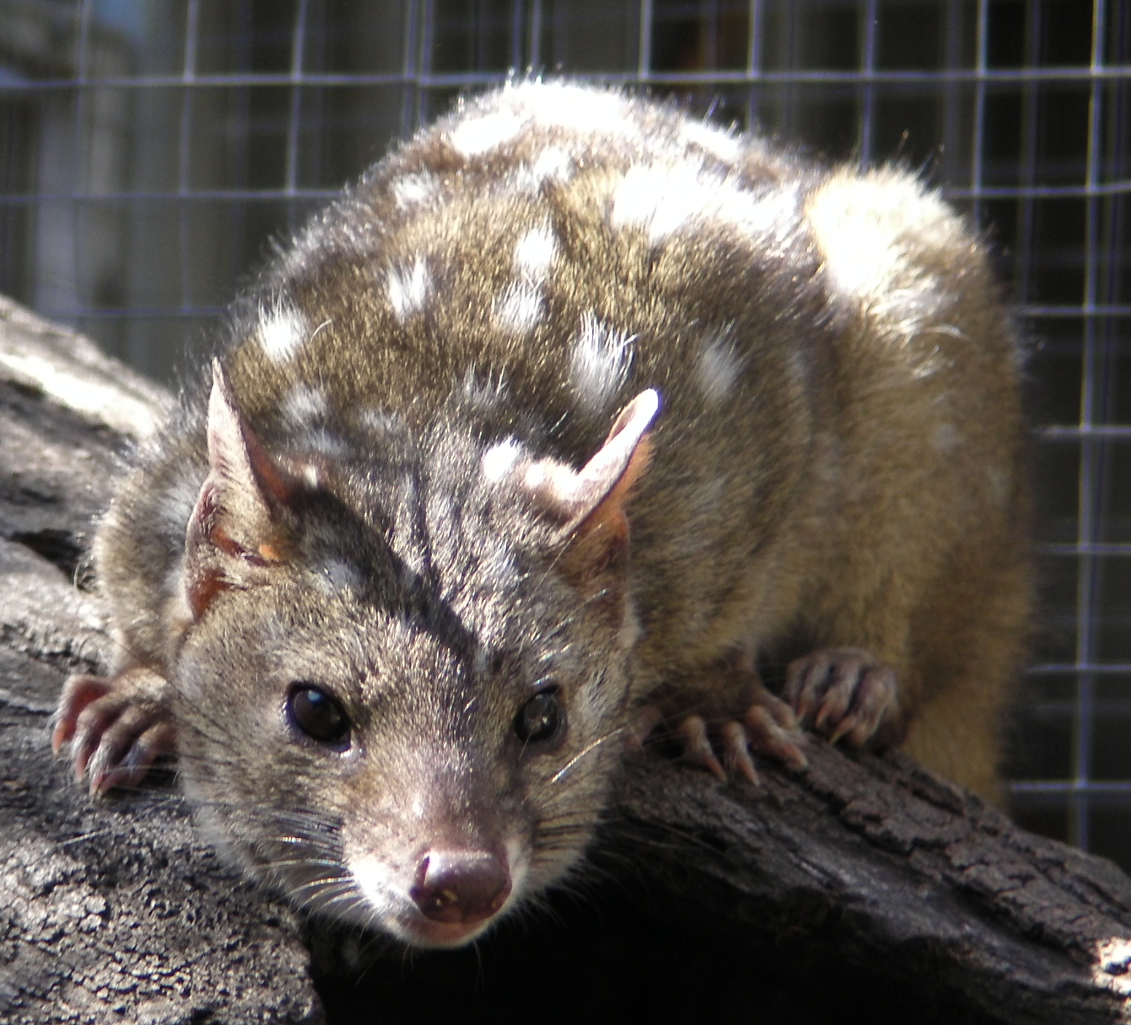
A western quoll at Caversham Wildlife Park, Western Australia
Scientific classification Edit this classification
Kingdom: Animalia
Phylum: Chordata
Class: Mammalia
Infraclass: Marsupialia
Order: Dasyuromorphia
Family: Dasyuridae
Genus: Dasyurus
Species:
D. geoffroii
Binomial name
Dasyurus geoffroii
Gould, 1841
Western quoll range

The western quoll (Dasyurus geoffroii) is Western Australia's largest endemic mammalian carnivore.[4] One of the many marsupial mammals native to Australia, it is also known as the chuditch. The species is currently classed as near-threatened.

Taxonomy

[edit]

The western quoll is a member of the family Dasyuridae and is most closely related to the bronze quoll (Dasyurus spartacus), a recently described species from New Guinea that was for some time believed to be an outlying population of the western quoll. Its species name, geoffroii, refers to the prominent French naturalist Étienne Geoffroy Saint-Hilaire, who named the genus Dasyurus in 1796. The species has occasionally been placed in the genus Dasyurinus.[5]

It is also known as the chuditch (/ˈʊdɪ/) in Western Australia (from Noongar djooditj);[6] chuditch serves as both the singular and plural form. Other common names include atyelpe or chilpa (from Arrernte),[7] kuninka (from Western Desert language);[8] idnya (Adnyamathanha people of the Flinders Ranges)[9] and the archaic western native cat.

Description

[edit]

The western quoll is about the size of a domestic cat. It is coloured a rufous brown and has 40–70 white spots on its back with a creamy white underside. Its spots help diminish its outline under moonlight at night when hunting.[10] It has five toes on its hind feet and granular pads.[5] The head and body are about 36 to 46 cm (14 to 18 in) in length, and the tail is around 22 to 30 cm (8.7 to 11.8 in).[11] With large eyes and pointed ears,[11] it is well adapted for nocturnal life. The black brush on its tail extends from halfway down to the tip. Males typically weigh around 1.3 kg (2.9 lb), and females 0.9 kg (2.0 lb). The longest they are likely to live is four years.[4]

Often confused with eastern quoll, it differs in possessing a first toe on the hind foot and a darker tail. It does share a white-spotted brown coat and a long tail with both the eastern quoll and northern quoll.

Habitat

[edit]

Once found across 70% of the Australian continent, the western quoll is now confined to south-western corner of Western Australia. This perhaps was due to European settlement in the late 1780s as their range dramatically declined after this event.[4] It currently inhabits wet and dry sclerophyll forests, including contiguous Jarrah Forest and mallee.[12] These areas consist of open forest, low open forest, woodland, and open shrub.[11] On occasion they are recorded in the WA Wheatbelt and Goldfields regions, and by the 1930s disappeared completely from Swan Coastal Plain and surrounds.[4]

As a result of its carnivorous feeding habits, the western quoll has a large home range. These territories often share rock ledges and other open spaces. This serves to mark territory and for other social functions. Males spread out over about 15 square kilometres (5.8 sq mi) and typically overlap with several female ranges, about 3–4 square kilometres (1.2–1.5 sq mi) each. Although males share their large territories with smaller female territories, females do not cross theirs with other females. Most female home ranges contains around 70 hollow log dens and 110 burrows.[13]

Behaviour

[edit]

A solitary, mostly terrestrial nocturnal predator, the western quoll is most active around dusk (crepuscular) when it hunts. It moves swiftly on the ground, climbs efficiently, and may dig or occupy existing burrows. During the day it seeks refuge in hollow logs or earth burrows as dens,[14] and saves energy by lowering its body temperature in its sleep.[15]

The western quoll is at the top of the food chain, and depends on resource abundance and a healthy ecosystem.[14] Being a carnivore, the western quoll feeds on large invertebrates and any small animal it can. This includes lizards, birds, frogs, spiders, insects, and small mammals; the largest it will eat is the size of a bandicoot or parrot.[citation needed]

Reintroduced populations in South Australia have been recorded preying on rabbits[16] and burrowing bettongs.[17]

They hunt mostly on the ground, but will climb a tree to grab a bird's egg. A bite to the back of the head kills their larger prey. It possesses an ability to obtain most of its water from its food, which is especially handy for survival during a drought.[14]

As seasonal breeders, western quolls mate between late April to July, and have a peak in June.[12] During this time, the western quoll tends to take up large areas of habitat, and females aggressively defend their territory of 55–120 ha.[15] Male and female quolls meet up only to mate. Although there are occasional cases when more young are produced than can be nursed, most litters range from two to six. There is a gestational period of 16 to 23 days which is followed by the young living in their mother's shallow pouch. After another seven to fifteen weeks, the young outgrow the pouch and are left in the den while the female forages for food. Weaned at 23 to 24 weeks, western quoll are independent at 18 weeks and are sexually mature at one year of age. The young disperse in November before taking up their own territories.[11]

Cultural significance

[edit]

The western quoll is known as tjilpa amongst the Arrernte language group of Australian Aboriginal people.[18] There are many Dreamtime stories of tribes of ancestral Tjilpa-men, who had a significant mythological role. The geographical range of these stories includes Aranda, Anmatyerre, Kaytetye, Ngalia, Ilpara and Kukatja lands.

Decline

[edit]
Western quoll roadkill

The western quoll has declined due to several factors. Land clearing, inappropriate fire regimes, grazing by stock and feral herbivores, illegal shooting, accidental drowning in water tanks, being hit by motor vehicles, and poisoning are all responsible for their disappearances.[4] Foxes and cats have a massive impact; both predation and competition narrow room for the western quoll.[2] As more land became less suitable for living in, the western quoll is forced to move elsewhere.

AWC (Australia Wildlife Conservancy) protects this species at Paruna Sanctuary using a comprehensive feral predator control program, which sees feral cat and fox numbers controlled using trapping and baiting.[4]

Reintroductions

[edit]

There have been ongoing attempts to re-establish the western quoll in parts of its former range.[19]

A five-year trial re-introduction of western quoll to the Flinders Ranges in South Australia began in April 2014.[9] Despite the loss of about a third of the first release population (mostly due to predation by feral cats), most of the surviving females bred and sixty joeys were born.[20] As of May 2016, a final release of 15 quolls from Western Australia was carried out in the Flinders Ranges, with a total population of 150. About half of this population was born locally. Monitoring of the population continued for an additional two years.[21] The success of the reintroduction led to relocation of animals from the initial site in the Ikara–Flinders Ranges National Park to the Vulkathunha-Gammon Ranges National Park in 2022 and 2023.[22][23]

The species has been returned to the South Australian arid zone, with a population established at the fenced Arid Recovery Reserve near Roxby Downs.[24] Animals were reintroduced to the semi-arid Mount Gibson Sanctuary in WA in April 2023, with the aid of feral predator control.[25]

Plans are in process to reintroduce the species to Dirk Hartog Island in Shark Bay,[26] Wardang Island[27] as part of the Marna Banggara[28] (formerly Great Southern Ark) project on the southern Yorke Peninsula[29] in South Australia, and large fenced reserves in the Pilliga Forest,[30] Mallee Cliffs National Park[31] and Sturt National Park,[32] all in NSW.

Captive breeding programs have contributed to reintroduction efforts, with Perth Zoo providing some animals for release.[11]

References

[edit]
[edit]
Revisions and contributorsEdit on WikipediaRead on Wikipedia
from Grokipedia
The Western quoll (Dasyurus geoffroii), also known as the chuditch, is a medium-sized carnivorous endemic to and the largest native mammalian predator in , measuring 26–40 cm in body length with a tail of 21–35 cm, weighing 0.9–2 kg (males up to 2 kg) and featuring a brown or black coat covered in white spots, a pointed muzzle, large eyes, and white-rimmed ears. It belongs to the family and is distinguished by its nocturnal, solitary, and territorial lifestyle, with individuals using dens in hollow logs, burrows, or trees for shelter. Historically distributed across much of , the western quoll's range has contracted dramatically to less than 5% of its former extent, now primarily confined to jarrah forests, woodlands, shrublands, and mallee habitats in southwestern , with small translocated populations in areas like Kalbarri National Park and Lake Magenta Nature Reserve, including thriving reintroduced populations in South Australia's as of 2025. These habitats provide essential den sites and prey resources, though the species avoids dense rainforests and arid deserts without suitable cover. As an opportunistic , the western quoll preys mainly on such as , along with small vertebrates including , birds, mammals, and occasionally carrion or matter, with diet varying by season and availability; it is agile both on the ground and in trees, using its non-hopping and climbing ability to hunt nocturnally. Reproduction occurs once annually from May to , with a short of 16–23 days yielding litters of 2–6 young that are weaned at 23–24 weeks and reach maturity around one year, though high mortality rates affect population stability. The western quoll faces significant threats from due to land clearing, predation and by introduced foxes and cats, road mortality, and historical poisoning, leading to its classification as Near Threatened on the since 2016 and Vulnerable under Australia's Environment Protection and Biodiversity Conservation Act 1999. Conservation efforts include fox and cat baiting programs, habitat protection, , and reintroduction initiatives, including successful reintroductions such as in Australia's Flinders Ranges where populations are thriving as of 2025, which have stabilized some populations but require ongoing monitoring to prevent further decline.

Taxonomy and etymology

Taxonomic classification

The Western quoll (Dasyurus geoffroii) belongs to the family within the order , a group of predominantly carnivorous marsupials native to and New Guinea. It is placed in the genus Dasyurus, which comprises six extant species of quolls characterized by their spotted pelage and predatory lifestyle. The species was first described by in 1841 based on a specimen from the Liverpool Plains in . Phylogenetic analyses using mitochondrial and nuclear DNA sequences have clarified the evolutionary relationships among Dasyurus species, positioning D. geoffroii as sister to or closely nested with the bronze quoll (Dasyurus spartacus) from New Guinea, with the northern quoll (Dasyurus hallucatus) as the basal species in the genus. These studies indicate that D. geoffroii and D. spartacus form a clade that diverged from other Dasyurus lineages during the Pliocene. The genus Dasyurus as a whole diverged from the Tasmanian devil (Sarcophilus harrisii) around 11–13 million years ago during the Miocene radiation of dasyurids. Recent genomic analyses support the monotypic status of D. geoffroii, with no recognized ; historical distinctions, such as D. g. fortis for southwestern populations and the now-extinct D. g. geoffroii from eastern , are not upheld in modern due to insufficient genetic differentiation. This classification reflects the species' isolation in remnant southwestern Australian populations following extensive historical range contraction.

Names and synonyms

The scientific name of the Western quoll is Dasyurus geoffroii. The genus name Dasyurus derives from the words dasys (meaning "hairy" or "shaggy") and oura (meaning "tail"), referring to the animal's distinctive bushy tail, and was coined by the French naturalist in 1796. The species epithet geoffroii honors Geoffroy Saint-Hilaire, as designated by the English ornithologist and mammalogist when he described the species in 1841 based on a specimen from the Liverpool Plains in . Indigenous Australian peoples have long recognized the Western quoll through various traditional names tied to their languages and cultural contexts. In the of southwestern , it is known as chuditch (an anglicized form of djooditj or dju-tytch), which imitates the animal's sharp, guttural cry when threatened. Among the people of South Australia's , it is called idnya, a name reflecting its cultural significance as a in their traditions. The of refer to it as atyelpe (or sometimes chilpa), while in the Western Desert languages spoken by and related groups, it is known as kuninka. Historically, the Western quoll has been known under variant spellings and synonyms in taxonomic literature, reflecting early inconsistencies in . A common older form was Dasyurus geoffroyi (with a "y" instead of "ii"), used as an alternate spelling by Gould around 1840 and later by George Robert Waterhouse in 1841, who also referred to it as "Geoffroy’s Dasyurus" in his descriptions. These variants are no longer in use, with Dasyurus geoffroii established as the valid binomial following Waterhouse's taxonomic contributions.

Physical description

Morphology and appearance

The Western quoll (Dasyurus geoffroii) possesses short that is typically rufous-brown, marked by 40 to 70 conspicuous white spots distributed across the back, sides, and limbs, though absent from the tail. The underparts are pale creamy white, providing contrast to the dorsal coloration. This spotted pattern aids in within dappled or vegetated habitats. The head features a pointed muzzle, large rounded ears with white-rimmed edges, and prominent eyes adapted for enhanced vision in low-light conditions. The is bushy and predominantly from about halfway to the tip, lacking spots. As a carnivorous , it has specialized , including blade-like premolars functioning as teeth for shearing meat. Sexual dimorphism is evident primarily in , with males being slightly larger than females, though other external differences are minimal. Females possess a shallow forward-opening pouch containing six teats, which supports the development of young.

Size, weight, and lifespan

The Western quoll exhibits in , with males generally larger than females. Head-body ranges from 260 to 400 mm (males 310–400 mm, females 260–360 mm), while tail measures 210 to 350 mm. Adult males average 1.3 kg in weight, with a range of 0.7 to 2.0 kg, whereas females average 0.9 kg, ranging from 0.6 to 1.1 kg. These dimensions render the Western quoll comparable in size to a , underscoring its role as a mid-sized carnivorous . In the wild, Western quolls typically live up to 4 years, though high juvenile mortality often reduces the average lifespan to around 2 years. In , individuals can survive 5 to 6 years.

Habitat and distribution

Historical and current distribution

The Western quoll (Dasyurus geoffroii) historically occupied over 70% of prior to European settlement, with its range extending from the southwest of , across arid and semi-arid regions, through , Victoria, , southeastern , and the . This extensive distribution encompassed diverse habitats, though the underwent a severe contraction beginning in the early , linked to environmental changes and human impacts, resulting in its disappearance from more than 90% of its former mainland range. Today, the natural population is restricted to a fragmented area of approximately 212,000 km² (as of 2006) in southwestern , primarily within Jarrah eucalypt forests and the fringes of the wheatbelt region, with small translocated populations in Kalbarri National Park and Lake Magenta Nature Reserve. This represents less than 5% of the species' original continental extent, highlighting the drastic reduction in its geographic footprint. Reintroduction efforts have established small populations beyond its remnant range, including in the () since 2014, the Arid Recovery reserve () since 2018, and Sturt National Park () since 2024, with ongoing success reported as of 2025.

Habitat types and requirements

The Western quoll inhabits a variety of semi-arid and temperate environments in southwestern , including dry forests such as jarrah and mallee eucalypt woodlands, as well as heathlands and open shrublands. These habitats provide the structural complexity needed for shelter and prey availability, with the species showing a preference for areas with moderate canopy cover and vegetation rather than closed-canopy wet forests. Essential habitat requirements include access to den sites, particularly horizontal hollow logs greater than 30 cm in diameter for daytime refuge, with females utilizing over 70 such logs within their home ranges alongside numerous burrows. Rocky outcrops and crevices serve as additional shelter options, offering protection from predators and . Proximity to sources, such as riparian zones, is also critical, as evidenced by higher densities in moist areas near creeks. Home ranges vary by and quality but typically span up to 15 km² for males and 3–4 km² for females, with significant overlap between males and females but minimal intrusion into core areas to reduce conflict. These ranges encompass diverse microhabitats to support denning and resource needs, though fragmentation in the current southwest Western Australian distribution limits effective movement.

Ecology and behavior

Social behavior and activity patterns

The western quoll (Dasyurus geoffroii) exhibits a predominantly solitary , with individuals interacting only briefly during the mating season in late to early July. This isolation minimizes direct confrontations outside of reproductive contexts, as both males and females maintain separate core areas. Territorial defense is aggressive and primarily intrasexual among females, who show little overlap in their core areas except occasionally with non-dispersing daughters. Individuals mark territories using scent deposition, including cloacal dragging by females in response to foreign odors and fecal aggregations by both sexes at movement hotspots like paths and river crossings. Vocalizations support this defense, featuring sharp guttural cries when threatened, along with hisses and screams during encounters. These signals help maintain spacing without frequent physical clashes. Western quolls are strictly nocturnal and crepuscular, with peak activity periods at and dawn for and movement. They rest in dens during the day, though limited daytime activity may occur during breeding or in cold, wet weather. To enhance vigilance, they frequently climb to elevated perches such as tree branches for scanning surroundings or evading threats. Olfactory communication dominates, relying on anal gland secretions, , and to convey territorial and reproductive status over distances. The limited vocal repertoire includes distress calls and mating vocalizations, such as chirps and coughs in close-range interactions, complementing chemical cues for coordination during rare social encounters. This solitary strategy aids survival in predator-rich habitats by reducing visibility and resource competition.

Diet and foraging behavior

The western quoll (Dasyurus geoffroii), also known as the chuditch, is a carnivorous with a generalist diet dominated by and small vertebrates. In analyses of scats from populations, mammals and were the primary components, occurring in 88% and 81% of samples respectively, each comprising roughly 40% of the dietary volume. Specific prey includes large such as beetles and spiders, alongside small vertebrates like , birds, frogs, and mammals up to the size of bandicoots or rabbits; occasional carrion supplements the diet, while plant material such as fruits or seeds appears rarely. Although minor frugivory has been recorded, it does not constitute a significant portion of intake. Foraging occurs primarily at night on the ground, aided by acute senses of sight, hearing, and smell to detect and locate prey. Western quolls hunt by stalking and then pouncing from ambush on unsuspecting prey, or by pursuing smaller animals in short bursts across open terrain. Excess food may be cached in dens for later consumption, particularly in captive individuals exhibiting this . Dietary composition shifts seasonally with prey availability; invertebrate intake declines during dry periods when populations fluctuate, leading to greater reliance on vertebrates. As a mid-to-upper predator, the western quoll helps regulate and populations, contributing to balance and serving as an indicator of productivity. Its nocturnal activity patterns enhance hunting efficiency in low-light conditions, minimizing competition and predation risks.

Reproduction and development

The western quoll exhibits a seasonal breeding pattern, with occurring from late April to early July in southern regions, peaking in June. Due to their solitary nature, interactions between males and females are limited to brief encounters, with males' home ranges overlapping those of several females to maximize opportunities. Gestation lasts 16-23 days, after which 2-6 altricial young (typically attaching to the mother's six teats) are born and remain in the shallow pouch for approximately 8-10 weeks (data as of 2012). During this period, the young are permanently attached to the teats and undergo rapid development, outgrowing the pouch around 61-72 days and being left in dens while the mother forages. Post-pouch, the young emerge well-furred and begin consuming solid food by about 110 days (roughly 16 weeks). They achieve full around 170 days (24 weeks) and reach independence around 18-24 weeks, foraging semi-independently before fully dispersing from the maternal den. Both sexes attain at one year of age, allowing breeding in their first year, though is often highest in young females.

Conservation

Historical decline and causes

The Western quoll (Dasyurus geoffroii), once abundant across an extensive range covering approximately 70% of continental , including arid and semi-arid regions from the east (such as western and ) to the west, experienced stable populations prior to European settlement, as indicated by Indigenous cultural records and early explorer accounts describing it as common in arid and semi-arid regions. In the early , the species remained widespread in , the , and , but rapid declines began shortly thereafter due to anthropogenic pressures. By the 1930s, the Western quoll had disappeared from the Swan Coastal Plain and surrounding areas in , largely vanishing from eastern and central regions including (last recorded in the 1880s) and the (presumed extinct by the 1960s). The decline accelerated through the mid-20th century, with over 90% of its mainland Australian range lost by the 1970s, confining the species primarily to south-western . This contraction represented a catastrophic reduction from its pre-European distribution, which spanned approximately 80% of the continent. The primary historical drivers of this decline included from widespread and , which cleared riparian and areas critical for shelter and . Altered regimes, characterized by increased frequency and intensity following European practices, further reduced available den sites in hollow logs and dense vegetation, exacerbating vulnerability. Indirect was a significant factor, as baits targeting introduced rabbits and foxes—using toxins like , , and 1080—led to secondary ingestion by quolls scavenging poisoned carcasses, contributing to widespread mortality during the .

Current threats

The primary ongoing threat to the western quoll (Dasyurus geoffroii) is predation by introduced red foxes (Vulpes vulpes) and feral cats (Felis catus), which exert significant pressure on populations, particularly juveniles dispersing from natal dens. These predators target young quolls, contributing to high mortality rates in areas without intensive management, and are recognized as key factors limiting population persistence across the species' remaining range. An emerging threat is the southward advance of invasive cane toads (Rhinella marina) toward Western Australia's region, with a November 2025 study predicting potential arrival within 10–20 years (2035–2045) and colonization of up to 75% of the region depending on rainfall patterns, potentially causing severe declines in native predators. Western quolls lack evolved resistance to the toads' , and ingestion—even mouthing—can be lethal, posing risks to individuals in this area should reintroductions expand the species' range northward. Additional threats include vehicle collisions, which cause direct mortality during nocturnal and dispersal, especially on roads traversing remnants. Climate change exacerbates vulnerability through intensified droughts that reduce prey availability, such as small mammals and , altering success in arid margins of the quoll's distribution. transmission from domestic and feral animals, including pathogens like Toxoplasma gondii carried by cats, further endangers quoll health and survival by weakening immune responses in stressed populations.

Conservation status and efforts

The Western quoll (Dasyurus geoffroii) is classified as Near Threatened on the , a status updated in 2024 from Endangered (assessed in 1996) due to conservation interventions stabilizing populations. In , it is listed as Vulnerable under the Environment Protection and Biodiversity Conservation Act 1999 (EPBC Act). Under Western Australia's Biodiversity Conservation Act 2016, it is also categorized as Vulnerable in Schedule 2, Division 3 of the Biodiversity Conservation (Listing of Native Species) (Fauna) Order 2022. The global population is estimated at fewer than 10,000 mature individuals (2006 estimate, with recent total population around 12,000–15,000 as of 2024), primarily confined to southwestern with smaller translocated groups elsewhere. Population monitoring relies on non-invasive methods such as camera traps to detect individuals and activity patterns, combined with scat for genetic identification and dietary assessment. These techniques provide data on distribution, abundance, and without disturbing the species. Conservation efforts focus on mitigating key threats like predation through targeted feral predator control, including the use of 1080 () baiting programs in protected reserves to reduce and numbers. Captive breeding programs, led by institutions such as , have produced hundreds of individuals for supplementation and translocation, contributing to population recovery and the species' improved IUCN status. Ongoing genetic research evaluates diversity levels across populations to ensure translocation viability, minimizing risks and enhancing long-term adaptability.

Reintroduction programs

Reintroduction programs for the Western quoll (Dasyurus geoffroii) have focused on restoring populations in regions where the species had been extinct for over a century, primarily through translocations from source populations in to predator-managed sites in and . In South Australia's Flinders Ranges, the Bounceback program, in partnership with the Foundation for Australia's Most Endangered Species (FAME), initiated reintroductions in 2014 by translocating 40 wild individuals from to fenced and baited areas within Ikara-Flinders Ranges National Park. By 2016, the population exceeded 150 individuals, with approximately half born locally, and ongoing monitoring in 2025 confirmed a thriving population including evidence of sustained local breeding despite challenging dry conditions. At the Arid Recovery Reserve in northern , a trial reintroduction began in May 2018 with 12 adult western quolls (four males and eight females) released into a 123 km² feral-free enclosure, resulting in 30 offspring in the first year and establishing a self-sustaining population by subsequent monitoring. The program has highlighted the quolls' role as native predators, with post-release tracking via radio collars revealing movements across over 400 locations, though challenges persist in balancing predation impacts on co-reintroduced prey species. In , the Wild Deserts project at Sturt marked the species' return to the state in 2024 with the release of 16 captive-bred individuals from into a 7,800-hectare feral-predator-free zone, followed by 2025 observations of wild dispersal beyond fenced areas. Across South Australian sites, combined populations grew from over 150 individuals by 2016 to hundreds by 2025, supported by intensive post-release monitoring to mitigate predation risks and ensure survival. In , efforts at fenced sanctuaries such as Mount Gibson Wildlife Sanctuary have advanced through releases starting in 2023, culminating in the birth of second-generation pups in 2025, with one confirmed litter of four observed in a female's pouch, indicating successful establishment outside strict predator-proof zones. Additionally, the Return to 1616 ecological restoration project on has included planning for western quoll translocation since 2023, prioritizing it as a top-order predator once prey populations are secured, with ongoing preparations as of 2025.

References

Add your contribution
Related Hubs
User Avatar
No comments yet.