Hubbry Logo
BandicootBandicootMain
Open search
Bandicoot
Community hub
Bandicoot
logo
8 pages, 0 posts
0 subscribers
Be the first to start a discussion here.
Bandicoot
Bandicoot
from Wikipedia

Bandicoots
Temporal range: Late Oligocene - Recent Late Oligocene–Recent
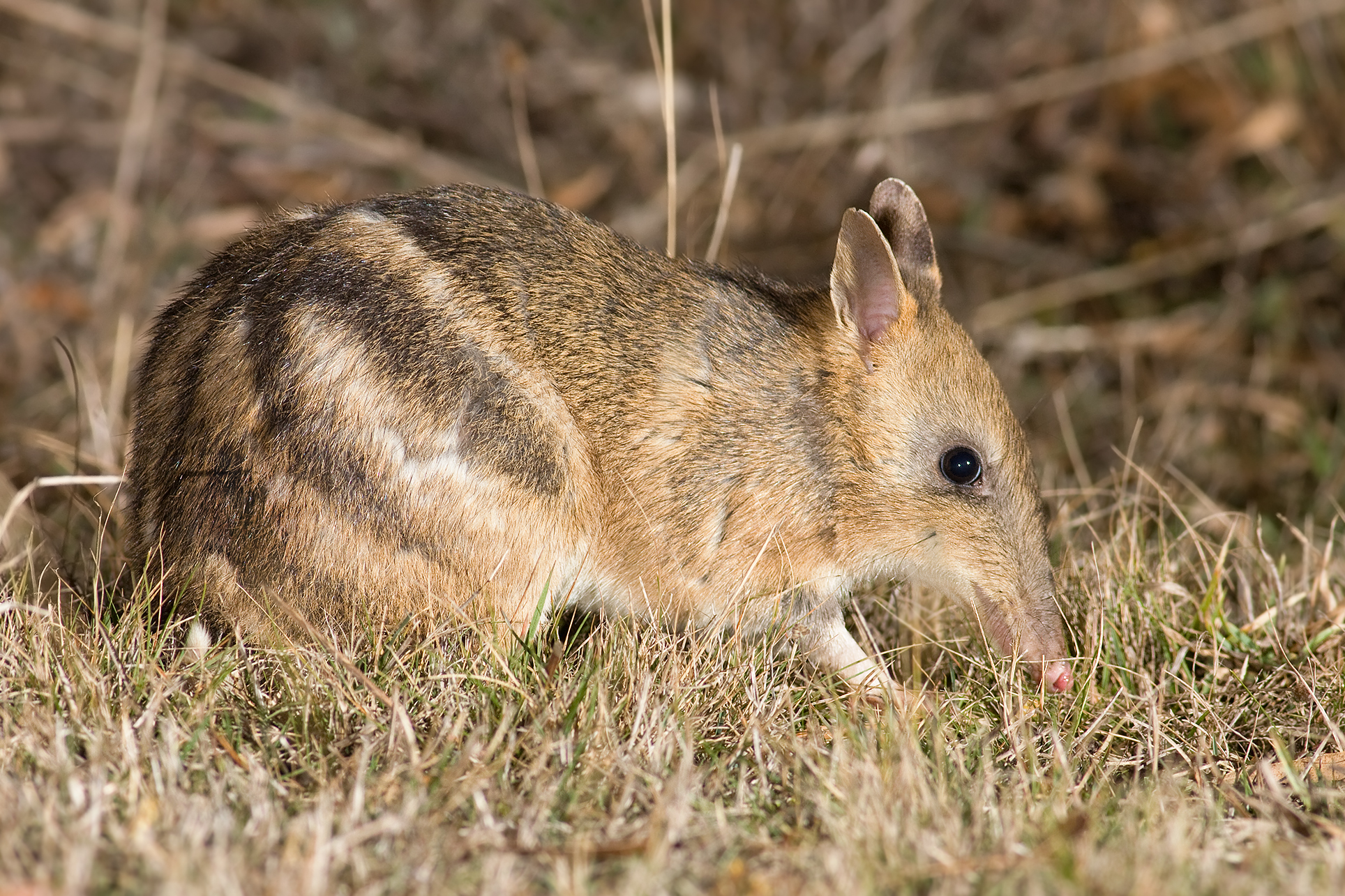
Eastern barred bandicoot (Perameles gunni)
Scientific classificationEdit this classification
Kingdom: Animalia
Phylum: Chordata
Class: Mammalia
Infraclass: Marsupialia
Clade: Agreodontia
Order: Peramelemorphia
Superfamilies, etc.

See text.

Bandicoots are a group of more than 20 species of small to medium-sized, terrestrial, largely nocturnal marsupial omnivore in the order Peramelemorphia.[1] They are endemic to the AustraliaNew Guinea region, including the Bismarck Archipelago to the east and Seram and Halmahera to the west.

Etymology

[edit]

The bandicoot is a member of the order Peramelemorphia and the word bandicoot is often used informally to refer to any peramelemorph, such as the bilby.[2] The term originally referred to the unrelated Indian bandicoot rat from the Telugu word pandikokku (పందికొక్కు), wherein pandi means pig and kokku means rat.[3]

Characteristics

[edit]

Bandicoots have V-shaped faces, ending with their prominent noses similar to proboscides. These noses make them, along with bilbies, similar in appearance to elephant shrews and extinct leptictids and they are distantly related to both mammal groups. With their well-attuned snouts and sharp claws, bandicoots are fossorial diggers. They have small but fine teeth that allow them to chew their food easily.[4]

Like most marsupials, male bandicoots have bifurcated penises.[5]

A sign near Armadale shopping city, Perth, Australia, asking members of the public not to leave bread for bandicoots and other animals

The embryos of bandicoots have a chorioallantoic placenta that connects them to the uterine wall, in addition to the choriovitelline placenta common to all marsupials.[6] However the chorioallantoic placenta is small compared with those of the Placentalia and lacks chorionic villi.

Bandicoots can reach 11 to 31 in (28 to 79 cm) in length and 0.4 to 3.5 lb (0.18 to 1.6 kg) in weight. A bandicoot has a long pointed snout, large ears, a short body and a long tail. Its body is covered with fur that can be brown, black, golden, white or grey. Bandicoots have strong hind legs well adapted for jumping.

Bandicoots also have low body temperatures and low basal metabolic rates, which aids their survival in hot and dry climates. They also have a low total water evaporative rate and effective panting mechanisms, which further aid their survival in hotter temperatures.[7]

Classification

[edit]

Classification within the Peramelemorphia was previously thought to be straightforward, with two families in the order—the short-legged and mostly herbivorous bandicoots, and the longer-legged, nearly carnivorous bilbies. In recent years, however, the situation clearly has become more complex. First, the bandicoots of the New Guinean and far-northern Australian rainforests were deemed distinct from all other bandicoots and were grouped together in the separate family Peroryctidae. More recently, the bandicoot families were reunited in the Peramelidae, with the New Guinean species split into four genera in two subfamilies, Peroryctinae and Echymiperinae, while the "true bandicoots" occupy the subfamily Peramelinae. The only exception is the now-extinct pig-footed bandicoot, which has been given its own family, Chaeropodidae.

Vernacular names

[edit]
Bandicoots in bronze at the Waratah Mills light rail stop on Sydney's Inner West Light Rail line; public art by Ochre Lawson[16]

The name bandicoot is an Anglicised version of a word from the Telugu language of South India meaning 'pig-rat'.[17] What are now called bandicoots are not found in India and ‘bandicoot’ was originally applied to completely unrelated mammals—several species of large rat (rodents). Today these species, belonging to the genera Bandicota and Nesokia, are referred to as bandicoot rats.

Robert Blust[18][19][20][21] reconstructs the form *mansar or *mansər 'bandicoot' for Proto-Central–Eastern Malayo-Polynesian (i.e., the reconstructed most recent common ancestor of the Central–Eastern Malayo-Polynesian languages) from related words like Oceanic Motu mada and Fijian gwaca,[22] but the validity of this reconstruction is doubted by Schapper (2011).[23] It is known as aine in the Abinomn language of Papua, Indonesia.[24]

Bandicoots have different names by the indigenous peoples of the Australia–New Guinea region. For example, the Kaurna people refer to the southern brown bandicoot as the bung or the marti.[25][26]

References

[edit]
[edit]
Revisions and contributorsEdit on WikipediaRead on Wikipedia
from Grokipedia
Bandicoots are a group of approximately 20 species of small to medium-sized, terrestrial marsupials in the order , endemic to and , known for their pointed snouts, strong forepaws adapted for digging, and largely nocturnal, omnivorous lifestyle. These marsupials, primarily in the family , range in size from 30 to 80 cm in length and weigh between 0.5 and 2 kg, with features like large hind feet for hopping and a backward-opening pouch in females to protect young from during foraging. They inhabit diverse environments, including rainforests, woodlands, heaths, and grasslands, often nesting in shallow burrows under dense vegetation, and play key ecological roles in and through their digging behavior. Bandicoots are solitary and territorial, foraging at night for insects, larvae, fungi, , and small vertebrates using a distinctive galloping , and they communicate through vocalizations such as whuffs, chuffs, and shrieks. Their reproduction is notable for the shortest period among marsupials—about 11 to 12.5 days—resulting in tiny, underdeveloped young that crawl to the pouch, where they remain for 50 to 55 days before emerging; females can breed up to four times a year, though lifespans in the wild are typically 2 to 4 years. Many bandicoot species face conservation challenges, with habitat loss, introduced predators like foxes and cats, and competition contributing to the extinction of at least two species and the endangered status of several others, such as the southern brown bandicoot and , prompting ongoing breeding and reintroduction programs.

Etymology and Naming

Etymology

The term "bandicoot" derives from the Telugu word pandikokku, literally meaning "pig-rat," and entered English in the late 18th century to describe large, destructive rats of the genus Bandicota native to India and Southeast Asia. These rodents, known for their pig-like grunts and burrowing behavior, were first documented in European accounts around 1789, reflecting early colonial encounters in the region. The name's adoption highlighted the animals' perceived hybrid traits, combining porcine and rodent features. Following European settlement in beginning in , the term was repurposed for indigenous marsupials exhibiting similar long snouts, nocturnal habits, and digging tendencies, despite no close biological relation to the Asian rats. The term was applied to Australian fauna in the early , with the first documented uses appearing around , distinguishing them from the Asian . This usage appeared in early texts, marking the linguistic shift from Old World to New World marsupials amid growing scientific interest in Australia's unique . By the , "bandicoot" had become the common English name for the order , encompassing diverse species like short-nosed and long-nosed bandicoots as well as bilbies, thereby establishing a clear taxonomic distinction from the rodent . This evolution underscores how colonial often prioritized superficial resemblances over phylogenetic accuracy, a pattern that persists in vernacular references to these animals in Indigenous Australian languages.

Vernacular and Indigenous Names

Bandicoots are known by a variety of vernacular and indigenous names across their range in Australia and New Guinea, reflecting the linguistic diversity of over 250 Aboriginal languages in Australia and more than 800 Papuan languages in New Guinea, which often encode cultural and ecological observations of these marsupials as nocturnal diggers and foragers. In Australian Aboriginal traditions, names for bandicoots vary by region and language group, highlighting their role in ecosystems as soil-turners that create foraging pits. For instance, the southern brown bandicoot (Isoodon obesulus) is called "kwenda" or "quenda" in the Noongar language of southwestern Western Australia, terms that evoke its ground-dwelling habits, while the Kaurna people of the Adelaide Plains refer to it as "marti" or "bung," names passed down through oral histories emphasizing its burrowing behavior. The greater bilby (Macrotis lagotis), a larger bandicoot species, derives its common name "bilby" from the Yuwaalaraay language of northern New South Wales, where "bilba" translates to "long-nosed rat," underscoring its distinctive snout used for probing soil—though this must be distinguished from the numbat (Myrmecobius fasciatus), a non-bandicoot marsupial similarly named "noombat" in Noongar but recognized separately in indigenous classifications for its termite-specialized diet. Linguistic reconstructions from proto-Pama-Nyungan, the ancestral language family spoken across much of Australia around 5,000–6,000 years ago, suggest roots for mammal names that influenced modern terms, such as variations on digger-related descriptors for bandicoot-like animals, though specific etymologies remain under study in comparative Aboriginal linguistics. In , Papuan indigenous names for bandicoots similarly capture their as engineers that aerate through digging, with variations across dialects illustrating cultural adaptations to highland and lowland habitats. For example, broader Papuan linguistic diversity yields dialect-specific names like "mada" in , a reflecting the animal's role as a hunted and soil disturber in subsistence economies. These names underscore the cultural significance of bandicoots in , where they are often linked to stories of land stewardship and biodiversity maintenance.

Physical Characteristics

Morphology and Size

Bandicoots, members of the family , display a characteristic external morphology suited to their terrestrial , featuring an elongate, pointed snout that forms a V-shape in cross-section, with a prominent, sensitive tip for soil probing. Their body is stocky with relatively short limbs and neck; the forelimbs are powerful and equipped with strong, flattened claws on the digits for efficient digging, while the hind limbs are longer and adapted for movement or hopping in some . The hind feet exhibit , with the second and third digits fused, a trait typical of marsupials. Fur coloration varies across , typically drab dorsally in shades of brown, fawn, , or grey, often paler ventrally, with some taxa like certain Perameles showing transverse black bars on the rump. In terms of dentition, bandicoots possess small, fine, pointed teeth resembling those of insectivores, including 3 pairs of lower incisors and a dental formula of I 1-5/1-3, C 1/1, PM 1-3/1-3, M 1-4/1-4, which support their omnivorous diet by allowing efficient processing of , plant matter, and fungi. is present but generally subtle, with males slightly larger than females in body size and occasionally exhibiting more robust canines in larger species, though this is reduced or absent in smaller taxa. Size varies significantly among the approximately 20 species, with head and body lengths ranging from 150 to 560 mm and weights from 200 g to over 4.7 kg, though most fall between 250–500 mm in length and 500–2000 g. For example, the smallest species, the mouse bandicoot (Microperoryctes murina), measures 150–170 mm in head-body length and weighs around 100 g. In contrast, the largest, the giant bandicoot (Peroryctes broadbenti), reaches 390–560 mm in head-body length and up to 4.7 kg, though Australian species like the (Isoodon macrourus) typically max out at around 1.6 kg. Tail lengths generally range from 120–340 mm, often comprising about half the head-body length.

Sensory and Physiological Adaptations

Bandicoots exhibit physiological adaptations suited to arid and semi-arid environments, including a low and labile typically ranging from 33 to 35°C, which minimizes stress and loss. This is complemented by a low (BMR), often below predicted eutherian levels, enabling efficient energy and in hot, dry climates where resources are scarce. For instance, the golden bandicoot (Isoodon auratus) maintains a as low as 31.5°C at cooler ambient temperatures, rising only modestly under , further supported by low thermal conductance and evaporative loss. Reproductively, bandicoots possess a chorioallantoic unique among , which supplements the typical choriovitelline placenta and facilitates more efficient nutrient and during . This structure appears late in and involves fusion with maternal tissues, enhancing embryonic development in an otherwise brief marsupial period. Males feature a bifurcated , a trait common to , allowing copulation with the female's dual lateral vaginas leading to separate uteri, which supports and rapid successive pregnancies. Sensory adaptations emphasize olfaction, with an acute enabled by an extensive and elongated nasal passages that house specialized turbinals for detecting subterranean insects and food sources. The long , as described in morphological studies, further amplifies this capability by positioning the nasal openings optimally for ground-level scent detection. behaviors are supported by strong, curved forelimb claws adapted for rapid digging into soil, minimizing energy expenditure during . The female's backward-facing pouch prevents soil ingress during these activities, protecting pouch young from contamination.

Taxonomy and Evolution

Classification and Families

Bandicoots belong to the order , a group of Australasian marsupials distinguished by their polyprotodont dentition and omnivorous habits. This order encompasses two extant families: , which includes the diverse true bandicoots, and Thylacomyidae, consisting solely of the bilbies in the genus . The extinct family Chaeropodidae is represented by the pig-footed bandicoot (), known from historical records but no longer extant. Within , three subfamilies are recognized: Peroryctinae, comprising New Guinean bandicoots in the genera Peroryctes (two species) and Microperoryctes (three species); Echymiperinae, featuring spiny bandicoots such as those in the genus Echymipera (five species) and the Seram bandicoot (Rhynchomeles prattorum); and Peramelinae, which includes Australian long-nosed bandicoots of the genus Perameles (three species, e.g., the long-nosed bandicoot P. nasuta) and short-nosed bandicoots of the genus Isoodon (three species, e.g., the I. macrourus). In total, 18 extant species are recognized across these genera in Peramelidae, alongside the single extant bilby species Macrotis lagotis in Thylacomyidae (as of 2023). Peramelemorphians differ from other marsupials, particularly the carnivorous dasyurids (order ), through specialized dental features like bunodont molars with rounded cusps suited for grinding a mixed diet of , fungi, and , rather than the shearing typical of dasyurids. in bandicoots also sets them apart, with a unique vascularized yolk-sac (choriovitelline) enabling embryonic development up to 12.5 days—longer than the brief gestations (as short as 10–11 days) in dasyurids—while still retaining a posterior-facing pouch characteristic of polyprotodont marsupials.

Fossil Record and Evolutionary History

The fossil record of bandicoots (order ) extends back to the late , approximately 26–24 million years ago, with the earliest known specimens recovered from the Etadunna Formation in . These include two species of the genus BulunguB. muirheadae and B. campbelli—which represent small, insectivorous stem peramelemorphians weighing less than 250 grams and exhibiting plesiomorphic dental traits such as complete centrocristae on molars. These finds indicate that peramelemorphians originated in during a period of tectonic isolation and climatic cooling following the mid-Paleocene (~60 million years ago), with stem forms diversifying by the Eocene. During the Miocene (~23–5 million years ago), bandicoot lineages underwent significant diversification, coinciding with environmental shifts toward more open habitats and the emergence of land connections between and . This radiation included the split between xeric-adapted groups (ancestral to modern bilbies and pig-footed bandicoots) and mesic-adapted forms (ancestral to peramelids), dated to the latest –early Miocene (~25–20 million years ago) based on integrated fossil and molecular data. Dispersal to New Guinea occurred via vicariant land bridges formed during the middle Miocene as the Australian continent collided with the Pacific plate, enabling peroryctine and echymiperine clades to colonize rainforests there and achieve greater diversity in montane ecosystems. Fossils from this period, such as Galadi speciosus from Riversleigh, reveal short-snouted, dasyurid-like forms adapted to faunivory in Oligo-Miocene rainforests, highlighting ecological experimentation before the dominance of modern genera. Phylogenetic analyses, bolstered by molecular sequences from nuclear and , position as a distinct order within the supercohort , closely related to diprotodontians and dasyuromorphians but separated by a deep divergence around 40–30 million years ago. Relaxed-clock Bayesian methods estimate the crown-group origin near the boundary, with subsequent radiations aligning with evidence of arid adaptations in Australian lineages. Major extinctions struck in the (~50,000 years ago onward), following human arrival in , which decimated diverse bandicoot assemblages including the now-endangered giant species Peroryctes broadbenti from New Guinean highlands—reaching up to 5 kg and adapted to forested s—likely due to and habitat alteration. Stem-grade survivors, such as Lemdubuoryctes aruensis from the Aru Islands (dated 28,000–9,000 years ago), persisted into the but ultimately vanished, underscoring a bottleneck that reduced peramelemorphian diversity to modern levels.

Distribution and Habitats

Geographic Range

Bandicoots are endemic to the Australia-New Guinea region, occurring across , , numerous offshore islands, and , which encompasses both and the Indonesian provinces of Papua and West Papua. This distribution reflects their evolutionary ties to the ancient of , with species adapted to diverse environments from coastal zones to inland areas. In , bandicoots are primarily confined to habitats, while in , they span a broader array of ecosystems. Prior to European colonization, bandicoots were widespread throughout much of Australia, with many species occupying extensive ranges across both arid and mesic zones. For instance, semi-arid adapted species like the golden bandicoot (Isoodon auratus) and western barred bandicoot (Perameles bougainville) were once common in regions such as the Kimberley and the upper Murray River, respectively. In New Guinea, their presence has remained more stable, though limited to specific elevational bands. Recent conservation efforts have reintroduced some species to parts of their former ranges. As of 2025, the western barred bandicoot has been re-established in through releases at Pilliga State Conservation Area (2023, with breeding success reported in 2025) and Mallee Cliffs National Park (November 2025). Similarly, the golden bandicoot has been reintroduced to Sturt National Park in (2024–2025). These efforts aim to expand populations in predator-free zones. Species-specific distributions vary significantly. The southern brown bandicoot (Isoodon obesulus) is primarily distributed in southeastern , including coastal areas of , Victoria, southeastern , and , with fragmented populations in southern . In contrast, the (I. macrourus) ranges across northern and eastern —from to the —and extends into southern and southeastern . Habitat loss and other pressures have led to substantial range contractions for many species; the (Perameles eremiana), once found in the arid interior of central and , is now presumed extinct, with the last confirmed record from in the region.

Habitat Preferences and Microhabitats

Bandicoots exhibit a strong preference for habitats characterized by dense understory vegetation, which provides essential cover from predators and extreme weather. Across their range, species such as the southern brown bandicoot (Isoodon obesulus) favor woodlands, heathlands, and grasslands with thick shrub layers and tall grasses, while others like the northern brown bandicoot (Isoodon macrourus) occupy wet tropical forests, open woodlands, and shrublands with low ground cover. Rainforest environments, particularly those with layered vegetation, are also commonly utilized by several peramelids, including long-nosed bandicoots (Perameles nasuta), which thrive in areas of dense low vegetation for shelter. Most bandicoot species avoid open deserts, though specialized arid-adapted forms, such as the golden bandicoot (Isoodon auratus), persist in dry savannas with sparse acacia or eucalyptus overstories. Within these broader habitats, bandicoots exploit specific microhabitats that support their nocturnal lifestyles and needs. They frequently construct shallow burrows or nests in sandy or loose soils, often lining these with leaf litter and debris for insulation and camouflage, as observed in species like the (Perameles gunnii). Proximity to water sources is a key feature, with many populations, including those of the long-nosed bandicoot, selecting sites near creeks or moist areas to facilitate hydration and prey availability. Dense leaf litter layers on floors serve as prime microhabitats, where bandicoots probe for and fungi, while regrowth eucalypt understories provide low-light shelters during the day. These microhabitat choices enhance survival by minimizing exposure and maximizing resource access. Bandicoots demonstrate adaptability to both wet and arid conditions, reflecting their evolutionary versatility. In , peroryctid bandicoots, such as the kalubu bandicoot (Echymipera kalubu), inhabit -influenced rainforests, lowland savannas, and highland woodlands, where seasonal flooding shapes vegetation density. In , species like the navigate wet-dry tropical cycles by utilizing forests and adjacent grasslands, adjusting to fluctuating moisture levels without extensive migration. Seasonal shifts in use occur in some arid-zone populations, where individuals may concentrate in wetter refugia during prolonged dry periods to access reliable and , as inferred from patterns in golden bandicoot enclosure studies.

Behavior and Ecology

Diet and Foraging Strategies

Bandicoots are omnivorous marsupials with a diet primarily consisting of invertebrates, which often dominate their food intake and can comprise the majority, such as 35–56% of fecal contents in species like the southern brown bandicoot (Isoodon obesulus) in Queensland. Common invertebrates include beetles, earthworms, ants, spiders, insect larvae, and centipedes, supplemented by plant material like roots, tubers, seeds, fruits, and berries, as well as hypogeous fungi and occasionally small vertebrates such as lizards, mice, and snails. This varied intake reflects their opportunistic feeding, allowing adaptation to available resources in their habitats. Foraging occurs primarily at night, with bandicoots relying on their keen to detect buried prey and using their elongated and strong forelimbs—adaptations detailed in physical characteristics—to dig conical pits, typically 5–15 cm deep, in soft to uncover food. These "snout pokes" target subterranean items like larvae and fungi, and bandicoots may create numerous such pits in a single bout. Bandicoots have high metabolic demands. Their digging behavior also contributes to , , and . Seasonal variations influence diet composition, with subterranean foods like hypogeous fungi, roots, and larvae becoming more prominent in winter and dry periods compared to summer's emphasis on surface and . In arid conditions, increased consumption of hypogeous fungi provides essential hydration, as these truffles contain 70–94% by weight, helping bandicoots endure . Males tend to incorporate more of these underground resources than females, particularly during when energy needs shift.

Activity Patterns and Social Behavior

Bandicoots are primarily nocturnal or crepuscular marsupials, with activity patterns typically initiating at and extending through the night, often peaking shortly after sunset and around dawn. For example, the (Isoodon macrourus) emerges around and remains active for much of the night, while southern brown bandicoots (Isoodon obesulus) show activity for an average of approximately 7 hours per night, predominantly involving movement and foraging. Individuals occupy home ranges of 1 to 10 hectares, which frequently overlap between males and females but support largely solitary existence, with temporary associations limited to mothers and their offspring during breeding seasons. Males typically maintain larger ranges than females to facilitate patrolling, and ranges expand in resource-scarce periods such as the . Social behavior is characterized by low , with mutual avoidance predominant among adults and occasional aggressive interactions, particularly among males, resolved through chases, fights, or dominance displays based on body size. Communication relies on scent marking via subauricular glands—often intensified after conflicts—vocalizations including grunts, hisses, sharp squeaks, and high-pitched bird-like calls for alarms or location, as well as such as postural threats. Locomotion employs a characteristic bounding at moderate to high speeds, transitioning from trots or paces at lower velocities to asymmetrical bounds with gathered suspensions for efficiency, complemented by the ability to execute vertical jumps up to 2 meters when alarmed. This adaptation balances their powerful digging forelimbs with cursorial needs for rapid escape and traversal.

Reproduction and Development

Mating and Breeding Systems

Bandicoots generally exhibit promiscuous or polygynandrous systems, in which both males and females mate with multiple partners during the breeding season. Males compete for mating opportunities primarily through olfactory cues, utilizing subauricular to mark territories and attract females, as observed in species like the (Perameles gunnii). Behavioral displays include prolonged following of receptive females, which can last several hours before copulation, with the actual act being brief, often lasting seconds to minutes. In captive settings, female choice based on male scent has been shown to enhance , suggesting that chemical signals play a key role in mate selection. The in bandicoots is relatively short compared to many other marsupials, averaging 22 days (range 14–30 days) in the (Isoodon macrourus). Breeding patterns vary by habitat: in tropical regions such as and , reproduction occurs year-round, while in temperate zones like , it peaks during late winter to spring (e.g., ), aligning with favorable environmental conditions. lasts 12–15 days, the shortest among marsupials, enabling rapid reproductive turnover without , unlike in macropods. Female bandicoots possess a rearward-opening pouch adapted for their lifestyle, which prevents entry during and contains typically 6–8 teats, though litter sizes range from 2–5 young per birth. This pouch structure supports immediate attachment of altricial neonates post-gestation, facilitating efficient early development.

Pouch and Offspring Development

Bandicoot young, known as joeys, are born in an altricial state after a brief period and must crawl unaided into the mother's backward-facing pouch to attach to one of the teats, where they remain permanently fixed for approximately 50 days (varying by ). This attachment ensures nourishment through , with the joeys developing key features such as fur around 40 days and opening their eyes at about 45 days. Litter sizes typically range from 1 to 5 joeys, though reductions occur during pouch life due to high , estimated at around 50% in species like the (Isoodon macrourus), where mean litter size drops from 3.7 early in lactation to 1.9 later. By 50-55 days, joeys begin the head-out phase, peeking from the pouch (e.g., in ), and fully exit around 55-60 days, transitioning to nest-based shelter while still suckling; timelines vary by species, with long-nosed bandicoots exiting later (~70 days). completes at approximately 60-70 days. Maternal care post-pouch exit is limited; females leave joeys in nests during nocturnal foraging and carry them briefly outside the pouch only in the final stages before full weaning. Independence is achieved by 3-4 months, with joeys dispersing rapidly and minimal ongoing interaction, though females may reach sexual maturity as early as 96 days to support the species' high reproductive turnover.

Conservation and Threats

Bandicoots, comprising approximately 20 species in the family , face varied conservation challenges, with about half listed as threatened on the . For instance, the (Perameles gunnii) is classified as Near Threatened on the , with the mainland population listed as Endangered under Australian law due to severe historical declines and ongoing habitat pressures, while the southern brown bandicoot (Isoodon obesulus) shares this Endangered status in key regions like Victoria, . In contrast, the (Perameles eremiana) is considered Extinct, last recorded in the 1940s, and several others, such as the Seram bandicoot (Rhynchomeles prattorum), are Endangered owing to restricted ranges and habitat loss. In the October 2025 IUCN Red List update, three more Australian bandicoot species—the marl (Perameles myosuros), south-eastern striped bandicoot (Perameles notina), and Nullarbor barred bandicoot—were officially declared extinct. Recent IUCN assessments in 2025 have noted positive shifts for some, including the golden bandicoot (Isoodon auratus), downlisted from Vulnerable to Least Concern following successful translocations and population stabilization in protected areas. Population estimates for many bandicoot species remain low and fragmented, reflecting extensive range contractions since European settlement in , where Australian bandicoots have collectively lost 50-90% of their historical distribution due to clearance and predation. The golden bandicoot, for example, persists in an estimated 20,000 or more individuals, primarily on Barrow Island and other isolated northern Australian populations, though exact figures are elusive in remote areas. Stable populations occur in protected New Guinean habitats for species like the (Isoodon macrourus), which maintains viable numbers outside heavily impacted Australian ranges. Overall, these declines have been compounded by the of at least five Australian bandicoot species since , highlighting a broader trend of 28 endemic losses in the . Post-2020 trends indicate slight recoveries in select translocated populations, driven by conservation interventions, yet fragmentation persists amid broader environmental stressors. The eastern barred bandicoot's mainland population has grown from near in the wild (fewer than 150 individuals in 1988) to an estimated 1,500 by 2021, with ongoing monitoring in fenced reserves showing stable growth through 2024. Similarly, reintroductions of the bandicoot (Perameles bougainville) since 2023 have yielded breeding successes, including family groups observed in 2025 surveys at sites like Pilliga , marking its return after 150 years of local absence. However, arid-adapted species face heightened risks from , with 2024 assessments indicating increased vulnerability and shifts for remnants like the golden bandicoot, potentially exacerbating fragmentation despite recent status improvements.

Major Threats and Protection Measures

Bandicoots face significant threats from driven by and , which fragment and reduce suitable across their range in and . Introduced predators, particularly European red foxes and feral cats, pose a major risk by preying on bandicoots, especially in areas with degraded cover that limits escape options. from vehicle collisions further exacerbates mortality, particularly for nocturnal species foraging near roadsides. intensifies these pressures through increased temperatures, altered patterns, and droughts that reduce and water availability, compounding habitat stress and post-fire vulnerabilities. Conservation efforts include and reintroduction programs to bolster populations of . For the , Zoos Victoria has bred over 650 individuals since 1991, supporting reintroductions to four mainland sites protected by predator-exclusion fences and three fox-free islands, contributing to its reclassification from to Endangered. Similarly, the Save the Bilby Fund focuses on the , breeding genetically diverse captives for release into a 25,000-hectare predator-proof sanctuary at Currawinya in , with over 30 bilbies reintroduced since 2019 toward a goal of 10,000 by 2030. Legal protections under Australia's Environment Protection and Biodiversity Conservation (EPBC) Act list several bandicoot species, such as the southern brown bandicoot and southern long-nosed bandicoot, as Endangered, requiring approval for actions impacting their and mandating threat abatement plans. Recent initiatives emphasize targeted interventions, including fencing projects in to exclude predators from key habitats, as seen in ongoing expansions at Currawinya National Park from 2023 to 2025 to safeguard reintroduced bilbies. In , community-led monitoring programs in protected areas like the YUS Conservation Area engage local residents to track bandicoot populations alongside other wildlife, using camera traps and patrols to inform habitat management. Success stories highlight the efficacy of predator control; for instance, intensive fox baiting in southern has driven recovery of the long-nosed bandicoot, with detections at over 40% of monitoring sites within two years post-2019-2020 bushfires, restoring pre-fire abundance levels.

References

Add your contribution
Related Hubs
User Avatar
No comments yet.