
Recent from talks
Cinchona
Knowledge base stats:
Talk channels stats:
Members stats:
Cinchona
Cinchona (pronounced /sɪŋˈkoʊnə/ or /sɪnˈtʃoʊnə/) is a genus of flowering plants in the family Rubiaceae containing at least 23 species of trees and shrubs. All are native to the tropical Andean forests of western South America. A few species are reportedly naturalized in Central America, Jamaica, French Polynesia, Sulawesi, Saint Helena in the South Atlantic, and São Tomé and Príncipe off the coast of tropical Africa, and others have been cultivated in India and Java, where they have formed hybrids.
Cinchona has been historically sought after for its medicinal value, as the bark of several species yields quinine and other alkaloids. These were the only effective treatments against malaria during the height of European colonialism, which made them of great economic and political importance. Trees in the genus are also known as fever trees because of their antimalarial properties.
The artificial synthesis of quinine in 1944, an increase in resistant forms of malaria, and the emergence of alternate therapies eventually ended large-scale economic interest in Cinchona cultivation. Cinchona alkaloids show promise in treating Plasmodium falciparum malaria, which has evolved resistance to synthetic drugs. Cinchona plants continue to be revered for their historical legacy; the national tree of Peru is in the genus Cinchona.
Carl Linnaeus named the genus in 1742, based on a claim that the plant had cured the wife of the Count of Chinchón, a Spanish viceroy in Lima, in the 1630s, though the veracity of this story has been disputed. Linnaeus used the Italian spelling Cinchona, but the name Chinchón (pronounced [tʃinˈtʃon] in Spanish) led to Clements Markham and others proposing a correction of the spelling to Chinchona, and some prefer the pronunciation /tʃɪnˈtʃoʊnə/ for the common name of the plant. Traditional medicine uses from South America known as Jesuit's bark and Jesuit's powder have been traced to Cinchona.[citation needed]
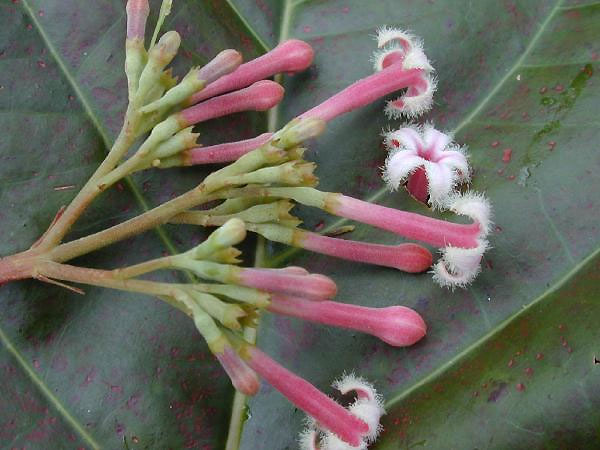
Cinchona plants belong to the family Rubiaceae and are large shrubs or small trees with evergreen foliage, growing 5 to 15 m (16 to 49 ft) in height. The leaves are opposite, rounded to lanceolate, and 10–40 cm long. The flowers are white, pink, or red, and produced in terminal panicles. The fruit is a small capsule containing numerous seeds. A key character of the genus is that the flowers have marginally hairy corolla lobes. Some species display heterostyly. The tribe Cinchoneae includes the genera Cinchonopsis, Jossia, Ladenbergia, Remijia, Stilpnophyllum, and Ciliosemina. In South America, natural populations of Cinchona species have geographically distinct distributions. During the 19th century, the introduction of several species into cultivation in the same areas of India and Java, by the English and Dutch East India Company, respectively, led to the formation of hybrids.
Linnaeus described the genus based on the species Cinchona officinalis, which is found only in a small region of Ecuador and is of little medicinal significance. Nearly 300 species were later described and named in the genus, but a revision of the genus in 1998 identified only 23 distinct species.
The febrifugal properties of bark from trees now known to be in the genus Cinchona were used by many South American cultures prior to European contact. Jesuits played a key role in the transfer of remedies from the New World.
The traditional story connecting Cinchona species with malaria treatment was first recorded by Italian physician Sebastiano Bado in 1663. It tells of the wife of Luis Jerónimo de Cabrera, 4th Count of Chinchón and Viceroy of Peru, who fell ill in Lima with a tertian fever. A Spanish governor advised a traditional remedy, which resulted in a miraculous and rapid cure. The countess then supposedly ordered a large quantity of the bark and took it back to Europe. Bado claimed to have received this information from an Italian named Antonius Bollus, who was a merchant in Peru. Clements Markham identified the countess as Ana de Osorio, but this was shown to be incorrect by Haggis. Ana de Osorio married the Count of Chinchón in August 1621 and died in 1625, several years before the count was appointed viceroy of Peru in 1628. His second wife, Francisca Henriques de Ribera, accompanied him to Peru. Haggis further examined the count's diaries and found no mention of the countess suffering from fever, although the count himself had many malarial attacks. Because of these and numerous other discrepancies, Bado's story has been generally rejected as little more than a legend.
Hub AI
Cinchona AI simulator
(@Cinchona_simulator)
Cinchona
Cinchona (pronounced /sɪŋˈkoʊnə/ or /sɪnˈtʃoʊnə/) is a genus of flowering plants in the family Rubiaceae containing at least 23 species of trees and shrubs. All are native to the tropical Andean forests of western South America. A few species are reportedly naturalized in Central America, Jamaica, French Polynesia, Sulawesi, Saint Helena in the South Atlantic, and São Tomé and Príncipe off the coast of tropical Africa, and others have been cultivated in India and Java, where they have formed hybrids.
Cinchona has been historically sought after for its medicinal value, as the bark of several species yields quinine and other alkaloids. These were the only effective treatments against malaria during the height of European colonialism, which made them of great economic and political importance. Trees in the genus are also known as fever trees because of their antimalarial properties.
The artificial synthesis of quinine in 1944, an increase in resistant forms of malaria, and the emergence of alternate therapies eventually ended large-scale economic interest in Cinchona cultivation. Cinchona alkaloids show promise in treating Plasmodium falciparum malaria, which has evolved resistance to synthetic drugs. Cinchona plants continue to be revered for their historical legacy; the national tree of Peru is in the genus Cinchona.
Carl Linnaeus named the genus in 1742, based on a claim that the plant had cured the wife of the Count of Chinchón, a Spanish viceroy in Lima, in the 1630s, though the veracity of this story has been disputed. Linnaeus used the Italian spelling Cinchona, but the name Chinchón (pronounced [tʃinˈtʃon] in Spanish) led to Clements Markham and others proposing a correction of the spelling to Chinchona, and some prefer the pronunciation /tʃɪnˈtʃoʊnə/ for the common name of the plant. Traditional medicine uses from South America known as Jesuit's bark and Jesuit's powder have been traced to Cinchona.[citation needed]
Cinchona plants belong to the family Rubiaceae and are large shrubs or small trees with evergreen foliage, growing 5 to 15 m (16 to 49 ft) in height. The leaves are opposite, rounded to lanceolate, and 10–40 cm long. The flowers are white, pink, or red, and produced in terminal panicles. The fruit is a small capsule containing numerous seeds. A key character of the genus is that the flowers have marginally hairy corolla lobes. Some species display heterostyly. The tribe Cinchoneae includes the genera Cinchonopsis, Jossia, Ladenbergia, Remijia, Stilpnophyllum, and Ciliosemina. In South America, natural populations of Cinchona species have geographically distinct distributions. During the 19th century, the introduction of several species into cultivation in the same areas of India and Java, by the English and Dutch East India Company, respectively, led to the formation of hybrids.
Linnaeus described the genus based on the species Cinchona officinalis, which is found only in a small region of Ecuador and is of little medicinal significance. Nearly 300 species were later described and named in the genus, but a revision of the genus in 1998 identified only 23 distinct species.
The febrifugal properties of bark from trees now known to be in the genus Cinchona were used by many South American cultures prior to European contact. Jesuits played a key role in the transfer of remedies from the New World.
The traditional story connecting Cinchona species with malaria treatment was first recorded by Italian physician Sebastiano Bado in 1663. It tells of the wife of Luis Jerónimo de Cabrera, 4th Count of Chinchón and Viceroy of Peru, who fell ill in Lima with a tertian fever. A Spanish governor advised a traditional remedy, which resulted in a miraculous and rapid cure. The countess then supposedly ordered a large quantity of the bark and took it back to Europe. Bado claimed to have received this information from an Italian named Antonius Bollus, who was a merchant in Peru. Clements Markham identified the countess as Ana de Osorio, but this was shown to be incorrect by Haggis. Ana de Osorio married the Count of Chinchón in August 1621 and died in 1625, several years before the count was appointed viceroy of Peru in 1628. His second wife, Francisca Henriques de Ribera, accompanied him to Peru. Haggis further examined the count's diaries and found no mention of the countess suffering from fever, although the count himself had many malarial attacks. Because of these and numerous other discrepancies, Bado's story has been generally rejected as little more than a legend.
Recent media