Hubbry Logo
logo
Circular sector
Community hub

Circular sector

logo
0 subscribers
Read side by side
from Wikipedia
The minor sector is shaded in green while the major sector is shaded white.

A circular sector, also known as circle sector or disk sector or simply a sector (symbol: ), is the portion of a disk (a closed region bounded by a circle) enclosed by two radii and an arc, with the smaller area being known as the minor sector and the larger being the major sector.[1] In the diagram, θ is the central angle, r the radius of the circle, and L is the arc length of the minor sector.

Types

[edit]

A sector with the central angle of 180° is called a half-disk and is bounded by a diameter and a semicircle. Sectors with other central angles are sometimes given special names, such as quadrants (90°), sextants (60°), and octants (45°), which come from the sector being one quarter, sixth or eighth part of a full circle, respectively.

Area

[edit]

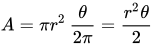
The total area of a circle is πr2. The area of the sector can be obtained by multiplying the circle's area by the ratio of the angle θ (expressed in radians) and 2π (because the area of the sector is directly proportional to its angle, and 2π is the angle for the whole circle, in radians):
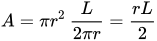
The area of a sector in terms of L can be obtained by multiplying the total area πr2 by the ratio of L to the total perimeter 2πr.
Another approach is to consider this area as the result of the following integral:

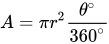
Converting the central angle into degrees gives[2]

Perimeter

[edit]

The length of the perimeter of a sector is the sum of the arc length and the two radii: where θ is in radians.

Arc length

[edit]

The formula for the length of an arc is:[3] where L represents the arc length, r represents the radius of the circle and θ represents the angle in radians made by the arc at the centre of the circle.[4]

If the value of angle is given in degrees, then we can also use the following formula by:[5]

Chord length

[edit]

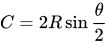
The length of a chord formed with the extremal points of the arc is given by where C represents the chord length, R represents the radius of the circle, and θ represents the angular width of the sector in radians.
See also

[edit]

References

[edit]

Sources

[edit]
Revisions and contributorsEdit on WikipediaRead on Wikipedia
from Grokipedia
A circular sector is a region of a disk bounded by two radii of the circle and the arc connecting their endpoints.[1] This geometric figure is defined by a central angle at the circle's center, distinguishing it from a circular segment, which is the area between a chord and the corresponding arc.[2] The arc length $ s $ of a circular sector with radius $ r $ and central angle $ \theta $ in radians is given by the formula $ s = r \theta $. The area $ A $ of the sector is $ A = \frac{1}{2} r^2 \theta $, representing the proportion of the full circle's area corresponding to the angle.[1] These formulas derive from the radian measure, where a full circle corresponds to $ 2\pi $ radians, allowing sectors to be scaled proportionally for angles less than or equal to $ 2\pi $.[3] Circular sectors appear in classical geometry, as described in Euclid's Elements, where they are formed by constructing an angle at the circle's center and enclosing the figure with the angle's sides and the arc.[4] They are fundamental in applications such as calculating areas in polar coordinates and analyzing rotational symmetry in mathematics and physics.[5]

Definition and History

Definition

A circular sector is the portion of a disk bounded by two radii and the arc connecting their endpoints on the circumference, where the central angle θ is formed at the center of the circle. This region encompasses the area swept by the arc as the angle varies from 0 to θ. Visually, a circular sector resembles a "pie slice" of the circle, incorporating both the straight-sided triangular section defined by the two radii and the center point, as well as the curved arc segment along the boundary.[6] In standard diagrams, it is illustrated with the circle's radius labeled as $ r $, the central angle $ \theta $ marked at the origin, and the enclosed area highlighted to show the wedge-shaped extent.[7] Distinct from a full disk, which spans the entire $ \theta = 2\pi $, or an annulus, defined as the ring-shaped area between two concentric circles, a circular sector constitutes a partial wedge satisfying $ 0 < \theta \leq 2\pi $.

Historical Development

The concept of the circular sector emerged in ancient Greek mathematics as part of broader studies on circle properties. Thales of Miletus, around 650 BCE, is credited with the first recorded theorems on circles, including the proof that a diameter bisects a circle into two equal arcs and that an angle inscribed in a semicircle is a right angle.[8] Euclid further systematized these notions in his Elements around 300 BCE, particularly in Book III, where he explored circle theorems such as the equality of angles subtended by the same arc and the doubling of the central angle compared to the inscribed angle, implicitly supporting the geometric properties of sectors as pie-shaped regions bounded by radii and arcs.[8] In the 3rd century BCE, Archimedes advanced the understanding through his work Measurement of a Circle, where he approximated the circle's area using inscribed and circumscribed regular polygons, dividing the circle into triangular sectors to bound the total area between sums of these triangles and demonstrate that the circle's area equals a right triangle with the radius as one leg and the circumference as the base.[9] During the Renaissance, the integration of circular sectors into trigonometry accelerated their development, with Regiomontanus (Johannes Müller, 1436–1476) contributing through his treatise On Triangles, which treated trigonometry independently and used circular divisions for precise angular measurements in astronomy, laying groundwork for sector-based calculations of arc lengths and areas.[10] By the 19th century, geometry texts formalized the term "circular sector" to denote the region enclosed by two radii and an arc, distinguishing it clearly from the segment (the area between the chord and arc).

Types and Terminology

Types Based on Central Angle

Circular sectors are classified primarily according to the measure of their central angle, denoted as θ, which subtends the arc bounding the sector. This angle can be expressed in degrees (°) or radians (rad), with the conversion given by θ_rad = θ_deg × (π / 180).[11] A minor sector is defined as the region of a circle enclosed by two radii and an arc where the central angle θ is less than 180° (or π radians), representing the smaller portion relative to the full circle.[12] In contrast, a major sector corresponds to the larger portion, where θ exceeds 180° (or π radians) but does not surpass 360° (or 2π radians).[12] When θ equals exactly 180° (or π radians), the sector forms a semicircle, which divides the circle into two equal halves.[13] Another notable special case occurs when θ measures 90° (or π/2 radians), resulting in a quadrant that occupies one-quarter of the circle's area.[13]

Key Terminology

In the context of a circular sector, the radius $ r $ is defined as the line segment connecting the center of the circle to one of the endpoints of the arc that bounds the sector.[7] This straight edge forms one of the two radial boundaries of the sector.[14] The central angle $ \theta $ refers to the angle formed at the circle's center by the two radii that enclose the sector, subtending the arc between them.[7] This angle, typically measured in radians or degrees, determines the sector's angular extent.[14] The value of $ \theta $ plays a role in classifying sectors according to their size relative to the full circle. The arc is the curved portion of the circle's circumference that lies between the endpoints of the two radii defining the sector.[7] It serves as the third boundary of the sector, distinguishing it from a triangular region.[14] The circular sector itself is commonly denoted by the symbol ⌔ in mathematical notation.[14] Related to the sector is the concept of a disk, which denotes the entire interior region bounded by the full circle, with the sector representing a portion thereof.[7] In contrast, an annulus describes a ring-shaped region between two concentric circles of different radii.

Geometric Properties

Arc Length

The arc length of a circular sector represents the portion of the circle's circumference subtended by the central angle. It is derived from the fact that the full circumference of a circle is 2πr2\pi r, where rr is the radius, corresponding to a full angle of 2π2\pi radians or 360 degrees. Thus, the arc length LL is the proportional fraction of this circumference based on the central angle θ\theta. When θ\theta is measured in radians, the formula simplifies to L=rθL = r \theta. This follows directly from the definition of radian measure, where θ=Lr\theta = \frac{L}{r}, rearranged to solve for the arc length.[15] For θ\theta in degrees, the formula is L=θ360×2πrL = \frac{\theta}{360} \times 2\pi r. This proportion equates the angle fraction θ360\frac{\theta}{360} to the arc fraction of the full circumference.[16] The units of LL are the same as those of the radius rr, such as meters or centimeters, ensuring consistency in measurement.[15] For example, with r=5r = 5 and θ=π3\theta = \frac{\pi}{3} radians, L=5×π35.236L = 5 \times \frac{\pi}{3} \approx 5.236.[15]

Chord Length

The chord length of a circular sector is the straight-line distance between the two endpoints of the arc, forming the base of the isosceles triangle created by the two radii and the arc.[17] This length $ c $ is given by the formula
c=2rsin(θ2), c = 2 r \sin\left(\frac{\theta}{2}\right),
where $ r $ is the radius of the circle and $ \theta $ is the central angle in radians.[17][18]
To derive this, consider the isosceles triangle formed by the two radii and the chord, with apex angle $ \theta $ at the center. Drawing a perpendicular from the center to the midpoint of the chord bisects the isosceles triangle into two congruent right triangles, each with hypotenuse $ r $ and one acute angle $ \theta/2 $. In one of these right triangles, the side opposite $ \theta/2 $ is half the chord length $ c/2 $, so
sin(θ2)=c/2r. \sin\left(\frac{\theta}{2}\right) = \frac{c/2}{r}.
Solving for $ c $ yields the formula above.[17]
When $ \theta $ is given in degrees, convert it to radians by multiplying by $ \pi/180 $ before applying the sine function, or use the degree mode on a calculator: $ c = 2 r \sin\left(\frac{\theta^\circ}{2}\right) $.[19] For example, with radius $ r = 5 $ and central angle $ \theta = \pi/3 $ radians (60°), $ \theta/2 = \pi/6 $, and $ \sin(\pi/6) = 0.5 $, so $ c = 2 \times 5 \times 0.5 = 5 $.[17] Geometrically, for $ 0 < \theta < 2\pi $, the chord length is always shorter than the corresponding arc length, as the straight line represents the shortest path between the endpoints.[17] The chord serves as the straight boundary of the related circular segment.[18]

Perimeter

The perimeter of a circular sector refers to the total length of its boundary, which consists of the curved arc and the two straight radii extending from the center to the endpoints of the arc.[7] This boundary excludes any chord connecting the arc's endpoints, as the chord is not part of the sector's outer edge.[20] The perimeter PP is calculated by adding the arc length to the lengths of the two radii. For a sector with radius rr and central angle θ\theta in radians, the arc length is rθr\theta, so the perimeter is given by
P=rθ+2r=r(θ+2). P = r\theta + 2r = r(\theta + 2).
When the central angle is expressed in degrees, the arc length is θ360×2πr\frac{\theta}{360} \times 2\pi r, yielding
P=θ360×2πr+2r. P = \frac{\theta}{360} \times 2\pi r + 2r.
[21] For example, consider a circular sector with radius r=5r = 5 units and central angle θ=π/3\theta = \pi/3 radians (approximately 60 degrees). The arc length is 5×(π/3)5.2365 \times (\pi/3) \approx 5.236 units, and the two radii contribute 2×5=102 \times 5 = 10 units, for a total perimeter of approximately 15.236 units.[21]

Area

The area of a circular sector, which is the region bounded by two radii and the included arc, can be calculated using formulas that depend on the measure of the central angle. For a sector with radius $ r $ and central angle $ \theta $ measured in radians, the area $ A $ is given by
A=12r2θ. A = \frac{1}{2} r^2 \theta.
[5] This formula arises from the proportionality of the sector's area to the central angle relative to the full circle. The total area of the circle is $ \pi r^2 $, corresponding to a central angle of $ 2\pi $ radians, so the sector area is $ \frac{\theta}{2\pi} \cdot \pi r^2 = \frac{1}{2} r^2 \theta $.[15] An alternative derivation uses polar integration, where the area is $ A = \frac{1}{2} \int_0^\theta r^2 , d\phi = \frac{1}{2} r^2 \theta $ for constant radius $ r $.[5] When the central angle $ \theta $ is measured in degrees, the area formula adjusts to account for the full circle's 360 degrees:
A=θ360πr2. A = \frac{\theta}{360} \pi r^2.
This is equivalent to the radian form, as $ \theta $ degrees equals $ \frac{\theta \pi}{180} $ radians. An alternative expression for the area is $ A = \frac{1}{2} r L $, where $ L $ is the length of the arc subtended by the central angle.[15] For example, consider a sector with radius $ r = 5 $ and central angle $ \theta = \frac{\pi}{3} $ radians (60 degrees). Substituting into the radian formula gives $ A = \frac{1}{2} \times 25 \times \frac{\pi}{3} = \frac{25\pi}{6} \approx 13.09 $ square units.[15] A major sector, corresponding to a central angle greater than $ \pi $ radians (or 180 degrees), has an area equal to the full disk area minus the area of the complementary minor sector.[5]

Circular Segment

A circular segment is the region of a disk bounded by a chord and the arc subtended by that chord, forming a central angle θ\theta. It is derived by subtracting the area of the isosceles triangle—formed by the two radii to the chord's endpoints and the chord itself—from the area of the corresponding circular sector.[18] The area AA of a circular segment is given by the formula
A=12r2(θsinθ), A = \frac{1}{2} r^2 (\theta - \sin \theta),
where rr is the radius of the circle and θ\theta is the central angle in radians.[18] This expression results directly from the difference between the sector area 12r2θ\frac{1}{2} r^2 \theta and the triangular area 12r2sinθ\frac{1}{2} r^2 \sin \theta. Unlike the full sector, the segment excludes this triangular portion, focusing solely on the curved cap. Segments are classified as minor when θ<π\theta < \pi (less than a semicircle) or major when θ>π\theta > \pi (more than a semicircle).[18] The height of the segment, termed the sagitta hh, measures the perpendicular distance from the chord's midpoint to the arc's midpoint and is calculated as
h=r(1cos(θ/2)). h = r (1 - \cos(\theta/2)).
This provides a key dimension for the segment's depth.[18] For a minor segment example, consider a circle of radius r=5r = 5 cm and central angle θ=π/3\theta = \pi/3 radians (60°). The sector area is 12×25×π/313.09\frac{1}{2} \times 25 \times \pi/3 \approx 13.09 cm², while the isosceles triangle area is 12×25×sin(π/3)10.83\frac{1}{2} \times 25 \times \sin(\pi/3) \approx 10.83 cm²; thus, the segment area is approximately 2.262.26 cm². The sagitta is h=5(1cos(π/6))0.67h = 5 (1 - \cos(\pi/6)) \approx 0.67 cm.[18]

Sectors in Calculus

In calculus, circular sectors play a fundamental role in polar coordinate integration, particularly for computing areas bounded by polar curves. The area AA of a sector with radius rr and central angle θ\theta (in radians) can be derived using a definite integral in polar coordinates, where the infinitesimal area element is 12r2dϕ\frac{1}{2} r^2 d\phi. Specifically, A=0θ12r2dϕ=12r2θA = \int_0^\theta \frac{1}{2} r^2 \, d\phi = \frac{1}{2} r^2 \theta.[22] This integral confirms the standard geometric formula for the sector area and extends naturally to regions bounded by non-constant polar functions r=f(ϕ)r = f(\phi), yielding A=12αβ[f(ϕ)]2dϕA = \frac{1}{2} \int_\alpha^\beta [f(\phi)]^2 \, d\phi.[22] The arc length of a circular sector's boundary arc is also expressed through calculus in parametric or polar form. For a circular arc of constant radius rr, the differential arc length element is ds=rdθds = r \, d\theta, so the total arc length LL from θ=α\theta = \alpha to θ=β\theta = \beta is L=αβrdθ=r(βα)L = \int_\alpha^\beta r \, d\theta = r (\beta - \alpha).[22] This simplifies from the general polar arc length formula L=αβr2+(drdθ)2dθL = \int_\alpha^\beta \sqrt{r^2 + \left( \frac{dr}{d\theta} \right)^2} \, d\theta, where drdθ=0\frac{dr}{d\theta} = 0 for a circle.[22] Double integrals over circular sectors leverage polar coordinates for regions with radial symmetry, such as 0rR0 \leq r \leq R and αθβ\alpha \leq \theta \leq \beta. The integral Df(r,θ)dA\iint_D f(r, \theta) \, dA transforms to αβ0Rf(r,θ)rdrdθ\int_\alpha^\beta \int_0^R f(r, \theta) r \, dr \, d\theta, where the Jacobian factor rr accounts for the area element in polar space.[23] This setup is essential for evaluating moments, mass distributions, or probabilities in annular sectors. Sectors facilitate approximations of irregular areas and volumes of revolution in calculus. For instance, polar sectors can tile complex regions to approximate integrals numerically, as in Monte Carlo methods or Riemann sums adapted to polar grids. In volumes of revolution, revolving a sector about an axis generates frustums or cones, with the volume computed via integrals like the disk method, where cross-sections are scaled sector areas. As an example, the sector area integral 0θ12r2dϕ\int_0^\theta \frac{1}{2} r^2 \, d\phi directly verifies 12r2θ\frac{1}{2} r^2 \theta, providing a foundational check for more advanced polar computations.[22]

Applications

Mathematical Applications

Circular sectors are integral to trigonometry, where the unit circle is divided into sectors to define and prove properties of trigonometric functions. Each sector corresponds to a central angle in radians or degrees, with the coordinates of points on the unit circle providing the sine and cosine values for that angle. This division facilitates proofs of trigonometric identities, such as the relationship between central angles and arc lengths, where the sector's arc length equals the angle measure in radians.[24] In polar coordinates, circular sectors provide a natural framework for graphing curves and computing areas enclosed by polar equations. The region bounded by a polar curve from θ = α to θ = β is approximated by summing the areas of thin sectors, each with radius r(θ) and infinitesimal angle dθ, leading to the integral formula for area. This approach simplifies the evaluation of regions with radial symmetry, such as petals of roses or cardioids, by leveraging the sector's geometric properties.[25] Archimedes utilized sectors formed by radii to regular polygons in his method of exhaustion, bounding π between the perimeters of inscribed and circumscribed polygons around a unit circle; for a 96-sided polygon, he established 3 + 10/71 < π < 3 + 1/7. These polygonal sectors, composed of isosceles triangles from the center, provided tight approximations by comparing their total areas and perimeters to the circle's.[26] In combinatorics and probability theory, dividing a circle into sectors models uniform random events, such as a dart landing on a dartboard where sectors represent scoring regions with probabilities proportional to their central angles or areas. For an equal-division dartboard into n sectors, the probability of hitting any specific sector is 1/n, enabling combinatorial analysis of outcomes like repeated throws or sector arrangements to optimize scoring fairness.[27][28] Circular sectors relate to infinite series through approximations where the circle's area emerges as the sum of infinitely many infinitesimal sector areas, akin to a geometric series in polar integration limits. As explored further in sectors in calculus, this summation underpins the derivation of the circle's area formula πr² as a limiting case.[25]

Engineering and Physics Applications

Sector gears, which utilize circular sector profiles for non-circular motion transmission, are modeled using three-dimensional parametric equations to adjust backlash and optimize meshing in mechanical systems. In radar engineering, sector scans—where the antenna sweeps a specific angular sector rather than a full circle—facilitate targeted surveillance, reducing power consumption and enabling pattern recognition for false target identification in air traffic control and defense applications. In physics, circular sector transformations serve as optical elements to multiply the orbital angular momentum of light beams, converting input states with integer topological charges into higher multiples through coordinate mapping in phase plates, which has implications for quantum information processing and high-capacity communications. In electromagnetics, circular sector microstrip antennas are designed to excite specific modes for radiation pattern control, with theoretical models predicting far-field characteristics based on sector angle and feed position, applicable in wireless communications and radar systems. Architectural applications involve calculating material quantities for curved elements like sector-shaped windows or roof sections, where the sector's arc and area inform structural loading and fabrication, as in conoid configurations that integrate circular sector bases for efficient load distribution in dome-like structures. In civil engineering, circular sectors approximate resource allocation in radial plots, such as irrigation sectors in circular fields, optimizing water distribution via angular divisions.
User Avatar
No comments yet.