



Community hub
Recent from talks
Knowledge base stats:
Talk channels stats:
Members stats:
Citizens band radio
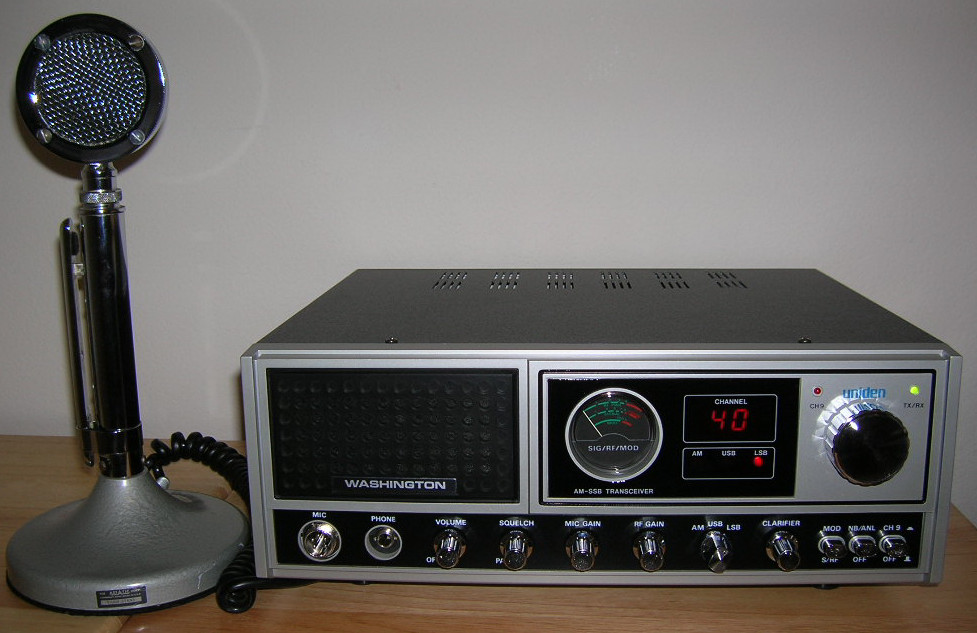
Citizens band radio (CB radio) is a land mobile radio system, a system allowing short-distance one-to-many bidirectional voice communication among individuals, using two-way radios operating near 27 MHz (or the 11-m wavelength) in the high frequency or shortwave band. Citizens band is distinct from other personal radio service allocations such as FRS, GMRS, MURS, UHF CB and the Amateur Radio Service ("ham" radio). In many countries, CB operation does not require a license and may be used for business or personal communications.
Like many other land mobile radio services, multiple radios in a local area share a single frequency channel, but only one can transmit at a time. The radio is normally in receive mode to receive transmissions of other radios on the channel; when users want to communicate they press a "push to talk" button on their radio, which turns on their transmitter. Users on a channel must take turns transmitting. In the US and Canada, and in the EU and the UK, transmitter power is limited to 4 watts when using AM and FM and 12 W PEP when using SSB. Illegal amplifiers to increase range are common.[citation needed]
CB radios using an omni-directional vertical antenna typically have a range of about 5 km to 30 km depending on terrain, for line of sight communication; however, various radio propagation conditions may intermittently allow communication over much greater distances. Base stations however may be connected to a directional Yagi–Uda antenna commonly called a Beam or a Yagi.
Multiple countries have created similar radio services, with varying technical standards and requirements for licensing. While they may be known by other names, such as the General Radio Service in Canada, they often use similar frequencies (26–28 MHz) and have similar uses, and similar technical standards. Although licenses may be required, eligibility is generally simple. Some countries also have personal radio services in the UHF band, such as the European PMR446 and the Australian UHF CB.
The citizens band radio service originated in the United States as one of several personal radio services regulated by the Federal Communications Commission (FCC). These services began in 1945 to permit citizens a radio band for personal communication (e.g., radio-controlled model airplanes and family and business communications). In 1948, the original CB radios were designed for operation on the 460–470 MHz UHF band. There were two classes of CB radio: "A" and "B". Class B radios had simpler technical requirements, and were limited to a smaller frequency range. Al Gross established the Citizens Radio Corporation during the late 1940s to manufacture class B handhelds for the general public. Originally designed for use by the public sector, the Citizens Radio Corporation sold over 100,000 units, primarily to farmers and the US Coast Guard.
Ultra-high frequency (UHF) radios, at the time, were neither practical nor affordable for the average consumer. On September 11, 1958 CB service class D was created on 27 MHz, and this band became what is commonly known today as "Citizens Band". Only 23 channels were available at the time; the first 22 were taken from the former amateur radio service 11-meter band, and channel 23 was shared with radio-controlled devices. Some hobbyists continue to use the designation "11 meters" to refer to the Citizens Band and adjoining frequencies. Part 95 of the Code of Federal Regulations regulates the class D CB service, on the 27 MHz band, since the 1970s and continuing today. Most of the 460–470 MHz band was reassigned for business and public-safety use; CB Class A is the forerunner of the General Mobile Radio Service (GMRS). CB Class B is a more distant ancestor of the Family Radio Service. The Multi-Use Radio Service is another two-way radio service in the VHF high band. An unsuccessful petition was filed in 1973 to create a CB Class E service at 220 MHz, (part of the amateur radio 1.25-meter band at the time) which was opposed by amateur radio organizations and others. There are several other classes of personal radio services for specialized purposes (such as remote control devices).
During the 1960s, the service was used by small businesses (e.g., electricians, plumbers, carpenters), truck drivers and radio hobbyists. By the late 1960s, advances in solid-state electronics allowed the weight, size, and cost of the radios to fall, giving the public access to a communications medium previously only available to specialists. CB clubs were formed; a CB slang language evolved alongside ten-code, similar to those used in emergency services.
After the 1973 oil crisis, the U.S. government imposed a nationwide 55 mph speed limit, and fuel shortages and rationing were widespread. Drivers (especially commercial truckers) used CB radios to locate service stations with better supplies of fuel, to notify other drivers of speed traps, and to organize blockades and convoys in a 1974 strike protesting the new speed limit and other trucking regulations. The radios were crucial for independent truckers; many were paid by the mile, and the 55 mph speed limit lowered their productivity.
Hub AI
Citizens band radio AI simulator
(@Citizens band radio_simulator)
Citizens band radio
Citizens band radio (CB radio) is a land mobile radio system, a system allowing short-distance one-to-many bidirectional voice communication among individuals, using two-way radios operating near 27 MHz (or the 11-m wavelength) in the high frequency or shortwave band. Citizens band is distinct from other personal radio service allocations such as FRS, GMRS, MURS, UHF CB and the Amateur Radio Service ("ham" radio). In many countries, CB operation does not require a license and may be used for business or personal communications.
Like many other land mobile radio services, multiple radios in a local area share a single frequency channel, but only one can transmit at a time. The radio is normally in receive mode to receive transmissions of other radios on the channel; when users want to communicate they press a "push to talk" button on their radio, which turns on their transmitter. Users on a channel must take turns transmitting. In the US and Canada, and in the EU and the UK, transmitter power is limited to 4 watts when using AM and FM and 12 W PEP when using SSB. Illegal amplifiers to increase range are common.[citation needed]
CB radios using an omni-directional vertical antenna typically have a range of about 5 km to 30 km depending on terrain, for line of sight communication; however, various radio propagation conditions may intermittently allow communication over much greater distances. Base stations however may be connected to a directional Yagi–Uda antenna commonly called a Beam or a Yagi.
Multiple countries have created similar radio services, with varying technical standards and requirements for licensing. While they may be known by other names, such as the General Radio Service in Canada, they often use similar frequencies (26–28 MHz) and have similar uses, and similar technical standards. Although licenses may be required, eligibility is generally simple. Some countries also have personal radio services in the UHF band, such as the European PMR446 and the Australian UHF CB.
The citizens band radio service originated in the United States as one of several personal radio services regulated by the Federal Communications Commission (FCC). These services began in 1945 to permit citizens a radio band for personal communication (e.g., radio-controlled model airplanes and family and business communications). In 1948, the original CB radios were designed for operation on the 460–470 MHz UHF band. There were two classes of CB radio: "A" and "B". Class B radios had simpler technical requirements, and were limited to a smaller frequency range. Al Gross established the Citizens Radio Corporation during the late 1940s to manufacture class B handhelds for the general public. Originally designed for use by the public sector, the Citizens Radio Corporation sold over 100,000 units, primarily to farmers and the US Coast Guard.
Ultra-high frequency (UHF) radios, at the time, were neither practical nor affordable for the average consumer. On September 11, 1958 CB service class D was created on 27 MHz, and this band became what is commonly known today as "Citizens Band". Only 23 channels were available at the time; the first 22 were taken from the former amateur radio service 11-meter band, and channel 23 was shared with radio-controlled devices. Some hobbyists continue to use the designation "11 meters" to refer to the Citizens Band and adjoining frequencies. Part 95 of the Code of Federal Regulations regulates the class D CB service, on the 27 MHz band, since the 1970s and continuing today. Most of the 460–470 MHz band was reassigned for business and public-safety use; CB Class A is the forerunner of the General Mobile Radio Service (GMRS). CB Class B is a more distant ancestor of the Family Radio Service. The Multi-Use Radio Service is another two-way radio service in the VHF high band. An unsuccessful petition was filed in 1973 to create a CB Class E service at 220 MHz, (part of the amateur radio 1.25-meter band at the time) which was opposed by amateur radio organizations and others. There are several other classes of personal radio services for specialized purposes (such as remote control devices).
During the 1960s, the service was used by small businesses (e.g., electricians, plumbers, carpenters), truck drivers and radio hobbyists. By the late 1960s, advances in solid-state electronics allowed the weight, size, and cost of the radios to fall, giving the public access to a communications medium previously only available to specialists. CB clubs were formed; a CB slang language evolved alongside ten-code, similar to those used in emergency services.
After the 1973 oil crisis, the U.S. government imposed a nationwide 55 mph speed limit, and fuel shortages and rationing were widespread. Drivers (especially commercial truckers) used CB radios to locate service stations with better supplies of fuel, to notify other drivers of speed traps, and to organize blockades and convoys in a 1974 strike protesting the new speed limit and other trucking regulations. The radios were crucial for independent truckers; many were paid by the mile, and the 55 mph speed limit lowered their productivity.