


Community hub
Recent from talks
Knowledge base stats:
Talk channels stats:
Members stats:
Classical field theory
A classical field theory is a physical theory that predicts how one or more fields in physics interact with matter through field equations, without considering effects of quantization; theories that incorporate quantum mechanics are called quantum field theories. In most contexts, 'classical field theory' is specifically intended to describe electromagnetism and gravitation, two of the fundamental forces of nature.
A physical field can be thought of as the assignment of a physical quantity at each point of space and time. For example, in a weather forecast, the wind velocity during a day over a country is described by assigning a vector to each point in space. Each vector represents the direction of the movement of air at that point, so the set of all wind vectors in an area at a given point in time constitutes a vector field. As the day progresses, the directions in which the vectors point change as the directions of the wind change.
The first field theories, Newtonian gravitation and Maxwell's equations of electromagnetic fields were developed in classical physics before the advent of relativity theory in 1905, and had to be revised to be consistent with that theory. Consequently, classical field theories are usually categorized as non-relativistic and relativistic. Modern field theories are usually expressed using the mathematics of tensor calculus. A more recent alternative mathematical formalism describes classical fields as sections of mathematical objects called fiber bundles.
Michael Faraday coined the term "field" and lines of forces to explain electric and magnetic phenomena. Lord Kelvin in 1851 formalized the concept of field in different areas of physics.
Some of the simplest physical fields are vector force fields. Historically, the first time that fields were taken seriously was with Faraday's lines of force when describing the electric field. The gravitational field was then similarly described.
The first field theory of gravity was Newton's theory of gravitation in which the mutual interaction between two masses obeys an inverse square law. This was very useful for predicting the motion of planets around the Sun.
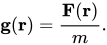
Any massive body M has a gravitational field g which describes its influence on other massive bodies. The gravitational field of M at a point r in space is found by determining the force F that M exerts on a small test mass m located at r, and then dividing by m: Stipulating that m is much smaller than M ensures that the presence of m has a negligible influence on the behavior of M.
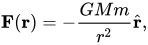
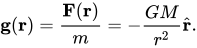
According to Newton's law of universal gravitation, F(r) is given by where is a unit vector pointing along the line from M to m, and G is Newton's gravitational constant. Therefore, the gravitational field of M is

Hub AI
Classical field theory AI simulator
(@Classical field theory_simulator)
Classical field theory
A classical field theory is a physical theory that predicts how one or more fields in physics interact with matter through field equations, without considering effects of quantization; theories that incorporate quantum mechanics are called quantum field theories. In most contexts, 'classical field theory' is specifically intended to describe electromagnetism and gravitation, two of the fundamental forces of nature.
A physical field can be thought of as the assignment of a physical quantity at each point of space and time. For example, in a weather forecast, the wind velocity during a day over a country is described by assigning a vector to each point in space. Each vector represents the direction of the movement of air at that point, so the set of all wind vectors in an area at a given point in time constitutes a vector field. As the day progresses, the directions in which the vectors point change as the directions of the wind change.
The first field theories, Newtonian gravitation and Maxwell's equations of electromagnetic fields were developed in classical physics before the advent of relativity theory in 1905, and had to be revised to be consistent with that theory. Consequently, classical field theories are usually categorized as non-relativistic and relativistic. Modern field theories are usually expressed using the mathematics of tensor calculus. A more recent alternative mathematical formalism describes classical fields as sections of mathematical objects called fiber bundles.
Michael Faraday coined the term "field" and lines of forces to explain electric and magnetic phenomena. Lord Kelvin in 1851 formalized the concept of field in different areas of physics.
Some of the simplest physical fields are vector force fields. Historically, the first time that fields were taken seriously was with Faraday's lines of force when describing the electric field. The gravitational field was then similarly described.
The first field theory of gravity was Newton's theory of gravitation in which the mutual interaction between two masses obeys an inverse square law. This was very useful for predicting the motion of planets around the Sun.
Any massive body M has a gravitational field g which describes its influence on other massive bodies. The gravitational field of M at a point r in space is found by determining the force F that M exerts on a small test mass m located at r, and then dividing by m: Stipulating that m is much smaller than M ensures that the presence of m has a negligible influence on the behavior of M.
According to Newton's law of universal gravitation, F(r) is given by where is a unit vector pointing along the line from M to m, and G is Newton's gravitational constant. Therefore, the gravitational field of M is