



Community hub
Recent from talks
Contribute something
Nothing was collected or created yet.
Ricci calculus
View on WikipediaIn mathematics, Ricci calculus constitutes the rules of index notation and manipulation for tensors and tensor fields on a differentiable manifold, with or without a metric tensor or connection.[a][1][2][3] It is also the modern name for what used to be called the absolute differential calculus (the foundation of tensor calculus), tensor calculus or tensor analysis developed by Gregorio Ricci-Curbastro in 1887–1896, and subsequently popularized in a paper written with his pupil Tullio Levi-Civita in 1900.[4] Jan Arnoldus Schouten developed the modern notation and formalism for this mathematical framework, and made contributions to the theory, during its applications to general relativity and differential geometry in the early twentieth century.[5] The basis of modern tensor analysis was developed by Bernhard Riemann in a paper from 1861.[6]
A component of a tensor is a real number that is used as a coefficient of a basis element for the tensor space. The tensor is the sum of its components multiplied by their corresponding basis elements. Tensors and tensor fields can be expressed in terms of their components, and operations on tensors and tensor fields can be expressed in terms of operations on their components. The description of tensor fields and operations on them in terms of their components is the focus of the Ricci calculus. This notation allows an efficient expression of such tensor fields and operations. While much of the notation may be applied with any tensors, operations relating to a differential structure are only applicable to tensor fields. Where needed, the notation extends to components of non-tensors, particularly multidimensional arrays.
A tensor may be expressed as a linear sum of the tensor product of vector and covector basis elements. The resulting tensor components are labelled by indices of the basis. Each index has one possible value per dimension of the underlying vector space. The number of indices equals the degree (or order) of the tensor.
For compactness and convenience, the Ricci calculus incorporates Einstein notation, which implies summation over indices repeated within a term and universal quantification over free indices. Expressions in the notation of the Ricci calculus may generally be interpreted as a set of simultaneous equations relating the components as functions over a manifold, usually more specifically as functions of the coordinates on the manifold. This allows intuitive manipulation of expressions with familiarity of only a limited set of rules.
Applications
[edit]Tensor calculus has many applications in physics, engineering and computer science including elasticity, continuum mechanics, electromagnetism (see mathematical descriptions of the electromagnetic field), general relativity (see mathematics of general relativity), quantum field theory, and machine learning.
Working with a main proponent of the exterior calculus Élie Cartan, the influential geometer Shiing-Shen Chern summarizes the role of tensor calculus:[7]
In our subject of differential geometry, where you talk about manifolds, one difficulty is that the geometry is described by coordinates, but the coordinates do not have meaning. They are allowed to undergo transformation. And in order to handle this kind of situation, an important tool is the so-called tensor analysis, or Ricci calculus, which was new to mathematicians. In mathematics you have a function, you write down the function, you calculate, or you add, or you multiply, or you can differentiate. You have something very concrete. In geometry the geometric situation is described by numbers, but you can change your numbers arbitrarily. So to handle this, you need the Ricci calculus.
Notation for indices
[edit]Basis-related distinctions
[edit]Space and time coordinates
[edit]Where a distinction is to be made between the space-like basis elements and a time-like element in the four-dimensional spacetime of classical physics, this is conventionally done through indices as follows:[8]
- The lowercase Latin alphabet a, b, c, ... is used to indicate restriction to 3-dimensional Euclidean space, which take values 1, 2, 3 for the spatial components; and the time-like element, indicated by 0, is shown separately.
- The lowercase Greek alphabet α, β, γ, ... is used for 4-dimensional spacetime, which typically take values 0 for time components and 1, 2, 3 for the spatial components.
Some sources use 4 instead of 0 as the index value corresponding to time; in this article, 0 is used. Otherwise, in general mathematical contexts, any symbols can be used for the indices, generally running over all dimensions of the vector space.
Coordinate and index notation
[edit]The author(s) will usually make it clear whether a subscript is intended as an index or as a label.
For example, in 3-D Euclidean space and using Cartesian coordinates; the coordinate vector A = (A1, A2, A3) = (Ax, Ay, Az) shows a direct correspondence between the subscripts 1, 2, 3 and the labels x, y, z. In the expression Ai, i is interpreted as an index ranging over the values 1, 2, 3, while the x, y, z subscripts are only labels, not variables. In the context of spacetime, the index value 0 conventionally corresponds to the label t.
Reference to basis
[edit]Indices themselves may be labelled using diacritic-like symbols, such as a hat (ˆ), bar (¯), tilde (˜), or prime (′) as in:
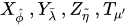
to denote a possibly different basis for that index. An example is in Lorentz transformations from one frame of reference to another, where one frame could be unprimed and the other primed, as in:
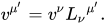
This is not to be confused with van der Waerden notation for spinors, which uses hats and overdots on indices to reflect the chirality of a spinor.
Upper and lower indices
[edit]Ricci calculus, and index notation more generally, distinguishes between lower indices (subscripts) and upper indices (superscripts); the latter are not exponents, even though they may look as such to the reader only familiar with other parts of mathematics.
In the special case that the metric tensor is everywhere equal to the identity matrix, it is possible to drop the distinction between upper and lower indices, and then all indices could be written in the lower position. Coordinate formulae in linear algebra such as for the product of matrices may be examples of this. But in general, the distinction between upper and lower indices should be maintained.

A lower index (subscript) indicates covariance of the components with respect to that index:

An upper index (superscript) indicates contravariance of the components with respect to that index:

A tensor may have both upper and lower indices:

Ordering of indices is significant, even when of differing variance. However, when it is understood that no indices will be raised or lowered while retaining the base symbol, covariant indices are sometimes placed below contravariant indices for notational convenience (e.g. with the generalized Kronecker delta).
Tensor type and degree
[edit]The number of each upper and lower indices of a tensor gives its type: a tensor with p upper and q lower indices is said to be of type (p, q), or to be a type-(p, q) tensor.
The number of indices of a tensor, regardless of variance, is called the degree of the tensor (alternatively, its valence, order or rank, although rank is ambiguous). Thus, a tensor of type (p, q) has degree p + q.
The same symbol occurring twice (one upper and one lower) within a term indicates a pair of indices that are summed over:

The operation implied by such a summation is called tensor contraction:

This summation may occur more than once within a term with a distinct symbol per pair of indices, for example:

Other combinations of repeated indices within a term are considered to be ill-formed, such as
(both occurrences of are lower; would be fine) ( occurs twice as a lower index; or would be fine).


The reason for excluding such formulae is that although these quantities could be computed as arrays of numbers, they would not in general transform as tensors under a change of basis.
If a tensor has a list of all upper or lower indices, one shorthand is to use a capital letter for the list:[9]

where I = i1 i2 ⋅⋅⋅ in and J = j1 j2 ⋅⋅⋅ jm.
Sequential summation
[edit]A pair of vertical bars | ⋅ | around a set of all-upper indices or all-lower indices (but not both), associated with contraction with another set of indices when the expression is completely antisymmetric in each of the two sets of indices:[10]

means a restricted sum over index values, where each index is constrained to being strictly less than the next. More than one group can be summed in this way, for example:
![{\displaystyle {\begin{aligned}&A_{|\alpha \beta \gamma |}{}^{|\delta \epsilon \cdots \lambda |}B^{\alpha \beta \gamma }{}_{\delta \epsilon \cdots \lambda |\mu \nu \cdots \zeta |}C^{\mu \nu \cdots \zeta }\\[3pt]={}&\sum _{\alpha <\beta <\gamma }~\sum _{\delta <\epsilon <\cdots <\lambda }~\sum _{\mu <\nu <\cdots <\zeta }A_{\alpha \beta \gamma }{}^{\delta \epsilon \cdots \lambda }B^{\alpha \beta \gamma }{}_{\delta \epsilon \cdots \lambda \mu \nu \cdots \zeta }C^{\mu \nu \cdots \zeta }\end{aligned}}}](https://wikimedia.org/api/rest_v1/media/math/render/svg/8147a102c1e44f90d4fc7d00507d039ec893e687)
When using multi-index notation, an underarrow is placed underneath the block of indices:[11]

where

By contracting an index with a non-singular metric tensor, the type of a tensor can be changed, converting a lower index to an upper index or vice versa:

The base symbol in many cases is retained (e.g. using A where B appears here), and when there is no ambiguity, repositioning an index may be taken to imply this operation.
Correlations between index positions and invariance
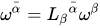
[edit]This table summarizes how the manipulation of covariant and contravariant indices fit in with invariance under a passive transformation between bases, with the components of each basis set in terms of the other reflected in the first column. The barred indices refer to the final coordinate system after the transformation.[12]
The Kronecker delta is used, see also below.
Basis transformation Component transformation Invariance Covector, covariant vector, 1-form Vector, contravariant vector





General outlines for index notation and operations
[edit]Tensors are equal if and only if every corresponding component is equal; e.g., tensor A equals tensor B if and only if
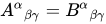
for all α, β, γ. Consequently, there are facets of the notation that are useful in checking that an equation makes sense (an analogous procedure to dimensional analysis).
Indices not involved in contractions are called free indices. Indices used in contractions are termed dummy indices, or summation indices.
A tensor equation represents many ordinary (real-valued) equations
[edit]The components of tensors (like Aα, Bβγ etc.) are just real numbers. Since the indices take various integer values to select specific components of the tensors, a single tensor equation represents many ordinary equations. If a tensor equality has n free indices, and if the dimensionality of the underlying vector space is m, the equality represents mn equations: each index takes on every value of a specific set of values.
For instance, if

is in four dimensions (that is, each index runs from 0 to 3 or from 1 to 4), then because there are three free indices (α, β, δ), there are 43 = 64 equations. Three of these are:

This illustrates the compactness and efficiency of using index notation: many equations which all share a similar structure can be collected into one simple tensor equation.
Indices are replaceable labels
[edit]Replacing any index symbol throughout by another leaves the tensor equation unchanged (provided there is no conflict with other symbols already used). This can be useful when manipulating indices, such as using index notation to verify vector calculus identities or identities of the Kronecker delta and Levi-Civita symbol (see also below). An example of a correct change is:

whereas an erroneous change is:

In the first replacement, λ replaced α and μ replaced γ everywhere, so the expression still has the same meaning. In the second, λ did not fully replace α, and μ did not fully replace γ (incidentally, the contraction on the γ index became a tensor product), which is entirely inconsistent for reasons shown next.
Indices are the same in every term
[edit]The free indices in a tensor expression always appear in the same (upper or lower) position throughout every term, and in a tensor equation the free indices are the same on each side. Dummy indices (which implies a summation over that index) need not be the same, for example:

as for an erroneous expression:

In other words, non-repeated indices must be of the same type in every term of the equation. In the above identity, α, β, δ line up throughout and γ occurs twice in one term due to a contraction (once as an upper index and once as a lower index), and thus it is a valid expression. In the invalid expression, while β lines up, α and δ do not, and γ appears twice in one term (contraction) and once in another term, which is inconsistent.
Brackets and punctuation used once where implied
[edit]When applying a rule to a number of indices (differentiation, symmetrization etc., shown next), the bracket or punctuation symbols denoting the rules are only shown on one group of the indices to which they apply.
If the brackets enclose covariant indices – the rule applies only to all covariant indices enclosed in the brackets, not to any contravariant indices which happen to be placed intermediately between the brackets.
Similarly if brackets enclose contravariant indices – the rule applies only to all enclosed contravariant indices, not to intermediately placed covariant indices.
Symmetric and antisymmetric parts
[edit]Parentheses, ( ), around multiple indices denotes the symmetrized part of the tensor. When symmetrizing p indices using σ to range over permutations of the numbers 1 to p, one takes a sum over the permutations of those indices ασ(i) for i = 1, 2, 3, ..., p, and then divides by the number of permutations:

For example, two symmetrizing indices mean there are two indices to permute and sum over:

while for three symmetrizing indices, there are three indices to sum over and permute:

The symmetrization is distributive over addition;

Indices are not part of the symmetrization when they are:
- not on the same level, for example;
- within the parentheses and between vertical bars (i.e. |⋅⋅⋅|), modifying the previous example;


Here the α and γ indices are symmetrized, β is not.
Antisymmetric or alternating part of tensor
[edit]Square brackets, [ ], around multiple indices denotes the antisymmetrized part of the tensor. For p antisymmetrizing indices – the sum over the permutations of those indices ασ(i) multiplied by the signature of the permutation sgn(σ) is taken, then divided by the number of permutations:
![{\displaystyle {\begin{aligned}&A_{[\alpha _{1}\cdots \alpha _{p}]\alpha _{p+1}\cdots \alpha _{q}}\\[3pt]={}&{\dfrac {1}{p!}}\sum _{\sigma }\operatorname {sgn} (\sigma )A_{\alpha _{\sigma (1)}\cdots \alpha _{\sigma (p)}\alpha _{p+1}\cdots \alpha _{q}}\\={}&\delta _{\alpha _{1}\cdots \alpha _{p}}^{\beta _{1}\dots \beta _{p}}A_{\beta _{1}\cdots \beta _{p}\alpha _{p+1}\cdots \alpha _{q}}\\\end{aligned}}}](https://wikimedia.org/api/rest_v1/media/math/render/svg/2d1ed3a3d65899f83cceb9f6cc97981f79e26ee8)
where δβ1⋅⋅⋅βp
α1⋅⋅⋅αp is the generalized Kronecker delta of degree 2p, with scaling as defined below.
For example, two antisymmetrizing indices imply:
![{\displaystyle A_{[\alpha \beta ]\gamma \cdots }={\dfrac {1}{2!}}\left(A_{\alpha \beta \gamma \cdots }-A_{\beta \alpha \gamma \cdots }\right)}](https://wikimedia.org/api/rest_v1/media/math/render/svg/fef2be00b1aa41e860f5f8702aca3b7d5367c2ac)
while three antisymmetrizing indices imply:
![{\displaystyle A_{[\alpha \beta \gamma ]\delta \cdots }={\dfrac {1}{3!}}\left(A_{\alpha \beta \gamma \delta \cdots }+A_{\gamma \alpha \beta \delta \cdots }+A_{\beta \gamma \alpha \delta \cdots }-A_{\alpha \gamma \beta \delta \cdots }-A_{\gamma \beta \alpha \delta \cdots }-A_{\beta \alpha \gamma \delta \cdots }\right)}](https://wikimedia.org/api/rest_v1/media/math/render/svg/bed48763fa258288b5223bfca013c8077b73c1cc)
as for a more specific example, if F represents the electromagnetic tensor, then the equation
![{\displaystyle 0=F_{[\alpha \beta ,\gamma ]}={\dfrac {1}{3!}}\left(F_{\alpha \beta ,\gamma }+F_{\gamma \alpha ,\beta }+F_{\beta \gamma ,\alpha }-F_{\beta \alpha ,\gamma }-F_{\alpha \gamma ,\beta }-F_{\gamma \beta ,\alpha }\right)\,}](https://wikimedia.org/api/rest_v1/media/math/render/svg/7b0ed84d31ca18fe3439603344b790da0d240dd4)
represents Gauss's law for magnetism and Faraday's law of induction.
As before, the antisymmetrization is distributive over addition;
![{\displaystyle A_{[\alpha }\left(B_{\beta ]\gamma \cdots }+C_{\beta ]\gamma \cdots }\right)=A_{[\alpha }B_{\beta ]\gamma \cdots }+A_{[\alpha }C_{\beta ]\gamma \cdots }}](https://wikimedia.org/api/rest_v1/media/math/render/svg/36bebf226cf448c16e018ba4c4be7d3c23e8c1d0)
As with symmetrization, indices are not antisymmetrized when they are:
- not on the same level, for example;
- within the square brackets and between vertical bars (i.e. |⋅⋅⋅|), modifying the previous example;
![{\displaystyle A_{[\alpha }B^{\beta }{}_{\gamma ]}={\dfrac {1}{2!}}\left(A_{\alpha }B^{\beta }{}_{\gamma }-A_{\gamma }B^{\beta }{}_{\alpha }\right)}](https://wikimedia.org/api/rest_v1/media/math/render/svg/b4836ea3af90f4cfd3a577ba3aee7758824dc096)
![{\displaystyle A_{[\alpha }B_{|\beta |}{}_{\gamma ]}={\dfrac {1}{2!}}\left(A_{\alpha }B_{\beta \gamma }-A_{\gamma }B_{\beta \alpha }\right)}](https://wikimedia.org/api/rest_v1/media/math/render/svg/ca6e27819f5c787c31c829d21cefff2a45f1e3ee)
Here the α and γ indices are antisymmetrized, β is not.
Sum of symmetric and antisymmetric parts
[edit]Any tensor can be written as the sum of its symmetric and antisymmetric parts on two indices:
![{\displaystyle A_{\alpha \beta \gamma \cdots }=A_{(\alpha \beta )\gamma \cdots }+A_{[\alpha \beta ]\gamma \cdots }}](https://wikimedia.org/api/rest_v1/media/math/render/svg/9c77f98f8ba96ab296be8245ee3b8655edb17f9e)
as can be seen by adding the above expressions for A(αβ)γ⋅⋅⋅ and A[αβ]γ⋅⋅⋅. This does not hold for other than two indices.
Differentiation
[edit]For compactness, derivatives may be indicated by adding indices after a comma or semicolon.[13][14]
While most of the expressions of the Ricci calculus are valid for arbitrary bases, the expressions involving partial derivatives of tensor components with respect to coordinates apply only with a coordinate basis: a basis that is defined through differentiation with respect to the coordinates. Coordinates are typically denoted by xμ, but do not in general form the components of a vector. In flat spacetime with linear coordinatization, a tuple of differences in coordinates, Δxμ, can be treated as a contravariant vector. With the same constraints on the space and on the choice of coordinate system, the partial derivatives with respect to the coordinates yield a result that is effectively covariant. Aside from use in this special case, the partial derivatives of components of tensors do not in general transform covariantly, but are useful in building expressions that are covariant, albeit still with a coordinate basis if the partial derivatives are explicitly used, as with the covariant, exterior and Lie derivatives below.
To indicate partial differentiation of the components of a tensor field with respect to a coordinate variable xγ, a comma is placed before an appended lower index of the coordinate variable.
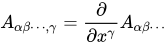
This may be repeated (without adding further commas):

These components do not transform covariantly, unless the expression being differentiated is a scalar. This derivative is characterized by the product rule and the derivatives of the coordinates

where δ is the Kronecker delta.
The covariant derivative is only defined if a connection is defined. For any tensor field, a semicolon ( ; ) placed before an appended lower (covariant) index indicates covariant differentiation. Less common alternatives to the semicolon include a forward slash ( / )[15] or in three-dimensional curved space a single vertical bar ( | ).[16]
The covariant derivative of a scalar function, a contravariant vector and a covariant vector are:



where Γαγβ are the connection coefficients.
For an arbitrary tensor:[17]

An alternative notation for the covariant derivative of any tensor is the subscripted nabla symbol ∇β. For the case of a vector field Aα:[18]

The covariant formulation of the directional derivative of any tensor field along a vector vγ may be expressed as its contraction with the covariant derivative, e.g.:

The components of this derivative of a tensor field transform covariantly, and hence form another tensor field, despite subexpressions (the partial derivative and the connection coefficients) separately not transforming covariantly.
This derivative is characterized by the product rule:

Connection types
[edit]A Koszul connection on the tangent bundle of a differentiable manifold is called an affine connection.
A connection is a metric connection when the covariant derivative of the metric tensor vanishes:

An affine connection that is also a metric connection is called a Riemannian connection. A Riemannian connection that is torsion-free (i.e., for which the torsion tensor vanishes: Tαβγ = 0) is a Levi-Civita connection.
The Γαβγ for a Levi-Civita connection in a coordinate basis are called Christoffel symbols of the second kind.
The exterior derivative of a totally antisymmetric type (0, s) tensor field with components Aα1⋅⋅⋅αs (also called a differential form) is a derivative that is covariant under basis transformations. It does not depend on either a metric tensor or a connection: it requires only the structure of a differentiable manifold. In a coordinate basis, it may be expressed as the antisymmetrization of the partial derivatives of the tensor components:[3]: 232–233
![{\displaystyle (\mathrm {d} A)_{\gamma \alpha _{1}\cdots \alpha _{s}}={\frac {\partial }{\partial x^{[\gamma }}}A_{\alpha _{1}\cdots \alpha _{s}]}=A_{[\alpha _{1}\cdots \alpha _{s},\gamma ]}.}](https://wikimedia.org/api/rest_v1/media/math/render/svg/71004231b37834cf42c9a1f6327be680986e7502)
This derivative is not defined on any tensor field with contravariant indices or that is not totally antisymmetric. It is characterized by a graded product rule.
The Lie derivative is another derivative that is covariant under basis transformations. Like the exterior derivative, it does not depend on either a metric tensor or a connection. The Lie derivative of a type (r, s) tensor field T along (the flow of) a contravariant vector field Xρ may be expressed using a coordinate basis as[19]

This derivative is characterized by the product rule and the fact that the Lie derivative of a contravariant vector field along itself is zero:

Notable tensors
[edit]The Kronecker delta is like the identity matrix when multiplied and contracted:
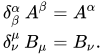
The components δα
β are the same in any basis and form an invariant tensor of type (1, 1), i.e. the identity of the tangent bundle over the identity mapping of the base manifold, and so its trace is an invariant.[20]
Its trace is the dimensionality of the space; for example, in four-dimensional spacetime,

The Kronecker delta is one of the family of generalized Kronecker deltas. The generalized Kronecker delta of degree 2p may be defined in terms of the Kronecker delta by (a common definition includes an additional multiplier of p! on the right):
![{\displaystyle \delta _{\beta _{1}\cdots \beta _{p}}^{\alpha _{1}\cdots \alpha _{p}}=\delta _{\beta _{1}}^{[\alpha _{1}}\cdots \delta _{\beta _{p}}^{\alpha _{p}]},}](https://wikimedia.org/api/rest_v1/media/math/render/svg/836fd04ca45b520cd9af075de8d7dbd7f0752750)
and acts as an antisymmetrizer on p indices:
![{\displaystyle \delta _{\beta _{1}\cdots \beta _{p}}^{\alpha _{1}\cdots \alpha _{p}}\,A^{\beta _{1}\cdots \beta _{p}}=A^{[\alpha _{1}\cdots \alpha _{p}]}.}](https://wikimedia.org/api/rest_v1/media/math/render/svg/ee3b68e70b8aa0aa35e6023ddfacf8f8b0d51c44)
An affine connection has a torsion tensor Tαβγ:

where γαβγ are given by the components of the Lie bracket of the local basis, which vanish when it is a coordinate basis.
For a Levi-Civita connection this tensor is defined to be zero, which for a coordinate basis gives the equations
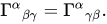
If this tensor is defined as

then it is the commutator of the covariant derivative with itself:[21][22]

since the connection is torsionless, which means that the torsion tensor vanishes.
This can be generalized to get the commutator for two covariant derivatives of an arbitrary tensor as follows:

which are often referred to as the Ricci identities.[23]
The metric tensor gαβ is used for lowering indices and gives the length of any space-like curve
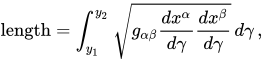
where γ is any smooth strictly monotone parameterization of the path. It also gives the duration of any time-like curve

where γ is any smooth strictly monotone parameterization of the trajectory. See also Line element.
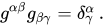
The inverse matrix gαβ of the metric tensor is another important tensor, used for raising indices:
See also
[edit]- Abstract index notation
- Connection
- Curvilinear coordinates
- Differential form
- Differential geometry
- Exterior algebra
- Hodge star operator
- Holonomic basis
- Matrix calculus
- Metric tensor
- Multilinear algebra
- Multilinear subspace learning
- Penrose graphical notation
- Regge calculus
- Ricci calculus
- Ricci decomposition
- Tensor (intrinsic definition)
- Tensor calculus
- Tensor field
- Vector analysis
Notes
[edit]- ^ While the raising and lowering of indices is dependent on a metric tensor, the covariant derivative is only dependent on the connection while the exterior derivative and the Lie derivative are dependent on neither.
References
[edit]- ^ Synge J.L.; Schild A. (1949). Tensor Calculus. first Dover Publications 1978 edition. pp. 6–108.
- ^ J.A. Wheeler; C. Misner; K.S. Thorne (1973). Gravitation. W.H. Freeman & Co. pp. 85–86, §3.5. ISBN 0-7167-0344-0.
- ^ a b R. Penrose (2007). The Road to Reality. Vintage books. ISBN 978-0-679-77631-4.
- ^ Ricci, Gregorio; Levi-Civita, Tullio (March 1900). "Méthodes de calcul différentiel absolu et leurs applications" [Methods of the absolute differential calculus and their applications]. Mathematische Annalen (in French). 54 (1–2). Springer: 125–201. doi:10.1007/BF01454201. S2CID 120009332. Retrieved 19 October 2019.
- ^ Schouten, Jan A. (1924). R. Courant (ed.). Der Ricci-Kalkül – Eine Einführung in die neueren Methoden und Probleme der mehrdimensionalen Differentialgeometrie (Ricci Calculus – An introduction in the latest methods and problems in multi-dimensional differential geometry). Grundlehren der mathematischen Wissenschaften (in German). Vol. 10. Berlin: Springer Verlag.
- ^ Jahnke, Hans Niels (2003). A history of analysis. Providence, RI: American Mathematical Society. p. 244. ISBN 0-8218-2623-9. OCLC 51607350.
- ^ "Interview with Shiing Shen Chern" (PDF). Notices of the AMS. 45 (7): 860–5. August 1998.
- ^ C. Møller (1952), The Theory of Relativity, p. 234 is an example of a variation: 'Greek indices run from 1 to 3, Latin indices from 1 to 4'
- ^ T. Frankel (2012), The Geometry of Physics (3rd ed.), Cambridge University Press, p. 67, ISBN 978-1107-602601
- ^ J.A. Wheeler; C. Misner; K.S. Thorne (1973). Gravitation. W.H. Freeman & Co. p. 91. ISBN 0-7167-0344-0.
- ^ T. Frankel (2012), The Geometry of Physics (3rd ed.), Cambridge University Press, p. 67, ISBN 978-1107-602601
- ^ J.A. Wheeler; C. Misner; K.S. Thorne (1973). Gravitation. W.H. Freeman & Co. pp. 61, 202–203, 232. ISBN 0-7167-0344-0.
- ^ G. Woan (2010). The Cambridge Handbook of Physics Formulas. Cambridge University Press. ISBN 978-0-521-57507-2.
- ^ Covariant derivative – Mathworld, Wolfram
- ^ T. Frankel (2012), The Geometry of Physics (3rd ed.), Cambridge University Press, p. 298, ISBN 978-1107-602601
- ^ J.A. Wheeler; C. Misner; K.S. Thorne (1973). Gravitation. W.H. Freeman & Co. pp. 510, §21.5. ISBN 0-7167-0344-0.
- ^ T. Frankel (2012), The Geometry of Physics (3rd ed.), Cambridge University Press, p. 299, ISBN 978-1107-602601
- ^ D. McMahon (2006). Relativity. Demystified. McGraw Hill. p. 67. ISBN 0-07-145545-0.
- ^ Bishop, R.L.; Goldberg, S.I. (1968), Tensor Analysis on Manifolds, p. 130
- ^ Bishop, R.L.; Goldberg, S.I. (1968), Tensor Analysis on Manifolds, p. 85
- ^ Synge J.L.; Schild A. (1949). Tensor Calculus. first Dover Publications 1978 edition. pp. 83, p. 107.
- ^ P. A. M. Dirac. General Theory of Relativity. pp. 20–21.
- ^ Lovelock, David; Hanno Rund (1989). Tensors, Differential Forms, and Variational Principles. p. 84.
Sources
[edit]- Bishop, R.L.; Goldberg, S.I. (1968), Tensor Analysis on Manifolds (First Dover 1980 ed.), The Macmillan Company, ISBN 0-486-64039-6
- Danielson, Donald A. (2003). Vectors and Tensors in Engineering and Physics (2/e ed.). Westview (Perseus). ISBN 978-0-8133-4080-7.
- Dimitrienko, Yuriy (2002). Tensor Analysis and Nonlinear Tensor Functions. Kluwer Academic Publishers (Springer). ISBN 1-4020-1015-X.
- Lovelock, David; Hanno Rund (1989) [1975]. Tensors, Differential Forms, and Variational Principles. Dover. ISBN 978-0-486-65840-7.
- C. Møller (1952), The Theory of Relativity (3rd ed.), Oxford University Press
- Synge J.L.; Schild A. (1949). Tensor Calculus. first Dover Publications 1978 edition. ISBN 978-0-486-63612-2.
{{cite book}}: ISBN / Date incompatibility (help) - J.R. Tyldesley (1975), An introduction to Tensor Analysis: For Engineers and Applied Scientists, Longman, ISBN 0-582-44355-5
- D.C. Kay (1988), Tensor Calculus, Schaum's Outlines, McGraw Hill (USA), ISBN 0-07-033484-6
- T. Frankel (2012), The Geometry of Physics (3rd ed.), Cambridge University Press, ISBN 978-1107-602601
Further reading
[edit]- Dimitrienko, Yuriy (2002). Tensor Analysis and Nonlinear Tensor Functions. Springer. ISBN 1-4020-1015-X.
- Sokolnikoff, Ivan S (1951). Tensor Analysis: Theory and Applications to Geometry and Mechanics of Continua. Wiley. ISBN 0471810525.
{{cite book}}: ISBN / Date incompatibility (help) - Borisenko, A.I.; Tarapov, I.E. (1979). Vector and Tensor Analysis with Applications (2nd ed.). Dover. ISBN 0486638332.
- Itskov, Mikhail (2015). Tensor Algebra and Tensor Analysis for Engineers: With Applications to Continuum Mechanics (2nd ed.). Springer. ISBN 9783319163420.
- Tyldesley, J. R. (1973). An introduction to Tensor Analysis: For Engineers and Applied Scientists. Longman. ISBN 0-582-44355-5.
- Kay, D. C. (1988). Tensor Calculus. Schaum’s Outlines. McGraw Hill. ISBN 0-07-033484-6.
- Grinfeld, P. (2014). Introduction to Tensor Analysis and the Calculus of Moving Surfaces. Springer. ISBN 978-1-4614-7866-9.
External links
[edit]- Dullemond, Kees; Peeters, Kasper (1991–2010). "Introduction to Tensor Calculus" (PDF). Retrieved 17 May 2018.
Differentiable computing | |
|---|---|
| General | |
| Hardware | |
| Software libraries | |
| |

Ricci calculus
View on GrokipediaFundamentals of Notation
Index Positions and Covariance
In Ricci calculus, indices are placed in upper or lower positions to distinguish between contravariant and covariant components of tensors, ensuring that the overall expression remains invariant under coordinate transformations.[1] Contravariant tensors, denoted with upper indices, transform in a manner that aligns with the basis vectors under a change of coordinates from to . Specifically, for a contravariant vector , the components in the new system are given by where the partial derivatives form the Jacobian matrix of the transformation.[4] This law ensures that the vector's directional properties are preserved relative to the coordinate grid. Covariant tensors, in contrast, are represented with lower indices and transform inversely to the basis vectors, reflecting their role in measuring quantities like gradients. For a covariant vector , the transformation is which compensates for the stretching or contraction of the coordinate differentials.[4] This dual behavior allows covariant components to pair naturally with contravariant ones, maintaining scalar invariance when contracted. Tensors of mixed type combine both upper and lower indices, classified by their rank as (p,q) tensors, where p denotes the number of contravariant indices and q the number of covariant indices. For example, a (1,1) tensor transforms as generalizing the rules for pure contravariant or covariant cases and enabling the representation of linear maps between vector spaces.[4] The distinction between index positions arises from the choice of basis: covariant basis vectors span the tangent space, while contravariant dual basis vectors span the cotangent space. These satisfy the inner product relation , the Kronecker delta, which enforces orthogonality and completeness in the dual pairing.[5] This setup allows tensor components to be expressed relative to either basis, with upper indices for expansion in the contravariant basis and lower for the covariant one. The emphasis on index placement for achieving invariance originated with Gregorio Ricci-Curbastro's development of absolute differential calculus in the late 1880s and 1890s, where he introduced systematic notation to handle tensorial quantities independently of coordinates.[1]Summation Convention
The Einstein summation convention, also known as the Einstein notation or implied summation, is a notational shorthand used in tensor calculus to omit explicit summation symbols over repeated indices in expressions involving vectors, matrices, and higher-rank tensors. Introduced by Albert Einstein in his foundational paper on general relativity, this convention states that when an index is repeated exactly twice in a term—once as a superscript (contravariant index) and once as a subscript (covariant index)—a summation over that index is implied, ranging over all possible values in the space (typically from 1 to the dimension of the space, such as 4 in spacetime).[6] For example, the scalar product of a contravariant vector and a covariant vector is written as , which implicitly means .[7] The rules for applying the convention are strict to ensure clarity and avoid errors. A repeated index must appear exactly once as upper and once as lower in each term; if both are upper (e.g., ) or both lower (e.g., ), no summation is implied unless explicitly stated, though in some contexts the metric tensor may be used to adjust index positions (without altering the summation rule itself).[8] Multiple pairs of repeated indices lead to sequential summations over each pair independently; for instance, in the expression , the result is , where remains free (unsummed), indicating a vector output.[7] Each index in a term can appear at most twice overall, and all free indices must match across terms for the expression to be well-defined.[8] For higher-rank tensors, multi-index notation provides a compact way to represent summations over multiple indices, grouping them as a single composite index to simplify complex contractions without explicit sums. For example, a double contraction like can be viewed as summing over the multi-index . This is particularly useful in Ricci calculus for handling intricate tensor equations efficiently.[7] To prevent ambiguity, especially in non-standard or interdisciplinary contexts where readers may not be familiar with the convention, authors are advised to use explicit summation symbols (e.g., ) when the implied summation could lead to confusion, or to state the convention clearly at the outset of a derivation. Repeated indices that are summed are termed dummy indices, while unsummed ones are free indices, distinguishing their roles in equations (as elaborated in the section on free and dummy indices).[8] This practice ensures the notation's power in compacting expressions without sacrificing precision.[7]Raising and Lowering Indices
In Ricci calculus, the metric tensor and its inverse play a central role in manipulating tensor indices by converting between contravariant (upper) and covariant (lower) forms, ensuring consistent representation of geometric quantities across different coordinate systems. The covariant metric tensor lowers indices, while the contravariant inverse metric raises them, leveraging the property that , where is the Kronecker delta. This operation is fundamental to tensor algebra, as it allows expressions to be adapted without altering their intrinsic meaning.[9] For a contravariant vector , lowering an index yields the covariant form , where the summation convention applies over repeated indices. Conversely, raising an index on a covariant vector produces . These transformations are linear and preserve the vector's tensorial nature under coordinate changes. \begin{equation} V_i = g_{ij} V^j, \quad V^i = g^{ij} V_j \end{equation} The process extends naturally to higher-rank tensors by applying the metric to each desired index. For instance, to obtain the fully covariant Riemann curvature tensor from its mixed form , one lowers the first index via . Similar contractions with multiple metrics can lower or raise several indices simultaneously, maintaining the tensor's rank and symmetries.[10] These index manipulations ensure that raised and lowered forms describe the same geometric object, as the metric tensor encodes the manifold's geometry and guarantees invariance of tensor equations under diffeomorphisms. The operations do not depend on the specific coordinate basis but on the underlying metric structure, preserving scalar invariants like contractions of the tensor with itself.[11] In special cases, such as orthogonal coordinate systems where the metric is diagonal ( for ), raising and lowering simplifies significantly, reducing to multiplications by the diagonal components (scale factors ). For example, in such bases, for the -th component, avoiding off-diagonal summations and facilitating computations in curvilinear coordinates like spherical or cylindrical systems.[10]Tensor Algebra Basics
Free and Dummy Indices
In Ricci calculus, tensor expressions distinguish between free indices, which appear only once in each term and vary to label distinct components of a tensor, and dummy indices, which are repeated within a term to indicate summation over their range as per the Einstein summation convention. Free indices determine the rank and type (contravariant or covariant) of the tensor represented by the equation; for instance, a single free upper index corresponds to a contravariant vector equation, while a free lower index denotes a covariant vector equation.[12][13] Dummy indices, by contrast, do not contribute to the tensor type and can be relabeled arbitrarily without altering the expression's value, provided the relabeling is consistent within the term; for example, the scalar product equals under the summation convention, where (or ) is dummy and summed over all dimensions.[12] A tensor equation featuring free indices is equivalent to scalar component equations in an -dimensional space, as each free index independently takes possible values.[13] Free indices function as replaceable labels that must be renamed consistently across all terms in an equation to maintain validity; inconsistent renaming would alter the tensor type or introduce errors in component matching.[12] In Ricci notation, punctuation clarifies index structure: round brackets group terms or indices to override implied summation, while commas separate multiple indices in symbols (such as Christoffel symbols ) without implying additional summation.Symmetric and Antisymmetric Components
In Ricci calculus, a second-rank tensor can be decomposed into its symmetric and antisymmetric components to isolate parts that behave differently under index permutation. The symmetric part is defined as which remains invariant if the indices and are interchanged.[14] The antisymmetric, or alternating, part is given by which changes sign under interchange of and , satisfying . This decomposition is unique and exhaustive, such that any second-rank tensor satisfies .[14] Symmetric tensors play a key role in defining quadratic forms and bilinear invariants, such as those arising in the contraction with vectors to yield scalars independent of index order. Antisymmetric tensors, conversely, are essential for describing oriented volumes and bivectors in exterior algebra, where they encode rotational and orientational properties. Additionally, antisymmetric tensors have vanishing diagonal components, as implies (no sum), leading to a zero trace . The symmetric and antisymmetric parts are orthogonal under contraction, meaning .[14] A prominent example of a symmetric tensor is the metric tensor , which satisfies and defines the geometry of spacetime without an antisymmetric component. In contrast, the electromagnetic field tensor is purely antisymmetric, with , capturing the electric and magnetic field strengths through its six independent components in four dimensions.[14]Index Permutations and Contractions
In Ricci calculus, permutations of indices in a tensor involve rearranging the positions of the indices while preserving the tensor's transformation properties under coordinate changes. For general tensors, such rearrangements do not introduce sign changes, but for antisymmetric tensors, swapping two indices results in a sign flip; for instance, an alternating bivector satisfies , ensuring the tensor's skew-symmetry is maintained across permutations.[15] This property is crucial for objects like differential forms, where even permutations preserve the sign and odd permutations reverse it.[15] Contractions reduce the rank of a tensor by summing over a pair consisting of one contravariant (upper) index and one covariant (lower) index, following the Einstein summation convention. The simplest case is the trace of a rank-2 tensor, defined as , which yields a scalar invariant independent of the basis choice.[15] More generally, contracting a higher-rank tensor, such as the Riemann curvature tensor , over the first and third indices produces the Ricci tensor , lowering the rank from (1,3) to (0,2).[15] Multiple contractions further reduce tensor rank by pairing additional index sets, often leading to scalars in physical applications. In the theory of elasticity, the elasticity tensor (a rank-4 object) undergoes double contraction to form traces that decompose it into isotropic and deviatoric parts; for example, the double trace relates to bulk modulus contributions, while a second contraction yields the shear modulus scalar.[16] These operations preserve the tensor's intrinsic geometric meaning, as contractions are basis-independent.[16] Bracket notation in Ricci calculus implies permutations for symmetrized or antisymmetrized products of tensors. Parentheses denote symmetrization over enclosed indices, such as the symmetric product , which averages over even permutations to project onto the symmetric subspace.[17] Square brackets indicate antisymmetrization, , incorporating sign changes for odd permutations; this notation extends to higher ranks and is used in products like wedge operations for forms.[17] Building on the symmetric and antisymmetric components of tensors, these notations facilitate efficient algebraic manipulations without explicit summation.[15] Index permutations and contractions ensure the invariance of tensor equations under basis changes, as the operations commute with the coordinate transformation rules that mix indices via the Jacobian matrix. For a tensor equation to hold in one basis, permuting free indices or contracting dummy pairs yields an equivalent equation in another basis, maintaining physical scalars and vectors unchanged.[15] This invariance underpins the coordinate-free nature of Ricci calculus, allowing consistent formulations in curved spaces.[15]Differential Operators
Partial Derivatives
In Ricci calculus, partial derivatives are denoted using index notation as , where are the coordinates of the manifold and the index runs over the appropriate range. This operator acts on scalar fields to produce the components of the gradient, , which transform as the components of a covariant vector (or covector). For contravariant vector fields , the partial derivative represents the rate of change of the vector components along the coordinate directions, but unlike the scalar case, these components do not generally transform as a mixed tensor of type (1,1).[18][19] The transformation properties of these partial derivatives follow from the chain rule under coordinate changes. Consider a scalar function ; in a new coordinate system , the partial derivative transforms as where the Jacobian matrix ensures the tensorial nature.[20][18] A key example is the gradient of a scalar field in Cartesian coordinates, where , directly giving the covariant components of the gradient vector without additional factors. In this simple case, the partial derivatives suffice to compute directional changes, as the basis vectors are constant. However, in general curvilinear coordinate systems, the partial derivatives of tensor components do not transform as higher-rank tensors, misapplication—such as computing divergences without accounting for the basis—can lead to spurious results, like non-zero divergence for a constant vector field in flat space. These limitations arise because partial derivatives alone do not account for changes in the basis vectors, necessitating more advanced operators for basis-independent formulations.[19][20] The foundational use of partial derivatives in index notation was introduced in the development of absolute differential calculus, where they serve as the starting point for differentiating tensor quantities in local coordinates.[3]Covariant Derivatives
The covariant derivative extends the partial derivative to curved spaces by incorporating a connection that ensures the result transforms as a tensor under coordinate changes. For a contravariant vector field , it is defined as where are the connection coefficients.[21] This form corrects the non-tensorial behavior of the partial derivative alone.[21] For a covariant vector field , the covariant derivative is The minus sign arises from the transformation properties of lower indices.[21] In the context of Ricci calculus, these expressions use index notation to maintain compatibility with tensor algebra.[21] The connection coefficients are specified by the Christoffel symbols of the second kind for the Levi-Civita connection on a pseudo-Riemannian manifold, given by where is the metric tensor and its inverse.[21] This choice defines the unique torsion-free and metric-compatible connection.[21] A connection is torsion-free if , implying the torsion tensor vanishes.[21] It is metric-compatible if the covariant derivative of the metric tensor is zero, , preserving lengths and angles under parallel transport.[21] The Levi-Civita connection satisfies both properties simultaneously.[21] For a general tensor of type , the covariant derivative generalizes by adding terms for each upper index and terms for each lower index, ensuring the result is a tensor of type .[21] It obeys the Leibniz rule for products of tensors: .[21] This compatibility with tensor algebra makes the covariant derivative a fundamental operation in Ricci calculus.[21]Lie and Exterior Derivatives
In Ricci calculus, the Lie derivative quantifies the rate of change of a tensor field under the infinitesimal flow generated by a vector field , providing a tool for analyzing symmetries without relying on a specific coordinate system. For a contravariant vector field , the Lie derivative along is given by where denotes the covariant derivative.[22] This expression combines the transport of along with the adjustment for the variation in itself.[23] The formula extends to general tensors through an alternating summation over the index positions, with signs determined by the tensor type: positive for contravariant indices and negative for covariant indices. For a mixed (1,1) tensor , it takes the form [22] This generalization preserves the Leibniz rule and ensures compatibility with tensor contractions. A defining property is the commutator relation , linking the Lie derivative to the Lie bracket of vector fields.[24] The exterior derivative operates on antisymmetric tensor fields, or differential forms, to produce forms of one higher degree via antisymmetrized partial derivatives. For a -form with components , the components of are where is the permutation group and is the sign function.[22] In torsion-free connections, torsion terms vanish, simplifying to pure partial derivatives.[25] An essential property is , implying that the exterior derivative of an exact form (one that is of a lower-degree form) is closed (zero).[26] In coordinate-free differential geometry, the Lie derivative identifies symmetries, such as when for the metric tensor , indicating isometries preserved under the flow of .[27] Similarly, the exterior derivative underpins integration theorems, including the generalized Stokes theorem for a compact oriented manifold with boundary , enabling the translation of volume integrals to boundary evaluations.[28]Core Tensors
Kronecker Delta
The Kronecker delta, denoted , is a fundamental mixed tensor of type (1,1) in Ricci calculus, defined such that its components are if and otherwise.[29] This structure positions it as the identity tensor, analogous to the identity matrix in linear algebra, where it serves as a basic selector for indices in tensor expressions.[15] Key properties include its role as an identity map on vectors: contracting with a contravariant vector yields , preserving the vector components under index summation.[30] The trace of the Kronecker delta, obtained by contracting its indices, equals the dimension of the space: in an -dimensional manifold, providing a scalar invariant that reflects the underlying dimensionality.[15] In contractions, it simplifies tensor manipulations by effectively renaming or selecting indices, as seen in the expression , which leaves the tensor unchanged while facilitating efficient index gymnastics without altering the geometric content.[29] In three dimensions, the Kronecker delta functions as a basic selector in contrast to the Levi-Civita permutation symbol , which encodes oriented volumes through the signed determinant of a parallelepiped via the triple scalar product.[31] While introduces antisymmetry for cross products and volume elements, the delta maintains its selective role in identities linking the two, such as contractions yielding differences of deltas.[31] The Kronecker delta exhibits invariance under coordinate transformations, with its components transforming in a manner that preserves the defining relation \delta^i_j = \delta'^i'_j', ensuring it remains a consistent tool across different bases in tensor calculus.[30] This property underscores its utility as a structural element in index-based formulations, independent of the specific metric or geometry of the space.[15]Metric Tensor
The metric tensor, denoted , is a symmetric (0,2) tensor field on a differentiable manifold that equips the tangent space at each point with an inner product, enabling the measurement of lengths and angles between vectors.[32] In local coordinates, it defines the line element as , where the infinitesimal arc length is invariant under coordinate transformations, providing a geometric structure for Riemannian or pseudo-Riemannian manifolds.[15] In the context of spacetime in general relativity, the metric tensor typically adopts a Lorentzian signature such as , distinguishing timelike, spacelike, and null separations.[32] The inverse metric tensor is the contravariant (2,0) tensor satisfying , where is the Kronecker delta, allowing the conversion between covariant and contravariant components.[15] The determinant is non-zero due to the non-degeneracy of the metric, and it plays a crucial role in defining the volume element on the manifold as , which remains invariant under coordinate changes and is essential for integration in curved spaces.[32][15] As a real symmetric bilinear form, the metric tensor is orthogonally diagonalizable at each point by a suitable choice of basis, with eigenvalues corresponding to the principal curvatures or squared lengths in orthogonal directions.[32] In curvilinear coordinate systems, particularly orthogonal ones such as spherical or cylindrical coordinates, the metric tensor often takes a diagonal form, simplifying computations of distances and simplifying the scale factors along each coordinate axis.[15] The metric tensor is compatible with the Levi-Civita connection, the unique torsion-free affine connection on the manifold, satisfying , which ensures that the inner product is preserved under parallel transport and maintains the metric's role in defining geodesics as shortest paths.[15][32] This compatibility underpins the covariant derivative's action on tensor fields derived from the metric. Historically, Gregorio Ricci-Curbastro introduced the metric tensor within his absolute differential calculus in the late 19th century, using quadratic differential forms to express the invariant arc length independent of coordinate systems, as detailed in his 1884 work on quadratic forms and further developed in collaborations with Tullio Levi-Civita.[1] This framework, formalized in their 1901 memoir, laid the foundation for tensorial manipulations in curved spaces, emphasizing the metric's centrality to geometric invariants.[1] The metric also facilitates raising and lowering indices in Ricci calculus, converting between tensor types while preserving invariance.[15]Curvature and Torsion Tensors
In differential geometry, the torsion tensor quantifies the extent to which an affine connection fails to be symmetric, measuring the non-commutativity in the parallel transport of vectors along infinitesimal paths. It is defined in local coordinates by the components , where are the Christoffel symbols of the second kind associated with the connection.[33] This tensor is antisymmetric in its lower indices, , and vanishes for torsion-free connections, such as the Levi-Civita connection derived from a metric tensor. Geometrically, the torsion tensor captures the "skewed" nature of the connection, representing the failure of small parallelograms formed by vector displacements to close under parallel transport, which indicates a twisting or rotational discrepancy in the manifold's structure.[34]/05%3A_Curvature/5.09%3A_Torsion) The Riemann curvature tensor extends this analysis to the intrinsic curvature of the manifold, arising from the non-commutativity of covariant derivatives acting on vector fields. Its components are given by where the partial derivatives act on the Christoffel symbols, and the summation convention applies over repeated indices. This expression, first systematically developed in the context of absolute differential calculus by Gregorio Ricci-Curbastro and Tullio Levi-Civita, encodes how the connection deviates from flat space behavior.[35][2] The Riemann tensor is a (1,3)-tensor that transforms appropriately under coordinate changes, ensuring its geometric invariance. The Riemann tensor exhibits several algebraic symmetries that reduce the number of independent components. Notably, it is antisymmetric in the last two indices: , reflecting the orientation reversal under interchange of the directions defining the curvature. Additionally, it satisfies the first Bianchi identity, a differential relation given by where denotes the covariant derivative; this identity arises from the cyclic invariance of the curvature under permutations of the lower indices and imposes constraints on the tensor's evolution along geodesics. In four dimensions, these symmetries, along with and the pairwise antisymmetry, reduce the independent components from 256 to 20.[35][36] Geometrically, the Riemann tensor measures the path-dependence of parallel transport: when a vector is transported around a closed infinitesimal loop in the - plane, the net rotation or displacement is proportional to times the loop's area, quantifying tidal forces and geodesic deviation in the manifold. In contrast, torsion introduces an additional skew that affects the closure of such loops independently of curvature, distinguishing non-metric compatible connections from the standard Riemannian case.[37][38] Contractions of the Riemann tensor yield lower-rank objects central to Ricci calculus. The Ricci tensor is obtained by contracting the first and third indices: , resulting in a symmetric (0,2)-tensor that averages the sectional curvatures over directions orthogonal to the - plane. Further contraction with the metric tensor produces the Ricci scalar, or scalar curvature: , a single scalar invariant that provides an overall measure of the manifold's curvature density. These contractions, introduced by Ricci-Curbastro in his foundational work on tensor analysis, facilitate applications in geometry and physics by simplifying the full curvature information.[39][40][2]Applications
General Relativity
In general relativity, Ricci calculus provides the index notation essential for formulating the theory's core equations in a coordinate-independent manner, enabling the description of spacetime curvature due to mass and energy. Albert Einstein, in collaboration with Marcel Grossmann, first incorporated elements of the absolute differential calculus developed by Gregorio Ricci-Curbastro and Tullio Levi-Civita into his gravitational framework in 1913, but it was during his pivotal work in late 1915 that he fully embraced this tensorial approach to achieve general covariance. This adoption allowed Einstein to express gravitational effects through contractions and permutations of tensor indices, resolving earlier limitations in his Entwurf theory.[41][42] The cornerstone of general relativity is the Einstein field equations, which relate the geometry of spacetime to its matter and energy content: where is the Ricci curvature tensor, is the Ricci scalar (obtained via contraction with the inverse metric ), is the metric tensor, is the stress-energy tensor, is the gravitational constant, and is the speed of light. These equations, presented by Einstein on November 25, 1915, use Ricci calculus to contract the Riemann curvature tensor into the Ricci tensor, capturing how local energy-momentum curves spacetime. The left side represents the Einstein tensor , ensuring the equations are generally covariant.[43] A key application of index notation in general relativity is the geodesic equation, which describes the motion of freely falling particles in curved spacetime: where is the proper time and are the Christoffel symbols of the second kind, defined as . These symbols, computed via partial derivatives and metric contractions, encode the gravitational acceleration in the affine connection. For instance, in the Schwarzschild metric describing the spacetime around a spherically symmetric mass , the non-vanishing Christoffel symbols include and , derived through explicit index permutations and differentiations of the metric components. This computation exemplifies how Ricci calculus handles the symmetries of the metric to simplify the connection terms.[44] The theory's consistency is further ensured by covariant conservation laws, such as , which states that the stress-energy tensor is divergence-free with respect to the covariant derivative . This follows directly from the contracted Bianchi identity applied to the Einstein tensor in the field equations, guaranteeing local energy-momentum conservation without additional assumptions. Einstein derived this implication in his systematic exposition of the theory, highlighting how the symmetries of the curvature tensors under Ricci calculus enforce physical principles like conservation in curved spacetime.[44]Differential Geometry
Ricci calculus plays a central role in the abstract study of manifolds within differential geometry, providing the index-based framework for expressing curvature invariants and variational principles that reveal topological properties. In the late 19th and early 20th centuries, foundational developments in this area were advanced by Elwin Bruno Christoffel, who introduced the three-index symbols in 1869 to address the equivalence of quadratic differential forms under coordinate transformations. These symbols, now known as Christoffel symbols of the second kind, enabled the formulation of covariant differentiation and laid the groundwork for handling curvature indices in a coordinate-invariant manner, directly influencing Gregorio Ricci-Curbastro's later tensorial approach. Christoffel's work also included early four-index expressions akin to the Riemann curvature tensor, derived from integrability conditions in his Reduktionssatz, which connected local metric properties to global geometric invariants.[1] A key application of Ricci calculus in manifold theory is the Gauss-Bonnet theorem, which links curvature to topology and can be expressed in index notation through the scalar curvature , where is the Ricci tensor and the inverse metric. For a compact oriented two-dimensional Riemannian manifold without boundary, the theorem states , where is the Gaussian curvature and the Euler characteristic; since the scalar curvature satisfies in two dimensions, this becomes . This local form arises from the curvature two-form in index notation, , whose trace contributes to the integrand. The theorem generalizes to higher even dimensions via the Chern-Gauss-Bonnet formula, where the Euler characteristic is given by the integral of a polynomial in the full Riemann curvature tensor , such as for four-manifolds, emphasizing the role of Ricci calculus in computing topological invariants.[45] Variational principles in Ricci calculus further illuminate manifold structure by examining how curvature responds to metric perturbations, crucial for understanding stability and critical metrics. The first variation of the scalar curvature under an infinitesimal change in the metric is given by where is the variation of the Ricci tensor and the Christoffel symbols; the divergence term ensures the total variation integrates to a boundary contribution on compact manifolds without boundary. This formula, derived from the Bianchi identities and metric compatibility, underpins the Euler-Lagrange equations for functionals like the Einstein-Hilbert action restricted to pure geometry, where critical points correspond to constant scalar curvature metrics.[46] Scalar curvature invariants, expressible via contractions like , are essential in embedding problems, where they constrain how abstract manifolds immerse into higher-dimensional spaces while preserving intrinsic geometry. In the context of polarized Kähler manifolds, the average scalar curvature (with the scalar curvature and the Kähler form) serves as a topological invariant within a fixed Kähler class, determining the existence of embeddings into projective space via positive line bundles. Metrics of constant scalar curvature emerge as limits of those induced by such embeddings, minimizing the Mabuchi functional , where variations yield the scalar curvature equation; this links embedding feasibility to the sign of , positive for Fano varieties admitting such structures.[47] Élie Cartan's generalization of Ricci calculus incorporates exterior differential forms to handle connections and curvature on manifolds, bridging coordinate-free geometry with index notation for computational precision. Cartan's moving frame method expresses the curvature two-form as , where are coframe forms and the Riemann tensor components, allowing Gauss-Bonnet integrands like the Pfaffian to be rewritten in Ricci indices for explicit evaluation. This formalism extends variational and invariant computations to non-coordinate bases, unifying Ricci's tensorial rules with differential forms while retaining index manipulations for torsion-free Levi-Civita connections.[48]Other Fields
Ricci calculus finds applications in continuum mechanics, particularly in the formulation of elasticity theory using tensor index notation. The infinitesimal strain tensor, which describes the deformation of a material, is expressed as , where represents the displacement vector and denotes the covariant derivative to account for curvature in non-Euclidean geometries. This symmetric tensor captures both normal and shear strains, enabling the analysis of stress-strain relations in deformed solids. Hooke's law, relating stress to strain, takes the index form , where and are the Lamé parameters, and is the Kronecker delta; this isotropic linear relation is fundamental for modeling elastic materials under small deformations.[49] In electromagnetism, Ricci calculus provides a compact tensorial representation of Maxwell's equations, facilitating their extension to relativistic and curved spacetimes. The Faraday tensor , where is the four-potential, encodes the electric and magnetic fields as antisymmetric components. The inhomogeneous Maxwell equations take the form , while the homogeneous equations are given by , where the alternation brackets denote antisymmetrization over the indices .[50] This notation highlights the gauge invariance and Lorentz covariance inherent in the theory. Numerical implementations of Ricci calculus appear in computational simulations, such as computational fluid dynamics (CFD) on manifolds, where finite difference schemes approximate Christoffel symbols to handle covariant derivatives in curvilinear coordinates. These symbols, computed via with the metric , enable discretization of the Navier-Stokes equations on non-Cartesian grids, improving accuracy for flows around complex geometries like aircraft or turbines. Recent advancements propose symbolic and automatic differentiation techniques to bypass explicit Christoffel symbol calculations, enhancing efficiency in differentiable manifold simulations relevant to CFD.[51] In the 2020s, Ricci calculus supports modern extensions in machine learning through tensor networks, which leverage index contraction and manipulation to model high-dimensional data efficiently. Tensor networks, such as matrix product states or tree tensor networks, approximate probability distributions or neural network layers using Ricci-like index notation for scalability in tasks like image recognition and generative modeling, drawing from quantum many-body techniques. Symbolic computation libraries further integrate Ricci calculus; for instance, SymPy's differential geometry module computes Christoffel symbols, Ricci tensors, and curvature invariants symbolically, aiding algorithmic verification in tensor-based algorithms.[52] Quantum field theory on curved spacetimes employs Ricci calculus to enforce covariant conservation laws, such as for the current , which classically preserves charge but can be violated by quantum anomalies in non-trivial topologies. These anomalies, arising from regularization of loop diagrams, manifest as non-zero trace in the stress-energy tensor, influencing phenomena like particle creation near black holes.[53]References
- https://en.wikisource.org/wiki/Translation:The_Field_Equations_of_Gravitation