


Community hub
0 subscribers8 pages, 0 posts
Recent from talks
All channels
Be the first to start a discussion here.
Be the first to start a discussion here.
Be the first to start a discussion here.
Be the first to start a discussion here.
Contribute something
Welcome to the community hub built to collect knowledge and have discussions related to Clavinet.
Nothing was collected or created yet.
Clavinet
View on Wikipediafrom Wikipedia
Not found
Clavinet
View on Grokipediafrom Grokipedia
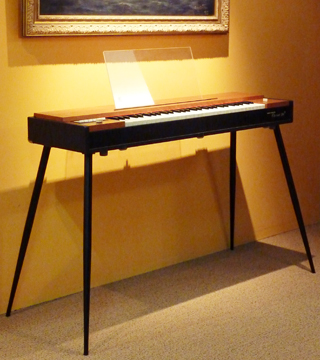
The Clavinet is an electro-mechanical keyboard instrument that produces a distinctive percussive, funky tone through a mechanism where small rubber-tipped hammers strike and dampen tensioned steel strings against metal anvils, with the vibrations captured by electromagnetic pickups for amplification.[1][2] Invented by German engineer Ernst Zacharias and manufactured by the Hohner company in Trossingen, West Germany, it was first introduced in 1964 as a modern take on the historical clavichord, designed initially for classical and home use but quickly adopted in popular music genres.[1][3]
Production of the Clavinet spanned nearly two decades until around 1982, during which Hohner produced approximately 38,000 units across several models, including the original Clavinet I (with built-in amplifier), Clavinet II (featuring tonal filters), the portable and iconic D6 (introduced in 1971 with improved hammer action), E7 (enhanced for durability), the rare triangular L model, and the hybrid Duo combining Clavinet and Pianet elements.[1][2][3] The instrument's fully dynamic 60-note keyboard allows for expressive playing, where harder strikes yield brighter, louder tones, and its two onboard pickups (neck and bridge) enable tonal variations via a mixer circuit, often producing a sharp, biting sound ideal for rhythmic accompaniment.[1][3]
Gaining prominence in the late 1960s and peaking in the 1970s, the Clavinet became a staple in funk, soul, rock, and R&B, with its debut recording on The Left Banke's "Let Go of You Girl" in 1967 and iconic use in Stevie Wonder's "Superstition" (1972), which showcased its wah-wah filtered riff as a defining funk element.[2][1] Other notable artists and tracks include Billy Preston, The Band, Led Zeppelin, The Zombies, and Small Faces, as well as early appearances in film scores like Jerry Goldsmith's In Like Flint (1967) and reggae hits such as The Termites' "Attractive Girl" (1967).[2][1][3] Its popularity waned in the 1980s with the advent of digital synthesizers, but it remains a sought-after vintage instrument for its unique tactile response and irreplaceable analog character, often emulated in modern music production software.[1][2]