


Community hub
Recent from talks
Contribute something
Nothing was collected or created yet.
Cleavage (crystal)
View on Wikipedia

Cleavage, in mineralogy and materials science, is the tendency of crystalline materials to split along definite crystallographic structural planes. These planes of relative weakness are a result of the regular locations of atoms and ions in the crystal, which create smooth repeating surfaces that are visible both in the microscope and to the naked eye. If bonds in certain directions are weaker than others, the crystal will tend to split along the weakly bonded planes. These flat breaks are termed "cleavage".[1] The classic example of cleavage is mica, which cleaves in a single direction along the basal pinacoid, making the layers seem like pages in a book. In fact, mineralogists often refer to "books of mica".
Diamond and graphite provide examples of cleavage. Each is composed solely of a single element, carbon. In diamond, each carbon atom is bonded to four others in a tetrahedral pattern with short covalent bonds. The planes of weakness (cleavage planes) in a diamond are in four directions, following the faces of the octahedron. In graphite, carbon atoms are contained in layers in a hexagonal pattern where the covalent bonds are shorter (and thus even stronger) than those of diamond. However, each layer is connected to the other with a longer and much weaker van der Waals bond. This gives graphite a single direction of cleavage, parallel to the basal pinacoid. So weak is this bond that it is broken with little force, giving graphite a slippery feel as layers shear apart. As a result, graphite makes an excellent dry lubricant.[2]
While all single crystals will show some tendency to split along atomic planes in their crystal structure, if the differences between one direction or another are not large enough, the mineral will not display cleavage. Corundum, for example, displays no cleavage.
Types of cleavage
[edit]
Cleavage forms parallel to crystallographic planes:[1]
- Basal, pinacoidal, or planar cleavage occurs when there is only one cleavage plane. Talc has basal cleavage. Mica (like muscovite or biotite) also has basal cleavage; this is why mica can be peeled into thin sheets.
- Prismatic cleavage occurs when there are two cleavage planes in a crystal (but not three). Spodumene is an example where the planes meet at a 90 degree angles. Hornblende is an example where the planes intersect at 56° and 124°.
- Cubic cleavage occurs when there are three cleavage planes intersecting at 90 degrees. Halite (or salt) has cubic cleavage, and therefore, when halite crystals are broken, they will form more cubes.
- Rhombohedral cleavage occurs when there are three cleavage planes intersecting at angles that are not 90 degrees. Calcite has rhombohedral cleavage.
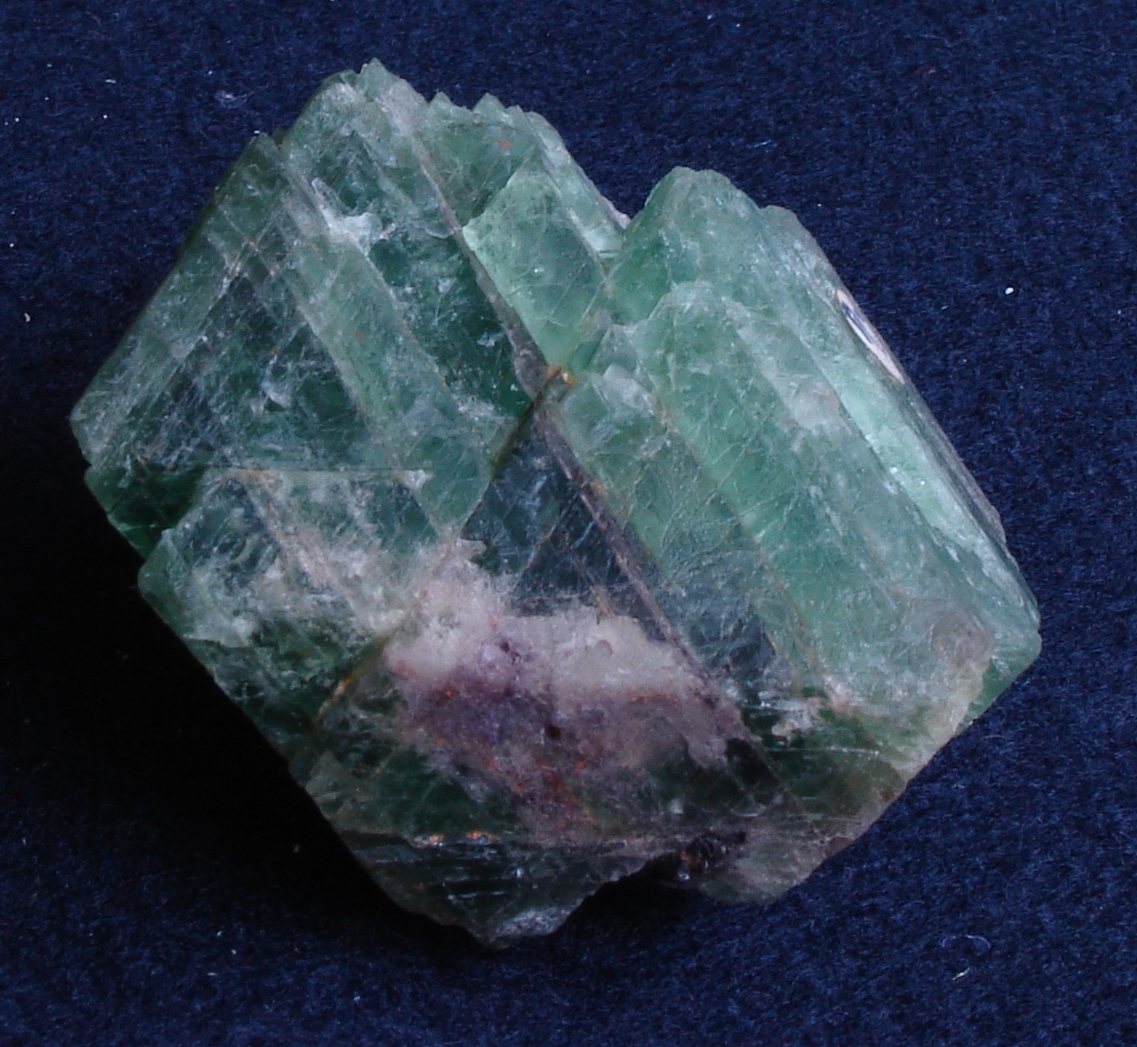
- Octahedral cleavage occurs when there are four cleavage planes in a crystal. Fluorite exhibits perfect octahedral cleavage. Octahedral cleavage is common for semiconductors. Diamond also has octahedral cleavage.
- Dodecahedral cleavage occurs when there are six cleavage planes in a crystal. Sphalerite has dodecahedral cleavage.
Parting
[edit]Crystal parting occurs when minerals break along planes of structural weakness due to external stress, along twin composition planes, or along planes of weakness due to the exsolution of another mineral. Parting breaks are very similar in appearance to cleavage, but the cause is different. Cleavage occurs because of design weakness while parting results from growth defects (deviations from the basic crystallographic design). Thus, cleavage will occur in all samples of a particular mineral, while parting is only found in samples with structural defects. Examples of parting include the octahedral parting of magnetite, the rhombohedral and basal parting in corundum,[3] and the basal parting in pyroxenes.[1]
Uses
[edit]
Cleavage is a physical property traditionally used in mineral identification, both in hand-sized specimen and microscopic examination of rock and mineral studies. As an example, the angles between the prismatic cleavage planes for the pyroxenes (88–92°) and the amphiboles (56–124°) are diagnostic.[1]
Crystal cleavage is of technical importance in the electronics industry and in the cutting of gemstones.
Precious stones are generally cleaved by impact, as in diamond cutting.
Synthetic single crystals of semiconductor materials are generally sold as thin wafers which are much easier to cleave. Simply pressing a silicon wafer against a soft surface and scratching its edge with a diamond scribe is usually enough to cause cleavage; however, when dicing a wafer to form chips, a procedure of scoring and breaking is often followed for greater control. Elemental semiconductors (silicon, germanium, and diamond) are diamond cubic, a space group for which octahedral cleavage is observed. This means that some orientations of wafer allow near-perfect rectangles to be cleaved. Most other commercial semiconductors (GaAs, InSb, etc.) can be made in the related zinc blende structure, with similar cleavage planes.
See also
[edit]References
[edit]- ^ a b c d Hurlbut, Cornelius S.; Klein, Cornelis, 1985, Manual of Mineralogy, 20th ed., Wiley, ISBN 0-471-80580-7
- ^ "How can graphite and diamond be so different if they are both composed of pure carbon?". ScientificAmerican.com. Retrieved 25 November 2020.
- ^ White, John Sampson (1979). "Boehmite exsolution in corundum" (PDF). American Mineralogist. 64: 1300–1302. Retrieved 25 November 2020.
External links
[edit]
Cleavage (crystal)
View on GrokipediaDefinition and Fundamentals
Definition
In mineralogy and materials science, cleavage refers to the tendency of crystalline materials to split along definite crystallographic planes, producing smooth, flat surfaces that reflect the underlying atomic arrangement.[4] These planes arise from zones of relatively weaker atomic bonding within the crystal lattice, allowing the material to break preferentially in those directions when subjected to stress.[1] For example, mica exhibits prominent cleavage parallel to its broad, sheet-like layers, yielding thin, flexible sheets.[5] Unlike random fracture, which produces irregular, curved, or jagged surfaces due to breaking along non-specific paths, cleavage is predictable and reproducible, consistently yielding planar breaks aligned with the crystal's symmetry.[4] This property highlights the ordered, repetitive nature of the crystal structure, where the split surfaces often mirror each other precisely.[5] The concept of cleavage originated in the late 18th century through the work of French mineralogist René-Just Haüy, who used observations of breakage patterns in minerals like calcite to link external crystal forms to internal structure.[6]Atomic and Structural Causes
Cleavage in crystals originates from the presence of planes within the atomic lattice where chemical bonds are relatively weaker compared to surrounding directions, allowing the crystal to split preferentially along these planes when subjected to stress. These weak planes arise due to uneven distribution of bond types, such as ionic, covalent, or van der Waals interactions, which vary in strength across the lattice. In many minerals, the atomic arrangement results in layers or sheets held together by weaker forces, facilitating clean breaks that reflect the underlying symmetry of the structure.[1][7] The atomic arrangement plays a crucial role in determining cleavage, particularly in anisotropic crystals where bond strengths differ by direction. In such structures, stronger bonds align along certain lattice vectors, while weaker bonds define planar weaknesses that coincide with the crystal's symmetry elements, like repeat units in the unit cell. This directional variability stems from the geometry of atomic orbitals and ionic radii, leading to preferential fracture paths that minimize energy during breakage. For instance, in sheet silicates like mica, strong covalent and ionic bonds form within individual silicate layers, but weak van der Waals forces or hydrogen bonds connect the layers, resulting in perfect basal cleavage. In contrast, minerals like quartz exhibit no cleavage because their tetrahedral SiO₄ networks create uniformly strong bonds without distinct weak planes, leading instead to irregular fracture.[1][8][7] Cleavage planes are precisely denoted using Miller indices, a notation system that identifies specific lattice planes through integers (hkl) derived from the reciprocals of the plane's intercepts on the crystallographic axes. For example, the {001} planes represent basal cleavage in mica, parallel to the layers where weak interlayer bonds predominate, while {111} denotes the octahedral planes in diamond, where even the strong tetrahedral carbon bonds align to permit splitting along these symmetric directions. This indexing highlights how cleavage reflects the lattice's periodic structure, with the curly braces {} indicating a family of equivalent planes related by symmetry.[1][9]Classification of Cleavage
Cleavage Quality
Cleavage quality refers to the ease with which a crystal breaks along specific planes and the smoothness of the resulting surfaces, categorized as perfect, good (or imperfect), indistinct (or poor), or absent. Perfect cleavage occurs when the mineral breaks effortlessly to produce clean, flat planes that closely parallel atomic planes, as seen in mica, where thin sheets separate with minimal force due to extremely weak interlayer bonds. Good or imperfect cleavage requires moderate effort to achieve relatively flat surfaces, though they may be slightly irregular; feldspar exemplifies this, splitting along two directions at nearly 90 degrees but often needing a firm strike. Indistinct or poor cleavage is barely noticeable, with breaks that do not form distinct planes. Absent cleavage means no preferred planes exist, and the mineral breaks via irregular fracture, as in quartz.[1][10][11][12] The quality of cleavage is primarily influenced by differences in atomic bond strengths across the crystal lattice and the degree of structural perfection, where greater anisotropy—variation in bonding directionality—results in higher quality by creating pronounced weak planes. For instance, in galena, perfect cubic cleavage arises from equal weakness in three perpendicular directions due to its ionic bonding structure, while calcite exhibits perfect rhombohedral cleavage that can vary in quality depending on lattice defects or impurities affecting bond uniformity. Crystal imperfections, such as twinning or inclusions, can reduce quality by disrupting the alignment of weak bonds, leading to less predictable breaks.[13][1][10] In hand samples, cleavage quality is assessed by applying controlled force to observe the break without causing shattering, typically using a fingernail for soft minerals, a knife edge for harder ones, or a small hammer strike while holding the sample in a gloved hand to protect against fragments. If the break yields smooth, parallel planes with little resistance, the quality is perfect; rougher or less consistent surfaces indicate good or indistinct quality. This method distinguishes cleavage from random fracture by focusing on the presence and evenness of planar surfaces rather than the break's shape. Absent cleavage is identified when no planar breaks occur.[3][14]Cleavage Directions
Cleavage directions refer to the specific orientations and number of parallel planes along which a crystal preferentially breaks, determined by the arrangement of atomic bonds in the lattice. These planes are geometrically classified based on their number and the angles at which they intersect, reflecting the underlying crystal symmetry. In crystallography, cleavage directions are denoted using Miller indices to specify the crystallographic planes, such as {001} for basal cleavage.[1] One-directional cleavage, also known as basal or pinacoidal cleavage, involves a single set of parallel planes, resulting in platy or sheet-like fragments. This type is common in minerals with layered structures, where weak bonds exist between strongly bonded sheets; for example, mica minerals like muscovite and biotite exhibit perfect basal cleavage along {001}, allowing them to split into thin, flexible sheets.[15][16] Two-directional cleavage, often termed prismatic, features two sets of parallel planes that intersect at specific angles, typically 90° or 60°. Orthoclase feldspar, for instance, displays prismatic cleavage with two directions at 90° along {001} and {010}, producing rectangular fragments that aid in its identification. This configuration arises in minerals with prismatic crystal habits, where bonding weaknesses align perpendicular to the prism axes.[17][1] Three-directional cleavage encompasses two main subtypes based on intersection angles. Cubic cleavage involves three mutually perpendicular planes (at 90°), as seen in galena, which breaks along {100} to form cubic fragments due to its isometric symmetry. In contrast, rhombohedral cleavage features three planes intersecting at non-right angles, such as approximately 75° in calcite, yielding rhombohedral shapes from {1011} planes; this reflects trigonal or orthorhombic symmetry where bonds are weaker in diagonal directions.[18][19][20] Cleavage with four or more directions is less common and typically occurs in higher-symmetry systems. Octahedral cleavage involves four planes intersecting at 109.5° tetrahedral angles, exemplified by fluorite, which cleaves along {111} to produce octahedral fragments. Dodecahedral cleavage, involving six planes to form 12-sided shapes, is rare and observed in sphalerite, aligning with its isometric structure but often obscured by imperfect quality.[21][22] Cleavage directions are intrinsically linked to the crystal systems' symmetry elements, such as rotation axes or mirror planes, where planes of weakness parallel these features to minimize bond disruption during fracture. For instance, in cubic systems, cleavages align with coordinate axes, while in hexagonal systems, they may follow basal or prism faces. The observability of these directions can vary with cleavage quality, but their geometric pattern remains a key diagnostic trait.[1][23]Distinctions from Similar Phenomena
Parting
Parting refers to the tendency of a crystal to break along planes of structural weakness that arise from external factors rather than inherent atomic bonding differences, resulting in a pseudo-cleavage appearance.[4] These planes are typically induced by twinning, where the interface between intergrown crystal individuals creates a zone of reduced cohesion, or by applied strain and deformation that reorients internal structures.[1] Inclusions or lamellar growth patterns can also generate such weaknesses, leading to breakage along non-repeating surfaces that mimic the regularity of true cleavage but lack its universality across mineral specimens. Unlike true cleavage, which stems from the mineral's lattice geometry and occurs predictably in all well-formed crystals, parting is sporadic and specimen-specific, often appearing only in crystals subjected to particular growth or stress conditions. The resulting parting planes tend to be broader and less finely spaced than cleavage planes, with surfaces that may show subtle textural differences, such as slight curvature or irregularity along the break.[24] Common examples illustrate parting's origins in twinning and strain. In magnetite, octahedral parting develops parallel to {111} planes due to spinel-law twinning, where the twin boundary serves as the weakness, allowing the cubic crystal to split into octahedral fragments under moderate force.[25] In pyroxenes, basal parting arises from deformation under pressure, creating horizontal planes perpendicular to the c-axis that resemble cleavage but result from post-growth strain rather than lattice anisotropy.[26]Fracture
In mineralogy, fracture refers to the manner in which a mineral breaks irregularly, producing uneven or curved surfaces rather than flat planes, when subjected to stress that exceeds the bond strength between its atoms or ions.[4] This contrasts with cleavage, the tendency to break along specific crystallographic planes of weakness.[4] Fractures occur in minerals lacking pronounced planes of atomic weakness, resulting in non-reproducible break patterns.[27] The primary cause of fracture is the uniform or nearly equal strength of interatomic bonds in all directions within the crystal lattice, preventing preferential breaking along aligned planes.[4] This isotropy is common in highly symmetric crystals, such as those in the isometric system, or in amorphous materials like obsidian, where no distinct weak bonds exist to guide the fracture path.[27] In such cases, the applied force propagates through the structure randomly, influenced by local stress concentrations rather than lattice orientation.[28] Fractures are classified into several types based on the surface texture and shape produced:- Conchoidal: Smooth, curved surfaces resembling broken glass or a clamshell, often with sharp edges and ripple marks; typical in quartz and amorphous silica like flint.[4]
- Hackly: Jagged and irregular with sharp, protruding edges, giving a torn appearance; seen in native metals like copper.[4]
- Splintery: Breaks into thin, sharp splinters along fibrous directions; exemplified by kyanite.[4]
- Earthy: Dull, powdery, and crumbling like dry soil, without sharp edges; characteristic of soft clays such as kaolinite.[29]