Recent from talks
Nothing was collected or created yet.
The Diamonds
View on Wikipedia
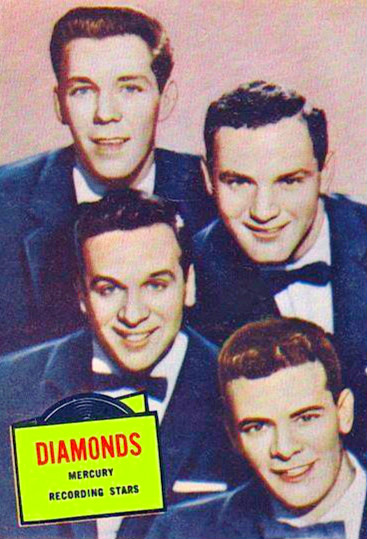
The Diamonds are a Canadian vocal quartet that rose to prominence in the 1950s and early 1960s with 16 Billboard hit records. The original members were Dave Somerville (lead), Ted Kowalski (tenor), Phil Levitt (baritone), and Bill Reed (bass).[2] They were most noted for interpreting and introducing rhythm and blues vocal group music to the wider pop music audience.
Key Information
History
[edit]1950s
[edit]In 1953, Dave Somerville, while working as a sound engineer for the Canadian Broadcasting Corporation in Toronto, Ontario, Canada, met three other young singers. They decided to form a stand-up quartet called the Diamonds. The group's first performance was in the basement of St. Thomas Aquinas Church in Toronto singing in a Christmas minstrel show. The audience's reaction to the Somerville-led group was so positive that they decided that night they would turn professional.
After 18 months of rehearsal, they drove to New York and tied for first place on Arthur Godfrey's Talent Scouts. The prize of being guest artist for a week on Godfrey's show led to a recording contract with Coral Records. Professional musician Nat Goodman became their manager. Coral released four songs, the most notable being "Black Denim Trousers and Motorcycle Boots", written by Jerry Leiber and Mike Stoller.[2]
The next big step was an audition with Cleveland, Ohio, radio disc jockey, Bill Randle, who had aided in the success of some popular groups, such as The Crew-Cuts. Randle was impressed with the Diamonds and introduced them to a producer at Mercury Records, which signed the group to a recording contract.[2]
The Diamonds' first recording for Mercury was "Why Do Fools Fall in Love" (originated by Frankie Lymon and the Teenagers),[2][1] which reached number 12 in the U.S. as their first hit, and their follow-up hit single, "The Church Bells May Ring" (originally by The Willows),[2] reached number 14 in the U.S.[3]
The Diamonds' biggest hits were 1957's "Little Darlin'"[4] (originally recorded by the Gladiolas, written by Maurice Williams) and "The Stroll" (1957), an original song written for the group by Clyde Otis, from an idea by Dick Clark.[5]
Although they were signed to do rock and roll, Mercury also paired them with jazz composer and arranger Pete Rugolo, in one of his Meet series recordings. The album, entitled The Diamonds Meet Pete Rugolo, allowed them to return to their roots and do some established standards.
The group sang "Little Darlin'" and "Where Mary Go" in the film The Big Beat. They sang the theme song to the 1958 film, Kathy O'.
Their television appearances included the TV shows of Steve Allen, Perry Como, Vic Damone, Tony Bennett, Eddy Arnold, and Paul Winchell. They also appeared on American Bandstand.
In the late 1950s, Reed, Kowalski and Levitt left the group and were replaced by Mike Douglas, John Felten, and Evan Fisher.[2]
1960s, 1970s and 1980s
[edit]Despite the ever-changing style of rock and roll and their Mercury contract expiring, the Diamonds continued touring the country. After Dave Somerville left the group in 1961[1] to pursue a folk singing career as "David Troy", he was replaced by Jim Malone. No more records by the Diamonds were hits after Somerville left.[6]
Throughout the 1960s and 1970s, the Diamonds performed mostly in Las Vegas, led at first by Mike Douglas, and later being continued by Glenn Stetson. At one time, at least two groups were performing under the Diamonds name, the other principally being led by John Felten until his death on May 17, 1982, in a plane crash.[2] This created an issue in the late 1980s that ultimately went to court. The right to the use of the name "The Diamonds" was awarded to Gary Owens (a member of Felten's group) with the original members being allowed to use their name on special occasions each year. Owens, along with members Bob Duncan, Steve Smith (both former members of Lawrence Welk's band and television program), and Gary Cech, released an album in 1987, Diamonds Are Forever, which contained two songs that entered the lower reaches of the country music charts, "Just a Little Bit" and "Two Kinds of Women".[7][8]
In 1986, Glenn Stetson and Dick Malono opened up Little Darlin's Rock and Roll Palace near Disney in Orlando, Florida, which was a magical success for all the acts of that era to perform. The Country Music Network also starting videos of the groups that went on the TV network. In 1983, the Diamonds with Glenn Stetson were the first rock and roll group to go on the Country Music Network on a show called Nashville Now with Ralph Emory.
2000s and beyond
[edit]The Diamonds received national attention once again in 2000, when the original members were invited to sing in TJ Lubinsky’s PBS production of Doo-Wop 51, and again in the PBS production entitled Magic Moments - The Best of '50s Pop in 2004.
Stetson received a heart transplant in 2000, and died in 2003. Original member Kowalski died on August 8, 2010, from heart disease, at the age of 79.[9]
In 2012, the Diamonds were listed as guest stars with the Fabulous Palm Springs Follies at the Plaza Theatre in Palm Springs, California.
Douglas died in a car accident on July 2, 2012, at age 78.[10]
Somerville died on July 14, 2015, in Santa Barbara, California.[11]
The Diamonds continue to tour to this day with the line-up of Gary Owens (baritone), Dan Vissers (tenor), Julian McCleary (lead), and Jeff Dolan (bass), although none of the members are from the original group who recorded for Mercury Records.
Original members
[edit]- Dave Somerville – lead (died 2015), replaced by Jim Malone in 1961
- Ted Kowalski – tenor (died 2010), replaced by Evan Fisher in 1958
- Phil Levitt – baritone, replaced by Mike Douglas in 1957
- Bill Reed – bass (died 2004), replaced by John Felten in 1958 (died 1982), replaced by Gary Cech until 1992 (voluntarily left the group)
Replacement members
[edit]- Glenn Stetson, lead vocalist, replaced John Felten in 1968. Mike Douglas remained with the group as the only original member who recorded for Mercury in the 1950s and early 1960s. At this time, the Diamonds consisted of Glenn Stetson (Canada), Harry Harding (Canada), Danny Rankin (USA), and Mike Douglas (Canada).
- Joe Derise, vocalist and composer, joined in 1969.
- Jerry Honeycutt was with John Felten during the mid-1970s, until Felten's death.
- Steve Smith, of The Lawrence Welk Show fame, has been with the Diamonds since 1982.[12]
- John Wagner, vocalist, singing tenor and playing tenor sax, joined Glen Stetson in 1983 and was with Stetson until 2003, when Stetson died. The Diamonds continued to perform until Stetson's death. The group that evolved when Somerville left the Diamonds in 1961[1] and Mike Douglas continued the group is the same group that Stetson kept going until his death in 2003. The historical continuation that began in 1968 ended with Stetson's death.
- Mike Douglas and Joe Derise rejoined the Diamonds in 1988. Derise eventually died and Mike Douglas (one of the original singers from the group's Mercury days) died in 2012.
- Bob Duncan, tenor, began singing with John Felten in 1979.[12]
- Gary Owens, baritone, joined John Felten in 1975. He sings, plays saxophone and flute, and does most of the vocal arranging for the group.[12]
- Gary Cech, bass, began singing with Bob Duncan in 1982 shortly after John Felten's death and left the group in 1992.[12]
- Jerry Siggins, bass.[12]
- Carson Church, bass, joined the Diamonds from 2001-2003
Contrary to a popular myth, the father of Tom Hanks was never a member of the group.[13]
Discography
[edit]Original albums
[edit]- The Diamonds (1957)
- America's Number One Singing Stylists (1957)
- The Diamonds Meet Pete Rugolo (Mercury, 1958) (with Pete Rugolo)
- America's Favorite Song Stylists (1959)
- Songs from the Old West (1959)
- Pop Hits (1960)
- Diamonds Are Forever (1987)
Compilation albums
[edit]- Little Darlin' (1981)
- The Best of The Diamonds: The Mercury Years (1996)
- The Diamonds Songbook (2007)
- The Stroll – 2 CD Set (2011)
- The Diamonds – 4 Classic Albums Plus (2015)
Singles
[edit]| Year | Titles (A-side, B-side) Both sides from same album except where indicated |
Chart positions | Album | |||
|---|---|---|---|---|---|---|
| US Pop [14] |
US Cashbox |
US R&B [14] |
UK [15] | |||
| 1955 | "Black Denim Trousers and Motorcycle Boots" b/w "Nip Sip" |
— | — | — | — | Non-album tracks |
| 1956 | "Smooch Me" b/w "Be My Lovin' Baby" |
— | — | — | — | |
| "Why Do Fools Fall in Love" b/w "You Baby You" (from America's Favorite Song Stylists) |
12 | 2 | — | — | Collection of Golden Hits (Mercury various artists compilation) | |
| "The Church Bells May Ring" b/w "Little Girl of Mine" (from Pop Hits) |
14 | 23 | — | — | ||
| "Love, Love, Love" b/w "Every Night About This Time" (from America's Favorite Song Stylists) |
30 | — | 14 | — | ||
| "Soft Summer Breeze" / | 34 | — | — | — | Non-album track | |
| "Ka-Ding-Dong" | 35 | 17 | 8 | — | America's Favorite Song Stylists | |
| "My Judge and My Jury" b/w "Put Your House in Order" |
— | — | — | — | Non-album tracks | |
| "A Thousand Miles Away" b/w "Every Minute of the Day" |
— | — | — | — | America's Favorite Song Stylists | |
| 1957 | "Little Darlin'" b/w "Faithful and True" |
2 | 2 | 2 | 3 | |
| "Words of Love" b/w "Don't Say Goodbye" |
13 | 47 | 12 | — | Pop Hits | |
| "Zip Zip" b/w "Oh How I Wish" |
16 | 36 | 12 | — | The Diamonds | |
| "Silhouettes" b/w "Honey Bird" |
10 | — | 6 | — | America's Favorite Song Stylists | |
| "The Stroll" b/w "Land of Beauty" (from Pop Hits) |
4 | 1 | 5 | — | ||
| 1958 | "High Sign" b/w "Chick-Lets (Don't Let Me Down)" |
37 | 21 | — | — | Pop Hits |
| "Kathy-O" / | 16 | 37 | — | — | Non-album tracks | |
| "Happy Years" | 73 | — | — | — | ||
| "Walking Along" b/w "Eternal Lovers" (from Pop Hits) |
29 | 19 | — | — | ||
| 1959 | "She Say (Oom Dooby Doom)" b/w "From the Bottom of My Heart" |
18 | 12 | — | — | |
| "Gretchen" b/w "A Mother's Love" |
— | 95 | — | — | ||
| "Sneaky Alligator" b/w "Holding Your Hand" |
— | — | — | — | ||
| "Young in Years" b/w "The Twenty-Second Day" |
— | 80 | — | — | ||
| "Walkin' the Stroll" b/w "Batman, Wolfman, Frankenstein or Dracula" |
— | — | — | — | ||
| 1960 | "Tell the Truth" b/w "Real True Love" |
— | — | — | — | |
| "Slave Girl" b/w "The Pencil Song" |
— | — | — | — | ||
| "You'd Be Mine" b/w "The Crumble" |
— | — | — | — | ||
| 1961 | "You Short Changed Me" b/w "I Sho' Lawd Will" |
— | — | — | — | |
| "The Munch" b/w "Woomai-Ling" |
— | — | — | — | ||
| "One Summer Night" b/w "It's a Doggone Shame" |
22 | 43 | — | — | ||
| 1962 | "The Horizontal Lieutenant" b/w "Vanishing American" |
— | — | — | — | |
| 1963 | "The Slide" b/w "Melody of Love" |
— | — | — | — | |
| "—" denotes releases that did not chart or were not released in that territory. | ||||||
Film appearances
[edit]- The Big Beat (1958)
TV appearances
[edit]- The Eddy Arnold Show (1956)
- The Steve Allen Show (1957)
- The Dick Clark Beech Nut Show (1959)
Awards and honours
[edit]- In 1984, the Canadian Juno "Hall of Fame" award by the Canadian Academy of Recording Arts and Sciences.[16]
- In October 2004, inducted into the Vocal Group Hall of Fame in Sharon, Pennsylvania.[17]
- In 2006 inducted into the Doo-Wop Hall of Fame.[18]
See also
[edit]References
[edit]- ^ a b c d Dahl, Bill. "Artist Biography". AllMusic. Retrieved 6 January 2022.
- ^ a b c d e f g Colin Larkin, ed. (1997). The Virgin Encyclopedia of Popular Music (Concise ed.). Virgin Books. p. 371. ISBN 1-85227-745-9.
- ^ "The Diamonds - Awards". AllMusic. Archived from the original on 31 March 2015. Retrieved 6 January 2022.
- ^ Gilliland, John (1969). "Show 11 – Big Rock Candy Mountain: Early rock 'n' roll vocal groups & Frank Zappa" (audio). Pop Chronicles. University of North Texas Libraries. Track 5.
- ^ "Video – CKA". Canadaka.net. Retrieved 26 March 2012.
- ^ "The Diamonds Page". 1 April 2007. Retrieved 6 January 2022.
- ^ "The Diamonds". History-of-rock.com. Retrieved 26 March 2012.
- ^ "The Diameonds Homepage". Thediamonds.cc. Retrieved 16 July 2015.
- ^ Doc Rock. "The Dead Rock Stars Club 2010 July to December". Thedeadrockstarsclub.com. Retrieved 16 July 2015.
- ^ Meacham, Andrew (16 July 2012). "Mike Douglas was at home on Ed Sullivan's stage, and later at the flea market". Tampa Bay Times. Retrieved 29 May 2021.
- ^ Barnes, Mike (17 July 2015). "Dave Somerville, Lead Singer of the Doo-Wop Group The Diamonds, Dies at 81". The Hollywood Reporter. Retrieved 6 January 2022.
- ^ a b c d e "The Diamonds at The Vocal Group Hall of Fame 2004 Induction". The Vocal Group Hall of Fame Foundation. Archived from the original on 6 January 2015. Retrieved 9 March 2016.
- ^ Mikkelson, David (5 February 2012). "Tom Hanks' Father Sang Lead for The Diamonds?". Snopes. Retrieved 6 February 2013.
- ^ a b "The Diamonds Top Songs / Chart Singles Discography". Music VF. Retrieved 6 January 2022.
- ^ "DIAMONDS - full Official Chart History". Official Charts Company. Retrieved 6 January 2022.
- ^ "Juno Awards/Canadian Music Hall of Fame winner and nominations". juno-awards.ca. Retrieved November 26, 2006
- ^ "Vocal Group Hall of Fame inductees". vocalgroup.org. Archived from the original on 16 December 2013. Retrieved 26 November 2006.
- ^ Kearney, Mark; Ray, Randy (2006). Whatever Happened To-- ?: Catching Up with Canadian Icons (illustrated ed.). Dundurn. p. 206. ISBN 9781550026542.
External links
[edit]The Diamonds
View on GrokipediaHistory
Formation and Early Career (1953–1956)
The Diamonds were formed in the summer of 1953 at the University of Toronto in Toronto, Ontario, Canada, initially as a barbershop quartet specializing in four-part harmony. The group consisted of baritone Phil Levitt (born July 9, 1935), lead Stan Fisher, tenor Ted Kowalski (born May 16, 1931, died August 8, 2010), and bass Bill Reed (born January 11, 1936, died October 22, 2004), all students or recent graduates who shared a passion for vocal music. Dave Somerville (born October 2, 1933) replaced Fisher as lead shortly after formation.[1][2][3] They began by practicing traditional barbershop styles, drawing from close-harmony techniques popular in North American collegiate singing groups at the time.[4] In their early days, the quartet performed at local events across Toronto, including parties, university functions, church socials, and talent competitions, which helped them refine their sound and build a modest following in Canada. Their debut professional appearance took place in December 1953 at a Christmas minstrel show in the basement of St. Thomas Aquinas Church, where they received positive audience feedback despite their amateur status.[4] These grassroots gigs exposed them to diverse crowds and encouraged experimentation beyond strict barbershop arrangements, laying the groundwork for their evolution toward rhythm and blues influences.[3] By 1955, the group caught the attention of Cleveland disc jockey Bill Randle during a performance, leading to a pivotal introduction to Mercury Records executives. Impressed by their clean-cut image and harmonious covers of R&B material, they first signed with Coral Records for the single "Black Denim Trousers and Motorcycle Boots," which achieved only modest sales. They then signed with Mercury later that year, prompting their relocation to New York City to pursue opportunities in the U.S. music scene.[2][3][5] This move marked a shift from local Canadian performances to professional touring, though it required adapting their barbershop roots to the emerging doo-wop style prevalent in American pop music.[4] The group's debut single on Mercury, a cover of Frankie Lymon & the Teenagers' "Why Do Fools Fall in Love," was released on January 16, 1956, showcasing their polished vocal blend over a pop-oriented arrangement.[6] Transitioning from barbershop's structured harmonies to doo-wop's improvisational R&B flair proved challenging, requiring intensive practice to compete in a market dominated by Black ensembles, yet it positioned them for broader appeal.[4][3]Rise to Fame (1957–1959)
In 1957, The Diamonds broke through to national prominence with their cover of "Little Darlin'," originally recorded by the Gladiolas, which peaked at number 2 on the Billboard Hot 100 and spent eight weeks in that position.[7] The single, released by Mercury Records, stayed on the chart for 26 weeks and was certified gold by the RIAA for sales exceeding 1 million copies, marking the group's first major commercial success and establishing their signature doo-wop harmonies with a rock and roll edge.[8] Later that year, they followed with a cover of the Rays' "Silhouettes," which reached number 10 on the Billboard pop chart, further solidifying their presence in the burgeoning rock and roll market.[9][10] Building on this momentum, "The Stroll" became their defining hit in late 1957, peaking at number 4 on the Billboard Hot 100 in 1958 and remaining on the chart for 21 weeks.[11] Written specifically for the group by Clyde Otis and Nancy Lee, the song's mid-tempo rhythm inspired a nationwide dance craze, where couples formed two lines facing each other and took slow steps side to side, popularized through their performances on American Bandstand.[12] This visual from the show, hosted by Dick Clark, helped integrate The Diamonds into the rock and roll revue circuit, leading to national tours alongside acts like Buddy Holly and the Everly Brothers.[3] Over the 1957–1959 period, The Diamonds amassed 16 entries on Billboard's pop charts, with seven reaching the top 20, including "Words of Love" at number 13 and "Kathy-O" at number 20, demonstrating their consistent appeal through covers of R&B originals adapted for broader audiences.[7] Their recording sessions during this peak, often held at Mercury's New York studios under producer David Carroll, emphasized tight vocal arrangements and upbeat tempos to capture the era's energetic vibe, evolving from pure doo-wop to more dance-oriented tracks that reflected the group's clean-cut, versatile dynamic.[13] These efforts not only boosted sales—estimated at over 2 million records combined for their top hits—but also positioned them as a staple of late-1950s teen culture.[3]Later Years and Lineup Changes (1960s–1980s)
As the 1960s began, The Diamonds experienced significant lineup instability following their peak commercial success, with several original members departing due to personal and professional commitments. Baritone Phil Levitt had already left in 1957 to return to his studies, replaced by Mike Douglas, while tenor Ted Kowalski and bass Bill Reed exited in 1958, citing fatigue from constant touring; Kowalski was substituted by Evan Fisher, and Reed by John Felten. By 1961, lead vocalist Dave Somerville departed to pursue a solo folk career under the name David Troy, succeeded by Jim Malone, marking the complete turnover of the original quartet. These changes reflected the group's transition from chart-topping stars to a more fluid ensemble reliant on replacements to maintain performances.[1][14] The shifting music landscape, particularly the arrival of the British Invasion in the mid-1960s, further diminished the doo-wop style's dominance, challenging The Diamonds' cover-oriented repertoire and contributing to their declining radio presence after 1961. Amid these pressures, internal factionalism emerged, leading to legal disputes over the group's name as multiple lineups vied for legitimacy; by the mid-1960s, at least two ensembles performed under "The Diamonds," one led by Somerville's faction and another by Felten, with courts ultimately favoring the touring group associated with Somerville's original vision to retain primary rights. Despite these conflicts, the band persisted through extensive touring across the United States and Canada, focusing on dinner clubs in Las Vegas, New York, and Chicago, as well as oldies circuits, driven largely by financial incentives to capitalize on lingering nostalgia for their hits like "Little Darlin'" and "The Stroll."[15][3] Sporadic releases helped sustain their career, including the 1961 album America's #1 Vocal Group and the 1963 live recording On Tour, which captured their stage energy amid the lineup flux. The group continued performing into the 1980s, with further changes such as Felten's tragic death in a 1982 plane crash on Mount Shasta, California, prompting additional substitutions like Gary Cech on bass.[16] A notable revival effort came with the 1987 album Diamonds Are Forever on Churchill Records, shifting toward country-infused tracks like "Just a Little Bit" and "Two Kinds of Women," which achieved modest chart success and underscored their adaptability, though it failed to recapture mainstream acclaim. These efforts, combined with oldies revue appearances alongside acts like Dion and the Belmonts, highlighted the band's resilience in an evolving industry.[3][14]Revival and Contemporary Era (1990s–Present)
In the 1990s and early 2000s, The Diamonds experienced a significant resurgence in visibility through appearances on public television specials dedicated to doo-wop and classic pop music. Their participation in the PBS production Doo Wop 51 in 2000, hosted by Jerry Butler, reunited original members and featured performances of hits like "The Stroll," drawing widespread acclaim and introducing their music to new generations of viewers. This was followed by another high-profile appearance in the 2004 PBS special Magic Moments: The Best of '50s Pop, which further highlighted their enduring appeal and contributed to renewed interest in their catalog on the oldies circuit.[17][18][19] The group faced profound losses among its founding members during this period. Bass singer Bill Reed passed away on October 22, 2004, at age 68 after a series of illnesses while residing in Florida.[20][21] Tenor Ted Kowalski succumbed to heart disease on August 8, 2010, at age 79 in Whitby, Ontario.[22] Lead singer Dave Somerville, who had pursued a solo career after leaving the group in the 1960s, died of cancer on July 14, 2015, at age 81 in Santa Barbara, California.[23][7] With no original members remaining, The Diamonds have continued to perform actively into the 2020s, adapting to the contemporary oldies and nostalgia circuits without releasing new studio material. Their live shows emphasize high-energy renditions of classic hits, often in themed productions that preserve the group's rock 'n' roll legacy. As of November 2025, they maintain an ongoing touring schedule across the United States, including frequent appearances in Florida and Texas venues, under formats like "Let's Rock Broadway!," which incorporates Broadway-inspired arrangements of their repertoire alongside doo-wop standards.[24][25][26] The group's official website, thediamonds.live, serves as a hub for fan engagement, offering updates on performances, media archives, and booking information to sustain their connection with audiences. Through these efforts, The Diamonds focus on legacy preservation, delivering polished live experiences that honor their 1950s roots while appealing to multigenerational crowds at theaters, casinos, and fairs.[24][27]Members
Original Lineup
The Diamonds were formed in 1953 at the University of Toronto by Stan Fisher (lead), Ted Kowalski (tenor), Phil Levitt (baritone), and Bill Reed (bass); Dave Somerville replaced Fisher as lead shortly after, forming the lineup responsible for their early successes with cover versions of rhythm and blues songs.[1][28] Dave Somerville, born David Troy Somerville on October 2, 1933, in Guelph, Ontario, grew up in nearby Rockwood before moving to Toronto at age 14, where he attended Central Technical School and developed an interest in music.[29] After high school, he worked as an audio engineer at CHUM radio and later the Canadian Broadcasting Corporation (CBC), experiences that honed his ear for harmony.[30] Somerville joined the group shortly after its inception when initial lead Stan Fisher departed, becoming not only the frontman but also an informal coach who helped refine their sound during rehearsals at the university.[7] His clear, versatile tenor led many of their hits, including "Little Darlin'" and "The Stroll," establishing the group's polished doo-wop style before he left in 1961.[31] Ted Kowalski, born on May 16, 1931, in Toronto to Polish-Canadian parents, was a tenor whose smooth, high-range voice provided the group's melodic backbone.[32] As a University of Toronto student, he met Phil Levitt and initially harmonized with him and others in informal settings, contributing to the early formation of the quartet alongside his studies.[33] Kowalski's tenor lines were essential to the interlocking vocals on tracks like "Silhouettes," helping propel their rise on the charts until his departure in 1958 to complete his engineering degree at the University of Toronto.[30] Phil Levitt, born on July 9, 1935, in Toronto, served as the baritone, adding depth and stability to the harmonies with his rich mid-range tone.[1] A Leaside High School graduate who sang in school choirs and ensembles, Levitt entered the University of Toronto to study electrical engineering, where he connected with Kowalski and recruited Reed for the group.[34] His engineering mindset influenced the precise arrangements in their performances, notably on covers like "Why Do Fools Fall in Love," before he left in 1957, weary of the touring lifestyle, to complete his electrical engineering degree at the University of Toronto.[35] Bill Reed, born on January 11, 1936, in Toronto, handled bass duties, delivering the foundational low notes that anchored the quartet's sound.[21] Coming from a musical family—his father sang bass in a barbershop quartet—Reed had prior experience in school choirs and quartets; he was studying pharmacy at the University of Toronto when Levitt and Kowalski enlisted him.[36] Reed's resonant bass underpinned hits such as "Words of Love," supporting the group's energetic live shows through 1958, when he left for personal pursuits.[3]Subsequent and Current Members
In 1957, Mike Douglas replaced Levitt as baritone.[1] Following the departure of original tenor Ted Kowalski in 1958, Evan Fisher joined The Diamonds as the new tenor, contributing to the group's recordings and performances through the early 1960s.[3][17] That same year, bass singer Bill Reed was replaced by John Felten, who provided the foundational low-end vocals for over two decades until his death in 1982 and helped stabilize the quartet during a period of frequent changes.[37][2] In 1961, following Somerville's departure, Jim Malone joined as lead.[1] In the mid-1970s, baritone Gary Owens became a cornerstone of the group, joining in 1973 alongside Felten to reform the lineup amid the nostalgia revival for 1950s music; Owens, a multi-instrumentalist on saxophone, flute, and bass, remains active today and handles much of the vocal arranging to preserve the group's signature sound.[38][2] Key transitions in the 1980s and 1990s included lead vocalist Glenn Stetson, who fronted the group from 1969 to 1982 and led performances in Las Vegas showrooms, followed by Steve Smith, a former Lawrence Welk Show singer, who took over as lead in 1982 and continued until 2011, bringing a polished stage presence that sustained touring through the era.[39][2] As of 2025, The Diamonds' lineup consists of Gary Owens on baritone, Julian McCleary on lead vocals, Dan Vissers on vocals, and Jeff Dolan on bass, with Dolan having joined in 2011 after a career in vocal jazz and barbershop ensembles.[27][40] This configuration draws from diverse backgrounds in musical theater, cruise entertainment, and choral work, ensuring the continuation of the group's tight four-part harmonies through rigorous vocal training and arrangement fidelity to the original doo-wop style.[41][42] New members like McCleary and Vissers adapt quickly to the harmonic roles, emphasizing blend and precision to evoke the classic Diamonds' energy on contemporary tours.[43]Musical Style and Influences
Genre Characteristics and Vocal Techniques
The Diamonds' musical style represented a fusion of rhythm and blues, pop, and barbershop quartet influences, hallmarks of the doo-wop genre that emerged in post-World War II urban communities. This blend emphasized tight four-part harmonies, where voices interlocked in precise, ringing chords derived from barbershop traditions, while incorporating the rhythmic propulsion and emotional depth of R&B. Call-and-response patterns, rooted in gospel and early black vocal group music, added dynamic interplay between the lead singer and backing ensemble, creating an engaging, conversational flow in their arrangements.[44][3][2] Central to their sound were sophisticated vocal techniques that highlighted individual strengths within the group dynamic. Lead vocalist Dave Somerville's prominent style featured a versatile four-octave range, shifting from a robust baritone to an explosive falsetto that conveyed both tenderness and intensity, as exemplified by the iconic opening wail in their 1957 recording of "Little Darlin'". Bassist Bill Reed contributed exaggerated bass runs and spoken introductions, providing rhythmic foundation and dramatic flair, while the tenor and baritone voices employed falsetto accents and nonsense syllables—such as the rhythmic "uh-ohs" and scat-like fills in "Little Darlin'"—to enhance texture and mimic instrumental elements without heavy reliance on accompaniment. These techniques, including vocal trills and hiccups, underscored the group's a cappella roots and ability to sustain listener interest through pure vocal artistry.[31][44][3] Mercury Records' production approach amplified these vocal elements, employing echo chambers—a prevalent 1950s technique—to impart a resonant, fuller sound to their tracks, giving the harmonies an expansive, stadium-like quality despite minimal instrumentation. This method, common in the era's pop and R&B recordings, helped bridge the intimacy of vocal groups with broader commercial appeal. Over time, the Diamonds' style evolved from polished, clean-cut pop renditions of R&B originals—often softening raw edges for mainstream audiences—to edgier rock and roll interpretations that incorporated upbeat tempos and exaggerated vocal effects, setting their covers apart from the source material's grit while injecting fresh energy into the genre.[45][2][3]Key Covers and Original Contributions
The Diamonds gained prominence through their reinterpretations of rhythm and blues songs, transforming them into accessible pop hits that emphasized tight vocal harmonies and lighthearted energy. Their cover of "Little Darlin'," originally recorded by the Gladiolas and written by Maurice Williams, introduced a signature spoken-word intro reminiscent of the Ink Spots style, adding theatrical drama to the doo-wop ballad and elevating its emotional appeal.[4] Similarly, their version of "Silhouettes," penned by Bob Crewe and Frank Slay and first released by the Rays, retained the song's romantic narrative while polishing the production for broader radio play, resulting in a smoother, more radio-friendly sound.[46] Another key adaptation was "The Stroll," written by Clyde Otis and Nancy Lee as a follow-up to Chuck Willis's earlier hit "C.C. Rider," which the Diamonds reimagined with an infectious rhythm that popularized the line-dance craze among teenagers.[12] These covers exemplified the group's role in bridging R&B and pop, often by lightening the originals' tempos, softening raw edges, and incorporating elements like spoken interludes to appeal to white mainstream audiences, a practice common in the 1950s cover trend.[47] Through such alterations, The Diamonds helped "whitewash" gritty R&B tracks, making them palatable for crossover success while inadvertently exposing original Black artists' works to wider listeners.[48] While primarily interpreters, the Diamonds contributed minimally to original songwriting; their career was dominated by covers, with "The Stroll" standing out as a signature non-cover hit that demonstrated their ability to blend street-corner roots with polished performance, paving the way for doo-wop's mainstream integration.[2]Discography
Studio Albums
The Diamonds' debut studio album, America's Number One Singing Stylists, was released in 1957 by Mercury Records. It featured tracks such as "Zip Zip" and "Cool, Cool Baby", many of which were covers that highlighted the group's tight vocal harmonies and rhythmic energy.[49] The production incorporated orchestral arrangements, providing a lush, big-band backdrop that enhanced the doo-wop style typical of mid-1950s recordings. In 1958, the group collaborated with jazz arranger Pete Rugolo for The Diamonds Meet Pete Rugolo, also issued by Mercury Records. This jazz-infused album included standout tracks like "The Stroll", "High Sign", and "Walkin' Along", blending the quartet's pop vocal techniques with sophisticated swing and improvisational elements. The sessions emphasized Rugolo's orchestral charts, allowing the Diamonds to experiment beyond their rock 'n' roll roots while maintaining their signature sound. The Diamonds followed with Swingin' Back to the Fifties in 1959 on Mercury, focusing on swing-era standards reinterpreted through their vocal lens. Tracks drew from classics like the title implies, showcasing continued use of orchestral swells and rhythmic phrasing in the group's arrangements.[50] They also released Songs from the Old West in 1959 on Mercury, featuring Western-themed covers such as "Cool Water" and "San Antonio Rose".[51] After a period of lineup changes and reduced output, the group released The Diamonds Are Forever Featuring Glen Stetson in 1976. This later effort revisited their classic style with updated productions, including selections from their repertoire that underscored their longevity in the vocal group tradition.[18]Compilation Albums
The Diamonds' compilation albums have primarily served as retrospective collections of their 1950s hits and lesser-known recordings, reintroducing their doo-wop and rock 'n' roll sound to later generations. One early example is the 1981 Mercury Records release Little Darlin', a mono vinyl LP that compiles key tracks from their initial hit-making era, including "Little Darlin'", "Why Do Fools Fall in Love", "Church Bells May Ring", and "Love, Love, Love", alongside covers like "Cool Water" and "High Noon".[52] This album focuses on their breakthrough 1950s material, capturing the group's signature close-harmony style and energetic renditions of rhythm and blues standards. In the 21st century, more expansive compilations emerged to encompass broader aspects of their discography. The 2011 Jasmine Records 2-CD set The Stroll – 4 Original LPs Plus 17 Bonus Tracks aggregates four of their early Mercury albums—America's Number One Singing Stylists (1957), The Diamonds Meet Pete Rugolo (1958), Swingin' Back to the Fifties (1959), and Songs from the Old West (1959)—along with 17 additional bonus tracks, such as rare singles and B-sides like "Silhouettes" and "Daddy Cool".[50] This remastered collection highlights previously unavailable full albums on CD, including the jazz-infused Meet Pete Rugolo, and incorporates their international hits to provide a comprehensive overview of their Mercury years.[53] Reissues of their debut album America's Number One Singing Stylists during the 1990s and 2000s further sustained interest in their foundational work. For instance, a 2000 digital edition reproduces the original 1957 Mercury LP's 12 tracks, featuring originals like "Til My Baby Comes Home" and "Shoo Ya Blues" alongside pop standards such as "Oh, How I Wish" and "One and Only".[54] These reissues, often in CD and streaming formats, have helped maintain the group's visibility in the oldies circuit by making their early vocal arrangements accessible to contemporary audiences seeking nostalgic rock 'n' roll.[55] Such compilations have played a crucial role in preserving The Diamonds' catalog amid the enduring popularity of 1950s doo-wop in the oldies market, ensuring that tracks from their Mercury era remain available through remastered formats and expanded sets.[19]Notable Singles
The Diamonds achieved commercial success primarily through their Mercury Records singles in the late 1950s, with 16 entries on the Billboard charts between 1956 and 1961.[7] Their early releases established their style of covering R&B tracks with polished vocal harmonies, leading to several top-10 hits. Key early singles include "Why Do Fools Fall in Love," released in February 1956 on Mercury (70790), which peaked at #12 on the Billboard Hot 100 and marked their debut chart entry.[15] This was followed by "Church Bells May Ring" in April 1956 on Mercury (70832), reaching #14 on the Billboard Hot 100; the B-side, "Soft Summer Breeze," did not chart significantly but complemented the A-side's doo-wop arrangement.[15] Their peak period produced their biggest hits, starting with "Little Darlin'" in March 1957 on Mercury (71060), which climbed to #2 on the Billboard Hot 100 for eight weeks, #2 on the R&B chart, #3 in the UK, and #1 in Canada, earning gold certification for over one million sales.[7][56] "Silhouettes," released in November 1957 on Mercury (71197) with B-side "Daddy Cool," peaked at #10 on the Billboard Hot 100 and #6 on the R&B chart, offering a variation on the original Rays version with tighter harmonies.[15] "The Stroll" followed in December 1957 on Mercury (71242), hitting #4 on the Billboard Hot 100, #5 on the R&B chart, and inspiring a popular line dance; its B-side "Land of Beauty" saw limited airplay.[7][12] Subsequent singles showed declining chart performance but maintained their vocal group appeal. "Words of Love" in June 1957 on Mercury (71128) reached #13 on the UK Singles Chart but only #25 in the US, while "Zip Zip" in August 1957 on Mercury (71165) peaked at #16 on the Billboard Hot 100.[15] By 1958, "Kathy-O" on Mercury (71330) hit #16, and "Walking Along" in October on Mercury (71366) reached #29.[15] In 1960, "Walkin' Out on Love" on Mercury saw minor US chart action, bubbling under at around #100 without a top-40 entry.[18] Their last notable charting single, "One Summer Night," released in July 1961 on Mercury (71831), peaked at #22 on the Billboard Hot 100.[10] In the 1980s, with lineup changes including new members like Glenn Stetson and Jimmy Dorsey, the group issued singles like "The Stroll '84" on a reissue label, which received regional play but no national chart impact, focusing instead on nostalgia tours and compilations. International variations included UK-specific pressings, such as "Little Darlin'" on London Records, which mirrored the US success at #3.[15]| Single | Release Year | Label (Catalog) | Peak Position (US Billboard Hot 100) | Notes |
|---|---|---|---|---|
| Why Do Fools Fall in Love | 1956 | Mercury (70790) | #12 | Cover of Frankie Lymon & the Teenagers; B-side: "Nip Sip" |
| Church Bells May Ring | 1956 | Mercury (70832) | #14 | Cover of the Willows; B-side: "Soft Summer Breeze" |
| Little Darlin' | 1957 | Mercury (71060) | #2 | Gold-certified; #1 Canada, #3 UK; B-side: "Faithful and True" |
| Silhouettes | 1957 | Mercury (71197) | #10 | Cover of the Rays; B-side: "Daddy Cool" |
| The Stroll | 1957 | Mercury (71242) | #4 | Gold-certified; inspired dance craze; B-side: "Land of Beauty" |
| Walkin' Out on Love | 1960 | Mercury | Minor (~#100) | Limited chart entry; B-side not specified in major sources |