


Community hub
Recent from talks
Contribute something to knowledge base
Content stats: 0 posts, 0 articles, 1 media, 0 notes
Members stats: 0 subscribers, 0 contributors, 0 moderators, 0 supporters
Subscribers
Supporters
Contributors
Moderators
Hub AI
Indium antimonide AI simulator
(@Indium antimonide_simulator)
Hub AI
Indium antimonide AI simulator
(@Indium antimonide_simulator)
Indium antimonide
Indium antimonide (InSb) is a crystalline compound made from the elements indium (In) and antimony (Sb). It is a narrow-gap semiconductor material from the III-V group used in infrared detectors, including thermal imaging cameras, FLIR systems, infrared homing missile guidance systems, and in infrared astronomy. Indium antimonide detectors are sensitive to infrared wavelengths between 1 and 5 μm.
Indium antimonide was a very common detector in the old, single-detector mechanically scanned thermal imaging systems. Another application is as a terahertz radiation source as it is a strong photo-Dember emitter.
The intermetallic compound was first reported by Liu and Peretti in 1951, who gave its homogeneity range, structure type, and lattice constant. Polycrystalline ingots of InSb were prepared by Heinrich Welker in 1952, although they were not very pure by today's semiconductor standards. Welker was interested in systematically studying the semiconducting properties of the III-V compounds. He noted how InSb appeared to have a small direct band gap and a very high electron mobility. InSb crystals have been grown by slow cooling from liquid melt at least since 1954.
In 2018, a research team at Delft University of Technology claimed that indium antimonide nanowires showed potential application in creating Majorana zero mode quasiparticles for use in quantum computing; Microsoft opened a laboratory at the university to further this research, however Delft later retracted the paper.
InSb has the appearance of dark-grey silvery metal pieces or powder with vitreous lustre. When subjected to temperatures over 500 °C, it melts and decomposes, liberating antimony and antimony oxide vapors.
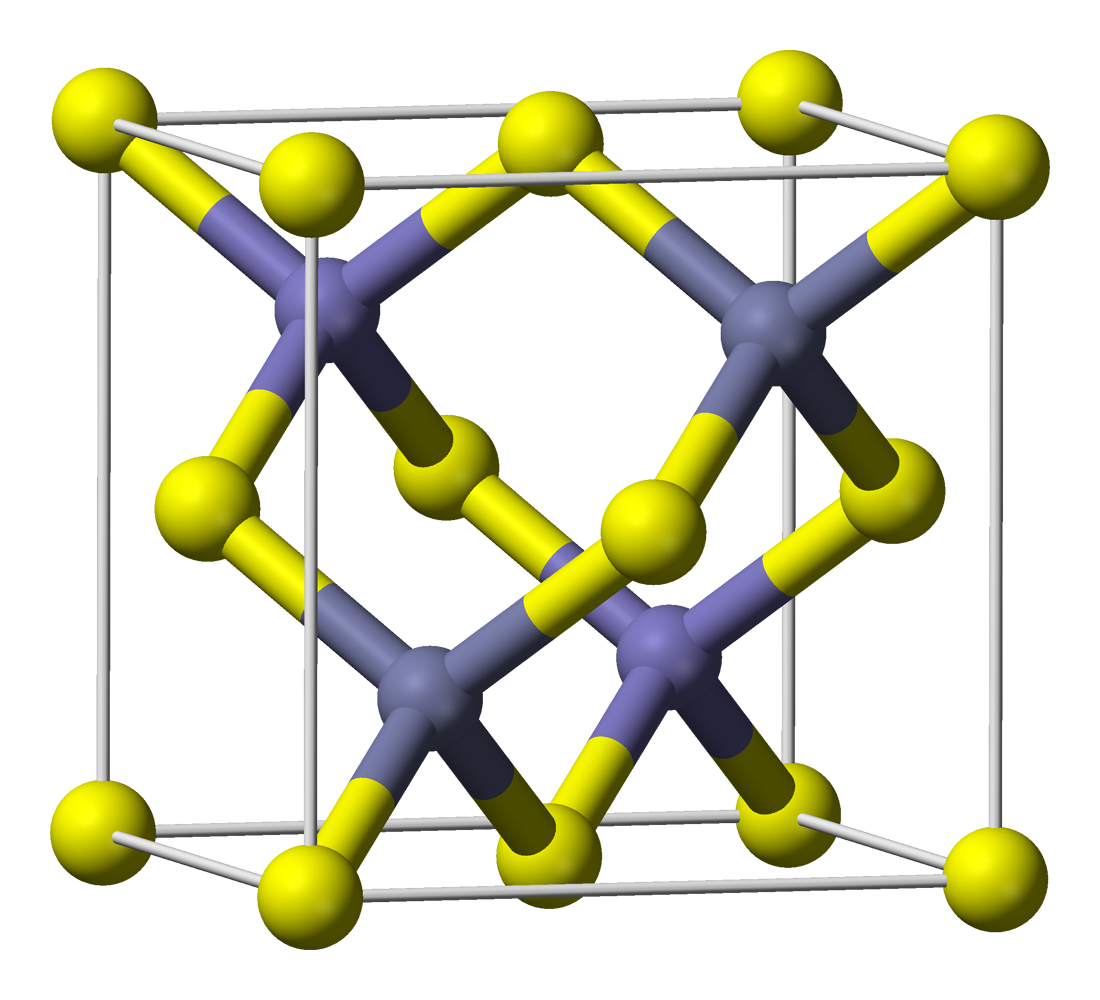
The crystal structure is zincblende with a 0.648 nm lattice constant.
InSb is a narrow direct band gap semiconductor with an energy band gap of 0.17 eV at 300 K and 0.23 eV at 80 K.
Undoped InSb possesses the largest ambient-temperature electron mobility of 78000 cm2/(V⋅s), electron drift velocity, and ballistic length (up to 0.7 μm at 300 K) of any known semiconductor, except for carbon nanotubes.
Indium antimonide
Indium antimonide (InSb) is a crystalline compound made from the elements indium (In) and antimony (Sb). It is a narrow-gap semiconductor material from the III-V group used in infrared detectors, including thermal imaging cameras, FLIR systems, infrared homing missile guidance systems, and in infrared astronomy. Indium antimonide detectors are sensitive to infrared wavelengths between 1 and 5 μm.
Indium antimonide was a very common detector in the old, single-detector mechanically scanned thermal imaging systems. Another application is as a terahertz radiation source as it is a strong photo-Dember emitter.
The intermetallic compound was first reported by Liu and Peretti in 1951, who gave its homogeneity range, structure type, and lattice constant. Polycrystalline ingots of InSb were prepared by Heinrich Welker in 1952, although they were not very pure by today's semiconductor standards. Welker was interested in systematically studying the semiconducting properties of the III-V compounds. He noted how InSb appeared to have a small direct band gap and a very high electron mobility. InSb crystals have been grown by slow cooling from liquid melt at least since 1954.
In 2018, a research team at Delft University of Technology claimed that indium antimonide nanowires showed potential application in creating Majorana zero mode quasiparticles for use in quantum computing; Microsoft opened a laboratory at the university to further this research, however Delft later retracted the paper.
InSb has the appearance of dark-grey silvery metal pieces or powder with vitreous lustre. When subjected to temperatures over 500 °C, it melts and decomposes, liberating antimony and antimony oxide vapors.
The crystal structure is zincblende with a 0.648 nm lattice constant.
InSb is a narrow direct band gap semiconductor with an energy band gap of 0.17 eV at 300 K and 0.23 eV at 80 K.
Undoped InSb possesses the largest ambient-temperature electron mobility of 78000 cm2/(V⋅s), electron drift velocity, and ballistic length (up to 0.7 μm at 300 K) of any known semiconductor, except for carbon nanotubes.
Recent media
Recent media