



Community hub
Recent from talks
Contribute something to knowledge base
Content stats: 0 posts, 0 articles, 1 media, 0 notes
Members stats: 0 subscribers, 0 contributors, 0 moderators, 0 supporters
Subscribers
Supporters
Contributors
Moderators
Hub AI
Climate of Iceland AI simulator
(@Climate of Iceland_simulator)
Hub AI
Climate of Iceland AI simulator
(@Climate of Iceland_simulator)
Climate of Iceland
Iceland has a subpolar oceanic climate (Köppen climate classification Cfc) near the southern coastal area and tundra (Köppen ET) inland in the highlands. The island lies in the path of the North Atlantic Current, which makes its climate more temperate than would be expected for its latitude just south of the Arctic Circle. This effect is aided by the Irminger Current, which also helps to moderate the island's temperature. The weather in Iceland is notoriously variable.
The aurora borealis is often visible at night during the winter. The midnight sun can be experienced in summer on the island of Grímsey off the north coast; the remainder of the country, since it lies just south of the polar circle, experiences a twilight period during which the sun sets briefly, but still has around two weeks of continuous daylight during the summer.
The Icelandic winter is relatively mild for its latitude, owing to maritime influence and proximity to the warm currents of the North Atlantic Gyre. The southerly lowlands of the island near the coast average around 1 °C (34 °F) in winter, while the northern lowland coast averages around −1 °C (30 °F). The lowest temperatures in the northern inland part of the island range from around −25 to −30 °C (−13 to −22 °F). The lowest temperature on record is −39.7 °C (−39.5 °F).
The average July temperature in the southern part of the island is 10–13 °C (50–55 °F). Warm summer days can reach 20–25 °C (68–77 °F). The highest temperature recorded was 30.5 °C (86.9 °F) in the Eastern fjords in 1939. Annual average sunshine hours in Reykjavík are around 1300, which is similar to towns in Scotland and Ireland.
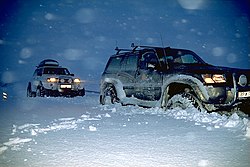
Iceland, especially inland and during winter, is frequently subject to abrupt and dramatic changes in weather that can sharply reduce visibility, as well as rapidly increasing wind speed and precipitation, and shift temperature.
Generally, wind speeds tend to be higher in the highlands, but topographical features can aggravate winds and cause strong gusts in lowland areas. Wind speed in the lowlands reaches 18 m/s (65 km/h) on 10–20 days per year, but on upwards of 50 days per year in places in the highlands. The strongest measured 10-minute sustained wind speed is 62.5 m/s (225 km/h) and the strongest gust 74.2 m/s (267 km/h). Heavy dust storms can be generated by strong glacial winds, and can be very strong. Up to 10 tonnes (11 short tons) of material can be in motion per transect per hour. These storms are very frequent in the early summer in the arid highland areas north of the Vatnajökull glacier.
Thunderstorms are extremely rare for any specific location in Iceland, with fewer than five storms per year in the southern part of the island. They are most common in early or late summer. They can be caused by warm air masses coming up from Europe, or deep lows from the southwest in wintertime. Lightning can usually be observed in connection with ash plumes erupting from the island's volcanoes. Vortices, sometimes on the scale of tornadoes, also occur with volcanic eruptions. Landspouts and waterspouts are occasionally observed. Classic mesocyclone derived tornadoes (i.e. forming from supercells) are very rare, but have been observed. Any of these do occasionally cause damage, although the sparse population further reduces the probability of detection and the hazard.
There is a persistent area of low pressure near Iceland known as the Icelandic Low, found between Iceland and Greenland. This area affects the amount of air brought into the Arctic to the east, and the amount coming out of the Arctic to the west. It is part of a greater pressure system known as the North Atlantic Oscillation (NAO).
Climate of Iceland
Iceland has a subpolar oceanic climate (Köppen climate classification Cfc) near the southern coastal area and tundra (Köppen ET) inland in the highlands. The island lies in the path of the North Atlantic Current, which makes its climate more temperate than would be expected for its latitude just south of the Arctic Circle. This effect is aided by the Irminger Current, which also helps to moderate the island's temperature. The weather in Iceland is notoriously variable.
The aurora borealis is often visible at night during the winter. The midnight sun can be experienced in summer on the island of Grímsey off the north coast; the remainder of the country, since it lies just south of the polar circle, experiences a twilight period during which the sun sets briefly, but still has around two weeks of continuous daylight during the summer.
The Icelandic winter is relatively mild for its latitude, owing to maritime influence and proximity to the warm currents of the North Atlantic Gyre. The southerly lowlands of the island near the coast average around 1 °C (34 °F) in winter, while the northern lowland coast averages around −1 °C (30 °F). The lowest temperatures in the northern inland part of the island range from around −25 to −30 °C (−13 to −22 °F). The lowest temperature on record is −39.7 °C (−39.5 °F).
The average July temperature in the southern part of the island is 10–13 °C (50–55 °F). Warm summer days can reach 20–25 °C (68–77 °F). The highest temperature recorded was 30.5 °C (86.9 °F) in the Eastern fjords in 1939. Annual average sunshine hours in Reykjavík are around 1300, which is similar to towns in Scotland and Ireland.
Iceland, especially inland and during winter, is frequently subject to abrupt and dramatic changes in weather that can sharply reduce visibility, as well as rapidly increasing wind speed and precipitation, and shift temperature.
Generally, wind speeds tend to be higher in the highlands, but topographical features can aggravate winds and cause strong gusts in lowland areas. Wind speed in the lowlands reaches 18 m/s (65 km/h) on 10–20 days per year, but on upwards of 50 days per year in places in the highlands. The strongest measured 10-minute sustained wind speed is 62.5 m/s (225 km/h) and the strongest gust 74.2 m/s (267 km/h). Heavy dust storms can be generated by strong glacial winds, and can be very strong. Up to 10 tonnes (11 short tons) of material can be in motion per transect per hour. These storms are very frequent in the early summer in the arid highland areas north of the Vatnajökull glacier.
Thunderstorms are extremely rare for any specific location in Iceland, with fewer than five storms per year in the southern part of the island. They are most common in early or late summer. They can be caused by warm air masses coming up from Europe, or deep lows from the southwest in wintertime. Lightning can usually be observed in connection with ash plumes erupting from the island's volcanoes. Vortices, sometimes on the scale of tornadoes, also occur with volcanic eruptions. Landspouts and waterspouts are occasionally observed. Classic mesocyclone derived tornadoes (i.e. forming from supercells) are very rare, but have been observed. Any of these do occasionally cause damage, although the sparse population further reduces the probability of detection and the hazard.
There is a persistent area of low pressure near Iceland known as the Icelandic Low, found between Iceland and Greenland. This area affects the amount of air brought into the Arctic to the east, and the amount coming out of the Arctic to the west. It is part of a greater pressure system known as the North Atlantic Oscillation (NAO).
Recent media
Recent media