Recent from talks
Nothing was collected or created yet.
Chlodio
View on WikipediaYou can help expand this article with text translated from the corresponding article in French. (December 2021) Click [show] for important translation instructions.
|
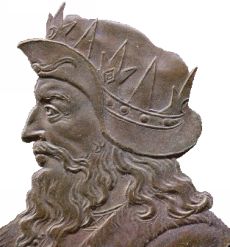
Chlodio (probably died after 450), also Clodio, Clodius, Clodion, Cloio or Chlogio, was a Frankish king who attacked and then apparently ruled Roman-inhabited lands around Cambrai and Tournai, near the modern border of Belgium and France. He is known from very few records.
His influence probably reached as far south as the River Somme. He was therefore the first Frankish ruler to become established so deep within the Roman Empire, and distant from the border regions where the Franks had already been established for a long time. He was possibly a descendant of the Salian Franks, who Roman sources report to have settled within Texandria in the 4th century.
Gregory of Tours reported that in his time people believed that the Merovingian dynasty, who were still ruling, were descended somehow from Chlodio.
Name
[edit]Chlodio is a short form of Frankish names such as *Hlodowig (the same name as Clovis, Louis and Ludwig) or *Hlodhari (Chlothar, Lothar, Lothair, Luther), which are derived from the Germanic root *hlod- ('famous').[1]
Ancestry
[edit]In later medieval chronicles, several different ancestries were given, naming Franks who were known from earlier Roman historical records. These pedigrees are considered unreliable today.
The non-contemporary Liber Historiae Francorum says his father was Pharamond, a Frankish king only known from medieval records. Pharamond in turn was said to be the son of a real Frankish king, known to have fought the Romans, named Marcomer.
The Chronicle of Fredegar, on the other hand, makes Chlodio a son of Theudemeres, another real Frankish king who Gregory of Tours reported to have been executed with his mother by the Romans.
Attestations
[edit]Gregory of Tours (II,9) reported that "Chlogio" (as he spells his name in Latin) attacked from a fort (castrum) named "Dispargum" within or upon the bounds of the "Thoringian" land, which is described as being west of the Rhine and north of the Romanized population living in Gaul north of the Loire. One translation of what Gregory wrote, adding some Latin key words in square brackets, is as follows:
- It is commonly said that the Franks came originally from Pannonia and first colonized the banks of the Rhine. Then they crossed the river, marched through Thuringia [Thoringiam transmeasse], and set up in each country district [pagus] and each city [civitas] long-haired kings chosen from the foremost and most noble family of their race. [...] They also say that Clodio, a man of high birth and marked ability among his people, was King of the Franks and that he lived in the castle of Duisberg [Dispargum castrum] in Thuringian territory [in terminum Thoringorum]. In those parts, that is towards the south, the Romans occupied the territory as far as the River Loire. [...] Clodio sent spies to the town of Cambrai. When they discovered all that they needed to know, he himself followed and crushed the Romans and captured the town. He lived there only a short time and then occupied the country up to the Somme. Some say that Merovech, the father of Childeric, was descended from Clodio.[2]
This description of locations does not match the normal medieval and modern "Thuringia", which is far inland and east of the Rhine and distant from all known Frankish areas.[3][4]
Dispargum has therefore been interpreted many ways, for example possibly as Duisburg on the Rhine itself, or Duisburg near Brussels, or Diest, which is also in Belgium.[4] The latter two proposals would fit the geography well, because they are within striking distance of the Silva Carbonaria, west of the Rhine, and close to Toxandria, which is known to have been settled by the Salians in the time of Julian the Apostate. It suggests that "Thoringorum" (genitive case) was actually referring to the "Civitas Tungrorum". This matches Gregory's previous mention in the same passage of how the Franks had earlier settled on the banks of the Rhine and then moved into "Thoringia" on the left side of the Rhine.
According to this account, Chlodio held power in the northernmost part of still-Romanized Northern Gaul, together with an area further northeast apparently already Frankish.
Two works written after Gregory of Tours, added details which are generally considered unreliable, but which may contain some facts derived from other sources. These are the Liber Historiae Francorum and the Chronicle of Fredegar. It is the first of these which specifies that Chlodio first pushed west through Roman-inhabited territories of the Silva Carbonaria, a large forested region which ran roughly from Brussels to the Sambre, and then took the Roman city of Turnacum (modern Tournai), before moving south to Cameracum (modern Cambrai). According to Lanting & van der Plicht (2010), the Frankish conquest of Turnacum and Cameracum probably happened in the period 445–450.[5] Syvänne Syvänne (2020) concludes that the Frankish War took place between 441 and 446.
In about 445 AD[6] or 448 AD,[7] a marriage party of the Franks of Chlodio was attacked and defeated at a village named Vicus Helena by Flavius Aëtius, the commander of the Roman army in Gaul. This is known because the future emperor Majorian was present, and this incident was therefore celebrated in the panegyric written by Sidonius Apollinaris for him. The passage describes "Cloio" as having overrun the land of the Atrebates (Artois, a province north of the Somme, and partly between Tournai and Cambrai).[8]
Possible connection to Merovingians
[edit]As explained above, Gregory of Tours mentions that "some people said" that Merovech, the ancestor of the 'Merovingian' dynasty, was descended from Chlodio. Merovech's supposed son Childeric I is known only from records associating him with Romanized northern Gaul. Only once Childeric's son Clovis I took power in that area did he turn to the Frankish kingdoms that were still ruling in more traditionally Frankish areas. According to Gregory's understanding, the original Franks living west of the Rhine had different kings in each Roman district (pagus or civitas), but they were all part of one specific noble family, which had included Chlodio. However, according to the Gesta episcoporum Cameracensium, Clovis and his noble-blooded competitor King Ragnachar of Cambrai (the town Chlodio had put under Frankish control) were related not through the male line, but through Clovis's mother, Basina, a "Thuringian" princess whom his father met when exiled from Gaul. Gregory reports that Clovis asked Ragnachar: "Why have you humiliated our family in permitting yourself to be bound? It would have been better for you to die." He then killed him with an axe and told Radnachar's brother Ricchar, "If you had aided your brother, he would not have been bound", before killing Ricchar in the same way.
A contemporary Roman historian, Priscus writes of having witnessed in Rome, a "lad without down on his cheeks as yet and with fair hair so long that it poured down his shoulders, Aëtius had made him his adopted son". Priscus writes that the excuse Attila used for waging war on the Franks was the death of their king and the disagreement of his children over the succession, the elder being allied with Attila and the younger with Aëtius. It has been speculated that this Frankish succession dispute may involve the royal family which supposedly included Chlodio and Merovech.[9] On the other hand, it has also been argued that the Franks in this story must be Rhineland Franks, with whom Aëtius was known to have had various interactions.[10]
References
[edit]- ^ Wolfgang Jungandreas and Reinhard Wenskus (1981). "Chlodio". Germanische Altertumskunde Online.
- ^ Gregory of Tours, The History of the Franks, Lewis Thorpe translation, Penguin. Section II.9. p.125. For the Latin see dmgh edition p.57.
- ^ Ulrich Nonn, Die Franken, pp.79-83
- ^ a b Freiherren von Richthofen (1841), "Review of "Der lex Salica und der lex Anglorum et Werinorum Alter und Heimat, von Hermann Müller, ordentlichem Professor der Rechte zu Würzburg" Würzburg, 1840", Kritische Jahrbücher für deutsche Rechtswissenschaft, vol. 5, p. 1000 (useful because includes quotations of early references)
- ^ Lanting, J. N.; van der Plicht, J. (2010). "De 14C-chronologie van de Nederlandse Pre- en Protohistorie VI: Romeinse tijd en Merovische periode, deel A: historische bronnen en chronologische thema's". Palaeohistoria 51/52 (2009/2010) (in Dutch). Groningen: Groningen Institute of Archaeology. pp. 46–47. ISBN 9789077922736. Retrieved 8 July 2020.
- ^ Syvänne, Ilkka (2020), Military History of Late Rome 425–457, Pen & Sword Military, pp. 57–62, ISBN 978-1-4738-7217-2
- ^ Wood, Ian (23 June 2014). The Merovingian Kingdoms 450 - 751. Routledge. pp. 37–. ISBN 978-1-317-87116-3.
- ^ Sidonius [1]
- ^ MacDowall, Simon (20 September 2015). Catalaunian Fields AD 451: Rome's Last Great Battle. Bloomsbury Publishing. pp. 23–. ISBN 978-1-4728-0744-1.
- ^ Ulrich Nonn, Die Franken, p.86
Sources
[edit]External links
[edit]- Stirnet: Franks1 (subscription required)
- Stirnet: Franks2 (subscription required)
Chlodio
View on GrokipediaName and Identity
Etymology and Variations
The name Chlodio derives from Proto-Germanic elements *hlōdaz, meaning "fame" or "loud," and *wīgą, meaning "warrior" or "battle," resulting in an interpretation such as "famous in battle" or "renowned warrior."[3] This compound structure is characteristic of early Germanic personal names, which often combined descriptive or aspirational elements to signify valor and renown. Historical texts present several variations of the name, reflecting adaptations in Latin transcription and regional linguistic influences. In the 6th-century Historia Francorum by Gregory of Tours, the name appears as Chlodio, emphasizing the Frankish leader's high birth and exploits.[1] The 8th-century Liber Historiae Francorum renders it as Chlodionem, portraying him as a successor in the Frankish line.[1] Other Latin sources employ forms like Chlogio, Cloio, Clodius, or Clodion, while possible Old High German equivalents include Chlodowig, akin to later names in the Merovingian tradition. These variations illustrate Frankish naming conventions, where dithematic names built from Proto-Germanic roots denoted status and prowess, often shortened for brevity. Latin chroniclers, writing in a Roman context, frequently simplified Germanic sounds—such as rendering the fricative /x/ as /k/ or /g/—to fit classical orthography, thus preserving the name's essence while adapting it to ecclesiastical and imperial records.[4] This process highlights the interplay between oral Frankish traditions and written Latin historiography.Debated Origins
Chlodio is widely regarded by historians as a leader of the Salian Franks, a subgroup of the broader Frankish confederation active along the Roman Rhine frontier in the 4th and 5th centuries. Roman historical accounts, such as those preserved in the works of Sulpicius Alexander and referenced by later chroniclers, depict the Salian Franks as a Germanic tribal group that had settled in the Low Countries and Toxandria region after being defeated and partially integrated by Roman forces under Emperor Julian in 358 CE. However, modern scholarship, particularly Matthias Springer's analysis, challenges the notion of "Salian" as a distinct ethnic designation, arguing instead that it derives from a Germanic legal term (saljan, meaning "to stand in hall" or denoting companionship in assembly) rather than a tribal identity, suggesting the label was a Roman-imposed or functional descriptor for Frankish warriors under treaty obligations.[5] Claims of Chlodio's Roman ancestry, including fabricated genealogies linking him to Pharamond—a purported first king of the Franks—or to Roman senators, emerged in medieval texts like the 8th-century Liber Historiae Francorum and the Chronicle of Fredegar. These narratives, which trace Frankish origins to Trojan exiles or Roman nobility, served to legitimize Merovingian rule by blending barbarian and imperial lineages. Modern historians, however, unanimously dismiss these as legendary inventions lacking contemporary evidence, with Edward James emphasizing in his study that such accounts reflect 8th-century Carolingian propaganda rather than 5th-century reality. Similarly, 19th- and early 20th-century scholars like Karl Ferdinand Werner initially entertained hybrid Roman-Frankish elite theories but later works, including James's, firmly reject Roman paternal origins for Chlodio, favoring a purely Germanic Frankish background rooted in the Rhine tribal migrations. Archaeological findings from 5th-century sites in northern Gaul, such as the cemeteries at Haillot and other locations in Belgica Secunda, provide indirect support for Chlodio's era by revealing the emergence of a mixed Romano-Frankish elite class. These sites yield grave goods combining Roman luxury items (e.g., glassware and pottery) with Germanic military artifacts like Krefeld-Gellep type swords and Danubian fibulae, indicating cultural fusion among warrior groups advancing into Roman territory around 430–450 CE.[6] This material evidence counters earlier notions of an archaeological "hiatus" in the region and underscores the gradual integration of Frankish settlers with Gallo-Roman populations, though it does not resolve debates over Chlodio's personal ethnic makeup. Scholars like Patrick Périn interpret these assemblages as markers of elite negotiation between Roman administrative structures and incoming Germanic leaders, aligning with Chlodio's reported incursions but without confirming non-Frankish heritage.[6]Historical Attestations
Primary Sources
The principal primary source attesting to Chlodio is Gregory of Tours' Historia Francorum (History of the Franks), completed around 590 AD. In Book II, Chapter 9, Gregory presents Chlodio as a leader of high birth and distinguished ability among the Salian Franks, who resided at the stronghold of Dispargum near the Thuringian border. According to the consular annals, during the consulship of Aetius and Symmachus (446 CE), Chlodio crossed the Rhine with a large army, dispatched spies to reconnoiter the Roman city of the Nervii (known as Civitas Nerviorum or Cambrai), and captured it by overpowering the defenders. His forces then pressed southward, engaging and defeating Roman troops near the Somme River, seizing extensive territory in the process, and establishing Frankish settlements while subduing the local population.[7]About this time a man named Chlodio, of high birth and marked ability among his people, was king of the Franks and lived in the stronghold of Dispargum, in the territory of the Thuringians. In the year of the consulship of Aetius and Symmachus a great army of the Franks crossed the Rhine and came to the frontiers of the Nervii, which the Romans call the Civitas Nerviorum. Sending spies before him, Chlodio took possession of the city and, after overcoming the guards, dwelt there with his people. Thence he advanced to the Somme, fought the Romans, took much spoil, and subdued the region as far as the Somme.[7]Fifth-century Roman sources offer only indirect references to Frankish military activities during Chlodio's era, without explicitly naming him. The historian Priscus of Panium, in his now-fragmentary history of Byzantine affairs (composed in the mid-5th century), describes Frankish incursions into Roman Gaul and their alliances amid the Hunnic threats of the 440s and 451 AD, including reports of internal Frankish conflicts that disrupted Roman-Frankish relations. Gregory's account, written roughly 140–150 years after the events it describes, draws on a mix of consular records, oral traditions from Frankish elites, and possibly lost Roman chronicles like that of Renatus Profuturus Frigeridus, but it interweaves verifiable history with legendary motifs, such as the emphasis on Chlodio's noble lineage to legitimize Merovingian rule. No contemporary written records from the Franks themselves survive, as their early society relied primarily on oral historiography rather than literacy.[8]
