Hubbry Logo
Silva CarbonariaSilva CarbonariaMain
Open search
Silva Carbonaria
Community hub
Silva Carbonaria
logo
8 pages, 0 posts
0 subscribers
Be the first to start a discussion here.
Silva Carbonaria
Silva Carbonaria
from Wikipedia
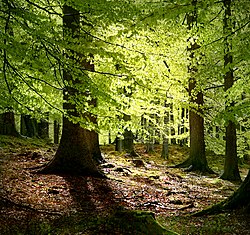
Compared to modern old-growth beech forests (shown here: Gribskov, Nordsjælland, Denmark), Silva Carbonaria was remarkably dense

The Silva Carbonaria (Latin for 'charcoal forest')[1] was the dense old-growth forest of beech and oak that formed a natural boundary during the Late Iron Age through Roman times into the Early Middle Ages across what is now western Wallonia. The Silva Carbonaria was a vast forest that stretched from the rivers Zenne and the Dijle in the north to the Sambre in the south.[2] Its northern outliers reached the then marshy site of modern Brussels.[3]

Further to the southeast, the higher elevation and deep river valleys were covered by the even less penetrable ancient Arduenna Silva, the deeply folded Ardennes, which are still partly forested to this day. To the east, the forested zone was possibly considered to extend to the Rhine. It was there in Cologne in 388 CE that the magistri militum praesentalis Nannienus and Quintinus[4] began a counter-attack against a Frankish incursion from across the Rhine, which was fought in the Silva Carbonaria.[5]

Roman road

[edit]
The green diamonds show places named as having been in the Silva Carbonaria in medieval records.[6] The Roman road between Bavay and Tongeren is shown in brown.

A great Roman road forming a "strategic axis"[7] linked the Rhine crossing at Cologne with Maastricht, where it crossed the Maas at the head of navigation. Skirting the northern edges of the Silva Carbonaria, it passed through Tongeren, Kortrijk and Cambrai to reach the sea at Boulogne. The highway was the main east–west route in a landscape where the river valleys, tributaries of the Meuse and the Scheldt, tended southwest to northeast. It remained viable through the Early Middle Ages as the chaussée Brunehaut, the "Road of Brunehaut". As a public work its scale had become unimaginable in the Middle Ages: the chronicler Jean d'Outremeuse solemnly related in 1398 that Brunehaut, wife of Sigebert I, had built this wide paved road in 526, and that it was completed in a single night with the devil's aid.[8]

Use as a border

[edit]

There are signs that the Silva Carbonaria represented the boundary between the Roman provinces of Gallia Belgica and Germania Inferior. In the Middle Ages, these provinces were still represented by the church dioceses of Reims and Cologne. On a smaller level, the forest served as a boundary between the Roman civitates of the Tungri to the east and the Nervii to the west. This boundary continued to be used into the Middle ages as the boundary between the bishoprics of Liège and Cambrai.[6]

With the collapse of central Roman administration in the fourth century, Germanic Franks living along the Rhine border established kingdoms within the empire, and settled in less populated areas. The Salian Franks expanded their settlements from a starting point near Nijmegen until they pressed into the more populated and Romanized areas in the Silva Carbonaria and near the Maas. The Romanized population came to be known as *walhōz or "strangers" to the Germanic Franks—continued speaking a Late Latin, whose name survives in Walloon. In the past the Romance-Germanic linguistic division that marks Belgium to this day has been perhaps too facilely linked[9] to these geographic parameters.[10]

In the 19th century, the iron ore in the formerly wooded valleys fuelled the sillon industriel of Wallonia

For a time in the sixth century, the Silva Carbonaria formed a barrier between the West Frankish kingdom of Clovis and the East Frankish kingdom of Sigebert the Lame, centred on Cologne, until he was assassinated in the forest of Buchaw by his son some time after 507, and Clovis joined the two kingdoms. [11] The Liber Historiae Francorum mentions that the Neustrian army invaded Austrasia in the succession battle of Pepin of Herstal and the war started when Ragenfrid and his army traversed the Silva Carbonaria.[12] The Annales Mettenses Priores note that the wealth of Pepin of Herstal's family was their vast territories between the Silva Carbonaria and the river Meuse.[13]

Throughout the rule of the Merovingian dynasty, founded by Clovis, the Silva Carbonaria thus became the boundary between their two kingdoms of Austrasia and Neustria.[6] The Silva Carbonaria is mentioned in the Salic Law of the Franks,[14] where it marked "the boundary of the territories occupied by the Frankish people".[15] The Liber Historiae Francorum mentions that the war of succession after the death of Pepin of Herstal started when the Neustrian army, under the command of Ragenfrid (mayor of the palace), traversed the Silva Carbonaria[16]

Medieval monasteries

[edit]

Extensive tracts of the untamed woodlands belonged to monasteries. The Benedictine Abbey of Lobbes lay in the Silva Carbonaria and that of Saint Foillan, in the present-day Sonian Forest (Forêt de Soignes/Zoniënwoud) not far from Nivelles.[17] From the 8th century onwards, parts of the Silva Carbonaria were cleared for agriculture, eventually subdividing it in several smaller isolated forests like the Sonian forest today.[18]

Economic importance

[edit]

The charcoal—which gave the forest its name and into which the once seeming inexhaustible woods were slowly converted—was required to fuel the scattered smelting furnaces that forged the plentiful iron found in outcroppings laid bare by riverside erosion. Even before the Romans arrived, iron weapons forged in the Silva Carbonaria were traded by the Belgae to their cousins in the southeast of Britain. In the High Middle Ages further woodlands were cleared. Today the most significant remnant[19] of the Silva Carbonaria is the Sonian Forest,[20] preserved because it had been set aside as a noble hunt. At the start of the nineteenth century the area of this remnant of the primeval forest still covered about 100 square kilometres, but due to timber cutting its area has diminished to its current protected area of 44.21 km².

Notes

[edit]

References

[edit]

Primary sources

[edit]

Revisions and contributorsEdit on WikipediaRead on Wikipedia
from Grokipedia
Silva Carbonaria, Latin for " forest," was a dense primarily composed of () and trees that spanned central , serving as a natural boundary from the Late through Roman times and into the . Its name derives from its exploitation for production, essential for and iron in antiquity, with evidence of sustained use persisting until at least the end of the Early Medieval period. The forest's extent covered areas from the and rivers eastward to the , though focused in the Brabant region, influencing regional ecology and patterns by acting as a barrier to expansion and migration. Remnants, such as the south of —a since 2017—preserve elements of its original beech-dominated composition, while modern interdisciplinary studies employing , , and anthracological analysis continue to reconstruct its historical boundaries, exploitation, and gradual clearance for and predating the 1500s. This vanishing woodland exemplifies the transformative impact of resource extraction and land-use changes on prehistoric and medieval European landscapes.

Geography and Ecology

Extent and Location

The Silva Carbonaria encompassed a vast expanse of central Belgium during the Roman era and early Middle Ages, primarily within the modern provinces of Flemish Brabant, Walloon Brabant, and adjacent areas of Hainaut and Namur. Archaeological findings, such as charcoal production pits from the period circa 650–1250 AD, provide material evidence of intensive woodland exploitation across this region, supporting its identification as a dense, managed forest. Its location positioned it as a between settled Romanized territories to the west and less integrated frontier zones to the east, potentially aligning with administrative divisions such as the boundary between the provinces of and . Remnants of this persist in areas like the south of , designated a in 2017, though the original extent covered a significantly larger area of central Belgian lowlands. Precise delineation remains uncertain due to sparse pre-medieval records and extensive later , with scholarly reconstructions relying on indirect historical references and paleoecological data indicating a coverage of several thousand square kilometers dominated by and stands. The forest's southern fringes likely merged with the highlands, while northern limits approached the river basin, forming an ecological and cultural divide in ancient .

Forest Composition and Natural Features

The Silva Carbonaria was characterized by dense old-growth stands dominated by European beech (Fagus sylvatica) and oak species such as pedunculate oak (Quercus robur) and sessile oak (Quercus petraea), which formed the core of its woodland composition in the northwest European lowlands. Charcoal analyses from Early Medieval pit kilns (c. 650–1250 AD) in central Belgium reveal that beech comprised the majority of wood used in early production phases, comprising up to 80–90% of assemblages in some sites, indicative of its prevalence in the pre-exploitation forest. This dominance aligned with beech's adaptation to the region's temperate climate, loamy and sandy soils, and moderate rainfall, where it formed extensive pure or mixed stands reaching heights of 30–40 meters with broad crowns creating a closed canopy. Oak species contributed structural diversity, offering larger boles for timber and higher-density wood suitable for sustained charcoal yields, though initially less abundant than . By the High Medieval period, kiln assemblages showed a marked shift, with rising to 60–70% dominance in younger sites, reflecting selective depletion of through repeated and burning rather than wholesale clearance. vegetation likely included shade-tolerant shrubs like (Corylus avellana) and ferns, though limited direct evidence exists; studies from associated sediments confirm 's role in the natural vegetation mosaic, with lesser contributions from (Carpinus betulus) and (Ulmus spp.) on moister sites. Natural features of the Silva Carbonaria emphasized its and impenetrability, with multi-layered canopies fostering minimal undergrowth and restricting large-scale human penetration without axes or . The forest spanned undulating plateaus and river valleys across modern-day Belgium's and Brabant regions, incorporating seasonal wetlands and streams that enhanced but also impeded drainage and settlement. Its old-growth status, with trees aged centuries, supported nutrient cycling via leaf litter and mast production, sustaining wildlife such as deer and boar, while the charcoal economy exploited its vast —estimated at millions of cubic meters—without fully eradicating the core stands until later medieval intensification.

Ancient History

Pre-Roman Tribal Boundaries

The dense old-growth beech and oak forests of the region later termed Silva Carbonaria by Romans acted as a formidable natural barrier during the Late , delineating territories among tribes in what is now central-southern , extending from near the River eastward toward the and into the fringes. This terrain, characterized by thick undergrowth and limited clearings, restricted movement and settlement, fostering distinct tribal domains north-south and east-west without formalized borders but enforced by environmental and martial realities. Archaeological evidence of hill forts and oppida, such as those near and the Condroz plateau, underscores sparse human presence within the core forest, pushing populations to its edges. To the northwest, the controlled lands from the to the River, encompassing modern Hainaut and parts of Brabant, with their southern frontier abutting the forest's northern reaches around the 50th parallel. described the Nervii as fierce warriors inhabiting wooded and marshy areas, their territory bordering the to the west and extending inland to resist easy incursion from southern groups. Southeastward, the held domains along the and southern , including areas near modern and , with their northern limits touching the forest's southern extensions; noted their proximity to the and alliances with trans-Rhenane Germans. Intervening the and were the Condrusi and Segni, smaller groups Caesar classified as Germanic in origin and kinship, dwelling in the eastern forest margins between the and tributaries; their envoys in 53 BC affirmed client status under the Treveri while disclaiming revolt involvement, highlighting the forest's role in buffering alliances. The , occupying northeast territories from the Maas to the —including northern edges—faced the across northern forest tracts, as evidenced by Ambiorix's raids spanning these zones in 54 BC. These configurations, fluid yet forest-constrained, reflected divisions Caesar attributed to Germanic migrations circa 150-100 BC, with the region serving as a defensible no-man's-land amid inter-tribal skirmishes and migrations.

Roman Era References and Strategic Role

The Silva Carbonaria, a vast expanse of dense and in northern , served as a critical during the Roman era, complicating overland movements and delineating territorial divisions. Historical analysis indicates it approximated the boundary between the Roman provinces of to the south and to the northeast, facilitating administrative control while hindering unauthorized crossings. This positioning rendered the forest strategically vital for defending against Germanic incursions from across the , as its impenetrable thickets merged with the plateaus, posing a formidable obstacle to northern and eastern threats. Late Roman military records reference the Silva Carbonaria explicitly in the context of campaigns. The historian Sulpicius Alexander (c. 350–425 AD), whose work survives in fragments via , describes a Roman victory there during the expedition of comes domesticorum Quintinus against the around 355–360 AD, following which forces pursued invaders beyond the before suffering defeat at . This engagement underscores the forest's role as a contested zone, where Roman legions engaged emerging Germanic confederations amid declining imperial authority in the . To mitigate the forest's logistical challenges, Romans engineered key infrastructure, including paved roads that pierced its core for rapid troop deployment and supply lines. A primary example is the via running from Bagacum (modern Bavay) to Tongernum (Tongeren), forming part of a broader "strategic axis" connecting the crossing at Colonia Agrippina () to the Meuse River at , thereby linking the to interior Gallic heartlands. These routes, constructed from the AD onward, enabled efficient control of resources and populations in an otherwise isolating , reflecting Rome's adaptation of first-principles to causal environmental constraints.

Infrastructure Development

The Roman era marked the primary phase of infrastructure development within the Silva Carbonaria, focused on overcoming the forest's to secure dominance and extract resources like timber and for iron production. Key efforts centered on road construction, as the legions engineered durable pathways to link frontier outposts and facilitate logistics in an otherwise impenetrable woodland barrier between Romanized and Germanic territories. These roads, typically built with a foundation of compacted , gravel layers, and surfaced with stone or slabs, enabled rapid troop deployments and the of —essential fuel for regional operations that supplied armories and construction. A prominent example was the strategic Roman connecting Colonia Agrippina () on the to Trajectum ad Mosam (), traversing the forest's northern fringes and crossing the at a navigable point to integrate with broader Gallic networks. This axis, constructed likely in the AD under emperors like or , supported the Two Belgicas' defense against incursions and boosted trade in forest-derived goods, with archaeological remnants including paved segments and milestones attesting to its engineering rigor. Further extensions tied into the Via Belgica, the main artery from Gesoriacum () to , passing through Atuatuca Tungrorum (Tongeren) approximately 15 km west of ; this route's Bavay-Tongeren segment alone spanned over 100 km of aligned, elevated causeways designed for all-weather use. Beyond roads, limited evidence points to ancillary developments like cleared access tracks for and furnaces, tied to pre-Roman ironworking traditions that Romans systematized for imperial needs. Surveys of metal production sites in the Ardennes-Brabant zone reveal heaps and furnace bases from the late into Roman times, suggesting semi-permanent setups clustered near oak-beech stands for fuel efficiency, though the forest's inaccessibility constrained large-scale villas or aqueducts. These infrastructures declined post-3rd century amid barbarian pressures, leaving fragmented traces integrated into later medieval paths.

Medieval Transformations

Frankish and Early Medieval Use

During the Merovingian period (c. 481–751), the Silva Carbonaria served as a critical natural boundary within the Frankish realms, delineating the sub-kingdoms of Neustria to the west and Austrasia to the east following the death of Clovis I in 511. This forested expanse, stretching across modern-day Belgium and northern France, impeded swift military movements and reinforced political divisions among the Frankish heirs, as seen in the persistent separation of royal territories along its edges. The dense beech and oak stands acted as a de facto frontier, complicating logistics for armies operating between the Rhineland heartlands and the Seine-Oise basins, exemplified by the 687 Battle of Tertry, situated between the forest and Merovingian core lands along the Oise River. In the Carolingian era (751–888), the forest retained its strategic utility under rulers like , who incorporated adjacent regions into imperial domains for defense against eastern threats, while exploiting its resources under regulated royal forestry rights. Charcoal production, implied by the forest's name Silva Carbonaria, fueled burgeoning iron operations in nearby areas, providing essential for metallurgical forges documented in early medieval charters from the and valleys. Timber extraction supported construction of fortifications and ships, with Carolingian capitularies mandating sustainable yields to preserve the woodland's ecological integrity for hunting preserves favored by the nobility. Settlement remained sparse due to the terrain's inaccessibility, but Frankish aristocrats and emerging monastic orders held estates bordering the forest, utilizing clearings for and pasturage; polyptyques from the record servile tenants gathering wood and acorns for pig rearing within its confines. This multifaceted use underscored the Silva Carbonaria's role not merely as a barrier but as an economic asset integral to Frankish consolidation of power in northern .

Monastic Foundations and Settlements

The Benedictine Abbey of Lobbes, located in Hainault, Belgium, was established around 650 by Saint Landelin, a former brigand from who converted to and sought to redeem his past through religious foundation in the forested region. Positioned within the Silva Carbonaria, the abbey served as a center for Benedictine observance, drawing on the surrounding woodlands for sustenance and isolation conducive to contemplation, while gradually influencing local settlement patterns through land grants and agricultural expansion. Under abbots such as Folcuin (965–990) and Heriger (990–1007), Lobbes flourished as a and intellectual hub, preserving annals that document its role in regional amid the dense forest. The Abbey of Saint Foillan, associated with the —a surviving fragment of the Silva Carbonaria south of —emerged from Irish missionary efforts in the mid-7th century, honoring Foillan, an Irish saint martyred in 655 after establishing monastic communities in the area. These foundations, linked to figures like , facilitated the integration of Celtic monastic traditions into Frankish territories, with the forest providing timber, game, and seclusion for hermitages that evolved into organized settlements. Frankish rulers, including Pippin II, supported such establishments by granting monastic orders extensive woodland tracts within the Silva Carbonaria, enabling self-sufficient communities that balanced resource extraction with preservation of the forest's ecological integrity. These abbeys not only anchored early medieval settlements but also mediated human-forest interactions, clearing limited areas for granges and fields while relying on the Silva's bounty for production and , thereby fostering gradual demographic growth in an otherwise sparsely populated . By the 8th and 9th centuries, monastic ownership had secured large untamed expanses, underscoring the forest's dual role as both spiritual refuge and economic asset under .

Economic Dimensions

Resource Extraction: Charcoal and Timber

The Silva Carbonaria derived its name from extensive production, with historical texts referring to it as carbonaria silva ( forest), highlighting its role as a key source from the Roman era through the medieval period. Archaeological evidence from pit kilns in central , dated to the Early and High Medieval periods (c. 650–1250 AD), confirms intensive exploitation, marking the first material traces of this vast woodland's economic utilization. These kilns produced primarily from beech () and oak (), species dominant in the forest's old-growth stands, which yielded dense, high-energy wood ideal for slow-burning . Charcoal output supported regional iron , as it served as the primary reductant before fossil coal's dominance around the late medieval period, with production involving coppice management to regenerate coppice shoots for sustained harvests. This selective harvesting altered dynamics, reducing mature and proportions while promoting of light-demanding taxa like hazel (), as revealed by residue analyses. Exploitation intensity is inferred from the density of sites, which spanned of square kilometers in what is now Belgium's Brabant region, underscoring the forest's strategic economic value amid growing metallurgical demands. Timber extraction complemented charcoal operations, drawing on the same beech- resources for and , though less emphasized in surviving records compared to production. High-quality timber, valued for durability, likely supplied and forts along the forest's edges, as well as medieval buildings and ships in nearby trade networks. Remnants like the preserve traces of this dual-use regime, where felling cycles balanced timber yields with coppicing for , preventing total depletion until later clearances. Overall, these activities positioned the Silva Carbonaria as a foundational resource hub, ing early industrial processes without mechanized alternatives.

Metallurgical Industries and Trade

The dense woodlands of the Silva Carbonaria provided essential for iron in pre-Roman and , where local ores and imported materials required high-quality reducing to produce blooms. Archaeological surveys have identified charcoal production sites and associated residues within the forest's historical boundaries in central , confirming its role in supplying for furnaces from the Late onward. Charcoal yields from beech and dominated stands were optimized through pit-kiln techniques, yielding approximately 20-25% conversion efficiency from to , sufficient to sustain small-scale operations processing up to several tons of annually per site. During the Roman period, the forest's strategic location facilitated the transport of to centers in the Meuse Valley and beyond, supporting Gaul's position as the Western Empire's leading iron producer with deposits exploited from the to the 2nd century AD. Evidence from heaps and furnace remains indicates production scales involving hundreds of tons of iron yearly across the region, with the Silva Carbonaria mitigating shortages noted in depleted areas like . Iron ingots, tools, and armaments derived from this process entered networks, exchanged for goods from the and Britain, though quantitative trade volumes remain unquantified due to limited epigraphic records. In the Early and (c. 650–1250 AD), remnants of the Silva Carbonaria sustained charcoal output for expanding forges in the , where ironworking clusters processed local ores into bars and hardware for and military use. Radiocarbon-dated pit kilns from this era, concentrated in Brabant and Haspengouw, reveal phased exploitation peaking around 800–1000 AD, with woodland composition shifting toward coppice-managed to meet demand. This fueled trade in finished iron products via the River to and the , underpinning Liège's emergence as a metallurgical hub by the , though contributed to gradual .

Decline and Modern Remnants

Deforestation Processes

The of the Silva Carbonaria commenced during the through systematic charcoal production to support metallurgical activities, particularly iron in the region. Archaeological evidence from Sterrebeek in central reveals rectangular pit dated between 660 and 943 AD, primarily utilizing beech wood, indicating selective felling that depleted dominant primeval beech stands. This process degraded the structure, transitioning it toward secondary woodlands with increased light-demanding . By the (1040–1260 AD), kiln designs shifted to circular pits fueled predominantly by , reflecting further compositional changes as availability diminished and exploitation intensified on remaining resources. These activities, tied to expanding Frankish and feudal economies, contributed to localized clearance and fragmentation, though the forest's overall density initially resisted widespread agricultural conversion due to its thickness. Radiocarbon analysis of 16 samples confirms this phased human impact, marking the onset of long-term decline without complete eradication at the time. Subsequent processes accelerated in the post-medieval period with and land privatization, enabling timber harvesting for and fuel. In the , landowners increasingly felled trees for commercial sale amid economic pressures, reducing the forest's extent significantly. Following Belgian independence in 1830, state-held portions were auctioned, leading to rapid for agriculture and settlement, with remnants like the shrinking to approximately 11,200 acres by that decade. These combined pressures—industrial resource extraction, , and speculative land sales—eroded the Silva Carbonaria's original vast coverage, leaving fragmented patches amid the ' lowlands.

Surviving Fragments and Conservation

The primary surviving fragment of the ancient Silva Carbonaria is the Sonian Forest (Dutch: Zoniënwoud; French: Forêt de Soignes), located at the southeastern edge of Brussels, Belgium, spanning approximately 4,400 hectares across the Brussels-Capital Region, Flemish Brabant, and Walloon Brabant. This beech-dominated woodland, with about 70% coverage by European beech (Fagus sylvatica), represents one of the last intact remnants of the vast old-growth forest that once extended across central Belgium, preserved due to its designation as a royal hunting preserve from the medieval period onward, which limited large-scale clearing. Soil analyses indicate that much of the area's glacial relief and podzolic soils remain undisturbed since the last Ice Age, approximately 10,000 years ago, supporting a continuity of ancient forest characteristics. Smaller scattered patches, such as those in the Halle region and connections to adjacent woodlands like the Bois de la Cambre, also persist as fragmented relics, though they cover far less area and exhibit more altered compositions due to historical edge effects and urban encroachment. Pollen core studies and historical reconstructions confirm that these sites retain genetic and ecological traces of the original Silva Carbonaria's oak-beech mix, though intensive charcoal production and agriculture reduced the forest's extent by over 90% from Roman times to the 19th century. Conservation efforts intensified in the , culminating in the 's inclusion in the "Ancient and Primeval Beech Forests of the Carpathians and Other Regions of Europe" in 2011, recognizing its role as the sole Atlantic-zone representative of primeval ecosystems with exceptional old-growth stands and associated . Management is coordinated by interregional authorities, including the Sonian Forest Foundation, focusing on habitat restoration projects since 2018 that emphasize natural regeneration, deadwood retention, and control of to mimic pre-industrial dynamics while balancing recreational use. These initiatives have prioritized conserving genetic reservoirs of and understory species, with monitoring showing stable populations of key indicators like woodpeckers and lichens, though challenges persist from nitrogen deposition and climate-induced decline.

Archaeological and Scholarly Insights

Key Excavations and Evidence

Excavations at Sterrebeek, located in central within the presumed boundaries of the historical Silva Carbonaria, have revealed multiple production pit kilns dating from the Early Medieval period (c. 650–900 AD) through the High Medieval period (c. 900–1250 AD). These features, primarily rectangular or oval in outline with depths of approximately 0.5–1 meter, were used for on-site manufacturing by stacking wood in pits, covering it with earth, and igniting it under low-oxygen conditions to produce fuel for regional industries. A total of over 20 such kilns were documented, with radiocarbon dates confirming their chronological span and association with woodland clearance patterns. Charcoal assemblages from the Sterrebeek demonstrate a marked shift in dominant tree species exploited over time: Early Medieval production was overwhelmingly based on beech (Fagus sylvatica), comprising up to 80% of samples in some pits, indicative of a dense, canopy suited to the region's . By the High Medieval period, (/petraea) became prevalent, accounting for 60–70% of remains, likely reflecting selective practices, increased demand from expanding metallurgical activities, or natural regeneration dynamics following initial exploitation. These findings provide the earliest direct archaeological evidence for the Silva Carbonaria's role as a specialized forest, aligning with Carolingian-era documents describing it as a resource boundary between Frankish territories, while challenging assumptions of uniform stasis by highlighting human-induced compositional changes. Further evidence emerges from interdisciplinary surveys of metal production sites in the Silva Carbonaria , including deposits and furnace remnants linked to iron , which required vast supplies—estimated at 1–2 tons per ton of iron produced. Preliminary analyses of these remains, integrated with and data, suggest clustered exploitation zones where charcoal pits fed nearby forges, contributing to localized by the . In the (Zoniënwoud), a surviving fragment of the , preserved archaeological traces of metallurgic activity, such as iron lenses and bases, underscore the forest's integral role in medieval extractive economies, with undisturbed profiles revealing multi-phase use from Roman times onward. These excavations collectively affirm the Silva Carbonaria not as an impenetrable barrier but as a managed , where empirical data from and wood taxa refute overly romanticized views of pristine medieval forests in favor of evidence-based models of sustainable yet intensifying exploitation.

Recent Findings

Recent anthracological studies of charcoal production pits excavated in Sterrebeek, central , have yielded the first material evidence confirming the Early Medieval Silva Carbonaria as a managed exploited for between approximately 650 and 1250 AD. of these pit kilns, combined with analysis of charcoal assemblages, reveals a coppice system dominated by (Quercus spp.), (Corylus avellana), and (Fagus sylvatica), with progressive shifts toward higher hazel representation indicative of sustained human intervention in woodland regeneration. These findings demonstrate that production altered local forest composition, favoring light-demanding species through periodic and burning, while underscoring the forest's role in supplying for regional metallurgical activities during the Frankish period. The Sterrebeek sites, situated within the historical bounds of the Silva Carbonaria, align with textual references to intensive charcoal-making in this area, providing empirical validation previously lacking in archaeological records. Interdisciplinary efforts since 2019 have integrated LiDAR-based detection of production sites with geophysical surveys, radiocarbon, and optically stimulated (OSL) to map the forest's prehistoric extent and , particularly in remnants like the . Preliminary results emphasize beech's prominence in the natural vegetation of the northwestern European lowlands and document exploitation patterns extending into the , challenging earlier assumptions of uniform timelines. Such research, led by paleoecologists like Koen Deforce, prioritizes direct archaeobotanical evidence over historical narratives alone, revealing the Silva Carbonaria as a dynamic, human-modified rather than an untouched , with implications for understanding early medieval resource economies in the region.

References

Add your contribution
Related Hubs
User Avatar
No comments yet.