Recent from talks
All channels
Be the first to start a discussion here.
Welcome to the community hub built to collect knowledge and have discussions related to Clue cell.
Nothing was collected or created yet.
Clue cell
View on Wikipediafrom Wikipedia


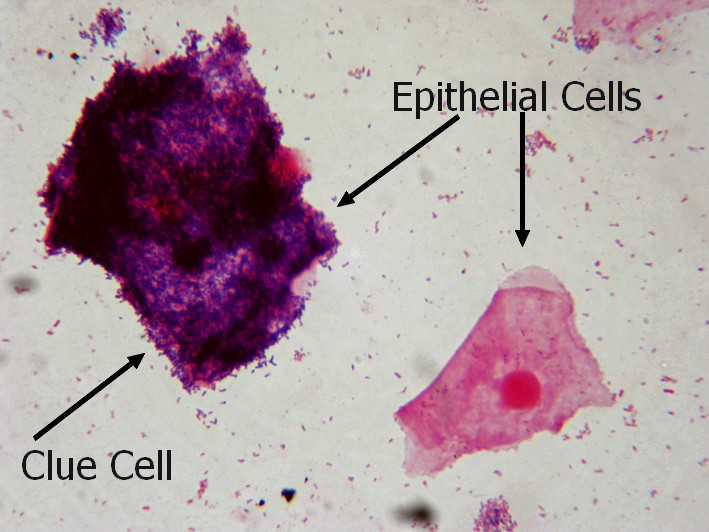
Clue cells are epithelial cells of the vagina that get their distinctive stippled appearance by being covered with bacteria. The etymology behind the term "clue" cell derives from the original research article from Gardner and Dukes describing the characteristic cells. The name was chosen for its brevity in describing the sine qua non of bacterial vaginosis.[1]
They are a medical sign of bacterial vaginosis, particularly that caused by Gardnerella vaginalis,[2] a group of Gram-variable bacteria. This bacterial infection is characterized by thin gray vaginal discharge, and an increase in vaginal pH from around 4.5 to over 5.5.

References
[edit]- ^ Gardner, Herman; Dukes, Charles (May 1955). "Haemophilus vaginalis vaginitis: A newly defined specific infection previously classified "nonspecific" vaginitis". American Journal of Obstetrics and Gynecology. 69 (5): 962–976. doi:10.1016/0002-9378(55)90095-8. PMID 14361525.
- ^ Scott TG, Smyth CJ, Keane CT (February 1987). "In vitro adhesiveness and biotype of Gardnerella vaginalis strains in relation to the occurrence of clue cells in vaginal discharges". Genitourinary Medicine. 63 (1): 47–53. doi:10.1136/sti.63.1.47. PMC 1194007. PMID 3493202.
External links
[edit]Clue cell
View on Grokipediafrom Grokipedia
Clue cells are squamous epithelial cells from the vaginal mucosa that exhibit a distinctive stippled or granular appearance under microscopic examination due to heavy adherence of bacteria, primarily serving as a hallmark diagnostic feature of bacterial vaginosis (BV).[1][2]
First described in 1955 by Gardner and Dukes as a specific indicator of what was then termed "Haemophilus vaginalis" vaginitis—now recognized as BV caused by polymicrobial overgrowth—these cells derive their name from providing a critical "clue" to the underlying infection.[3][4] The adherent bacteria, most commonly Gardnerella vaginalis and other anaerobic species such as Prevotella and Atopobium, form biofilms on the cell surface, obscuring the normal sharp borders and creating a fuzzy or beaded outline visible in wet mounts or Gram-stained smears.[5][1]
In clinical practice, the presence of clue cells is evaluated using Amsel's criteria for BV diagnosis, where their detection in more than 20% of epithelial cells in a microscopic high-power field, alongside other signs like elevated vaginal pH (>4.5), thin homogeneous discharge, and a positive whiff test (fishy amine odor upon KOH addition), confirms the condition with high specificity.[6][1] BV associated with clue cells increases risks of complications including preterm birth, pelvic inflammatory disease, and enhanced susceptibility to sexually transmitted infections like HIV, underscoring the importance of accurate identification.[2][7] Recent studies using advanced techniques like fluorescence in situ hybridization have distinguished true clue cells (with Gardnerella biofilms) from pseudo-clue cells (involving non-pathogenic bacteria like Lactobacillus iners), revealing variability in BV morphotypes across populations.[2]