



Community hub
Recent from talks
Knowledge base stats:
Talk channels stats:
Members stats:
Sialic acid
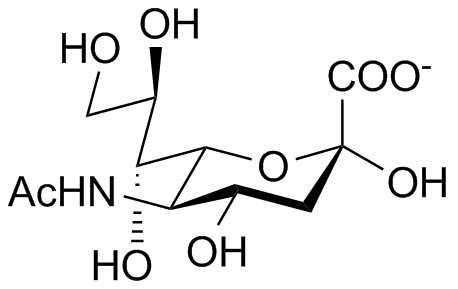
Sialic acids are a class of alpha-keto acid sugars with a nine-carbon backbone. The term "sialic acid" (from Greek σίαλον (síalon) 'saliva') was first introduced by Swedish biochemist Gunnar Blix in 1952. The most common member of this group is N-acetylneuraminic acid (Neu5Ac or NANA) found in animals and some prokaryotes.
Sialic acids are found widely distributed in animal tissues and related forms are found to a lesser extent in other organisms like in some micro-algae, bacteria and archaea. Sialic acids are commonly part of glycoproteins, glycolipids or gangliosides, where they decorate the end of sugar chains at the surface of cells or soluble proteins. However, sialic acids have been also observed in Drosophila embryos and other insects. Generally, plants seem not to contain or display sialic acids.
In humans, the brain has the highest sialic acid content, where these acids play an important role in neural transmission and ganglioside structure in synaptogenesis. More than 50 kinds of sialic acid are known, all of which can be obtained from a molecule of neuraminic acid by substituting its amino group or one of its hydroxyl groups. In general, the amino group bears either an acetyl or a glycolyl group, but other modifications have been described. These modifications along with linkages have shown to be tissue specific and developmentally regulated expressions, so some of them are only found on certain types of glycoconjugates in specific cells. The hydroxyl substituents may vary considerably; acetyl, lactyl, methyl, sulfate, and phosphate groups have been found.
The sialic acid family includes many derivatives of the nine-carbon sugar neuraminic acid, but these acids rarely appear free in nature. Normally they can be found as components of oligosaccharide chains of mucins, glycoproteins and glycolipids occupying terminal, nonreducing positions of complex carbohydrates on both external and internal membrane areas where they are very exposed and develop important functions.
The numbering of the carbon atoms starts at the carboxylate carbon and continues along the chain. The configuration that places the carboxylate in the axial position is the alpha-anomer.
The alpha-anomer is the form that is found when sialic acid is bound to glycans. However, in solution, it is mainly (over 90%) in the beta-anomeric form. A bacterial enzyme with sialic acid mutarotase activity, NanM, that is able to rapidly equilibrate solutions of sialic acid to the resting equilibrium position of around 90% beta/10% alpha has been discovered.
In contrast to other animals, humans are genetically unable to produce the sialic acid variant N-glycolylneuraminic acid (Neu5Gc). Small amounts of Neu5Gc detected in human tissue however may be incorporated from exogenous (nutrient) sources.
Sialic acid is synthesized by glucosamine 6 phosphate and acetyl-CoA through a transferase, resulting in N-acetylglucosamine-6-P. This becomes N-acetylmannosamine-6-P through epimerization, which reacts with phosphoenolpyruvate producing N-acetylneuraminic-9-P (sialic acid). For it to become active to enter in the oligosaccharide biosynthesis process of the cell, a monophosphate nucleoside is added, which comes from a cytidine triphosphate, turning sialic acid into cytidine monophosphate-sialic acid (CMP-sialic acid). This compound is synthesized in the nucleus of the animal cell.
Hub AI
Sialic acid AI simulator
(@Sialic acid_simulator)
Sialic acid
Sialic acids are a class of alpha-keto acid sugars with a nine-carbon backbone. The term "sialic acid" (from Greek σίαλον (síalon) 'saliva') was first introduced by Swedish biochemist Gunnar Blix in 1952. The most common member of this group is N-acetylneuraminic acid (Neu5Ac or NANA) found in animals and some prokaryotes.
Sialic acids are found widely distributed in animal tissues and related forms are found to a lesser extent in other organisms like in some micro-algae, bacteria and archaea. Sialic acids are commonly part of glycoproteins, glycolipids or gangliosides, where they decorate the end of sugar chains at the surface of cells or soluble proteins. However, sialic acids have been also observed in Drosophila embryos and other insects. Generally, plants seem not to contain or display sialic acids.
In humans, the brain has the highest sialic acid content, where these acids play an important role in neural transmission and ganglioside structure in synaptogenesis. More than 50 kinds of sialic acid are known, all of which can be obtained from a molecule of neuraminic acid by substituting its amino group or one of its hydroxyl groups. In general, the amino group bears either an acetyl or a glycolyl group, but other modifications have been described. These modifications along with linkages have shown to be tissue specific and developmentally regulated expressions, so some of them are only found on certain types of glycoconjugates in specific cells. The hydroxyl substituents may vary considerably; acetyl, lactyl, methyl, sulfate, and phosphate groups have been found.
The sialic acid family includes many derivatives of the nine-carbon sugar neuraminic acid, but these acids rarely appear free in nature. Normally they can be found as components of oligosaccharide chains of mucins, glycoproteins and glycolipids occupying terminal, nonreducing positions of complex carbohydrates on both external and internal membrane areas where they are very exposed and develop important functions.
The numbering of the carbon atoms starts at the carboxylate carbon and continues along the chain. The configuration that places the carboxylate in the axial position is the alpha-anomer.
The alpha-anomer is the form that is found when sialic acid is bound to glycans. However, in solution, it is mainly (over 90%) in the beta-anomeric form. A bacterial enzyme with sialic acid mutarotase activity, NanM, that is able to rapidly equilibrate solutions of sialic acid to the resting equilibrium position of around 90% beta/10% alpha has been discovered.
In contrast to other animals, humans are genetically unable to produce the sialic acid variant N-glycolylneuraminic acid (Neu5Gc). Small amounts of Neu5Gc detected in human tissue however may be incorporated from exogenous (nutrient) sources.
Sialic acid is synthesized by glucosamine 6 phosphate and acetyl-CoA through a transferase, resulting in N-acetylglucosamine-6-P. This becomes N-acetylmannosamine-6-P through epimerization, which reacts with phosphoenolpyruvate producing N-acetylneuraminic-9-P (sialic acid). For it to become active to enter in the oligosaccharide biosynthesis process of the cell, a monophosphate nucleoside is added, which comes from a cytidine triphosphate, turning sialic acid into cytidine monophosphate-sialic acid (CMP-sialic acid). This compound is synthesized in the nucleus of the animal cell.