


Community hub
Recent from talks
Contribute something
Nothing was collected or created yet.
Coast Guard Command (Turkey)
View on Wikipedia
| Coast Guard Command Sahil Güvenlik Komutanlığı | |
|---|---|
 Seal of the Turkish Coast Guard | |
 Racing Stripe | |
 Flag | |
| Agency overview | |
| Formed | July 9, 1982[1] |
| Preceding agency |
|
| Employees | 10,000 active personnel[2] |
| Jurisdictional structure | |
| Operations jurisdiction | Turkey |
| Constituting instrument |
|
| General nature | |
| Specialist jurisdiction |
|
| Operational structure | |
| Headquarters | Ankara |
| Elected officer responsible | |
| Agency executive |
|
| Parent agency | Ministry of the Interior |
| Website | |
| en.sg.gov.tr | |

The Coast Guard Command (Turkish: Sahil Güvenlik Komutanlığı) is the coast guard service of Turkey. The Turkish Coast Guard is under the command of the Ministry of the Interior. However, during wartime some of its elements can be subordinated to Turkish Naval Forces by the President.
The Turkish Coast Guard is organized into four area commands: the Black Sea, the Sea of Marmara, the Aegean Sea, and the Mediterranean Sea.
Organization
[edit]Affiliated with the Guarding Administration (Turkish: Muhafaza Memurluğu), the Coast Guard is responsible for controlling the maritime jurisdiction areas and coasts of Turkiye and fighting all kind of illegal action in the responsibility area. Turkish Coast Guard is also the main Search and Rescue Coordination Authority in Turkish SAR Zone.[4][5]
Strength
[edit]With a personnel strength of about 5,500, the coast guard is responsible for maintaining the security of the coast and territorial waters. The Coast guard is also responsible of search and rescue (SAR) operations, and for protecting the marine environment.
Mission
[edit]Coast Guard Command is a security service, established on 9 July 1982 by Act 2692, with the purpose of performing missions such as; providing the security of Turkish coasts, territorial waters and inland waters such as the Marmara Sea, Istanbul and Çanakkale Straits, ports and harbors and exercising such rights and powers where Turkey exercises sovereign rights under the rules of both national and international laws at sea areas which fall outside the scope of the general responsibility of the Turkish Naval Forces and to prevent and pursue all kinds of smuggling activities carried out by way of sea. The missions, Coast Guard Command was charged with by Act 2692 are:
- To protect and provide the security of our coasts and territorial waters,
- To provide the safety of life and property at sea.
- To take necessary measures for untethered mines, explosives and suspicious material identified in the sea and on the coast and report them to the authorities concerned.
- To observe and inspect the operating conditions of the aids-to-navigation and report the deficiencies observed to the authorities concerned,
- To disarm the refugees entering into our territorial waters and deliver them to the authorities concerned.
- To prevent all kinds of smuggling carried out by way of sea.
- To prevent the actions of the vessels and sea craft in violation of the laws on radio hygiene, passport, anchoring, mooring, fishing, diving and hoisting the flag.
- To inspect the fishing of aquatic products,
- To conduct inspections in order to prevent marine pollution.
- To prevent the smuggling of antiquities by conducting inspections on diving activities.
- To perform search and rescue missions within the search and rescue area of Turkey, in conformity with the International Search and Rescue Convention and National Search and Rescue Regulations.
- To inspect the yacht tourism,
- To participate in the operations conducted for the security of homeland under the command of the Naval Forces, when so ordered.[4]
Public order units
[edit]- Coast Guard Command (Ankara)[6]
- Coast Guard Academy (Ankara)
- Coast Guard Marmara and Straits Regional Command (Istanbul)
- Coast Guard Istanbul Group Command
- Coast Guard İmralı Special Task Group Command
- Coast Guard Southern Marmara Group Command (Bursa)
- Coast Guard Çanakkale Group Command
- Coast Guard North Aegean Group Command (Ayvalık / Çanakkale)
- Coast Guard Marmara and Straits Regional Repair Support Command (Istanbul)
- Sarıyer District Coast Guard Command (Sarıyer / İstanbul)
- Coast Guard Sarıyer Central Police Station Command (Yenimahalle / İstanbul)
- Beşiktaş District Coast Guard Command (Beşiktaş / İstanbul)
- Coast Guard station command (İstinye / Istanbul)
- Tuzla District Coast Guard Command (Tuzla / Istanbul)
- Coast Guard Tuzla Police Station Command (Tuzla / Istanbul)
- Kefken District Coast Guard Command (Kefken / Kocaeli)
- Bakırköy District Coast Guard Command (Ataköy / Istanbul)
- Coast Guard Ataköy Central Police Station (Ataköy Marina / Istanbul)
- Coast Guard Coast Watch Station (MOBESE = Security camera) (Istanbul)
- Coast Guard Küçükkuyu Patrol Command (Küçükkuyu / Çanakkale)
- Coast Guard Black Sea Regional Command (Samsun)
- Coast Guard Trabzon Group Command
- Coast Guard Amasra Group Command
- Coast Guard Supply Support Command
- Coast Guard Black Sea Region Repair Support Command
- Coast Guard Aegean Sea Regional Command (İzmir)
- Coast Guard South Aegean Group Command
- Coast Guard North Aegean Group Command
- Coast Guard Aegean Sea Regional Repair Support Command
- Radio Coast Guard (104.7 MHz.) (İzmir)
- Bodrum Coast Guard Police Station Command (Bodrum / Muğla)
- Coast Guard Mediterranean Regional Command (Mersin)
- Coast Guard Antalya Group Command
- Coast Guard İskenderun Group Command
- Coast Guard Çevlik Patrol Command (Çevlik / Hatay)
- Coast Guard Air Command (İzmir)
- Coast Guard Samsun Air Group Command
- Coast Guard Antalya Air Group Command
- Coast Guard Air Stand Training Fleet Command
- Coast Guard Air Operations Command
- Coast Guard Air Supply and Maintenance Command
- Coast Guard Training and Education Command (Antalya)
- Coast Guard Schools Command
- Coast Guard Training Central Command
- Coast Guard Supply Center Command (Istanbul)
- Units subject to Coast Guard Regional Commands
- Coast Guard Central Station Commands
- Coast Guard Patrol Commands and affiliated boat Commands
- Units subject to Coast Guard Regional Commands
- Diving Safety Security and Search and Rescue[7][8]
- Coast Guard Intelligence Directorate
Equipment
[edit].JPG)
Surface patrols are carried out by 52 patrol vessels and smaller craft. The most effective of these are 14 search-and-rescue vessels 220 tons of Turkish design. Smaller 150 ton and 70 ton patrol boats of German design were nearing obsolescence in the mid-1990s. An ambitious construction plan foresaw a major strengthening of the service with eight new vessels of 350–400 tons and 48 ships of 180–300 tons. Integrated ADVENT MARTI Air Command Control System for CN-235 aircraft.[9] Coast Guard is equipped also with 20 mobile radars.[10]
AB-412 EP SG Helicopter modernization project : Within the scope of the project, the Aselflir R400D Electro-Optic System, KDU-45 Keyboard Display Unit, SMFD-810 Display and Internal Communication System developed by ASELSAN in order to maximize the current and future operational capability of the Coast Guard Command will be integrated with avionics and navigation systems as well as the Surface Search Radar developed with domestic and national resources.[11] HELRAD Maritime Search and Weather RADAR-MSWR will be integrated on the AB-412EP SAR helicopters. First delivery of modernized helicopter is expected by 2025.[12]
Planned Acquisition : T625 Gökbey and T925 helicopters.[13]
| Turkish Coast Guard | |||
| Patrol Vessels[14] | |||
|---|---|---|---|
| Quantity | Name/Class | Displacement | Notes |
| - | 600 class | - | 2+6 optional on order.[15] |
| 4 | Dost-class patrol corvette[16] | 1750 tons | Based on the Sirio-class patrol vessel |
| 18(+4) | 80-class[16] | 195 tons | 4 used by TRNC[17] |
| 4 | SAR 35-class[16] | 210 tons | |
| 5(+4) | SAR 33-class[16] | 180 tons | +4 SAR 37 variant[18] |
| 13 | Kaan 33-class[16] | 110 tons | |
| 9 | Kaan 29-class[16] | 90 tons | |
| 17 | Kaan 19-class[16] | 30 tons | |
| 18 | Kaan 15-class[16] | 15 tons | |
| 15 | SAR 1906[16] | 33.6 tonnes | |
| 107(+6) | Ares 35 FPB | 11.85 tonnes | [19] |
| 10(+3) | Ares 42 Hector (SAGET)[16] | 13 tonnes | 3 used by TRNC[22] |
| 1 | OKHAN USV | N/A | [23] |
| Quantity | Boats |
|---|---|
| 30 | Control boats_1[24] |
| 84 | Composite hull inspection boats[25] |
| 38 | Control boats_2[26] |
| 50 | CG Control Boats (Rubber Inflatable Boats and Patrol Boats)[16] |
| 17 | DEGAK Coastal Safety and Salvage Teams (Rubber Inflatable Boat)[27] |
| 13 | SAGET Coast Guard and Safety Teams (Rubber Inflatable Boat)[16] |
| 2 | Securıty boats[16] |
| 6 | Search and rescue boats[16] |
| Name | Image | Type | In service | Note |
|---|---|---|---|---|
| Aircraft | ||||
| CN-235 | .jpg)
|
Maritime Patrol | 3[28] | Being upgraded with ADVENT MARTI CMS developed by Havelsan.[29] |
| Helicopter | ||||
| Bell AB-412 | 
|
Maritime Patrol/Utility | 14[30] | Upgrades by ASELSAN[31][32] |
| TAI T625 Gökbey | 
|
Maritime patrol/Utility | First batch : 3 on order.[33] 6 more planned to be delivered after first three.[34] | |
| Unmanned Aerial Vehicle | ||||
| Baykar Bayraktar TB2 | 
|
UCAV | 6 | [35] |
| UÇBEY | - | VTOL UAV | N/A | [36] |
| Armoured Vehicle | ||||
| BMC Vuran | 
|
MRAP | x | [37] |
| Otokar Cobra | 
|
MRAP | x | |
Others
[edit]| Model | Origin | Type | References |
|---|---|---|---|
| Sarsilmaz SAR 9 |  Turkey Turkey
|
Semi-automatic pistol | [38] |
| Canik TP9 | [39] | ||
| SAR 109T | Submachine gun | [40] | |
| Heckler & Koch MP5 |  West Germany West Germany
| ||
| MKE MPT | Turkey
|
Assault rifle | [41] |
| Heckler & Koch HK33 | West Germany
| ||
| Heckler & Koch G3 | |||
| M4 carbine |  United States United States
| ||
| Canik M2 QCB | Turkey
|
Machine gun | [42] |
| MG 3 machine gun | West Germany
|
[41] | |
| OTO MELARA DARDO | Turkey
|
Naval gun | [43] |
| OERLIKON 20mm | [44] | ||
| ASELSAN STAMP 12.7mm | [18] | ||
| DEMRE | Remotely operated underwater vehicle | [45] |
Ranks
[edit]Officers
[edit]| NATO code | OF-10 | OF-9 | OF-8 | OF-7 | OF-6 | OF-5 | OF-4 | OF-3 | OF-2 | OF-1 | ||||||||||||||||||||||||||
|---|---|---|---|---|---|---|---|---|---|---|---|---|---|---|---|---|---|---|---|---|---|---|---|---|---|---|---|---|---|---|---|---|---|---|---|---|
| Turkish Coast Guard Command[46] |

|

|

|

|

|

|

|

|

|

|
Various [a] | |||||||||||||||||||||||||
| Koramiral | Tümamiral | Tuğamiral | Albay | Yarbay | Binbaşı | Yüzbaşı | Üsteğmen | Teğmen | Asteğmen | Bahriyeli | ||||||||||||||||||||||||||
Enlisted
[edit]| NATO code | OR-9 | OR-8 | OR-7 | OR-6 | OR-5 | OR-4 | OR-3 | OR-2 | OR-1 | |||||||||||||||||||||||||||
|---|---|---|---|---|---|---|---|---|---|---|---|---|---|---|---|---|---|---|---|---|---|---|---|---|---|---|---|---|---|---|---|---|---|---|---|---|
| Turkish Coast Guard Command[47] |

|

|

|

|

|

|

|

|

|

|

|

|
No insignia | |||||||||||||||||||||||
| Astsubay kıdemli başçavuş | Astsubay başçavuş | Astsubay kıdemli üstçavuş | Astsubay üstçavuş | Astsubay kıdemli çavuş | Astsubay çavuş | Kıdemli Uzman Çavuş | Uzman çavuş | Çavuş | Kıdemli Uzman Onbaşı | Uzman onbaşı | Onbaşı | Er | ||||||||||||||||||||||||
The Force's highest-ranking officer is a Rear Admiral U.H. (Tümamiral). The coast guards wear the same rank and rate insignia as ordinary navy officers but with an orange thin arc-shaped stripe, with the words "Sahil Güvenlik" (Coast Guards) embroidered in black, worn on their upper right arm, close to the shoulder. Also, special pennants are flown for the senior officers of the Coast Guard.
- Commander of the Coast Guard : For the Commander of the Coast Guard, a square orange coloured flag with a black stripe running diagonally across the left side of the flag, also bearing three bombs is flown.
- Coast Guard Commander (Rank of Captain) : For these officers, a swallow tailed pennant with a horizontal black stripe across the flag, dividing it in two, also bearing a bomb on each side of the stripe, is flown.
- Coast Guard School Commander : The Coast Guard School Commander has a square orange flag, with a white anchor in the center and a vertical black stripe just near the mast.
- Coast Guard Group Commander : The Group Commander has a triangular orange pennant, with a black anchor in the middle.
Gallery
[edit]-
 Patrol boat
 -
 TCSG 65 (SAR 33-class)
 -
 TCSG 88 (Kaan 29-class)
 -
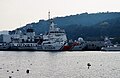 TCSG 90
 -
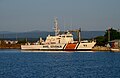 TCSG 93 (80-class)
 -
 TCSG 303
 -
 TCSG 312 (Kaan 33-class)
 -
 TCSG 702 (TCSG Güven)
 -
 TCSG 505 Agusta-Bell AB-412)
 -
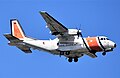 TCSG 552 (CASA CN-235)


.JPG)


.jpeg)


.jpg)
See also
[edit]Notes
[edit]- ^ Student officer insignia designates school grade rather than military seniority.
References
[edit]- ^ "History of Turkish Coast Guard Command". Turkish Coast Guard Command. Archived from the original on 23 July 2016. Retrieved 26 July 2016.
- ^ "Türkiye'deki asker sayısı: TSK'de kaç asker görev yapıyor? | Güncel".
- ^ "Turkey. Emergency degree laws of July - September 2016 Nos. 667 – 674". venice.coe.int. 10 November 2016. Retrieved 28 May 2023.
- ^ a b 2692 sayılı Sahil Güvenlik Komutanlığı Kanunu Archived 2 October 2016 at the Wayback Machine. T.C. Resmî Gazete, 17753, 13 July 1982
- ^ 668 sayılı Olağanüstü Hal Kapsamında Alınması Gereken Tedbirler ile Bazı Kurum ve Kuruluşlara Dair Düzenleme Yapılması Hakkında Kanun Hükmende Kararname Archived 10 September 2016 at the Wayback Machine. T.C. Resmî Gazete, 29783 (2.Mükerrer), 27 July 2016, Madde 23
- ^ "Arşivlenmiş kopya". Archived from the original on 21 September 2016. Retrieved 3 September 2016.
- ^ "Arşivlenmiş kopya". Archived from the original on 25 January 2020. Retrieved 25 January 2020.
- ^ "Arşivlenmiş kopya". 14 August 2017. Archived from the original on 25 January 2020. Retrieved 26 January 2020.
- ^ "Türk Donanmasının Savaş Yönetim Sistemleri: GENESiS ve ADVENT". Mavi Vatan (in Turkish). 5 June 2022. Retrieved 2 February 2023.
- ^ "SAHİL GÜVENLİK KOMUTANLIĞI 2024-2028 STRATEJİK PLANI". www.sg.gov.tr. Retrieved 15 March 2024.
- ^ Azman, Kaan (5 August 2023). "ASELSAN'dan AS-532 Cougar helikopterleri için modernizasyon". DefenceTurk (in Turkish). Retrieved 6 August 2023.
- ^ "AB412EP SAR Helikopterleri HELRAD ile Donatılıyor!". www.defenceturkey.com. Retrieved 12 November 2024.
- ^ "SAHİL GÜVENLİK KOMUTANLIĞI 2024-2028 STRATEJİK PLANI". www.sg.gov.tr. Retrieved 15 March 2024.
- ^ "Dost Class". Turkishnavy.net. 7 April 2013. Archived from the original on 18 August 2016. Retrieved 26 July 2016.
- ^ "www.mavivatan.net". Twitter. Retrieved 8 May 2023.
- ^ a b c d e f g h i j k l m n "Sahil Güvenlik Komutanlığı, Milli Sanayinin Gücüyle Envanterini Yenilemeyi Sürdürüyor - Vizyoner Genç". vizyonergenc.com (in Turkish). Retrieved 15 February 2023.
- ^ "80 Sınıf - Analiz Deniz" (in Turkish). 6 July 2024. Retrieved 11 July 2024.
- ^ a b Erkan, Kozan (23 December 2019). "Sahil Güvenlik Komutanlığı'na Bakış". DefenceTurk (in Turkish). Retrieved 15 February 2023.
- ^ "Kontrol Bot (ARES-35 FPB) - Analiz Deniz" (in Turkish). 7 July 2024. Retrieved 11 July 2024.
- ^ "ARES 35 FPB KTBK Komutanlığı'na Teslim Edildi" (in Turkish). 5 March 2022. Retrieved 15 February 2023.
- ^ MaviVatan.net [@mavivatannet] (22 March 2023). "Bugün hizmete giren 3 bot Sahil Güvenlik Komutanlığının hizmetlerine katkı sağlayacaktır." ifadelerini kullandı. KKTC SG-110 (Boğaz), KKTC SG-111 (Lefke) ve KKTC SG-112 (Serdarlı) botları, hizmete giriş belgelerinin verilmesinin ardından bot komutanlarına teslim edildi" [3 boats put into service today will contribute to the services of the Coast Guard Command." used his statements. KKTC SG-110 (Bosphorus), KKTC SG-111 (Lefke) and KKTC SG-112 (Serdarlı) boats were handed over to the boat commanders after the service entry documents were given.] (Tweet) (in Turkish). Retrieved 6 April 2023 – via Twitter.
- ^ "ARES 42 Hector Arama-Kurtarma Botları". Mavi Vatan (in Turkish). 9 November 2020. Retrieved 15 February 2023.
- ^ "İnsansız deniz aracı OKHAN testleri başarıyla geçti". www.aa.com.tr. Retrieved 20 January 2025.
- ^ "SAHİL GÜVENLİK KOMUTANLIĞI 2024-2028 STRATEJİK PLANI". www.sg.gov.tr. Retrieved 15 March 2024.
- ^ "SAHİL GÜVENLİK KOMUTANLIĞI 2024-2028 STRATEJİK PLANI". www.sg.gov.tr. Retrieved 15 March 2024.
- ^ "SAHİL GÜVENLİK KOMUTANLIĞI 2024-2028 STRATEJİK PLANI". www.sg.gov.tr. Retrieved 15 March 2024.
- ^ "SAHİL GÜVENLİK KOMUTANLIĞI 2024-2028 STRATEJİK PLANI". www.sg.gov.tr. Retrieved 15 March 2024.
- ^ "CASA CN-235-100M MPA". 5 January 2014. Retrieved 17 February 2023.
- ^ Staff, Naval News (8 January 2025). "Havelsan's ADVENT MARTI CMS Integrated into Turkish Coast Guard Aircraft". Naval News. Retrieved 23 January 2025.
- ^ "SAHİL GÜVENLİK KOMUTANLIĞI 2024-2028 STRATEJİK PLANI". www.sg.gov.tr. Retrieved 15 March 2024.
- ^ "ASELSAN Sahil Güvenlik'in helikopterlerini modernize ediyor – Tolga Özbek".
- ^ "AB-412 EP". 6 January 2014. Retrieved 17 February 2023.
- ^ "3 yılda 55 adet HÜRKUŞ geliyor! Haluk Görgün HÜRJET ve GÖKBEY için tarih verdi". TRHaber (in Turkish). 18 April 2024. Retrieved 18 April 2024.
- ^ "Coast Guard Gokbey helicopters".
- ^ "Sahil Güvenlik Komutanlığı'nda Bayraktar TB2 Dönemi" (in Turkish). 20 October 2022. Retrieved 17 February 2023.
- ^ Mehmet, Fatih (31 December 2022). "BİYOTEKSAN, Türkiye'nin operasyonel VTOL BİHA'sı UÇBEY'in ilk ihracatını yaptı!". DefenceTurk (in Turkish). Retrieved 17 February 2023.
- ^ MaviVatan.net [@mavivatannet] (3 March 2023). "Sahil Güvenlik Komutanlığına bağlı personeller BMC üretimi Vuran zırhlı araçları ile Hatay'da devriye görevine gece-gündüz devam ediyor. https://t.co/bJtZHO4vWO" [The personnel of the Coast Guard Command continue their patrol duty day and night in Hatay with their BMC production Vuran armored vehicles.] (Tweet) (in Turkish). Archived from the original on 8 March 2023. Retrieved 6 April 2023 – via Twitter.
- ^ "Modern Firearms". 22 October 2010. Retrieved 28 July 2015.
- ^ "Türk Silahlı Kuvvetleri - TRMilitary". www.trmilitary.org. Retrieved 21 January 2023.
- ^ Aybars [@aybarsbtr] (19 June 2018). "JÖAK'ın, Sahil Güvenlik Özel Harekat (SÖH) ile SAR-190T makineli tabanca kullanarak Ege'de icra ettiği tatbikat görüntüleri. 0:59'da, Türkiye'de sadece Jandarma envanterinde bulunan KAC SR-25 gözüküyor. SÖH birlikleri MP5 ile eşlik ediyor. https://t.co/64dikpbNYV" [Images of JÖAK's exercise with the Coast Guard Special Operations (SÖH) using a SAR-190T submachine gun in the Aegean. At 0:59, only the KAC SR-25, which is in the Gendarmerie inventory in Turkey, appears. SÖH troops are accompanied by MP5.] (Tweet) (in Turkish). Archived from the original on 1 May 2022. Retrieved 6 April 2023 – via Twitter.
- ^ a b "MKEK, güvenlik güçlerine 7 bin 650 piyade tüfeği sevkiyatı yaptı". aksam.com.tr (in Turkish). Retrieved 18 January 2023.
- ^ Ensonhaber (2 January 2023). "TSK ve kolluk kuvvetlerine 750 adet milli uçaksavar teslim edildi - En Son Haber". Ensonhaber (in Turkish). Retrieved 18 January 2023.
- ^ "Shahid Soleimani Sınıfı Korvetler". Mavi Vatan (in Turkish). 2 September 2023. Retrieved 14 September 2023.
- ^ says, Sahim Md Taha (7 April 2013). "KAAN 33 CLASS". Retrieved 5 May 2023.
- ^ "www.mavivatan.net". X (formerly Twitter). Retrieved 3 October 2023.
- ^ "Turkey - Coast Guard Command - Rank Insignia". Retrieved 17 September 2021.
- ^ "Turkey - Coast Guard Command - Rank Insignia". Retrieved 17 September 2021.
External links
[edit] Media related to Coast guard of Turkey at Wikimedia Commons
- Official website

| National |  | |
|---|---|---|
| Local | ||
| Intelligence | ||
| Government | ||
| Customs | ||
| Military | ||
| Africa | |
|---|---|
| Asia |
|
| Europe | |
| North America | |
| Oceania | |
| South America | |


Coast Guard Command (Turkey)
View on GrokipediaHistory
Establishment and Early Years
The Turkish Coast Guard Command (Sahil Güvenlik Komutanlığı) was formally established by Law No. 2692, enacted by the Grand National Assembly of Turkey and published in the Official Gazette on July 13, 1982, to centralize maritime security functions previously dispersed among naval forces and gendarmerie units.[9] This legislation aimed to enhance enforcement of maritime laws, combat smuggling, protect territorial waters, and conduct search-and-rescue operations amid growing coastal threats in the post-1970s era, including irregular migration and illicit trade across Turkey's extensive 8,333-kilometer coastline.[10] The Command commenced effective operations on September 1, 1982, initially drawing personnel and assets from the Turkish Navy and Gendarmerie General Command to form its core structure.[9][11] During its formative period from 1982 to 1985, the Command operated under the administrative oversight of the Gendarmerie General Command, reflecting a transitional phase to build operational independence while leveraging existing inland security expertise for coastal duties.[9] This subordination ensured coordinated responses to immediate challenges, such as patrolling the Aegean and Black Sea regions against smuggling networks that had intensified due to regional instabilities, but it also highlighted early dependencies on broader law enforcement frameworks rather than specialized maritime autonomy.[10] By January 1, 1985, the Command achieved structural integration into the Turkish Armed Forces, with peacetime responsibilities assigned to the Ministry of the Interior and wartime command to the General Staff, marking a shift toward dedicated coastal defense capabilities.[12] In these initial years, the Command's fleet consisted primarily of transferred patrol boats and small vessels, totaling around a dozen operational units by mid-1983, focused on basic interdiction and surveillance rather than advanced projection; this modest buildup prioritized rapid deployment over expansive infrastructure, enabling early successes in curbing coastal smuggling routes that exploited Turkey's strategic maritime position.[10] The emphasis on empirical task execution—such as routine inspections and emergency responses—laid the groundwork for institutional growth, though resource constraints limited expansive operations until subsequent expansions in the late 1980s.[11]Reforms and Independence
The Coast Guard Command's path to independence began with its integration into the Gendarmerie General Command following the abolition of the General Command of Customs Guard in 1956 under Law No. 6815. Duties previously handled by the Customs Guard were transferred to the Gendarmerie, leading to the formation of specialized regional sea commands: the Aegean Sea Regional Command in 1957, the Black Sea Regional Command in 1968, and the Mediterranean Sea Regional Command in 1971. These units operated under Gendarmerie oversight, focusing on maritime law enforcement and smuggling prevention, but lacked a unified, autonomous structure separate from land-based gendarmerie operations.[3] A pivotal reform occurred on July 9, 1982, with the enactment of Law No. 2692, which established the Coast Guard Command as an independent security service branch responsible for maritime security, safety, and law enforcement. Operations commenced effectively on September 1, 1982, marking the initial separation from Gendarmerie control, though full administrative detachment was completed by January 1, 1985. This legislation centralized authority, expanded operational scope to include search and rescue, environmental protection, and sovereignty enforcement, and positioned the Command under the Ministry of the Interior during peacetime, with provisions for subordination to the Turkish Naval Forces in wartime or emergencies.[3][13] Subsequent amendments reinforced independence. In 2003, revisions to Law No. 2692 granted the Command a fully autonomous structure akin to other specialized commands, enhancing decision-making efficiency and resource allocation. The 2016 reorganization under Decree Law No. 668 further integrated it directly under the Ministry of the Interior, aligning it with the Gendarmerie's civilian oversight while preserving military character and wartime naval integration. These reforms addressed inefficiencies in fragmented pre-1982 operations, enabling rapid response to rising maritime threats like irregular migration and smuggling in the Aegean and Mediterranean seas.[3]Organization
Command Structure
The Turkish Coast Guard Command operates under the administrative authority of the Ministry of the Interior during peacetime, functioning as a law enforcement agency responsible for maritime security within internal waters, territorial seas, and the contiguous zone, as well as select duties in the exclusive economic zone and high seas per international conventions.[1] In wartime or general mobilization, operational control transfers to the Turkish Naval Forces Command, allowing integration into broader naval operations while maintaining its specialized roles.[10] This dual-reporting structure ensures civilian oversight in routine conditions and military alignment during heightened threats, reflecting Turkey's coastal geography spanning multiple seas and the need for rapid adaptability. Headquartered in Ankara, the Command is led by a Commandant holding the rank of Rear Admiral (Tuğamiral), typically drawn from the Turkish Navy's officer corps, who oversees strategic planning, resource allocation, and inter-agency coordination.[14] The headquarters includes specialized directorates for operations, personnel, logistics, intelligence, and training, supporting a force of approximately 3,500 active personnel, including officers, non-commissioned officers, and enlisted sailors, supplemented by civilian staff.[15] Subordinate units emphasize decentralized execution, with authority delegated to regional commands for localized maritime enforcement. The primary operational hierarchy comprises four main area commands aligned with Turkey's maritime domains: the Black Sea Area Command (based in Trabzon), Marmara Area Command (Istanbul), Aegean Area Command (Izmir), and Mediterranean Area Command (Antalya).[15] These are augmented by the İskenderun Area Command for eastern Mediterranean operations, the Foça Search and Rescue Group Command for dedicated SAR missions, and the Coast Guard Academy in Ankara for officer training and education. Each area command directs subordinate group commands, coastal stations, and boat detachments, enabling responsive patrolling, interdiction, and response across over 8,000 kilometers of coastline.[16] This structure facilitates efficient coverage of diverse threats, from smuggling in the Aegean to pollution control in the Marmara Sea, with direct reporting lines to the Commandant for accountability.Regional Commands
The Turkish Coast Guard Command is structured into four regional commands, each overseeing maritime security, law enforcement, search and rescue, and environmental protection within their respective geographic areas along Turkey's extensive coastline. These commands were formalized in 1993 through the renaming and reorganization of prior subcommands to enhance operational efficiency.[13] The regions align with Turkey's major maritime zones: the Black Sea, Marmara Sea and Turkish Straits, Aegean Sea, and Mediterranean Sea, allowing for specialized responses to regional threats such as irregular migration, smuggling, and territorial disputes. The Black Sea Regional Command, headquartered in Samsun, manages operations along Turkey's northern Black Sea coast, spanning approximately 1,400 kilometers. It coordinates patrols, anti-smuggling efforts, and search and rescue missions in an area prone to cross-border trafficking from neighboring states. Subordinate units include group commands in eastern, central, and western Black Sea sectors, supported by patrol boats and stations in ports like Trabzon and Giresun.[17][15] The Marmara and Turkish Straits Regional Command, based in Istanbul, covers the densely trafficked Marmara Sea and critical chokepoints of the Bosphorus and Dardanelles Straits, handling high-volume commercial shipping, urban coastal security, and pollution control. This command includes specialized group commands for Istanbul, southern Marmara (Bursa), and the straits (Çanakkale), with assets focused on rapid response to vessel incidents and sovereignty enforcement in contested waters.[6][18] The Aegean Sea Regional Command in Izmir oversees the eastern Aegean, emphasizing border patrols amid ongoing tensions with Greece, irregular migrant interdictions, and fisheries protection across islands and coastal zones. It features group commands divided into northern, central, and southern Aegean sectors, operating from bases like Foça and Bodrum to support aerial and surface interdictions.[6][18] The Mediterranean Regional Command, located in Mersin, directs activities along the southern coast, prioritizing counter-smuggling from Syria and Libya, energy resource security, and humanitarian operations in a region with significant refugee flows. Subunits include group commands in Antalya, İskenderun, and patrol stations in Adana, equipped for extended patrols in open waters.[10][18]Missions and Responsibilities
Maritime Law Enforcement
The Turkish Coast Guard Command serves as the primary agency for maritime law enforcement within Turkey's territorial waters, contiguous zones, and exclusive economic zone, operating under the Ministry of Interior during peacetime to maintain public order and prevent criminal activities at sea.[2] Its mandate includes patrolling coastal areas to enforce navigation regulations, vessel safety standards, and customs protocols, ensuring compliance with both domestic legislation and international conventions such as the United Nations Convention on the Law of the Sea.[2] [10] Key enforcement activities target smuggling operations, encompassing narcotics, arms, and contraband transported by sea, with the Command authorized to intercept suspicious vessels, conduct boardings, and seize illicit goods.[2] It also regulates fishing through inspections of commercial and amateur vessels to curb illegal, unreported, and unregulated (IUU) fishing, enforcing quotas, licensing requirements, and seasonal restrictions to protect marine resources.[2] In parallel, the Command addresses irregular migration by detaining smuggling facilitators and vessels carrying undocumented persons, having intercepted over 190,000 individuals at sea since 2020 through coordinated patrols and intelligence-driven operations.[19] [2] Enforcement extends to environmental compliance, such as preventing illegal waste dumping and oil spills, and upholding radio hygiene laws by monitoring vessel communications.[2] The Command employs a fleet of patrol boats and aircraft for rapid response, often collaborating with customs authorities and provincial gendarmerie for joint operations, particularly in high-traffic areas like the Aegean and Mediterranean seas.[15] These efforts prioritize deterrence and apprehension, with annual captures of hundreds of smugglers and seizure of smuggling vessels underscoring operational effectiveness.[20]Search and Rescue Operations
The Coast Guard Command of Turkey coordinates and conducts maritime search and rescue (SAR) operations within the Turkish SAR region, encompassing internal waters, territorial seas, and contiguous zones in the Black Sea, Sea of Marmara, Aegean Sea, and Mediterranean Sea.[8] These responsibilities are defined under national regulations, including the establishment and operation of the Maritime Accidents Coordination Center for sea and air incidents, where the Command maintains oversight from coastal areas outward.[21] Operations are directed 24/7 from the Maritime Rescue Coordination Center (MRCC) in Ankara, which integrates distress alerts from vessels, aircraft, and satellite systems to mobilize response assets including patrol vessels, helicopters, diving teams, and shore-based stations.[8][22] Regional coordination occurs through dedicated SAR centers in key ports, facilitating rapid deployment for incidents ranging from vessel groundings and medical emergencies to overboard persons.[23] A substantial share of SAR missions addresses irregular migrant crossings, particularly overloaded dinghies in the Aegean, where the Command has rescued thousands annually amid high-risk conditions.[24] As of September 5, 2025, over 5,400 individuals had been rescued that year, building on 24,826 rescues in 2023 (including securing 62 boats and recovering 147 bodies) and 24,448 in 2024.[24] Over the preceding five years through mid-2025, more than 105,437 migrants were intercepted or rescued at sea during such efforts.[25] Beyond migration-related incidents, the Command handles diverse maritime distress calls, such as those from fishing vessels or yachts, and conducts medical evacuations within the SAR region under inter-agency protocols.[26] It also performs helicopter-supported exercises, like those in the Black Sea in early 2025, to maintain readiness for open-sea scenarios.[27] Recent examples include ongoing operations off Trabzon and Muğla in October 2025, involving multi-asset searches for missing persons following vessel incidents.[28]Environmental and Resource Protection
The Turkish Coast Guard Command is tasked with monitoring and preventing marine pollution in territorial waters, including enforcement of regulations prohibiting discharges from vessels and coastal facilities that violate national and international standards such as those under the International Convention for the Prevention of Pollution from Ships (MARPOL).[29] This includes conducting inspections of ships' oil record books, waste management logs, and pollution prevention equipment, with documented checks under Article 20/g of the Environment Law revealing non-compliance in cases like unauthorized ballast water discharges or oily water separators bypassing.[30] In 2023, the Command reported handling multiple pollution incidents, issuing administrative fines and detaining vessels for violations, contributing to a framework where primary responsibility for spill response lies with the Ministry of Environment, Urbanization and Climate Change, but frontline detection and initial containment often fall to Coast Guard patrols equipped with oil-slick observation tools.[31] Response to oil spills involves rapid deployment for containment and cleanup, as demonstrated in February 2025 when Coast Guard vessels skimmed fuel leaks from a dark fleet tanker off the Turkish coast, preventing wider shoreline contamination in line with national contingency plans aligned to the Oil Pollution Preparedness, Response and Co-operation Convention (OPRC).[32] [33] These operations prioritize causal containment—such as boom deployment and dispersant application based on spill volume and sea conditions—over reactive measures, with historical data from Black Sea incidents informing protocols that emphasize preemptive port state controls to mitigate risks from high-traffic straits like the Bosporus.[34] In resource protection, the Command enforces fisheries laws under Law No. 1380 to curb illegal, unreported, and unregulated (IUU) fishing, patrolling against overexploitation of stocks like anchovy and bluefin tuna in the Aegean and Black Seas through vessel interdictions and gear seizures.[35] Annual inspections target prohibited methods such as dynamite fishing or undersized mesh nets, with 2022 Mediterranean data showing characterized violations primarily involving unlicensed operations and quota exceedances, leading to fines exceeding millions of Turkish lira to sustain ecological balances amid pressures from invasive species and climate variability.[36] This enforcement integrates with broader marine resource safeguards, including monitoring protected areas and combating habitat destruction from unregulated anchoring or trawling, directly supporting stock recovery efforts without reliance on unsubstantiated sustainability claims from advocacy groups.[37]Key Operations
Anti-Smuggling and Irregular Migration Control
The Turkish Coast Guard Command (TCG) is responsible for patrolling maritime borders to intercept irregular migrants and dismantle human smuggling networks, primarily in the Aegean and Mediterranean Seas, where routes from Turkey to Greek islands are heavily utilized by smugglers originating from Syria, Afghanistan, and other conflict zones.[38] This mandate involves routine surveillance, boat interceptions, and coordination with land-based forces to apprehend facilitators, as smuggling operations often involve overcrowded dinghies launched from coastal areas like Izmir province.[39] Anti-smuggling teams, equipped with patrol vessels and rapid response units, target organized crime groups profiting from these crossings, with Turkish authorities arresting nearly 10,500 suspected migrant smugglers in 2023 alone, a record high reflecting intensified enforcement.[38] From 2020 to 2024, TCG operations resulted in the interception of approximately 190,000 irregular migrants at sea, with annual figures showing an initial rise followed by sustained efforts: 20,380 in 2020, 23,676 in 2021, and higher volumes in subsequent years amid peak migration pressures.[40] [19] Overall, Turkey intercepted over 1 million irregular migrants nationwide since 2020, including maritime cases handled by the Coast Guard, demonstrating the scale of operations amid Turkey's role as a transit country hosting millions of refugees.[41] In 2025, interceptions declined significantly, with 3,199 migrants caught in January across surrounding seas, dropping to 750 in February, attributed to stricter border controls and disrupted smuggling routes.[39] Key operations often combine rescue and detention, as many migrant vessels encounter distress due to poor seaworthiness or overloading; for instance, on September 3, 2025, TCG anti-smuggling teams detained 82 migrants, including 23 from a single boat with 8 children, off the Aegean coast.[42] Similarly, on October 17, 2025, 33 migrants were rescued off Izmir while 50 others attempting unauthorized crossings were detained, highlighting the dual focus on humanitarian response and enforcement.[43] These actions are supported by international cooperation, such as EU-funded vessels enhancing TCG's search-and-rescue capacity, though domestic priorities emphasize sovereignty over maritime borders against unauthorized entries.[44]Aegean Sea Enforcement and Sovereignty
The Turkish Coast Guard Command enforces maritime sovereignty in the Aegean Sea through routine patrols and interventions to protect national interests amid longstanding disagreements with Greece over territorial waters, continental shelf delimitation, and island sovereignty. Operating under the Ege Deniz Bölge Komutanlığı in Izmir, the Command asserts control over areas it considers under Turkish jurisdiction, including preventing unauthorized foreign activities near disputed features like the Kardak islets.[45][46] In the 1996 Kardak (Imia) crisis, Turkish Coast Guard vessels played a pivotal role in responding to Greek attempts to assert control over the uninhabited rocky islets, with armed patrol boats deployed to the vicinity and facilitating the landing of special forces to uphold Turkey's sovereignty claim, which is based on the islets' proximity to the Turkish mainland (3.8 nautical miles) and absence of explicit cession in international treaties.[47][46] This incident underscored the Command's mandate to monitor and defend against perceived encroachments in the Aegean, where Turkey opposes Greek extensions of territorial waters beyond 6 nautical miles, arguing such moves would unjustly reduce high seas access and enclose Turkish coastal areas.[46] Ongoing enforcement includes blocking Greek naval or official vessels from approaching contested zones, as in January 2018 when Coast Guard units prevented the Greek Defense Minister's boat from nearing Kardak, reinforcing Turkey's position that the islets fall under its sovereignty.[48] Similar patrols have led to confrontations, such as the January 2021 collision between Turkish and Greek Coast Guard boats near the same islets during routine operations.[49] The Command also counters alleged Greek harassment of Turkish fishing vessels in international waters, condemning such actions as violations of maritime rights.[50] In parallel with territorial assertions, the Coast Guard integrates sovereignty enforcement with monitoring for foreign maneuvers that infringe Turkish waters, including during irregular migration incidents where Greek assets are accused of pushbacks into Turkish jurisdiction; for instance, in November 2021, interventions prevented violations during such operations.[51] These activities align with Turkey's broader stance that the Aegean must remain a shared maritime domain, requiring equitable delimitation through dialogue rather than unilateral Greek claims that disregard Ottoman-era legacies and geographic realities.[46] The Command's operations emphasize legal compliance with international law while prioritizing national security and resource rights in the region.[45]Disaster Response and Humanitarian Aid
The Turkish Coast Guard Command contributes to national disaster response efforts, particularly in coastal regions affected by natural calamities, by deploying search and rescue (SAR) assets including helicopters, boats, and personnel for evacuations and victim recovery.[1] In the 2021 Black Sea floods, which caused at least 70 deaths along the northern coast, Coast Guard helicopters lowered teams onto building roofs to rescue stranded individuals amid flash flooding and landslides.[52][53] Similarly, during the 2021 wildfires that threatened coastal areas and tourism sites, Coast Guard units led sea-based evacuations of tourists and residents, coordinating with private vessels and deploying boats for rapid extraction from fire-encircled zones.[54] In response to the same fires, the Command dispatched 520 personnel, a corvette, 26 security boats, and a diving squad to support firefighting and rescue operations.[55] The Command also plays a supporting role in broader inland disasters with maritime implications, such as the February 2023 Kahramanmaraş earthquakes, where its forces aided post-event SAR activities alongside other military units, leveraging specialized equipment for victim location and extraction in affected coastal vicinities.[56] Annually, these efforts yield significant outcomes; for instance, through August 2025, Coast Guard teams rescued 5,423 individuals from maritime incidents, including disaster-related emergencies, while recovering 108 bodies.[24] Assets like AB-412 EP helicopters and search and rescue boats facilitate rapid deployment for such operations.[1] In humanitarian aid, the Turkish Coast Guard participates in international missions by providing personnel and logistical support for disaster-struck regions accessible by sea. Following the September 2023 Libya floods, two Turkish vessels transported 360 specialists, including Coast Guard service members, alongside search and rescue and fire brigade teams to assist in relief and recovery efforts.[57] Domestically, its SAR mandate extends humanitarian principles to maritime crises, emphasizing life-saving interventions without regard to nationality, as evidenced by routine operations saving thousands annually from peril at sea.[58]Equipment and Capabilities
Patrol Vessels and Boats
The Turkish Coast Guard Command operates a diverse fleet of patrol vessels and boats designed for maritime law enforcement, search and rescue, and border security, primarily in the Aegean, Black, and Mediterranean Seas. These assets include offshore patrol vessels (OPVs) and smaller patrol boats, with capabilities ranging from high-speed interdiction to extended endurance operations. The fleet emphasizes indigenous design and construction to enhance self-reliance, incorporating advanced sensors, armaments, and propulsion systems for multi-role missions.[59] Larger vessels, such as the DOST-class OPVs, serve as flagships for extended patrols and command functions. Each DOST-class ship displaces approximately 1,725 tons at full load, measures 88.4 meters in length with a beam of 12.2 meters and draft of 4.6 meters, and achieves a maximum speed of 22 knots powered by twin 6,973 HP engines. Armament includes one 40mm gun and two 12.7mm machine guns, with capacity for one AB-412 EP helicopter. Four units of this class are in service, built domestically to support operations in contested waters.[60] Patrol boats form the backbone of routine coastal and inshore duties, categorized into classes like the 80-class, SAR-33, SAR-35, and KAAN series. The 80-class boats, with a displacement of 195 tons, feature twin 2,692 HP engines enabling a maximum speed of 27 knots and an economic speed of 20 knots, offering a range of 1,000 nautical miles. These aluminum-hulled vessels are equipped for search and rescue, equipped with radar, communication systems, and light armaments for rapid response.[61] The KAAN-33, KAAN-29, KAAN-19, and KAAN-15 classes provide scaled capabilities for near-shore enforcement, with lengths varying from 15 to 33 meters, focusing on agility and maneuverability against smuggling and irregular migration.[15] Fleet modernization efforts prioritize domestic production, with a July 29, 2025, contract awarded to TAIS Shipyards for four new national coast guard ships, each approximately 68.1 meters long, 12 meters in beam, and 3 meters in draft, enhancing endurance and sensor integration. Additionally, the 2024 annual report outlines plans for eight new indigenous coast guard ships under the National Coast Guard Ship project, aiming to replace aging units with vessels featuring improved speed, range, and unmanned system compatibility by the late 2020s. These additions reflect a strategic shift toward blue-water capabilities amid regional tensions.[62][63]| Class | Displacement (tons) | Length (m) | Max Speed (knots) | Key Features |
|---|---|---|---|---|
| DOST-class OPV | 1,725 | 88.4 | 22 | Helicopter deck, 40mm gun |
| 80-class | 195 | ~50 (est.) | 27 | SAR-focused, 1,000 NM range |
| KAAN-33 | ~100-200 (est.) | 33 | 25+ (est.) | High-speed interdiction |
Auxiliary Assets and Technology
The Turkish Coast Guard Command operates a fleet of AB-412EP helicopters for search and rescue, reconnaissance, and maritime surveillance missions.[64] These twin-engine utility helicopters, numbering approximately 14 in active service, feature a maximum speed of 140 knots, a range of 250 nautical miles, and capacity for five casualties, with enhancements including HELRAD naval surveillance radars for improved detection capabilities.[65] [66] ASELSAN is modernizing these aircraft with advanced avionics to extend operational life and enhance sensor integration.[67] ![TAI T625 Gökbey TC-HLV.png][float-right] To bolster aviation capabilities, the Command is procuring indigenous T625 Gökbey multirole utility helicopters from Turkish Aerospace Industries, with three units scheduled for delivery: two in July 2026 and one in September 2026, as part of a broader contract for 57 helicopters serving Turkish security forces.[68] The Gökbey, a 6-ton twin-engine platform comparable to international medium-lift models, supports utility roles including transport and surveillance, advancing Turkey's self-reliance in rotorcraft production.[69] In unmanned systems, the Coast Guard integrates six Bayraktar TB2 medium-altitude long-endurance drones equipped with ASELSAN CATS electro-optical/infrared cameras for real-time maritime monitoring and intelligence gathering.[70] These rotary-wing UAVs, operational since 2022, complement fixed-wing assets like the CASA CN-235 maritime patrol aircraft for extended coverage in search, anti-smuggling, and border enforcement tasks.[71] Auxiliary technology includes advanced radar and communication systems integrated across assets, such as those from METEKSAN and ASELSAN, enabling networked operations for environmental monitoring and threat detection, though specific land vehicles like MRAPs remain primarily aligned with broader security forces rather than core Coast Guard maritime roles.[65]Personnel
Ranks and Hierarchy
The Turkish Coast Guard Command (Sahil Güvenlik Komutanlığı) operates under a hierarchical structure modeled on the Turkish Armed Forces, with authority flowing from the Coast Guard Commander at the apex to subordinate regional group commands, stations, and detachments. In peacetime, the Command falls under the Ministry of Interior, while in wartime it integrates into the Turkish Naval Forces chain of command. The highest position, Coast Guard Commander, is held by an officer of Vice Admiral (Oramiral) rank, as exemplified by the current incumbent promoted to this rank via presidential decree in 2023.[72] Regional commands are typically led by officers of Captain (Albay) or Commander (Yarbay) rank, with smaller units under Lieutenant (Yüzbaşı) or lower officers.[73] Personnel are categorized into commissioned officers (subay), non-commissioned officers or petty officers (astsubay), specialist enlisted (uzman erbaş), and basic enlisted (er). The rank structure parallels that of the Turkish Navy, with insignia featuring naval sleeve stripes or shoulder boards modified by a central anchor emblem to distinguish coast guard affiliation.[73][74] Officer ranks, from highest to lowest, are:| Turkish Rank | NATO Equivalent | English Title |
|---|---|---|
| Oramiral | OF-8 | Vice Admiral |
| Tümamiral | OF-7 | Rear Admiral (Upper Half) |
| Tuğamiral | OF-6 | Rear Admiral (Lower Half) |
| Albay | OF-5 | Captain |
| Yarbay | OF-4 | Commander |
| Binbaşı | OF-3 | Lieutenant Commander |
| Yüzbaşı | OF-2 | Lieutenant |
| Üsteğmen | OF-1 | Lieutenant Junior Grade |
| Teğmen | OF-1 | Ensign |
| Asteğmen | OF(D) | Midshipman/Cadet |
| Turkish Rank | NATO Equivalent | English Title |
|---|---|---|
| Astsubay Kıdemli Başçavuş | OR-9 | Master Chief Petty Officer |
| Astsubay Başçavuş | OR-8 | Senior Chief Petty Officer |
| Astsubay Kıdemli Çavuş | OR-7 | Chief Petty Officer |
| Astsubay Çavuş | OR-6 | Petty Officer First Class |
| Çavuş | OR-5 | Petty Officer Second Class |
| Uzman Çavuş | OR-4 | Specialist Petty Officer |
| Kıdemli Ekipbaşı | OR-3 | Leading Seaman |
| Ekipbaşı | OR-2 | Able Seaman |
| Er | OR-1 | Seaman Recruit |