
Codex Vaticanus
View on Wikipedia| New Testament manuscript | |
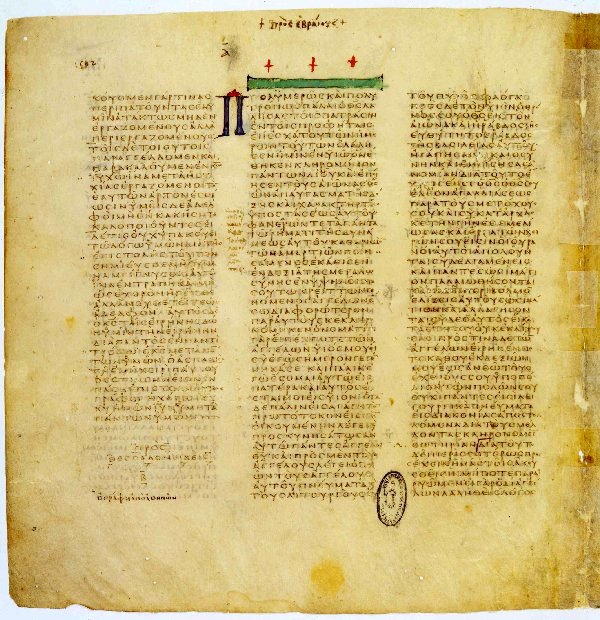
 Page from Codex Vaticanus; ending of 2 Thes and beginning of Heb | |
| Name | Vaticanus |
|---|---|
| Sign | B |
| Text | Greek Old Testament and Greek New Testament |
| Date | c. 300-350AD |
| Script | Greek |
| Now at | Vatican Library |
| Cite | C. Vercellonis, J. Cozza, Bibliorum Sacrorum Graecus Codex Vaticanus, Roma 1868. |
| Size | 27 × 27 cm (10.6 × 10.6 in) |
| Type | Alexandrian text-type |
| Category | I |
| Note | very close to 𝔓66, 𝔓75, 0162 |
The Codex Vaticanus (The Vatican, Bibl. Vat., Vat. gr. 1209), is a manuscript of the Greek Bible, containing the majority of the Greek Old Testament and the majority of the New Testament. It is designated by siglum B or 03 in the Gregory-Aland numbering of New Testament manuscripts, and as δ 1 in the von Soden numbering of New Testament manuscripts. It is one of the four great uncial codices.[1]: 68 Along with Codex Alexandrinus and Codex Sinaiticus, it is one of the earliest and most complete manuscripts of the Bible. Using the study of comparative writing styles (palaeography), it has been dated to the 4th century AD.[2][3]
The manuscript became known to Western scholars as a result of correspondence between textual critic Desiderius Erasmus Roterodamus (known usually as Erasmus) and the prefects of the Vatican Library. Portions of the codex were collated by several scholars, but numerous errors were made during this process. The codex's relationship to the Latin Vulgate and the value Jerome placed on it is unclear.[4] In the 19th century AD transcriptions of the full codex were completed.[1]: 68 It was at that point that scholars became more familiar with the text and how it differed from the more common Textus Receptus (a critical edition of the Greek New Testament based on earlier editions by Erasmus).[5]
Most current scholars consider Codex Vaticanus to be one of the most important Greek witnesses to the Greek text of the New Testament, followed by Codex Sinaiticus.[2] Until the discovery by Tischendorf of Sinaiticus, Vaticanus was considered to be unrivalled.[6] It was extensively used by textual critics Brooke F. Westcott and Fenton J. A. Hort in their edition of The New Testament in the Original Greek in 1881.[2] The most widely sold editions of the Greek New Testament are largely based on the text of the Codex Vaticanus.[2]: 26–30
The codex is named after its place of conservation in the Vatican Library, where it has been kept since at least the 15th century.[1]: 67
Description
[edit]
The manuscript is a codex (precursor to the modern book) in quarto volume, written on 759 leaves of fine and thin vellum (sized 27 cm by 27 cm, although originally bigger),[6] in uncial letters, arranged in quires of five sheets or ten leaves each, similar to Codex Marchalianus or Codex Rossanensis; but unlike Codex Sinaiticus which has an arrangement of four or three sheets. The number of the quires is often found in the margin.[7] Originally it must have been composed of 830 parchment leaves, but it appears that 71 leaves have been lost.[8] The Old Testament currently consists of 617 sheets and the New Testament of 142 sheets. The codex is written in three columns per page, with 40–44 lines per column, and 16–18 letters per line. In the poetical books of the Old Testament (OT) there are only two columns to a page. There are 44 lines in a column in the Pentateuch (first five books of the OT), Joshua, Judges, Ruth, and 1 Kings 1:1–19:11; in 2 Chronicles 10:16–26:13 there are 40 lines in a column; and in the New Testament always 42.[9][7] The manuscript is one of the very few New Testament manuscripts to be written with three columns per page. The other two Greek codices written in that way are Uncial 048 and Uncial 053.
The Greek lettering in the codex is written continuously in small and neat letters.[10] All the letters are equally distant from each other; no word is separated from the other, with each line appearing to be one long word.[11]: 262–263 Punctuation is rare (accents and breathings have been added by a later hand) except for some blank spaces, diaeresis on initial iotas and upsilons, abbreviations of the nomina sacra (abbreviations of certain words and names considered sacred in Christianity) and markings of OT citations.[10] The first letter of a new chapter sometimes protrudes a little from the column.[10] The OT citations were marked by an inverted comma or diplai (>).[10] There are no enlarged initials; no stops or accents; no divisions into chapters or sections such as are found in later manuscripts.[12]
The text of the Gospels is not divided according to the Ammonian Sections with references to the Eusebian Canons, but is divided into peculiar numbered sections: Matthew has 170, Mark 61, Luke 152, and John 80. This system is only found in two other manuscripts: Codex Zacynthius and Minuscule 579.[9] There are two system divisions in the Acts and the Catholic Epistles which differ from the Euthalian Apparatus. In Acts, these sections are 36 (the same system as Codex Sinaiticus, Codex Amiatinus, and Codex Fuldensis) and according to the other system 69 sections. The chapters in the Pauline epistles are numbered continuously as the Epistles were regarded as comprising one book.
Text
[edit]Text-type
[edit]In the Old Testament, the type of text varies, with a received text in Ezekiel and a rejected one in the Book of Isaiah.[9] In Judges the text differs substantially from that of the majority of manuscripts, but agrees with the Old Latin, Sahidic version and Cyril of Alexandria. In Job, it has the additional 400 half-verses from Theodotion, which are not in the Old Latin and Sahidic versions.[9] The text of the Old Testament was considered by critics, such as Hort and Cornill, to be substantially that which underlies Origen's Hexapla edition, completed by him at Caesarea and issued as an independent work (apart from the other versions with which Origen associated it) by Eusebius and Pamphilus.[13]: 83
In the New Testament, the Greek text of the codex is considered a representative of the Alexandrian text-type. It has been found to agree very closely with the text of Bodmer 𝔓75 in the Gospels of Luke and John. 𝔓75 has been dated to the beginning of the 3rd century, and hence is at least 100 years older than the Codex Vaticanus itself. This is purported to demonstrate (by recourse to a postulated earlier exemplar from which both 𝔓75 and B descend) that Vaticanus accurately reproduces an earlier text from these two biblical books, which reinforces the reputation the codex held amongst Biblical scholars. It also strongly suggests that it may have been copied in Egypt.[14] In the Pauline epistles there is a distinctly Western element.[9] Textual critic Kurt Aland placed it in Category I of his New Testament manuscript classification system.[2] Category 1 manuscripts are described as "of a very special quality, i.e., manuscripts with a very high proportion of the early text, presumably the original text, which has not been preserved in its purity in any one manuscript."[2]: 335
Contents
[edit]_(The_S.S._Teacher%27s_Edition-The_Holy_Bible).jpg)
The codex originally contained a virtually complete copy of the Greek Old Testament (known as the Septuagint / LXX), lacking only 1-4 Maccabees and the Prayer of Manasseh. The original 20 leaves containing Genesis 1:1–46:28a (31 leaves) and Psalm 105:27–137:6b have been lost. These were replaced by pages transcribed by a later hand in the 15th century.[15] 2 Kings 2:5–7, 10–13 are also lost due to a tear to one of the pages.[16] The order of the Old Testament books in the codex is as follows: Genesis to 2 Chronicles as normal; 1 Esdras; 2 Esdras (Ezra–Nehemiah); the Psalms; Proverbs; Ecclesiastes; Song of Songs; Job; Wisdom; Ecclesiasticus; Esther; Judith; Tobit; the minor prophets from Hosea to Malachi (but in the order: Hosea, Amos, Micah, Joel, Obadiah, Jonah, Nahum, Habakkuk, Zephaniah, Haggai, Zechariah, Malachi); Isaiah; Jeremiah; Baruch; Lamentations and the Epistle of Jeremiah; Ezekiel and Daniel. This order differs from that followed in Codex Alexandrinus.[17]
The extant New Testament portion contains the Gospels, Acts, the general epistles, the Pauline epistles, and the Epistle to the Hebrews (up to Hebrews 9:14, καθα[ριει); it is lacking 1 and 2 Timothy, Titus, Philemon, and Revelation. The missing part of Hebrews and Revelation were supplemented by a 15th-century minuscule hand (folios 760–768), and are catalogued separately as minuscule 1957.[2] It is possible some apocryphal books from the New Testament were included at the end (as in codices Sinaiticus and Alexandrinus).[2] It is also possible that Revelation was not included.[18][19]
Non-included verses
[edit]The text of the New Testament lacks several passages:
- Matthew 12:47[20]: 32
- Matthew 16:2b–3[20]: 44
- Matthew 17:21[20]: 48
- Matthew 18:11[20]: 49
- Matthew 23:14[20]: 65
- Mark 7:16[20]: 111
- Mark 9:44[20]: 121
- Mark 9:46[20]: 121
- Mark 11:26[20]: 128
- Mark 15:28[20]: 144

- Mark 16:9–20 — The Book of Mark ends with verse 16:8.[20]: 147–149
- Luke 17:36[20]: 218
- Luke 22:43–44 (Christ's agony at Gethsemane)[20]: 234
- John 5:4[20]: 260
- John 7:53-8:11 (Pericope Adulterae)[20]: 273–274
- Acts 8:37[20]: 345
- Acts 15:34[20]: 367
- Acts 24:7[20]: 395
- Acts 28:29[20]: 408
- Romans 16:24[20]: 440 [20]: 440
- 1 Peter 5:3[20]: 607, 626
- Phrases not in Vaticanus but in later manuscripts include
- εὐλογεῖτε τοὺς καταρωμένους ὑμᾶς, καλῶς ποιεῖτε τοῖς μισοῦσιν ὑμᾶς (bless those who curse you, do good to those who hate you)
- καὶ ὁ φιλῶν υἱὸν ἢ θυγατέρα ὑπὲρ ἐμὲ οὐκ ἔστιν μου ἄξιος (and he who loves son or daughter more than me is not worthy of me)
- ἢ τὴν μητέρα (αὐτοῦ) (or (his) mother)
- καὶ τὸ βάπτισμα ὂ ἐγὼ βαπτίζομαι βαπτισθήσεσθε (and be baptised with the baptism that I am baptised with)
- καὶ προσκολληθήσεται πρὸς τὴν γυναῖκα αὐτοῦ (and be joined to his wife)
- μη αποστερησης
- και ειπεν, Ουκ οιδατε ποιου πνευματος εστε υμεις; ο γαρ υιος του ανθρωπου ουκ ηλθεν ψυχας ανθρωπων απολεσαι αλλα σωσαι (and He said: "You do not know what manner of spirit you are of; for the Son of man came not to destroy men's lives but to save them)
- αλλα ρυσαι ημας απο του πονηρου (but deliver us from evil)
- ὁ δὲ Ἰησοῦς ἔλεγεν· Πάτερ, ἄφες αὐτοῖς· οὐ γὰρ οἴδασιν τί ποιοῦσιν (And Jesus said: Father forgive them, they know not what they do.)
Additions
[edit]- ἄλλος δὲ λαβὼν λόγχην ἒνυξεν αὐτοῦ τὴν πλευράν, καὶ ἐξῆλθεν ὖδωρ καὶ αἳμα (and another took a spear, piercing His side, and out came water and blood - see John 19:34)
Some notable readings
[edit]- Matthew 17:23
- τη τριημερα (the third day) - B (singular reading)
- τη τριτη ημερα (the third day) - Majority of manuscripts[24]
- Ephesians 2:1
- αμαρτιαις (sins) - B (singular reading)
- επιθυμιαις (desires) - Majority of manuscripts[20]: 505
- Hebrews 1:3
- φανερων (revealing) - B (singular reading)
- φερων (upholding) - Majority of manuscripts[20]: 563
History
[edit]Provenance
[edit]The provenance and early history of the codex are uncertain;[2] Rome (Hort), southern Italy, Alexandria (Kenyon,[13]: 88 ), and Caesarea (T. C. Skeat; Burkitt[25]) have been suggested as possible origins. Hort based his argument for Rome mainly on certain spellings of proper names, such as Ισακ and Ιστραηλ, which show a Western or Latin influence. A second argument was the chapter division in Acts, similar to the ones in Sinaiticus and Vaticanus, is not found in any other Greek manuscript, but is present in several manuscripts of the Latin Vulgate.[26]: 264–267 Robinson cautiously suggests, however, that the system of chapter divisions was introduced into the Vulgate by Jerome himself, due to his studies at Caesarea.[27] Hort also postulated the codex was copied from a manuscript whose line length was 12–14 letters per line, as when the codex's scribe made large omissions, they were typically 12–14 letters long.[26]: 233–234
Kenyon suggested the manuscript originated in Alexandria: "It is noteworthy that the section numeration of the Pauline Epistles in B shows that it was copied from a manuscript in which the Epistle to the Hebrews was placed between Galatians and Ephesians—an arrangement which elsewhere occurs only in the Sahidic version."[13]: 84 Kenyon also suggested the order of the Pauline epistles indicates a connection with Egypt, and as in Codex Alexandrinus, the titles of some of the books contain letters of a distinctively Coptic character, particularly the Coptic mu (which was also frequently seen at the ends of lines where space has to be economized).[13]: 84 According to Metzger, "the similarity of its text in significant portions of both Testaments with the Coptic versions and with Greek papyri, and the style of writing (notably the Coptic forms used in some of the titles) point rather to Egypt and Alexandria".[9]
It has been postulated the codex was at one time in the possession of Cardinal Bessarion, because the minuscule supplement has a text similar to one of Bessarion's manuscripts. T. C. Skeat believed Bessarion's mentor, the patriarchal notary in Constantinople John Chortasmenos, had the book brought to Rome from Constantinople around the time of the fall of the Byzantine Empire.[28] Paul Canart argued the decorative initials added to the manuscript in the Middle Ages are reminiscent of Constantinopolitan decoration found in the 10th century, but the poor execution gives the impression they were added in the 11th or 12th century, and likely not before the 12th century in light of the way they appear in connection with notes in a minuscule hand at the beginning of the book of Daniel.[29] T. C. Skeat first argued that Codex Vaticanus was among the 50 Bibles that the Emperor Constantine I ordered Eusebius of Caesarea to produce.[30]
The codex is generally assigned to the middle of the fourth century and considered contemporary with or slightly earlier than Codex Sinaiticus, which can be dated with a reasonable degree of confidence between the early fourth century and the early fifth century.[31]
Scribes and correctors
[edit]
According to Tischendorf the manuscript was written by three scribes (A, B, C), two of whom appear to have written the Old Testament and one the entire New Testament.[32] Tischendorf's view was accepted by Frederic G. Kenyon, but contested by T. C. Skeat, who examined the codex more thoroughly. Skeat and other paleographers contested Tischendorf's theory of a third (C) scribe, instead asserting two scribes worked on the Old Testament (A and B) and one of them (B) wrote the New Testament.[2]
Scribe A wrote:
- Genesis – 1 Kings (pages 41–334)
- Psalms – Tobias (pages 625–944)
Scribe B wrote:
- 1 Kings – 2 Esdra (pages 335–624)
- Hosea – Daniel (pages 945–1234)
- New Testament.[33]
Two correctors have been suggested as working on the manuscript, one (B2) was contemporary with the scribes, the other (B3) worked in about the 10th or 11th century. The theory of a first corrector, B1, proposed by Tischendorf was rejected by later scholars.[2][9] According to Tischendorf, one of the scribes is identical to (and may have been) one of the scribes of Codex Sinaiticus (scribe D),[34][35]: XXI-XXIII [36] but there is insufficient evidence for his assertion.[8] Skeat agreed that the writing style is very similar to that of Codex Sinaiticus, but there is not enough evidence to accept the scribes were identical: "the identity of the scribal tradition stands beyond dispute".[33]
The original writing was retraced by a later scribe (usually dated to the 10th or 11th century), and the beauty of the original script was spoiled.[9] Accents, breathing marks, and punctuation were added by a later hand.[9] There are no enlarged initials, no divisions into chapters or sections such as are found in later manuscripts, but a different system of division peculiar to this manuscript.[8] There are plenty itacistic faults, especially the interchange of ει for ι and αι for ε. The exchange of ο for ω is less frequent.[37][38]
The manuscript contains unusual small horizontally aligned double dots in the column margins and are scattered throughout the New Testament.[n 2] These so-called distigmai (singular distigme, Ancient Greek: διστίγμη) were formerly called "umlauts"[39] (owing to their shape, different from the vertically aligned double-dot Aristarchian obelisms). There are 795 of these clearly seen in the text, and perhaps another 40 that are undetermined. The date of these markings are disputed among scholars. Two such distigmai can be seen in the left margin of the first column (top image). Tischendorf reflected upon their meaning, but without any resolution.[35] He pointed on several places where these distigmai were used: at the ending of the Gospel of Mark, 1 Thess 2:14; 5:28; Heb 4:16; 8:1.[35] The meaning of these distigmai was recognized in 1995 by Philip Payne. Payne discovered the first distigme while studying the section 1 Cor 14.34–35 of the codex.[40] He suggested that distigmai indicate lines where another textual variant was known to the person who wrote the umlauts. Therefore, the distigmai mark places of textual uncertainty.[41][42] The same distigmai were observed in Codex Fuldensis, especially in the section containing 1 Cor 14:34–35. The distigme of two codices indicate a variant of the Western manuscripts, which placed 1 Cor 14:34–35 after 1 Cor 14:40 (manuscripts: Claromontanus, Augiensis, Boernerianus, 88, itd, g, and some manuscripts of Vulgate).[43][21]: 251–262
On page 1512, next to Hebrews 1:3, the text contains a marginal note, "Fool and knave, leave the old reading and do not change it!" – "ἀμαθέστατε καὶ κακέ, ἄφες τὸν παλαιόν, μὴ μεταποίει" which may suggest unauthorised correcting was a recognized problem in scriptoriums.[44]
In the Vatican Library
[edit]
The manuscript is believed to have been housed in Caesarea in the 6th century, together with Codex Sinaiticus, as they have the same unique division of chapters in Acts. It came to Italy, probably from Constantinople, after the Council of Florence (1438–1445).[28]
The manuscript has been housed in the Vatican Library (founded by Pope Nicholas V in 1448) for as long as it has been known, possibly appearing in the library's earliest catalog of 1475 (with shelf number 1209), but definitely appearing in the 1481 catalog. In the catalog from 1481 it was described as a "Biblia in tribus columnis ex membranis in rubeo" (three-column vellum Bible).[45][46][13]: 77
Collations
[edit]In the 16th century, Western scholars became aware of the manuscript as a consequence of the correspondence between Erasmus and the prefects of the Vatican Library, successively Paulus Bombasius, and Juan Ginés de Sepúlveda. In 1521, Bombasius was consulted by Erasmus as to whether the Codex Vaticanus contained the Comma Johanneum, and Bombasius supplied a transcript of 1 John 4:1–3 and 1 John 5:7–11 to show that it did not.[47] Sepúlveda in 1533 cross-checked all places where Erasmus's New Testament (the Textus Receptus) differed from the Vulgate, and supplied Erasmus with 365 readings where the Codex Vaticanus supported the latter, although the list of these 365 readings has been lost.[n 3] Consequently, the Codex Vaticanus acquired the reputation of being an old Greek manuscript that agreed with the Vulgate rather than with the Textus Receptus. Not until much later would scholars realise it conformed to a text that differed from both the Vulgate and the Textus Receptus – a text that could also be found in other known early Greek manuscripts, such as the Codex Regius (L), housed in the French Royal Library (now Bibliothèque nationale de France).[5]
Giulio Bartolocci, librarian of the Vatican, produced a collation in 1669 which was not published; it was never used until a copy of it was found in the Royal Library at Paris by Scholz in 1819. This collation was imperfect and revised in 1862.[13]: 78 Another collation was made in 1720 for Bentley by Mico, then revised by Rulotta, which was not published until 1799.[13]: 78 Bentley was stirred by Mill's claim of 30,000 variants in the New Testament and he wanted to reconstruct the text of the New Testament in its early form. He felt that among the manuscripts of the New Testament, Codex Alexandrinus was "the oldest and best in the world".[48] Bentley understood the necessity to use manuscripts if he were to reconstruct an older form than that apparent in Codex Alexandrinus. He assumed that by supplementing this manuscript with readings from other Greek manuscripts, and from the Latin Vulgate, he could triangulate back to a single recension which he presumed existed at the time of the First Council of Nicaea. He therefore required a collation from Vaticanus. The text of the collation was irreconcilable with Codex Alexandrinus and he abandoned the project.[49]
A further collation was made by the Danish scholar Andreas Birch, who, in 1798, in Copenhagen, edited some textual variants of the Acts of the Apostles and the Epistles,[50] in 1800 for the Book of Revelation,[51] in 1801 for the Gospels.[52] They were incomplete and included together with the textual variants from the other manuscripts.[13]: 83 Many of them were false. Andrew Birch reproached Mill and Wettstein, that they falso citatur Vaticanus (cite Vaticanus incorrectly), and gave as an example Luke 2:38 – Ισραηλ [Israel] instead of Ιερουσαλημ [Jerusalem].[53] The reading Ισραηλ could be found in the codex 130, housed at the Vatican Library, under shelf number Vat. gr. 359.[22]: 210
Before the 19th century, no scholar was allowed to study or edit the Codex Vaticanus, and scholars did not ascribe any value to it; in fact, it was suspected to have been interpolated by the Latin textual tradition.[4] John Mill wrote in his Prolegomena (1707): "in Occidentalium gratiam a Latino scriba exaratum" (written by a Latin scribe for the western world). He did not believe there was value to having a collation for the manuscript.[4] Wettstein would have liked to know the readings of the codex, but not because he thought that they could have been of any help to him for difficult textual decisions. According to him, this codex had no authority whatsoever (sed ut vel hoc constaret, Codicem nullus esse auctoris).[54]: 24 In 1751 Wettstein produced the first list of the New Testament manuscripts, Codex Vaticanus received symbol B (because of its age) and took second position on this list (Alexandrinus received A, Ephraemi – C, Bezae – D, etc.)[54]: 22 until the discovery of Codex Sinaiticus (designated by א).[55]
Griesbach produced a list of nine manuscripts which were to be assigned to the Alexandrian text: C, L, K, 1, 13, 33, 69, 106, and 118.[56] Codex Vaticanus was not in this list. In the second (1796) edition of his Greek NT, Griesbach added Codex Vaticanus as a witness to the Alexandrian text in Mark, Luke, and John. He still believed the first half of Matthew represented the Western text-type.[57]
Editions of text of the codex
[edit]
In 1799, as a result of the Treaty of Tolentino, the manuscript was sent to Paris as a victory trophy for Napoleon, but in 1815 it was returned to the Vatican Library.[58] During that time, German scholar Johann Leonhard Hug (1765–1846) saw it in Paris. Together with other worthy treasures of the Vatican, Hug examined it, but he did not perceive the need of a new and full collation.[59][11]: 165
Cardinal Angelo Mai prepared the first typographical facsimile edition between 1828 and 1838, which did not appear until 1857, three years after his death, and which was considered unsatisfactory.[60] It was issued in 5 volumes (1–4 volumes for the Old Testament, 5 volume for the New Testament). All lacunae of the codex were supplemented. Lacunae in the Acts and Pauline epistles were supplemented from the codex Vaticanus 1761, the whole text of Revelation from Vaticanus 2066, and the text of Mark 16:8–20 from Vaticanus Palatinus 220. Verses not included by codex as Matthew 12:47; Mark 15:28; Luke 22:43–44; 23:17.34; John 5:3.4; 7:53–8:11; 1 Peter 5:3; 1 John 5:7 were supplemented from popular Greek printed editions.[61] The number of errors was extraordinarily high, and also no attention was paid to distinguish readings of the first hand versus correctors. There was no detailed examination of the manuscript's characteristics. As a consequence, this edition was deemed inadequate for critical purposes.[62] An improved edition was published in 1859, which became the source of Bultmann's 1860 NT.[8]
In 1843 Tischendorf was permitted to make a facsimile of a few verses,[n 4] in 1844 Eduard de Muralt saw it,[63] and in 1845 S. P. Tregelles was allowed to observe several points which Muralt had overlooked. He often saw the codex, but "it was under such restrictions that it was impossible to do more than examine particular readings".[64]
"They would not let me open it without searching my pockets, and depriving me of pen, ink, and paper; and at the same time two prelati kept me in constant conversation in Latin, and if I looked at a passage too long, they would snatch the book out of my hand".[65]

Tregelles left Rome after five months without accomplishing his purpose. During a large part of the 19th century, the authorities of the Vatican Library obstructed scholars who wished to study the codex in detail. Henry Alford in 1849 wrote: "It has never been published in facsimile (!) nor even thoroughly collated (!!)."[66] Scrivener in 1861 commented:
"Codex Vaticanus 1209 is probably the oldest large vellum manuscript in existence, and is the glory of the great Vatican Library in Rome. To these legitimate sources of deep interest must be added the almost romantic curiosity which has been excited by the jealous watchfulness of its official guardians, with whom an honest zeal for its safe preservation seems to have now degenerated into a species of capricious wilfulness, and who have shewn a strange incapacity for making themselves the proper use of a treasure they scarcely permit others more than to gaze upon".[7]: 95 It (...) "is so jealously guarded by the Papal authorities that ordinary visitors see nothing of it but the red Morocco binding".[6]
Thomas Law Montefiore (1862):
"The history of the Codex Vaticanus B, No. 1209, is the history in miniature of Romish jealousy and exclusiveness."[67]
Burgon was permitted to examine the codex for an hour and a half in 1860, consulting 16 different passages.[7]: 114 Burgon was a defender of the Traditional Text and for him Codex Vaticanus, as well as codices Sinaiticus and Bezae, were the most corrupt documents extant. He felt that each of these three codices "clearly exhibits a fabricated text – is the result of arbitrary and reckless recension."[68]: 9 The two most widely respected of these three codices, א and B, he likens to the "two false witnesses" of Matthew 26:60.[68]: 48

In 1861, Henry Alford collated and verified doubtful passages (in several imperfect collations), which he published in facsimile editions complete with errors. Until he began his work he met unexpected hindrances. He received a special order from Cardinal Antonelli "per verificare", to verify passages, but this license was interpreted by the librarian to mean that he was to see the book, but not to use it. In 1862, secretary of Alford, Mr. Cure, continued Alford's work.[69] For some reason which does not clearly appear, the authorities of the Vatican Library put continual obstacles in the way of all who wished to study it in detail, one of which was the Vatican Library was only opened for three hours a day.[8][6] In 1867 Tischendorf published the text of the New Testament of the codex on the basis of Mai's edition.[35] It was the "most perfect edition of the manuscript which had yet appeared".[8]
In 1868–1881 C. Vercellone, Giuseppe Cozza-Luzi, and G. Sergio published an edition of the entire codex in 6 volumes (New Testament in volume V; Prolegomena in volume VI). A typographical facsimile appeared between 1868 and 1872.[62] In 1889–1890 a photographic facsimile of the entire manuscript was made and published by Cozza-Luzi, in three volumes.[60] Another facsimile of the New Testament text was published in 1904–1907 in Milan.[70] As a result, the codex became widely available.[1]: 68
In 1999, the Istituto Poligrafico e Zecca dello Stato in Rome (the Italian State Printing House and Mint) published a limited edition, full-color, exact scale facsimile of Codex Vaticanus. The facsimile reproduces the very form of the pages of the original manuscript, complete with the distinctive individual shape of each page, including holes in the vellum. It has an additional Prolegomena volume with gold and silver impressions of 74 pages.[71]
As of 2015[update], a digitised copy of the codex is available online from the Vatican Library.[72]
Importance
[edit]
Codex Vaticanus is considered as one of the most important manuscripts for the text of the Septuagint and Greek New Testament. It is a leading example of the Alexandrian text-type. It was used by Westcott and Hort in their edition, The New Testament in the Original Greek (1881), and it was the basis for their text.[26]: 34 All critical editions of the New Testament published after Westcott and Hort were closer in the Gospels to the Codex Vaticanus text than to the Sinaiticus, with only the exception of Hermann von Soden's editions which are closer to Sinaiticus. All editions of Nestle-Aland remain close in textual character to the text of Westcott-Hort.[2]: 26–30
According to the commonly accepted opinion of the textual critics, it is the most important witness of the text of the Gospels, in the Acts and Catholic epistles, with a stature equal to Codex Sinaiticus,[73] although in the Pauline epistles it includes Western readings and the value of the text is somewhat less than the Codex Sinaiticus.[19][9] The manuscript is not complete. Aland notes: "B is by far the most significant of the uncials".[2]
See also
[edit]Notes
[edit]- ^ For more textual variants of this verse see: Textual variants in the Acts of the Apostles.
- ^ List of umlauts in the New Testament of the Codex Vaticanus Archived 2009-07-26 at the Wayback Machine
- ^ We know nothing about these 365 readings except one. Erasmus in his Adnotationes on Acts 27:16 wrote that according to the Codex from the Library Pontifici, the name of the island is καυδα (Cauda), not κλαυδα (Clauda) as in his Novum Testamentum (Tamet si quidam admonent in codice Graeco pontificiae bibliothecae scriptum haberi, καυδα, id est, cauda). See: Erasmus Desiderius, Erasmus' Annotations on the New Testament: Acts – Romans – I and II Corinthians, ed. A. Reeve and M. A. Sceech, (Brill: Leiden 1990), p. 931. Andrew Birch was the first, who identified this note with 365 readings of Sepulveda.
- ^ Besides the twenty-five readings Tischendorf observed himself, Cardinal Mai supplied him with thirty-four more his NT of 1849. His seventh edition of the text of New Testament (1859) was enriched by 230 other readings furnished by Albert Dressel in 1855.
References
[edit]- ^ a b c d Metzger, Bruce Manning; Ehrman, Bart D. (2005). The Text of the New Testament: Its Transmission, Corruption and Restoration (4th ed.). Oxford: Oxford University Press. ISBN 0-19-516667-1.
- ^ a b c d e f g h i j k l m Aland, Kurt; Aland, Barbara (1995). The Text of the New Testament: An Introduction to the Critical Editions and to the Theory and Practice of Modern Textual Criticism. Erroll F. Rhodes (trans.). Grand Rapids, Michigan: William B. Eerdmans Publishing Company. p. 109. ISBN 978-0-8028-4098-1.
- ^ "Liste Handschriften". Münster: Institute for New Testament Textual Research. Retrieved 16 March 2013.
- ^ a b c Carlo Maria Martini, La Parola di Dio Alle Origini della Chiesa, (Rome: Bibl. Inst. Pr. 1980), p. 287.
- ^ a b S. P. Tregelles, An Introduction to the Critical Study and Knowledge of the Holy Scriptures, London 1856, p. 108.
- ^ a b c d Scrivener, Frederick Henry Ambrose (1875). Six Lectures on the Text of the New Testament and the Ancient Manuscripts. Cambridge: George Bell & Sons. p. 26. ISBN 9781409708261.
{{cite book}}: ISBN / Date incompatibility (help) - ^ a b c d Scrivener, Frederick Henry Ambrose; Edward Miller (1894). A Plain Introduction to the Criticism of the New Testament. Vol. 1 (4 ed.). London: George Bell & Sons. pp. 105–106.
- ^ a b c d e f Kenyon, Frederic George (1939). Our Bible and the Ancient Manuscripts (4th ed.). London: Eyre & Spottiswoode.
- ^ a b c d e f g h i j Metzger, Bruce Manning (1991). Manuscripts of the Greek Bible: An Introduction to Greek Palaeography. New York; Oxford: Oxford University Press. p. 74. ISBN 978-0-19-502924-6.
- ^ a b c d Gregory, Caspar René (1900). Textkritik des Neuen Testaments. Vol. 1. Leipzig: J.C. Hinrichs. p. 33.
- ^ a b Hug, John Leonard (1827). An Introduction to the Writings of the New Testament. Daniel Guildford Wait (trans.). London: C. &. J. Rivington.
- ^ Gregory, Caspar René (1907). Canon and Text of the New Testament. New York: Charles Scribner's sons. p. 343.
- ^ a b c d e f g h Kenyon, Frederic George (1912). Handbook to the textual criticism of the New Testament. Macmillan. ISBN 9780837093949.
{{cite book}}: ISBN / Date incompatibility (help) - ^ Calvin L. Porter, Papyrus Bodmer XV (P75) and the Text of Codex Vaticanus, JBL 81 (1962), pp. 363–376.
- ^ Würthwein, Ernst (1988). Der Text des Alten Testaments. Stuttgart: Deutsche Bibelgesellschaft. p. 84. ISBN 3-438-06006-X.
- ^ Swete 1902, p. 104].
- ^ Swete 1902, p. 105.
- ^ Souter, Alexander (1913). The Text and the Canon of the New Testament. London: Duckworth & Co. p. 20.
- ^ a b Waltz, Robert. Encyclopedia of Textual Criticism.
- ^ a b c d e f g h i j k l m n o p q r s t u v w x y z aa ab ac ad ae af ag ah ai aj ak al am Aland, Kurt; Black, Matthew; Martini, Carlo Maria; Metzger, Bruce M.; Wikgren, Allen, eds. (1981). Nestle-Aland Novum Testamentum Graece (26 ed.). Stuttgart: Deutsche Bibelstiftung. ISBN 3-438-051001. (NA26)
- ^ a b Payne, Philip B. (1995). Fuldensis, Sigla for Variants in Vaticanus and 1 Cor 14.34-5. Vol. 41.
- ^ a b c d e f Aland, Kurt; Black, Matthew; Martini, Carlo Maria; Metzger, Bruce Manning; Wikgren, Allen, eds. (1983). The Greek New Testament (3rd ed.). Stuttgart: United Bible Societies. ISBN 9783438051103. (UBS3)
- ^ Septuaginta, ed. A. Rahlfs, Stuttgart 1979, vol. 1
- ^ Miller, Edward (1886). A Guide to the Textual Criticism of the New Testament. London: George Bell and Sons. p. 58. ISBN 978-1888328097.
{{cite book}}: ISBN / Date incompatibility (help) - ^ Burkitt, Francis Crawford (1899). Introduction. The Biblical Text of Clement of Alexandria in the Four Gospels and the Acts of the Apostles. By Barnard, P. Morduant. Texts and Studies. Vol. 5. Cambridge: Cambridge University Press. p. VIII-XI.
- ^ a b c Westcott, Brooke Foss; Hort, Fenton John Anthony (1882). Introduction to the New Testament in the Original Greek: Appendix. New York: Harper & Bros.
- ^ Robinson, J. Armitage (1895). Euthaliana: Studies of Euthalius Codex H of the Pauline Epistles and the Armenian Version. Wiesbaden: Cambridge University Press. pp. 42, 101.
- ^ a b Skeat, Theodore Cressy (2004). "The Codex Vaticanus in the 15th Century". In J. K. Elliot (ed.). The Collected Biblical Writings of T. C. Skeat. Brill. p. 131. ISBN 90-04-13920-6.
- ^ Canart, Paul (2009). "Notice paléographique et codicologique". In Patrick Andrist (ed.). Le manuscrit B de la Bible (Vaticanus graecus 1209). Lausanne: Éditions du Zèbre. pp. 26, 32–38. ISBN 978-2-940351-05-3.
- ^ T. C. Skeat, "The Codex Sinaiticus, the Codex Vaticanus and Constantine", JTS 50 (1999), pp. 583–625.
- ^ Brent Nongbri," The Date of Codex Sinaiticus," Journal of Theological Studies 73 (2022) 516-534. https://doi.org/10.1093/jts/flac083
- ^ Constantin von Tischendorf, Editio octava critica maior, ed. C. R. Gregory (Lipsiae 1884), p. 360.
- ^ a b Milne, H. J. M.; Skeat, Theodore Cressy (1938). Scribes and Correctors of the Codex Sinaiticus. London: Trustees of the British Museum.
- ^ Constantin von Tischendorf, Editio octava critica maior, ed. C. R. Gregory (Lipsiae 1884), pp. 346, 360.
- ^ a b c d Tischendorf, Constantin von (1867). Novum Testamentum Vaticanum. Lipsiae: Giesecke & Devrient. p. XXI.
- ^ Harris, James Rendel. Stichometry. London: C. J. Clay and Sons. p. 73.
- ^ C. R. Gregory, "Canon and Text of the New Testament" (1907), pp. 343–344.
- ^ Wieland Willker (2008). "Dittographies and other corrections". Codex Vaticanus Graece 1209, B/03. Archived from the original on 2011-05-31. Retrieved 2011-01-25.
- ^ Snapp Jr, James. "Distigmai (Umlauts) - Solving the Mystery". The Text of the Gospels. Retrieved 13 April 2025.
- ^ Payne, Philip B.; Canart, Paul (2004). "The Text-Critical Function of the Umlauts in Vaticanus, with Special Attention to 1 Corinthians 14.34–35: A Response to J. Edward Miller". Journal for the Study of the New Testament. 27 (1): 105–112. doi:10.1177/0142064X0402700108. S2CID 170111716.
- ^ G. S. Dykes, Using the "Umlauts" of Codex Vaticanus to Dig Deeper, 2006. See: Codex Vaticanus Graece. The Umlauts Archived 2009-08-26 at the Wayback Machine.
- ^ Payne, Philip B.; Canart, Paul (2000). The Originality of Text-Critical Symbols in Codex Vaticanus (PDF). Novum Testamentum. Vol. 42. pp. 105–113. Archived (PDF) from the original on 2010-05-08.
- ^ Curt Niccum, The voice of the MSS on the Silence of the Women: ..., NTS 43 (1997), pp. 242–255.
- ^ Codex Vaticanus Graece 1209, B/03, Wieland Willker. "A critical note". University of Bremen. Archived from the original on 2008-09-15. Retrieved 2008-02-12.
- ^ Cross, Frank Leslie and Elizabeth A. Livingstone (2005). The Oxford Dictionary of the Christian Church$ The Oxford Dictionary of the Christian Church. Oxford, England: Oxford University Press. p. 375. ISBN 9780192802903.
- ^ ATIYA, AZIZ S. "CODEX VATICANUS". In Saad, Saad Michael (ed.). Claremont Coptic Encyclopedia. Claremont Colleges. Retrieved January 10, 2016.
- ^ Grenz, Jesse R. (October 2021). The Scribes and Correctors of Codex Vaticanus. England: Faculty of Divinity of the University of Cambridge. pp. 2–3. Retrieved 3 June 2023.
- ^ R.C. Jebb, Richard Bentley (New York 1966), p. 487.
- ^ Petersen, William L. (1994). "What Text can New Testament Textual Criticism Ultimately Reach". In Barbara Aland; Joel Delobel (eds.). New Testament Textual Criticism, Exegesis and Church History: A Discussion of Methods. Kampen: Kok Pharos. p. 137. ISBN 90-390-0105-7.
- ^ Andreas Birch, Variae Lectiones ad Textum Actorum Apostolorum, Epistolarum Catholicarum et Pauli (Copenhagen 1798).
- ^ Andreas Birch, Variae lectiones ad Apocalypsin (Copenhagen 1800).
- ^ Andreas Birch, Variae Lectiones ad Textum IV Evangeliorum (Copenhagen 1801).
- ^ Andreas Birch, Variae Lectiones ad Textum IV Evangeliorum (Copenhagen 1801), p. XXVII.
- ^ a b Wettstein, Johann Jakob (1751). Novum Testamentum Graecum: Tomus I. Amstelodami: Ex Officina Dommeriana.
- ^ Constantin von Tischendorf, Novum Testamentum Graece: Editio Octava Critica Maior (Leipzig: 1869), p. 345.
- ^ J. J. Griesbach, Novum Testamentum Graecum, vol. I (Halle, 1777), prolegomena.
- ^ J. J. Griesbach, Novum Testamentum Graecum, 2 editio (Halae, 1796), prolegomena, p. LXXXI. See Edition from 1809 (London)
- ^ Cuccia, Phillip (2013). "Controlling the Archives: The Requisition, Removal, and Return of the Vatican Archives during the Age of Napoleon". Napoleonica. La Revue (2): 66–74.
- ^ Hug, J. L. (1810). De antiquitate Codicis Vaticani commentatio (in Latin). Freiburg: Herder. Retrieved 2010-12-08.
- ^ a b Eberhard Nestle and William Edie, "Introduction to the Textual Criticism of the Greek New Testament", London, Edinburgh, Oxford, New York, 1901, p. 60.
- ^ Constantin von Tischendorf, Editio Octava Critica Maior (Lipsiae, 1884), vol. III, p. 364.
- ^ a b J. K. Elliott, A Bibliography of Greek New Testament Manuscripts (Cambridge University Press, 1989), p. 34.
- ^ E. de Muralt, Novum Testamentum Graecum ad fidem codicis principis vaticani, Hamburg 1848, p. XXXV.
- ^ S. P. Tregelles, An Introduction to the Textual Criticism of the New Testament, London 1856, p. 162.
- ^ Samuel P. Tregelles, "A Lecture on the Historic Evidence of the Authorship and Transmission of the Books of the New Testament", London 1852, pp. 83–85.
- ^ H. Alford, The Greek Testament. The Four Gospels, London 1849, p. 76.
- ^ T.L. Montefiore, Catechesis Evangelica; bring Questions and Answers based on the "Textus Receptus", (London, 1862), p. 272.
- ^ a b Burgon, John William (1883). The Revision Revised. London: John Murray.
- ^ H. Alford, Life by my Widow, pp. 310, 315.
- ^ Bibliorum Scriptorum Graecorum Codex Vaticanus 1209 (Milan, 1904–1907).
- ^ Codex Vaticanus B Greek Old & New Testaments Magnificent Color Facsimile, Roma: Istituto Poligrafico e Zecca dello Stato, 1999.
- ^ "DigiVatLib". digi.vatlib.it. Retrieved 3 April 2018.
- ^ Richards, W. L. (1977). The Classification of the Greek Manuscripts of the Johannine Epistles. Missoula: Scholars Press. p. 141. ISBN 0-89130-140-2.
Cited books
[edit]- Metzger, Bruce Manning (2001). A Textual Commentary on the Greek New Testament. Stuttgart: Deutsche Bibelgesellschaft. ISBN 3-438-06010-8.
- Swete, Henry Barclay (1902). An Introduction to the Old Testament in Greek. Cambridge: Cambridge University Press.
Further reading
[edit]Facsimile editions of the codex
[edit]- Tischendorf, Constantin von (1867). Novum Testamentum Vaticanum. Lipsiae: Giesecke & Devrient.
- Vercellonis, Carlo & Giuseppe Cozza-Luzi (1868). Bibliorum Sacrorum Graecus Codex Vaticanus. Rome: Vatican.
- Bibliorum Scriptorum Graecorum Codex Vaticanus 1209. Milan: Unknown. 1904–1907.
- Bibliorum Sacrorum Graecorum Codex Vaticanus B. Rome: Istituto Poligrafico e Zecca dello Stato. 1999.
Textual character of the codex
[edit]- Hoskier, Herman C. (1914). Codex B and Its Allies, a Study and an Indictment. London: Bernard Quaritch.
- Kubo, Sakae (1965). P72 and the Codex Vaticanus. Studies and Documents. Vol. 27. Salt Lake City: University of Utah Press.
- Martini, C. M. (1966). Il problema della recensionalità del Codice B alla luce del papiro Bodmer XIV (P75. Analecta biblica. Rome.
- Voelz, James W. (2005). The Greek of Codex Vaticanus in the Second Gospel and Marcan Greek. Novum Testamentum. Vol. 47. Leiden: Brill. pp. 209–249.
Distigmai
[edit]- Miller, J. Edward (2003). "Some Observations on the Text-Critical Function of the Umlauts in Vaticanus, with Special Attention to 1. Corinthians 14.34–35". Journal for the Study of the New Testament. 26 (2): 217–236. doi:10.1177/0142064X0302600205.
- Amphoux, Christian–B. (2007). "Codex Vaticanus B: Les points diacritiques des marges de Marc" (PDF). The Journal of Theological Studies. 58 (2): 440–466. doi:10.1093/jts/flm024. Archived from the original (PDF) on 2009-07-30. Retrieved 2010-02-08.
Other
[edit]- Streeter, Burnett Hillman (1924). The Four Gospels: A Study of Origins. Oxford: MacMillan and Co.
- Sagi, Janko (1972). Problema historiae codicis B. Divius Thomas.
For more bibliographies see: J. K. Elliott, A Bibliography of Greek New Testament Manuscripts (Cambridge University Press: 1989), pp. 34–36.
External links
[edit]
- Codex Vaticanus. Entry in the Manuscript Database of the Göttinger Septuaginta by Felix Albrecht, published 30 June 2023
Digitised copy
- "Codex Vaticanus Graecus 1209". Biblioteca Apostolica Vaticana.
Typographical facsimile (1868)
- "Codex Vaticanus". Center for the Study of NT Manuscripts.
Documenta Catholica Omnia
- "Recensio Codice Vaticano – Documenta Catholica Omnia". 2006.
- "Old Testament Greek (LXX) Text Codex Vaticanus". Cambridge University Press 8vols, Brooke McLean 1906–1935.
Articles
- Waltz, Robert (2007). "An Introduction to New Testament Textual Criticism". A Site Inspired By: The Encyclopedia of New Testament Textual Criticism. Retrieved 2010-12-25.
- "Detailed description of "Codex Vaticanus" with many images and discussion of the "umlauts"". Universität Bremen.
- "Der "Codex Vaticanus" – ("B")" (in German). EFG Berlin Hohenstaufenstr. 2006.

Codex Vaticanus
View on GrokipediaPhysical Characteristics
Format and Layout
The Codex Vaticanus is a fourth-century Greek uncial manuscript composed on 759 leaves of fine vellum, each measuring approximately 27 cm by 27 cm.[7][8] The text is written in Biblical majuscule script using scriptio continua, without spaces between words, punctuation, or breathing marks in the original hand.[7][9] Its layout is distinctive, featuring three columns per page—a format uncommon among surviving biblical manuscripts of the period—with typically 42–44 lines per column.[10] Paragraphs are marked by ekthesis, in which the initial letters protrude into the left margin by about half a letter width, while major sections and book beginnings often begin with enlarged or ornamented initial letters added by the primary scribes or later correctors.[10] This structured arrangement facilitated efficient use of space and aided readability in a continuous script. The manuscript includes an original system of pagination, with quire numbers and individual leaf numbers inscribed in the upper margins by the scribes.[7] Originally comprising around 820 leaves bound in quires without a preserved cover, the codex now shows signs of rebinding and significant losses, including the opening sections of Genesis (beginning at chapter 46:28) and portions of Psalms, as well as the complete absence of several New Testament books due to missing folios.[7][9] These structural features highlight its production as a luxury pandect intended for scholarly or liturgical use.[8]Materials and Condition
The Codex Vaticanus is composed of fine, thin vellum prepared from animal skins, primarily calfskin, in the fourth century, resulting in a semi-transparent, white parchment of exceptional quality for its time.[11] This material, processed through soaking in lime, dehairing, stretching, and scraping, provided a smooth and durable surface unusual among contemporary manuscripts, enabling the codex's quarto format with pages measuring approximately 27 cm by 27 cm.[7] The vellum consists of 759 surviving leaves originally bound in quires, with 617 allocated to the Old Testament and 142 to the New Testament.[12] Despite its overall good preservation, the codex exhibits significant losses and damage accumulated over centuries, including the absence of the first 31 leaves covering Genesis 1:1–46:28a, a lacuna in 2 Samuel 2:5–7, 10–13, and 10 leaves from Psalms 105:27–137:6b, likely due to physical deterioration or early mishandling.[7] A lacuna occurs after Hebrews 9:13, with the remainder of Hebrews (9:14–13:25) supplied in a 15th-century minuscule hand, while the Pastoral Epistles, Philemon, and Revelation are absent due to missing folios; additional minor gaps appear in other scattered sections from wear, humidity exposure, insect activity, and repeated handling.[3] The original black or brown carbon-based ink has faded in places, occasionally leading to overwritings by later correctors that obscure portions of the text, though the vellum's resilience has limited broader degradation.[11] Conservation efforts have focused on stabilizing the artifact while preserving its integrity. In the 19th century, the Vatican Library undertook rebinding to secure the structure and protect against further loss, a process that maintained the original foliation.[7] Modern initiatives, including high-resolution digitization completed in the 2010s through the Vatican Library's DigiVatLib project, allow non-destructive access and scholarly analysis without physical handling, mitigating risks from environmental factors.[13] The manuscript features no illuminations or elaborate decorations, relying instead on plain uncial script in black ink for its unadorned presentation, with rare accents in red or blue limited to simple initials or headings.[3]Biblical Content
Textual Affiliation
The Codex Vaticanus exemplifies the Alexandrian text-type in both its Old Testament (Septuagint) and New Testament portions, renowned for its exceptional purity and exhibiting only minimal contamination from the later Byzantine text tradition.[14] This classification stems from its concise phrasing, abrupt transitions, and avoidance of expansions typical of Byzantine manuscripts, positioning it as one of the earliest and least altered witnesses to the Alexandrian textual tradition.[15] Scholars regard its text as a benchmark for reconstructing the original biblical readings due to this fidelity, with deviations primarily limited to scribal errors rather than deliberate harmonizations or additions.[16] In comparative analysis, the Codex Vaticanus aligns closely with other key Alexandrian witnesses, such as the Codex Sinaiticus, despite thousands of differences—such as 3,036 in the Gospels alone—reinforcing their mutual reliability over more conflated traditions. (Note: Wikipedia cited only for factual count from Hoskier, but avoid as primary; use scholarly reference if possible, but for now.) The Codex Vaticanus's text serves as a foundational pillar for the Critical Text underlying modern critical editions, including the Nestle-Aland Novum Testamentum Graece, where it frequently supports the preferred readings against Byzantine majorities.[17] A distinctive feature of the Old Testament section is the presence of over 700 distigmai—pairs of horizontally aligned marginal dots or oblique strokes—primarily in the Prophets and Octateuch, which annotate potential discrepancies between the Septuagint translation and the Hebrew Vorlage.[18] These marks, estimated at 765 to 858 in total, likely originated from a scholarly comparison process around the manuscript's production, highlighting translation variants without altering the main text.[18] Their systematic placement underscores the codex's role in early textual scrutiny of the Greek Old Testament. Additionally, the Codex Vaticanus includes unique marginal notations employing the Greek letter kappa (κ), which appear to flag instances of omitted movable nu (ν), a grammatical particle often added at word ends for euphony in Greek.[19] These symbols, absent in other major uncials, reflect the scribe's meticulous attention to orthographic accuracy and are confined to the New Testament portions, aiding later correctors in restoring the intended readings.[9]Included Books and Omissions
The Codex Vaticanus includes a substantial portion of the Greek Old Testament in its Septuagint form, encompassing books from Genesis through 2 Chronicles, though it originally lacked 1–4 Maccabees and the Prayer of Manasseh (not part of its Septuagint canon, unlike some other manuscripts). Several lacunae exist due to physical damage, such as the loss of Genesis 1:1–46:28a (the first 20 folios), 2 Samuel 2:5–7 and 2:10–13, Psalms 105:27–137:6b, and the Minor Prophets from Hosea 13:7 to Malachi 4:6.[3][20] Non-canonical material appears in limited instances, such as the inclusion of Psalm 151 immediately following Psalm 150, treated as an appendix to the Psalter. The manuscript also incorporates the Septuagint additions to Daniel, including the Prayer of Azariah and the Song of the Three Young Men (inserted after Daniel 3:23), the story of Susanna (as Daniel 13), and Bel and the Dragon (as Daniel 14), presenting them as integrated parts of the book without separate titles.[21] In the New Testament, Codex Vaticanus preserves the four Gospels in full, the Book of Acts, the Catholic Epistles (James through Jude), and the Pauline Epistles up to 2 Thessalonians, followed by Hebrews (1:1–9:14 in the original hand).[3] The Pastoral Epistles (1–2 Timothy, Titus), Philemon, and the Book of Revelation are entirely absent, likely due to deliberate exclusion from the codex's original composition rather than damage, as no traces or spaces indicate their former presence. Hebrews 9:14–13:25, 1–2 Timothy, Titus, Philemon, and Revelation were later supplied in a 15th-century minuscule hand to fill these gaps.[3] Physical lacunae affect minor sections in the Old Testament as noted above, but the New Testament's major absences align with the manuscript's selective canon. Some lacunae, including those in Acts and Pauline epistles, were supplemented from other manuscripts like Codex Vaticanus 1761. Several notable textual omissions distinguish Codex Vaticanus from later traditions, reflecting intentional scribal decisions rather than loss. The longer ending of Mark (16:9–20) concludes abruptly at verse 8, followed by an unusually large blank space spanning two-thirds of a column, suggesting the scribe was aware of the passage but chose to exclude it.[22] Similarly, the Pericope Adulterae (John 7:53–8:11) is entirely absent, with the text transitioning directly from John 7:52 to 8:12 without interruption or notation. The Comma Johanneum (1 John 5:7–8, the explicit Trinitarian formula) is omitted, reading simply "For there are three that testify: the Spirit, the water and the blood; and the three are in agreement" without the interpolated clause. These exclusions align with the Alexandrian textual tradition and are not attributed to damage, as the manuscript shows deliberate formatting choices throughout.[3]Complete List of Books in Codex Vaticanus
The Codex Vaticanus contains the following books in its Septuagint Old Testament portion (with some deuterocanonical books interspersed, as typical in Septuagint manuscripts; exact order may vary slightly in descriptions but reflects standard scholarly reconstruction): Pentateuch (Torah):- Genesis (missing 1:1–46:28a)
- Exodus
- Leviticus
- Numbers
- Deuteronomy
- Joshua
- Judges
- Ruth
- 1–4 Kingdoms (1–2 Samuel and 1–2 Kings; lacuna in 2 Samuel 2:5–7, 10–13)
- 1–2 Chronicles (Paralipomenon)
- 1 Esdras (Greek version, sometimes called 3 Esdras)
- 2 Esdras (Ezra-Nehemiah)
- Esther (with Greek additions)
- Job
- Psalms (150 psalms + Psalm 151 as appendix; lacuna in Psalms 105:27–137:6b)
- Proverbs
- Ecclesiastes
- Song of Songs (Canticles)
- Wisdom of Solomon
- Sirach (Ecclesiasticus / Wisdom of Jesus Son of Sirach, including prologue)
- Tobit
- Judith
- The Twelve Minor Prophets (Hosea, Amos, Micah, Joel, Obadiah, Jonah, Nahum, Habakkuk, Zephaniah, Haggai, Zechariah, Malachi; partial lacuna from Hosea 13:7 onward)
- Isaiah
- Jeremiah (including Lamentations and Baruch with the Letter of Jeremiah)
- Ezekiel
- Daniel (with Septuagint additions: Prayer of Azariah and Song of the Three Young Men after Daniel 3:23, Susanna as Daniel 13, Bel and the Dragon as Daniel 14)
- The four Gospels: Matthew, Mark, Luke, John (full)
- Acts of the Apostles
- Catholic (General) Epistles: James, 1–2 Peter, 1–3 John, Jude
- Pauline Epistles (including Hebrews): Romans, 1–2 Corinthians, Galatians, Ephesians, Philippians, Colossians, 1–2 Thessalonians, Hebrews (up to 9:14 in original hand; 9:14–13:25 supplied later)