



Community hub
Recent from talks
Contribute something to knowledge base
Content stats: 0 posts, 0 articles, 1 media, 0 notes
Members stats: 0 subscribers, 0 contributors, 0 moderators, 0 supporters
Subscribers
Supporters
Contributors
Moderators
Hub AI
Gallic Wars AI simulator
(@Gallic Wars_simulator)
Hub AI
Gallic Wars AI simulator
(@Gallic Wars_simulator)
Gallic Wars
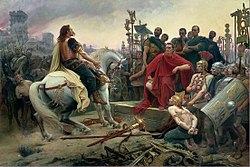
The Gallic Wars were waged between 58 and 50 BC by the Roman general Julius Caesar against the peoples of Gaul (present-day France, Belgium, and Switzerland). Gallic, Germanic, and Brittonic tribes fought to defend their homelands against an aggressive Roman campaign. The Wars culminated in the decisive Battle of Alesia in 52 BC, in which a complete Roman victory resulted in the expansion of the Roman Republic over the whole of Gaul. Though the collective Gallic armies were as strong as the Roman forces, the Gallic tribes' internal divisions eased victory for Caesar. Gallic chieftain Vercingetorix's attempt to unite the Gauls under a single banner came too late. Caesar portrayed the invasion as being a preemptive and defensive action, but historians agree that he fought the wars primarily to boost his political career and to pay off his debts. Still, Gaul was of significant military importance to the Romans. Native tribes in the region, both Gallic and Germanic, had attacked Rome several times. Conquering Gaul allowed Rome to secure the natural border of the river Rhine.
The wars began with conflict over the migration of the Helvetii in 58 BC, which drew in neighboring tribes and the Germanic Suebi. By 57 BC, Caesar had resolved to conquer all of Gaul. He led campaigns in the east, where the Nervii almost defeated him. In 56 BC, Caesar defeated the Veneti in a naval battle and took most of northwest Gaul. In 55 BC, Caesar sought to boost his public image. He undertook first-of-their-kind expeditions across the Rhine and the English Channel. Rome hailed Caesar as a hero upon his return from Britain, though he had achieved little beyond landing because his army had been too small. The next year, he returned with a larger army and reached much further inland; he extracted tribute from the locals and returned to Gaul. Tribes rose up on the continent, and the Romans suffered a humiliating defeat. 53 BC saw a brutal pacification campaign. That failed, and Vercingetorix led a revolt in 52 BC. Gallic forces won a notable victory at the Battle of Gergovia, but the Romans' indomitable siege works at the Battle of Alesia crushed the Gallic coalition.
In 51 and 50 BC, there was limited resistance, and Caesar's troops mainly engaged in mop-up operations. Gaul was conquered, although it would not become a Roman province until 27 BC, and resistance would continue until as late as 70 AD. There is no precise end date to the war, but the imminent Roman Civil War led to the withdrawal of Caesar's troops in 50 BC. Caesar's wild successes in the war had made him wealthy and provided a legendary reputation. The Gallic Wars were a key factor in Caesar's ability to win the Civil War and make himself dictator, which culminated in the end of the Roman Republic and the establishment of the Roman Empire.
Julius Caesar described the Gallic Wars in his book Commentarii de Bello Gallico. It is the primary source for the conflict, but modern historians consider it propaganda and prone to exaggeration. Caesar makes impossible claims about the number of Gauls killed (over a million), while claiming almost zero Roman casualties. Modern historians believe that Gallic forces were far smaller than the Romans claimed, and that the Romans suffered significant casualties. Regardless of the accuracy of the Commentarii, the campaign was still exceptionally brutal. Untold numbers of Gauls were killed, enslaved, or mutilated, including large numbers of civilians.
The tribes of Gaul were civilized and wealthy, constituting what is known to archeologists as the La Tène culture. Most had contact with Roman merchants and some, such as the Aedui, who were governed by republics, had enjoyed stable political alliances with Rome in the past. During the first century, parts of Gaul were becoming urbanized, which concentrated wealth and population centers, inadvertently making Roman conquest easier. Though the Romans considered the Gauls to be barbarians, their cities mirrored those of the Mediterranean. They struck coins and traded extensively with Rome, providing iron, grain, and many slaves. In exchange, the Gauls accumulated much wealth and developed a taste for Roman wine. The contemporary writer Diodoros explains that part of the conception of Gallic barbarity was because they drank their wine straight, unlike the supposedly civilized Romans who watered down their wine first. However, the Romans realized the Gauls were a powerful fighting force, and considered some of the most "barbaric" tribes to be the fiercest warriors, as they were supposedly uncorrupted by Roman luxuries.
The Gauls and the Romans had significantly different military strategies. The Roman army was extremely disciplined, kept standing between conflicts, and made mostly of heavy infantry; any auxiliary units were fielded from the less disciplined Roman allies, which as the war progressed would include some Gauls. By comparison, the Gauls were an irregular and less disciplined fighting force. Individual Gauls outfitted themselves, as did Romans, a practice that continued into the early Empire. Wealthier soldiers had better equipment. Unlike the Romans, the Gauls were a warrior culture. They prized acts of bravery and individual courage; frequent raiding of neighboring tribes kept their fighting skills sharp. Compared to the Romans, the Gauls carried longer swords and had far superior cavalry. The Gauls were generally taller than the Romans (a fact that seems to have embarrassed the Romans) and this combined with their longer swords gave them a reach advantage in combat. Both sides used archers and slingers. Little is known about Gallic battle strategy, and the effectiveness of Gallic slingers and archers is unknown. What is known indicates that battle strategy varied between tribes, although engagement in pitched battle was frequent, to prove bravery. Not all tribes engaged the Romans directly, as Rome was a formidable enemy. The Gauls frequently used attrition warfare against them. While the Gauls had much more flair in combat (such as fighting in intricately decorated armor, or even in the nude), the superior discipline and formation of the Romans generally gave them an advantage in hand-to-hand fighting.
The Wars cemented the Roman use of the cohort instead of the maniple. First described by Polybius as an administrative unit that was used in a battle in 206 BC, it had become a tactical unit by the 130s. Typically a quarter the size of a cohort, the maniple had proved too small and ineffective. The cohort was an effective counterbalance to Gallic and Germanic tactics. The system diversified the ranks by combining men from different socio-economic ranks: unlike in the maniple system, rich and poor fought alongside each other in a single uniform unit, greatly increasing overall morale by removing resentment. A cohort held 480 men. Ten cohorts, combined with a small cavalry unit, engineers, and officers, made a legion of around 5,000 men.
The practices of the army's baggage train would prove insufficient at times during the Wars. Following common practice of Roman generals as early as Scipio Aemilianus, each legionary was required to carry a substantial amount of his own gear, including weapons, and rations enough to operate independently of the baggage train for a few days. This reduced the size of the baggage train greatly and allowed for a legion to temporarily march well ahead of its baggage. Still, a legion usually had around a thousand beasts of burden to carry the tents, siege equipment, reserve food, entrenching tools, records, personal effects, and all other items a large army needed. While on march, the average legion with train stretched out for about 2.5 mi (4.0 km). Such a large number of animals also required a great deal of grazing or fodder; this limited campaigning to times when there was grass or adequate supplies. The logistical challenges of the baggage train forced the Romans' hand many times during the wars.
Gallic Wars
The Gallic Wars were waged between 58 and 50 BC by the Roman general Julius Caesar against the peoples of Gaul (present-day France, Belgium, and Switzerland). Gallic, Germanic, and Brittonic tribes fought to defend their homelands against an aggressive Roman campaign. The Wars culminated in the decisive Battle of Alesia in 52 BC, in which a complete Roman victory resulted in the expansion of the Roman Republic over the whole of Gaul. Though the collective Gallic armies were as strong as the Roman forces, the Gallic tribes' internal divisions eased victory for Caesar. Gallic chieftain Vercingetorix's attempt to unite the Gauls under a single banner came too late. Caesar portrayed the invasion as being a preemptive and defensive action, but historians agree that he fought the wars primarily to boost his political career and to pay off his debts. Still, Gaul was of significant military importance to the Romans. Native tribes in the region, both Gallic and Germanic, had attacked Rome several times. Conquering Gaul allowed Rome to secure the natural border of the river Rhine.
The wars began with conflict over the migration of the Helvetii in 58 BC, which drew in neighboring tribes and the Germanic Suebi. By 57 BC, Caesar had resolved to conquer all of Gaul. He led campaigns in the east, where the Nervii almost defeated him. In 56 BC, Caesar defeated the Veneti in a naval battle and took most of northwest Gaul. In 55 BC, Caesar sought to boost his public image. He undertook first-of-their-kind expeditions across the Rhine and the English Channel. Rome hailed Caesar as a hero upon his return from Britain, though he had achieved little beyond landing because his army had been too small. The next year, he returned with a larger army and reached much further inland; he extracted tribute from the locals and returned to Gaul. Tribes rose up on the continent, and the Romans suffered a humiliating defeat. 53 BC saw a brutal pacification campaign. That failed, and Vercingetorix led a revolt in 52 BC. Gallic forces won a notable victory at the Battle of Gergovia, but the Romans' indomitable siege works at the Battle of Alesia crushed the Gallic coalition.
In 51 and 50 BC, there was limited resistance, and Caesar's troops mainly engaged in mop-up operations. Gaul was conquered, although it would not become a Roman province until 27 BC, and resistance would continue until as late as 70 AD. There is no precise end date to the war, but the imminent Roman Civil War led to the withdrawal of Caesar's troops in 50 BC. Caesar's wild successes in the war had made him wealthy and provided a legendary reputation. The Gallic Wars were a key factor in Caesar's ability to win the Civil War and make himself dictator, which culminated in the end of the Roman Republic and the establishment of the Roman Empire.
Julius Caesar described the Gallic Wars in his book Commentarii de Bello Gallico. It is the primary source for the conflict, but modern historians consider it propaganda and prone to exaggeration. Caesar makes impossible claims about the number of Gauls killed (over a million), while claiming almost zero Roman casualties. Modern historians believe that Gallic forces were far smaller than the Romans claimed, and that the Romans suffered significant casualties. Regardless of the accuracy of the Commentarii, the campaign was still exceptionally brutal. Untold numbers of Gauls were killed, enslaved, or mutilated, including large numbers of civilians.
The tribes of Gaul were civilized and wealthy, constituting what is known to archeologists as the La Tène culture. Most had contact with Roman merchants and some, such as the Aedui, who were governed by republics, had enjoyed stable political alliances with Rome in the past. During the first century, parts of Gaul were becoming urbanized, which concentrated wealth and population centers, inadvertently making Roman conquest easier. Though the Romans considered the Gauls to be barbarians, their cities mirrored those of the Mediterranean. They struck coins and traded extensively with Rome, providing iron, grain, and many slaves. In exchange, the Gauls accumulated much wealth and developed a taste for Roman wine. The contemporary writer Diodoros explains that part of the conception of Gallic barbarity was because they drank their wine straight, unlike the supposedly civilized Romans who watered down their wine first. However, the Romans realized the Gauls were a powerful fighting force, and considered some of the most "barbaric" tribes to be the fiercest warriors, as they were supposedly uncorrupted by Roman luxuries.
The Gauls and the Romans had significantly different military strategies. The Roman army was extremely disciplined, kept standing between conflicts, and made mostly of heavy infantry; any auxiliary units were fielded from the less disciplined Roman allies, which as the war progressed would include some Gauls. By comparison, the Gauls were an irregular and less disciplined fighting force. Individual Gauls outfitted themselves, as did Romans, a practice that continued into the early Empire. Wealthier soldiers had better equipment. Unlike the Romans, the Gauls were a warrior culture. They prized acts of bravery and individual courage; frequent raiding of neighboring tribes kept their fighting skills sharp. Compared to the Romans, the Gauls carried longer swords and had far superior cavalry. The Gauls were generally taller than the Romans (a fact that seems to have embarrassed the Romans) and this combined with their longer swords gave them a reach advantage in combat. Both sides used archers and slingers. Little is known about Gallic battle strategy, and the effectiveness of Gallic slingers and archers is unknown. What is known indicates that battle strategy varied between tribes, although engagement in pitched battle was frequent, to prove bravery. Not all tribes engaged the Romans directly, as Rome was a formidable enemy. The Gauls frequently used attrition warfare against them. While the Gauls had much more flair in combat (such as fighting in intricately decorated armor, or even in the nude), the superior discipline and formation of the Romans generally gave them an advantage in hand-to-hand fighting.
The Wars cemented the Roman use of the cohort instead of the maniple. First described by Polybius as an administrative unit that was used in a battle in 206 BC, it had become a tactical unit by the 130s. Typically a quarter the size of a cohort, the maniple had proved too small and ineffective. The cohort was an effective counterbalance to Gallic and Germanic tactics. The system diversified the ranks by combining men from different socio-economic ranks: unlike in the maniple system, rich and poor fought alongside each other in a single uniform unit, greatly increasing overall morale by removing resentment. A cohort held 480 men. Ten cohorts, combined with a small cavalry unit, engineers, and officers, made a legion of around 5,000 men.
The practices of the army's baggage train would prove insufficient at times during the Wars. Following common practice of Roman generals as early as Scipio Aemilianus, each legionary was required to carry a substantial amount of his own gear, including weapons, and rations enough to operate independently of the baggage train for a few days. This reduced the size of the baggage train greatly and allowed for a legion to temporarily march well ahead of its baggage. Still, a legion usually had around a thousand beasts of burden to carry the tents, siege equipment, reserve food, entrenching tools, records, personal effects, and all other items a large army needed. While on march, the average legion with train stretched out for about 2.5 mi (4.0 km). Such a large number of animals also required a great deal of grazing or fodder; this limited campaigning to times when there was grass or adequate supplies. The logistical challenges of the baggage train forced the Romans' hand many times during the wars.
Recent media
Recent media