



Community hub
Recent from talks
Knowledge base stats:
Talk channels stats:
Members stats:
Common wombat
The common wombat (Vombatus ursinus), also known as the bare-nosed wombat, is a marsupial, one of three extant species of wombats and the only one in the genus Vombatus. It has three subspecies: Vombatus ursinus hirsutus, found on the Australian mainland; Vombatus ursinus tasmaniensis (Tasmanian wombat), found in Tasmania; and Vombatus ursinus ursinus (Bass Strait wombat), found on Flinders Island and Maria Island in the Bass Strait.
The mainland subspecies is the largest of the three, with its largest specimens measuring up to 1.2 m (3 ft 11 in) and 35 kg (77 lb). The common wombat is herbivorous, mainly nocturnal, and lives in burrows. Being a marsupial, its joeys inhabit a pouch on the mother for around five months after birth.
The common wombat was first described by George Shaw in 1800.[citation needed]
There are three extant subspecies of the common wombat, confirmed in 2019:
Hackett's wombat (V. hacketti) is an extinct species of genus Vombatus, inhabiting the southwestern part of Australia. Being around the same size as V. ursinus, with an average weight of 30 kg (66 lb), V. hacketti went extinct at the end of the Late Pleistocene, in the Quaternary extinction event.
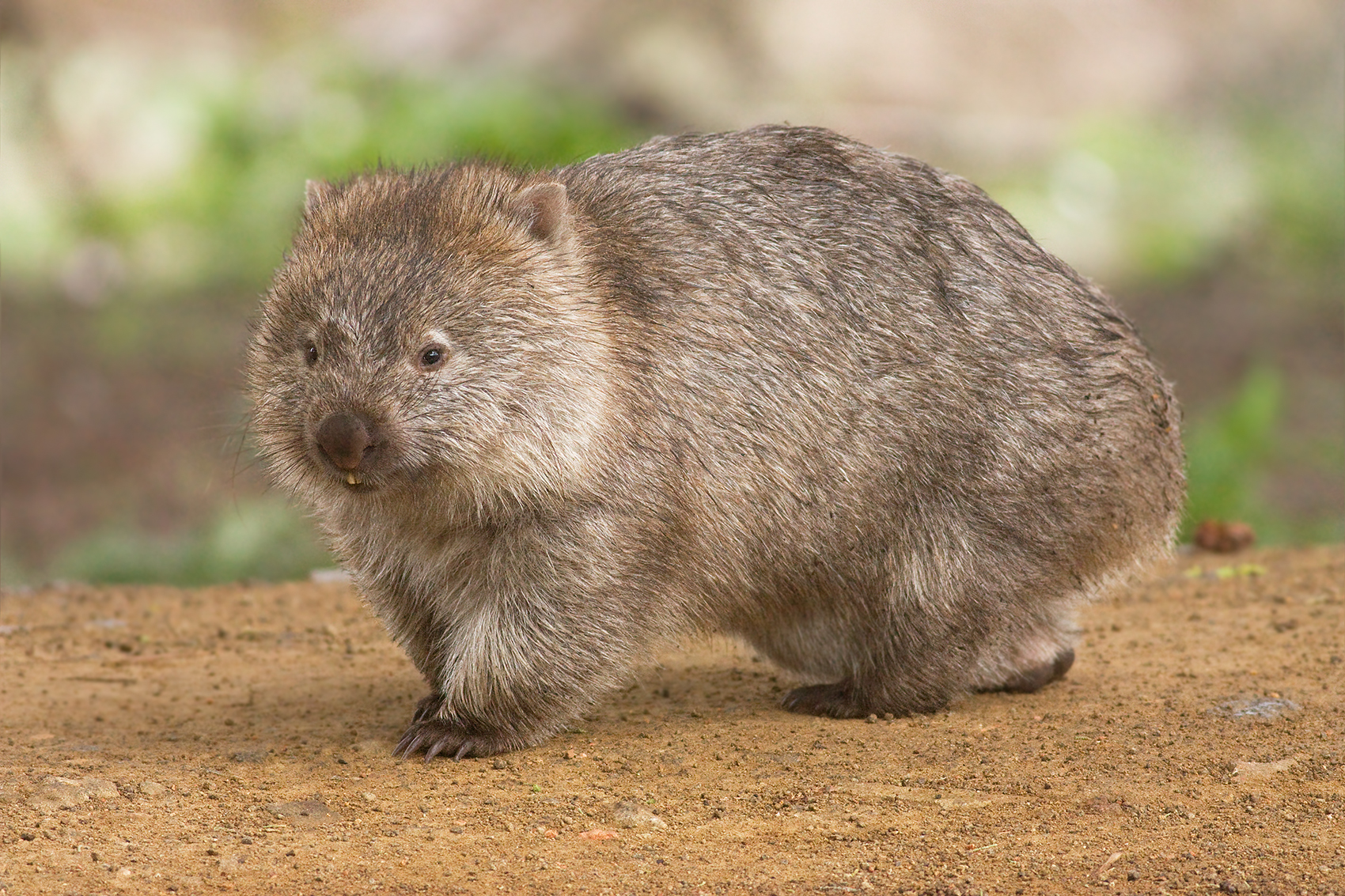
Common wombats are sturdy and built close to the ground. They have small ears and eyes, and a large bald nose. Their fur is thick and coarse and its colour varies from light brown to grey and black. The Flinders Island wombat is the smallest of the three subspecies at around 75 cm (30 in) in length, while the Tasmanian wombat averages 85 cm (33 in) and a weight of 20 kg (44 lb). The largest of the three, the mainland species, are around 1 m (3 ft 3 in) long and weigh 27 kg (60 lb) on average. Larger specimens can reach 1.2 m (3 ft 11 in) and 35 kg (77 lb).
They have short, strong legs with long claws and are very efficient diggers. One mark of distinction from all other marsupials is that the wombat has a single pair of upper and lower incisors, which never stop growing.
Common wombats are widespread in the cooler and better-watered parts of southern and eastern Australia, including Tasmania and Victoria, and in mountain districts as far north as southern Queensland. In Tasmania, their preference is heathland, coastal scrub, and open forest.
Hub AI
Common wombat AI simulator
(@Common wombat_simulator)
Common wombat
The common wombat (Vombatus ursinus), also known as the bare-nosed wombat, is a marsupial, one of three extant species of wombats and the only one in the genus Vombatus. It has three subspecies: Vombatus ursinus hirsutus, found on the Australian mainland; Vombatus ursinus tasmaniensis (Tasmanian wombat), found in Tasmania; and Vombatus ursinus ursinus (Bass Strait wombat), found on Flinders Island and Maria Island in the Bass Strait.
The mainland subspecies is the largest of the three, with its largest specimens measuring up to 1.2 m (3 ft 11 in) and 35 kg (77 lb). The common wombat is herbivorous, mainly nocturnal, and lives in burrows. Being a marsupial, its joeys inhabit a pouch on the mother for around five months after birth.
The common wombat was first described by George Shaw in 1800.[citation needed]
There are three extant subspecies of the common wombat, confirmed in 2019:
Hackett's wombat (V. hacketti) is an extinct species of genus Vombatus, inhabiting the southwestern part of Australia. Being around the same size as V. ursinus, with an average weight of 30 kg (66 lb), V. hacketti went extinct at the end of the Late Pleistocene, in the Quaternary extinction event.
Common wombats are sturdy and built close to the ground. They have small ears and eyes, and a large bald nose. Their fur is thick and coarse and its colour varies from light brown to grey and black. The Flinders Island wombat is the smallest of the three subspecies at around 75 cm (30 in) in length, while the Tasmanian wombat averages 85 cm (33 in) and a weight of 20 kg (44 lb). The largest of the three, the mainland species, are around 1 m (3 ft 3 in) long and weigh 27 kg (60 lb) on average. Larger specimens can reach 1.2 m (3 ft 11 in) and 35 kg (77 lb).
They have short, strong legs with long claws and are very efficient diggers. One mark of distinction from all other marsupials is that the wombat has a single pair of upper and lower incisors, which never stop growing.
Common wombats are widespread in the cooler and better-watered parts of southern and eastern Australia, including Tasmania and Victoria, and in mountain districts as far north as southern Queensland. In Tasmania, their preference is heathland, coastal scrub, and open forest.