Hubbry Logo
search
logo
1988583

Common wombat

logo
Community Hub0 Subscribers
Read side by side
from Wikipedia

Common wombat[1]
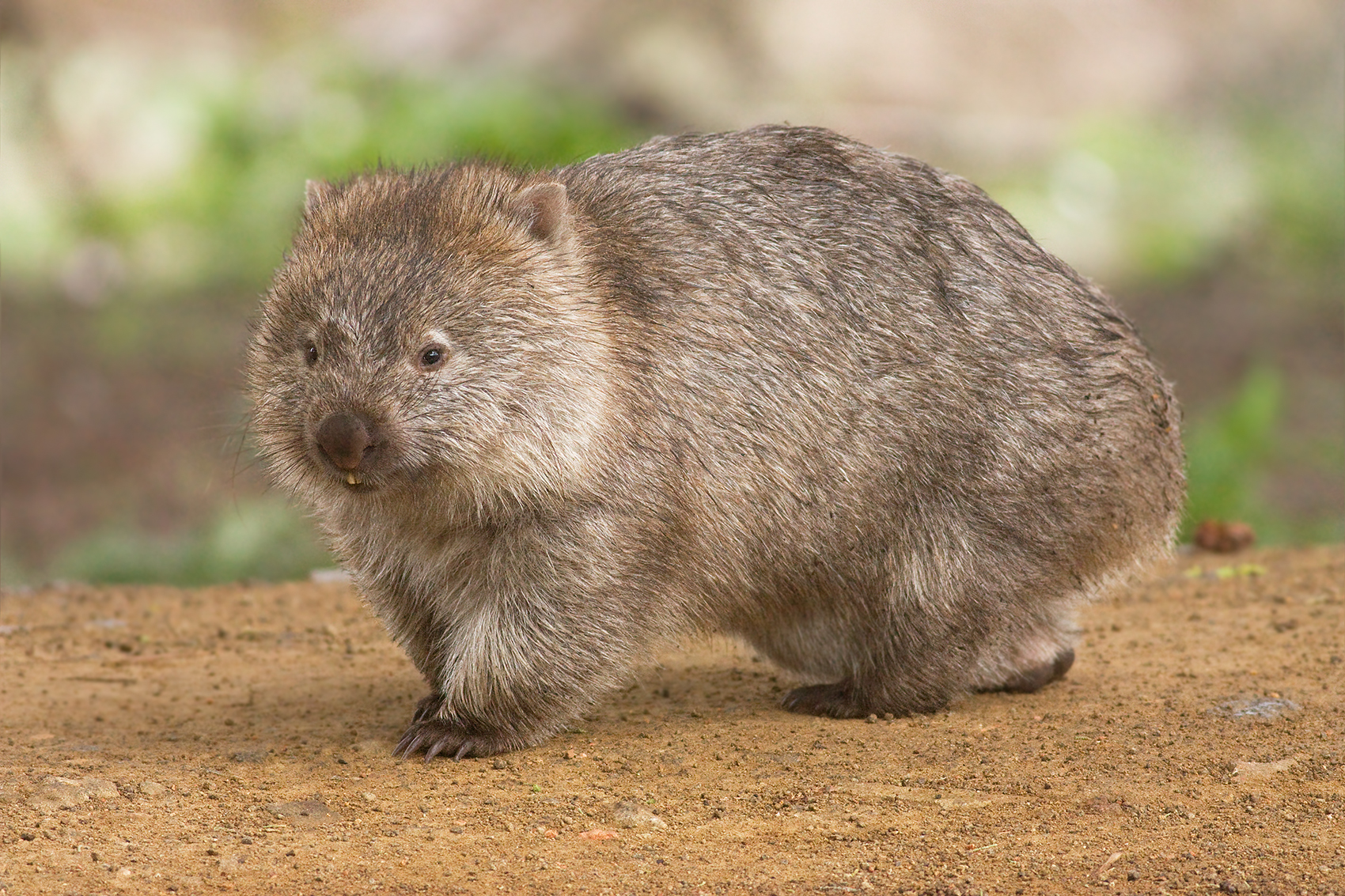
Vombatus ursinus ursinus, Maria Island, Tasmania
Scientific classification Edit this classification
Kingdom: Animalia
Phylum: Chordata
Class: Mammalia
Infraclass: Marsupialia
Order: Diprotodontia
Family: Vombatidae
Genus: Vombatus
Species:
V. ursinus
Binomial name
Vombatus ursinus
(Shaw, 1800)
Common wombat range
Synonyms

Reference[3]

  • Wombatus fossor
  • Phascolomis wombat
  • Phascolomis vombatus
  • Phascolomys platyrhinus
  • Phascolomys fuscus
  • Phascolomys mitchellii
  • Phascolomys niger
  • Phascolomys setosus
  • Phascolomys assimilis

The common wombat (Vombatus ursinus), also known as the bare-nosed wombat, is a marsupial, one of three extant species of wombats and the only one in the genus Vombatus. It has three subspecies: Vombatus ursinus hirsutus, found on the Australian mainland; Vombatus ursinus tasmaniensis (Tasmanian wombat), found in Tasmania; and Vombatus ursinus ursinus (Bass Strait wombat), found on Flinders Island and Maria Island in the Bass Strait.

The mainland subspecies is the largest of the three, with its largest specimens measuring up to 1.2 m (3 ft 11 in) and 35 kg (77 lb). The common wombat is herbivorous, mainly nocturnal, and lives in burrows. Being a marsupial, its joeys inhabit a pouch on the mother for around five months after birth.

Taxonomy

[edit]
1807 illustration of the now-extinct wombats of King Island[a]

The common wombat was first described by George Shaw in 1800.[citation needed]

There are three extant subspecies of the common wombat, confirmed in 2019:[4]

  • Bass Strait (common) wombat, also written "Common Wombat (Bass Strait)"[5] or "Bass Strait wombat"[6] (V. u. ursinus), the nominate form, was once found throughout the Bass Strait Islands, but is now restricted to Flinders Island to the north of Tasmania, and to Maria Island to the east of Tasmania where it was introduced. Its population was estimated at 74,000 in 2023.[7][8]
  • Tasmanian wombat (V. u. tasmaniensis) is found in Tasmania.[9][10] It is smaller than V. u. hirsutus.[11] Its population was estimated at 840,000 in 2023.[7][8]

Hackett's wombat (V. hacketti) is an extinct species of genus Vombatus, inhabiting the southwestern part of Australia.[12][13][14][15] Being around the same size as V. ursinus, with an average weight of 30 kg (66 lb), V. hacketti went extinct at the end of the Late Pleistocene, in the Quaternary extinction event.[16][17]

Description

[edit]

Common wombats are sturdy and built close to the ground. They have small ears and eyes, and a large bald nose. Their fur is thick and coarse and its colour varies from light brown to grey and black. The Flinders Island wombat is the smallest of the three subspecies at around 75 cm (30 in) in length, while the Tasmanian wombat averages 85 cm (33 in) and a weight of 20 kg (44 lb). The largest of the three, the mainland species, are around 1 m (3 ft 3 in) long and weigh 27 kg (60 lb) on average. Larger specimens can reach 1.2 m (3 ft 11 in) and 35 kg (77 lb).[8]

They have short, strong legs with long claws and are very efficient diggers. One mark of distinction from all other marsupials is that the wombat has a single pair of upper and lower incisors, which never stop growing.[8]

Distribution and habitat

[edit]
A hirsute wombat (V. u. hirsutus) at Wilsons Promontory; larger than the other subspecies, these wombats are widely distributed in southern and eastern parts of the Australian mainland

Common wombats are widespread in the cooler and better-watered parts of southern and eastern Australia, including Tasmania and Victoria, and in mountain districts as far north as southern Queensland.[18][19] In Tasmania, their preference is heathland, coastal scrub, and open forest.[8]

Common wombats can be found at any elevation in the south of their range, but in the north of their range are only found in higher, more mountainous areas. They may be found in a variety of habitats including rainforest, eucalyptus forest, woodland, alpine grassland, and coastal areas.[20] In some regions, they have adapted to farmland and can even be seen grazing in open fields with cattle and sheep.

Behaviour

[edit]

Common wombats have been described as ecological engineers,[21] as their burrow building results in soil turnover and aeration, which assists plant growth, and provides habitat for a range of invertebrate and vertebrate species.[22][23]

Common wombats are a solitary, territorial species, with each wombat having an established range in which it lives and feeds.[24] In this area, they dig a tunnel system, with tunnels ranging from 2–20 m (6 ft 7 in – 65 ft 7 in) in length, along with many side tunnels, and often more than one entrance. More than one wombat may build their nest, made from sticks, leaves, and grasses, in one burrow.[8]

A wide range of other animals are known to make use of wombat burrows including reptiles, rodents, rabbits, echidnas, wallabies, birds and koalas. Wombats are usually fairly tolerant of non-threatening species, and have a number of burrows that they can occupy.[25][26] They typically switch the burrow that they sleep in every 1–9 days.[27]

Many wombats can live in the same burrow, and wombats normally live in the same burrow for their whole lifespan unless the wombat is forced out of the burrow by farmers or other animal species, or unless the burrow is destroyed. Often nocturnal, the common wombat does come out during the day in cooler weather, such as in early morning or late afternoon.[28]

Diet

[edit]
Grazing on Maria Island, Tasmania

Common wombats are herbivorous,[29][30] subsisting on grass, snow tussocks, and other plant materials. Foraging is usually done during the night. They are the only marsupial in the world whose teeth constantly grow. Due to the underlying enamel structure of the teeth, the continuously growing teeth maintain a self-sharpening ridge[31] which allows easier grazing of the diet consisting of mainly native grasses.[28] Captive wombats are also fed a range of vegetables.[32]

Their dung is cube-shaped.[8]

Breeding

[edit]

The common wombat breeds mainly in winter.[8] It can breed every two years and produce a single joey. Wombats appear to mate side-ways[33] The gestation period is about 20–30 days, and the young remain in the pouch for five months. When leaving the pouch, they weigh between 3.5 and 6.5 kg (7.7 and 14.3 lb). The joey is weaned around 12 to 15 months of age, and is usually independent at 18 months of age.[28] Wombats have an average lifespan of 15 years in the wild and 20 years in captivity.

Threats

[edit]

Whilst bare-nosed wombats are listed as Least Concern by the IUCN,[2] they remain threatened largely due to anthropomorphic factors[34] including habitat reduction, roadkill[35] and sarcoptic mange.[36] Sarcoptic mange is prevalent in the population[37][38] and remains the most problematic of issues facing bare-nosed wombats, with wildlife carers regularly treating wombats in the field[36][39] with low-risk moxidectin.[40]

Wombats have also been reported to harbour a range of parasites, including ticks and associated pathogens.[41][42]

Its main predators are Tasmanian devils and eagles.[8]

There was a significant increase in overall wombat counts throughout Tasmania between 1985 and 2019 although numbers decreased in the last 10 years of that period in the west Tamar area.[8]

Footnotes

[edit]

References

[edit]
Revisions and contributorsEdit on WikipediaRead on Wikipedia
from Grokipedia
The common wombat (Vombatus ursinus), also known as the bare-nosed wombat, is a large, robust marsupial native to southeastern Australia, Tasmania, and Bass Strait islands, recognized for its powerful digging limbs, backward-facing pouch, and distinctive cube-shaped feces produced by its efficient digestive system.[1][2] Adults typically measure 77–115 cm in length and weigh 17–39 kg, with coarse fur ranging from sandy to grey-brown and a broad head featuring a naked, black nose and small triangular ears; males are slightly larger than females.[1][2] As a solitary, fossorial herbivore with a low metabolic rate (40–60% of that expected for similar-sized mammals), it plays a key ecological role in soil aeration and habitat modification through extensive burrowing.[2] Common wombats inhabit diverse environments including sub-alpine heath up to 1,800 m elevation, wet and dry forests, woodlands, coastal scrub, grasslands, and agricultural areas across eastern New South Wales, Victoria, South Australia, and Tasmania.[1][3] Their diet consists primarily of native grasses (such as Poa spp. and Themeda australis), sedges, roots, tubers, and occasionally pasture grasses, with individuals grazing for 3–8 hours nightly at rates of 75–100 bites per minute and rarely needing to drink water due to moisture extraction from food.[1][2] Behaviorally, they are mostly nocturnal, emerging at dusk to forage over territories of 4–23 hectares while scent-marking and defending feeding areas through aggression; they maintain complex burrow systems with up to 13 entrances, switching burrows every 1–9 days to avoid parasites and maintain hygiene.[1][2] Reproduction occurs year-round when conditions are favorable, peaking in summer, with a short gestation of about 22 days; a single joey develops in the pouch for 6–10 months before emerging and weaning at 12–15 months, reaching sexual maturity around 2 years and potentially living 15 years in the wild or up to 20 in captivity.[1][2] Classified as Least Concern by the IUCN, populations are estimated at around 432,000 in Victoria, 840,000 in Tasmania, and 72,000 on Bass Strait islands, though subpopulations like the Bass Strait variant face localized risks.[2][3] Major threats include habitat loss from bushfires and agriculture, road mortality, and sarcoptic mange caused by the mite Sarcoptes scabiei, which can devastate local groups if untreated.[1][3]

Taxonomy and phylogeny

Classification

The common wombat, Vombatus ursinus, is classified within the kingdom Animalia, phylum Chordata, class Mammalia, infraclass Marsupialia, order Diprotodontia, suborder Vombatiformes, family Vombatidae, genus Vombatus, and species V. ursinus.[4][5] The genus name Vombatus derives from "wombat," an English term originating from the Dharug Aboriginal word wombak or wambad, referring to the animal, while the specific epithet ursinus comes from the Latin ursus, meaning "bear," in allusion to the species' stocky, bear-like build.[6][7] The species was first scientifically described in 1800 by George Shaw as Didelphis ursina, based on a specimen from New Holland (Australia), with the current binomial Vombatus ursinus established shortly thereafter; the type locality is recorded as Clarke Island in the Bass Strait.[8][5] Within the family Vombatidae, the common wombat is the sole extant species in the genus Vombatus, distinguishing it taxonomically from the two hairy-nosed wombat species (Lasiorhinus krefftii and L. latifrons), which belong to the separate genus Lasiorhinus and feature hairy rhinaria and broader nasal structures.[9][6]

Subspecies and evolution

The common wombat (Vombatus ursinus) is classified into three extant subspecies, each adapted to specific regions in southeastern Australia and associated islands. The mainland subspecies, V. u. hirsutus, inhabits southeastern Australia, including parts of New South Wales, Victoria, and South Australia.[6] The Flinders Island subspecies, V. u. ursinus, is restricted to Flinders Island in the Bass Strait, while V. u. tasmaniensis occupies Tasmania, including areas like the Yolla Basin.[6] These subspecies exhibit minor morphological and genetic differences, such as variations in pelage coarseness and body size, reflecting their isolation; however, the taxonomic distinctness of these subspecies is somewhat uncertain due to low genetic divergence.[10][11] The evolutionary origins of the common wombat trace back to the Miocene epoch, approximately 23 to 5 million years ago, when early vombatids emerged in Australia's fossil record.[12] Primitive vombatids, such as Rhizophascolonus ngangaba, represent early species from Miocene deposits at sites like Riversleigh in Queensland, showing transitional dental and cranial features that link to modern wombats.[13] The divergence of the bare-nosed wombats (Vombatus) from hairy-nosed wombats (Lasiorhinus) occurred around 25 million years ago, during the late Oligocene to early Miocene, as part of broader radiation within the Vombatidae family.[14] Phylogenetically, the common wombat belongs to the suborder Vombatiformes, where it shares a close relationship with koalas (Phascolarctidae) and other diprotodont marsupials, forming a monophyletic clade distinct from macropodids and phalangerids.[15] Genetic studies using genome-wide single nucleotide polymorphisms reveal low genetic diversity in isolated populations, particularly on Bass Strait islands and Tasmania, due to historical marine transgressions that fragmented habitats around 10,000 to 14,000 years ago.[10] Mainland populations show higher diversity but still limited variation compared to other marsupials, underscoring the species' evolutionary conservatism.[16] Fossil evidence from the Pleistocene epoch (approximately 2.6 million to 11,700 years ago) indicates that common wombats had a broader distribution across eastern and southern Australia than their current range, with remains recovered from sites in New South Wales, Queensland, and South Australia where they are now locally extinct.[17] These fossils, including cranial and postcranial elements, suggest a contraction in range coinciding with climatic shifts and the arrival of humans around 65,000 years ago, which likely contributed to habitat alteration and population declines.[18]

Physical characteristics

Morphology

The common wombat (Vombatus ursinus) is a stocky, muscular marsupial adapted for a burrowing lifestyle, with adults typically measuring 84–115 cm in head and body length and weighing 22–39 kg.[9] Sexual dimorphism is minimal, with adults of both sexes similar in size, though some sources note females may be slightly larger at the same age.[9] The body is barrel-shaped with powerful shoulders, a short strong neck, and very short legs ending in broad paws equipped with sturdy claws for digging burrows.[9] Its fur is coarse and thick, varying in color from sandy brown to dark gray or black, often appearing patchy due to soil staining.[19] The head is broad and rounded, featuring small, dark eyes, short rounded ears, and a large naked nose lacking the hairy rhinarium found in related species.[19] The tail is stubby, about 25 mm long, and concealed within the fur.[9] Dentition includes a formula of I 1/1, C 0/0, P 1/1, M 4/4, totaling 24 teeth, with rootless incisors and molars that grow continuously, resembling those of rodents to accommodate constant wear from grazing.[20] Sensory capabilities emphasize olfaction and audition over vision, with poor eyesight due to small eyes but a keen sense of smell for navigation and food detection, complemented by excellent hearing.[21]

Unique adaptations

The common wombat (Vombatus ursinus) exhibits several distinctive physiological and anatomical adaptations that facilitate its survival in challenging environments. One of the most remarkable is the production of cube-shaped feces, a unique trait among mammals resulting from the irregular structure of its colon. The intestines feature varying elasticity and stiffness, with the last 17% of the intestine having undulating surfaces that mold the feces into cubic forms as they dry unevenly during passage; this process is driven by the viscoelastic properties of the intestinal walls, which compress the material into 2-4 cm cubes. These cubes, numbering 80 to 100 per night, serve as territorial markers, as they stack stably on rocks or logs without rolling away due to their flat faces that increase friction on uneven terrain, providing mechanical stability and ensuring the markers remain visible and persistent, enhancing visibility in the wombat's habitat.[22] Burrowing is central to the wombat's lifestyle, supported by specialized musculoskeletal features. Its powerful forelimbs, equipped with strong claws, and a robust spine enable efficient backward excavation, allowing the animal to dig extensive burrow systems while facing outward for safety.[21] Females possess a backward-facing pouch, which opens toward the rear to prevent soil ingress during digging; this orientation keeps the pouch clean and protects joeys from debris, contrasting with the forward-facing pouches of most marsupials.[23] Additionally, the wombat's tough, cartilaginous skin on the rump acts as a defensive shield, resistant to bites and scratches from predators; when cornered in a burrow, it can crush an intruder's skull against the tunnel ceiling using this armored rear.[24] Metabolic adaptations further underscore the wombat's efficiency in arid conditions. It maintains a low metabolic rate, approximately 40–60% of that expected for similar-sized mammals.[2] It can survive without free-standing water, deriving necessary moisture from its herbivorous diet through metabolic water production and minimal urinary concentration. The species conserves energy by extending digestion to 8-14 days and reducing overall activity levels, enabling endurance in food-scarce or dry landscapes.[25] Complementing this, the wombat's teeth are ever-growing and hypsodont, with aradicular (rootless) incisors and molars that continuously erupt to compensate for wear from grinding abrasive vegetation like grasses and roots.[26]

Distribution and habitat

Geographic range

The common wombat (Vombatus ursinus) is native to southeastern Australia, with its current distribution encompassing eastern New South Wales, most of Victoria, southeastern South Australia, Tasmania, and scattered populations on Bass Strait islands such as Flinders Island.[24][27] The species is absent from Queensland (except for fragmented populations in the far southeast near Stanthorpe) and Western Australia, as well as much of the arid interior.[28][29] These range limits are influenced by preferences for temperate, well-watered regions suitable for burrowing and foraging.[9] Historically, the common wombat was more widespread across southern Australia, including areas now unoccupied due to habitat fragmentation and loss since European settlement.[24] Populations on islands like King Island were once present but were eradicated in the 19th century.[30] Today, the distribution is patchy, with continuous occupancy in core southeastern mainland areas and Tasmania, but discontinuous in peripheral regions of South Australia.[1] Recent surveys estimate the total population at over 1.3 million individuals across its range, with state-specific assessments indicating around 433,000 in Victoria alone as of 2020. However, mainland Tasmania populations declined by 12.7% from 2015 to 2024, primarily due to sarcoptic mange.[31][32][33] Densities vary widely but reach up to 166 individuals per km² in optimal areas, though most habitats support 1–21 per km².[32] On Flinders Island, a subspecies population was estimated at approximately 72,000 in 2023.[34] Common wombats exhibit no migratory patterns and are sedentary, maintaining home ranges typically spanning 2–23 hectares that include multiple burrows and overlap minimally with neighbors.[35][36] These ranges allow individuals to remain within familiar territories year-round, focusing on local resources.

Habitat types

The common wombat (Vombatus ursinus) inhabits a variety of temperate ecosystems across southeastern Australia, including eucalypt forests, open woodlands, coastal heathlands, and grasslands. These habitats provide the necessary vegetation for foraging and suitable conditions for burrowing, with a preference for areas featuring native grasses, sedges, and open understories. The species shows overrepresentation in agricultural lands, dry woodlands, and both native and invasive grasslands, while being underrepresented in wet woodlands and dense rainforests, which offer less favorable foraging or burrowing opportunities. Friable, well-drained soils—such as sandy or loamy types on slopes—are essential for excavation, often located near creeks, gullies, or vegetation cover to facilitate drainage and stability.[37][24][1] Microhabitat requirements center on burrow systems that serve as shelters, with individual burrows typically ranging from 3 to 30 meters in length and featuring multiple entrances, tunnels, and chambers. These are often arranged in loose warrens shared among individuals, though not simultaneously occupied, and positioned in proximity to grassy foraging areas to minimize energy expenditure during nocturnal activity. Warrens cluster in forest, scrub, or grass-herb habitats, providing refuges from environmental extremes and predators.[38][37][9] The common wombat occupies an altitudinal range from sea level to over 1,800 meters, extending into subalpine heaths and woodlands, and demonstrates tolerance for semi-arid zones through its presence in dry woodlands and grasslands. It thrives in temperate climates with annual rainfall varying widely, from less than 600 mm in some areas to over 3500 mm in others, where seasonal variations influence resource availability but are buffered by burrow use. Burrows enable thermoregulation by offering stable microclimates against temperature extremes above 25°C or during droughts and floods.[37][1][34]

Behavior and ecology

Activity and social structure

The common wombat exhibits primarily nocturnal and crepuscular activity patterns, emerging from its burrow at dusk to forage during the cooler evening hours.[19] These animals typically remain active for several hours each night, often traveling several kilometers before returning to their burrows before dawn.[19] In cooler or overcast conditions, wombats may extend their foraging periods and occasionally display diurnal activity, such as basking or moving during daylight.[9] Common wombats maintain a largely solitary social structure, interacting minimally outside of breeding seasons and exhibiting aggression toward intruders in their territories.[39] Individuals defend personal home ranges, which can overlap with those of others, through scent marking and strategic placement of feces along boundaries.[24] While primarily solitary, wombats show occasional tolerance by sharing burrow systems or warrens, though they rarely occupy the same space simultaneously.[19] This territorial behavior helps minimize conflict in areas with limited resources. In terms of locomotion, common wombats typically move at a slow, waddling pace over short distances but can achieve rapid bursts of speed up to around 40 km/h over short distances to evade threats or cover ground quickly, though this is based primarily on observations of related species.[9][40] These sprints are short-lived, often lasting under a minute, and rely on their muscular build for powerful propulsion.[40] Wombats are also capable swimmers, using their sturdy limbs to navigate water when necessary, though this occurs infrequently.[41] Communication among common wombats involves a combination of vocalizations, olfactory signals, and physical markings. They produce a range of sounds, including low guttural growls as warnings, rasping hisses when alarmed or angry, and repetitive "chikker chikker" calls during aggressive encounters.[9] Scent marking is achieved through cloacal glands that secrete pheromones, applied to objects in the territory, while their uniquely cubic-shaped feces are placed on elevated surfaces like rocks or logs to delineate boundaries without rolling away.[42] This fecal placement enhances olfactory communication, given their reliance on smell over poor eyesight.[43]

Diet and foraging

The common wombat (Vombatus ursinus) is strictly herbivorous, with a diet dominated by native grasses such as kangaroo grass (Themeda triandra), sedges, roots, and occasionally bark. Grasses typically comprise 80% or more of the diet in many habitats, reflecting adaptation to fibrous, low-nitrogen forage available in their range. As selective feeders, wombats preferentially choose non-toxic plants, avoiding species that could cause health issues like liver damage when alternatives are present.[44][45][46] Foraging occurs primarily at night, with wombats emerging from burrows to graze within their home range of 4–23 hectares, often close to their burrows. They use powerful jaws and rodent-like incisor teeth that continuously grow to efficiently shear and grind tough, fibrous material. This behavior allows them to exploit patches of preferred forage without extensive travel.[47][48][19] Dietary composition varies seasonally to match availability; in summer, wombats shift toward herbs and lush grasses, while in winter they supplement with bark from trees and shrubs when green forage is scarce. Coprophagy—the re-ingestion of feces—is rarely documented but observed occasionally to recycle nutrients like vitamins produced by gut microbes.[49][50][51] The wombat's digestive system relies on hindgut fermentation in an enlarged cecum and colon, where microbes break down cellulose from low-quality plant matter. Passage time through the gut is exceptionally slow, up to 14 days, enabling maximal extraction of energy and water from fibrous diets that other herbivores might pass more quickly. Nocturnal activity patterns support efficient foraging under cover of darkness.[24][52][53]

Reproduction and lifecycle

The common wombat exhibits a polygynous mating system, in which males mate with multiple females and compete for access through displays such as chasing, biting the female's rump, and grasping with forelegs during courtship.[19][54] Breeding occurs year-round when food resources are abundant, with regional peaks (e.g., autumn in southern regions or summer in others), and births often clustered from late winter to spring.[1][54] This reproductive strategy aligns with the species' largely solitary social structure outside of breeding periods.[19] Gestation lasts 20-30 days, after which the female typically gives birth to a single underdeveloped joey, though twins are rare.[54][9] The tiny, jelly-bean-sized joey, blind and hairless, instinctively crawls from the birth canal into the mother's backward-facing pouch, where it attaches to a teat and remains for 6-9 months while developing further.[19][54] During this pouch phase, the female provides nourishment through milk and protects the joey, whose position in the pouch safeguards it from soil and debris during burrowing activities.[1] The joey begins making short excursions from the pouch around 6-7 months and emerges permanently by 7-9 months, continuing to suckle until weaning at 12-15 months, at which point it forages independently but often remains near the mother.[54][19] Sexual maturity is reached at 2-3 years, with females typically breeding every two years thereafter under favorable conditions.[54] In the wild, common wombats have a lifespan of 5-15 years, though individuals in captivity can live up to 30 years.[19] Parental care extends beyond weaning, as mothers teach joeys burrowing techniques and food selection through observation and imitation, though high infant mortality from predation affects up to 50% of young in their first year.[54][1]

Conservation

Threats and predators

The common wombat faces few natural predators as an adult due to its robust build and defensive behaviors, such as retreating to burrows and using its powerful hindquarters to crush intruders against burrow ceilings. Primary predators include introduced species like dingoes and European red foxes, which target weakened or solitary individuals, while Tasmanian devils pose a threat in Tasmania.[9][55] Joeys and juveniles are particularly vulnerable to predation by wedge-tailed eagles, barking owls, and eastern quolls, which can access pouch young or emerging offspring.[55] Human activities exacerbate mortality through habitat fragmentation caused by agriculture and urbanization, which isolates populations and reduces available foraging areas in grasslands and eucalypt forests. Vehicle collisions represent a leading cause of death, with an average of 478 reported incidents annually across Australia based on citizen science data from 2015–2019, particularly on rural roads during nocturnal activity periods; in some New South Wales regions, roadkill accounts for a substantial portion of recorded fatalities.[56][57] Wombats also face competition for grass and browse from livestock such as cattle and sheep, which overgraze preferred habitats and diminish food resources during dry periods.[48] Additionally, indirect poisoning occurs via rodenticides and baits intended for introduced pests like rabbits, which wombats ingest while foraging.[48] Sarcoptic mange, caused by the mite Sarcoptes scabiei, is a devastating disease that has driven localized population declines since the 1990s, with outbreaks leading to severe skin lesions, hair loss, hypothermia, and death if untreated. The condition spreads through direct contact or shared burrows, amplified in fragmented habitats with high wombat densities, and has caused up to 70-90% mortality in affected groups in southeastern Australia.[58][56] Other risks include drowning during floods, which inundate burrows and force wombats from shelter, as observed in major events like the 2022 New South Wales floods that destroyed extensive warren systems. Illegal shooting persists in rural areas where wombats are perceived as pests for damaging fences or competing with agriculture, despite legal protections under state wildlife acts.[59][36]

Population status

The common wombat (Vombatus ursinus) is classified as Least Concern on the IUCN Red List, with the most recent assessment in October 2024 indicating a stable global population trend despite regional variations. This status reflects the species' widespread distribution across southeastern Australia and its ability to persist in diverse habitats, though localized fragmentation poses risks to long-term viability.[60] Population trends show stability or increases in core ranges, such as New South Wales where the species remains abundant, and mainland Tasmania, where overall numbers rose by 61% between 1985 and 2023 based on long-term spotlight surveys. In contrast, declines are evident in isolated areas, including up to an 80-94% reduction in specific Tasmanian subpopulations over recent decades due to disease outbreaks, and ongoing contraction in South Australia and western Victoria from habitat fragmentation and isolation. For example, the subspecies V. u. ursinus on Flinders Island supports an estimated 71,826 individuals (95% credible interval: 43,913–136,761) as of 2020, contributing to regional stability in the Bass Strait area.[27][61][62][63][34] Monitoring relies on non-invasive methods including annual spotlight and distance sampling surveys, burrow occupancy assessments, and drone mapping to estimate abundances and track changes. These techniques reveal densities varying from 0.1 to 4 individuals per km², with higher values (up to 4 per km² or 0.4 per hectare) in favorable, well-watered habitats and lower in arid or fragmented zones. Scat analysis and camera trapping further aid in evaluating distribution, health, and genetic diversity, identifying bottlenecks in small populations where isolation reduces gene flow and increases vulnerability to stochastic events. The Tasmanian subspecies V. u. hirtipes exemplifies local concerns, with fragmented groups showing elevated risks despite broader stability.[34][64][65][66][67][10]

Protection measures

The common wombat (Vombatus ursinus) is protected under Australian state legislation, including the Biodiversity Conservation Act 2016 in New South Wales, which prohibits harming, trapping, or killing individuals without a licence from the Department of Climate Change, Energy, the Environment and Water.[68] In Victoria, it receives protection under the Wildlife Act 1975, making it illegal to take or destroy the species except under specific authority.[69] Comparable safeguards apply across other states and territories, such as Queensland's Nature Conservation Act 1992, though limited control permits for damage mitigation are occasionally granted to landowners. Commercial hunting has been prohibited nationwide since the mid-20th century, with bounties fully phased out by 1966 in key regions like Victoria.[70] Conservation actions focus on mitigating human-wildlife conflicts and health threats. Fencing initiatives, including innovative virtual fencing systems that use lights and sounds to deter crossing, have been trialed along high-risk roads in New South Wales and Victoria, demonstrating up to 80% reductions in wombat road mortalities in pilot areas.[71] Habitat restoration efforts involve revegetation and native tree planting on private and public lands to enhance foraging areas and buffer zones, thereby minimizing burrow-related damage to infrastructure.[36] For sarcoptic mange, community-led treatment programs administer topical moxidectin (e.g., Cydectin) via burrow flaps or direct application, with trials since the early 2010s showing high efficacy in restoring affected populations when coverage exceeds 70%.[72][73] Research supports these interventions through genetic analyses and behavioral studies. Investigations into subspecies divergence using mitochondrial DNA have informed translocation protocols, ensuring genetic diversity in relocated groups to bolster resilience.[74] Landscape genetics research examines how habitat fragmentation affects gene flow, guiding habitat connectivity projects.[16] Community education campaigns, led by groups like the Wombat Protection Society of Australia, promote awareness of wombats' roles in soil aeration and pest control to counter perceptions of them as agricultural pests and reduce unauthorized harm.[75] International efforts emphasize ex situ conservation. Captive breeding programs in Australian zoos, such as Healesville Sanctuary and Taronga Zoo, maintain populations for research and public education, with breeding success rates improving through enriched enclosures mimicking natural burrows.[76] While reintroductions are rare for the common wombat due to its stable status, genetic monitoring from captive stocks has supported small-scale releases in fragmented habitats within its core range.[34] These measures address localized population declines driven by habitat loss and disease.

References

User Avatar
No comments yet.