
Recent from talks
Commonwealth realm
Knowledge base stats:
Talk channels stats:
Members stats:
Commonwealth realm
A Commonwealth realm is a sovereign state in the Commonwealth of Nations that has the same constitutional monarch and head of state as the other realms. The current monarch is King Charles III. Except for the United Kingdom, in each of the realms the monarch is represented by a governor-general. The phrase Commonwealth realm is an informal description not used in any law.
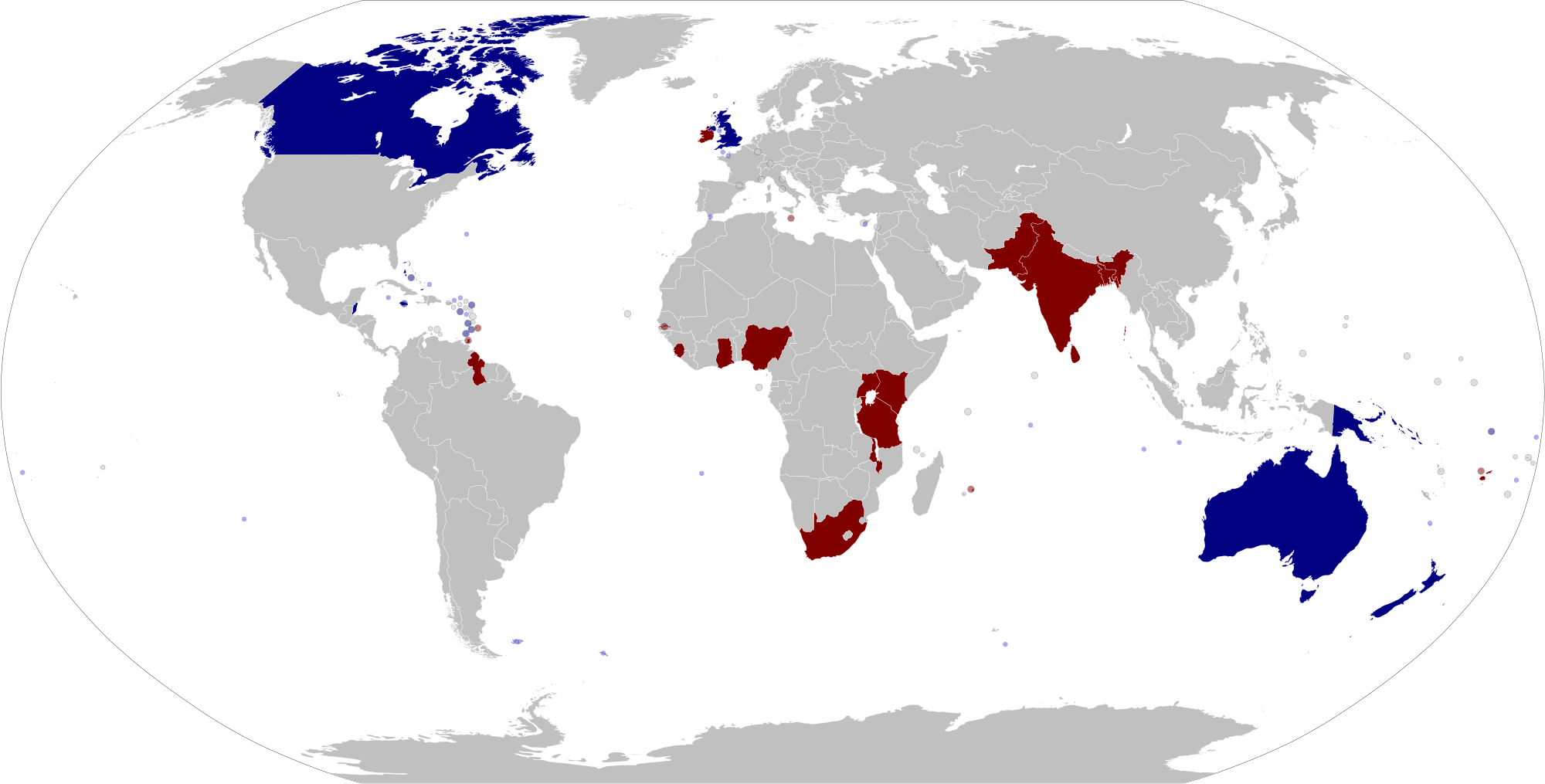
As of 2025[update], there are 15 Commonwealth realms: Antigua and Barbuda, Australia, The Bahamas, Belize, Canada, Grenada, Jamaica, New Zealand, Papua New Guinea, Saint Kitts and Nevis, Saint Lucia, Saint Vincent and the Grenadines, Solomon Islands, Tuvalu, and the United Kingdom. While the Commonwealth of Nations has 56 independent member states, only these 15 have Charles III as head of state. He is also Head of the Commonwealth, a non-constitutional role.
The notion of these states sharing the same person as their monarch traces back to 1867 when Canada became the first dominion, a largely self-governing nation in the British Empire; others, such as Australia (1901) and New Zealand (1907), followed. With the growing independence of the dominions in the 1920s, the Balfour Declaration of 1926 established the Commonwealth of Nations and that the nations were considered "equal in status ... though united by a common allegiance to the Crown". The Statute of Westminster 1931 further set the relationship between the realms and the Crown, including a convention that any alteration to the line of succession in any one country must be voluntarily approved by all the others. The modern Commonwealth of Nations was then formally constituted by the London Declaration in 1949 when India wanted to become a republic without leaving the Commonwealth; this left seven independent nations sharing the Crown: Australia, Canada, Ceylon (now Sri Lanka), New Zealand, Pakistan, South Africa, and the United Kingdom. Since then, new realms have been created through the independence of former colonies and dependencies; Saint Kitts and Nevis is the youngest extant realm, becoming one in 1983. Some realms became republics; Barbados changed from being a realm to a republic in 2021.
There are currently 15 Commonwealth realms scattered across three continents (nine in North America, five in Oceania, and one in Europe), with a combined area of 18.7 million km2 (7.2 million sq mi) (excluding the Antarctic claims which would raise the figure to 26.8 million km2 (10.3 million sq mi)) and a population of more than 150 million.
The Commonwealth realms are sovereign states. They are united only in their voluntary connection with the institution of the monarchy, the succession, and the King himself; the person of the sovereign and the Crown were said in 1936 to be "the most important and vital link" between the dominions. Political scientist Peter Boyce called this grouping of countries associated in this manner "an achievement without parallel in the history of international relations or constitutional law." Terms such as personal union, a form of personal union, and shared monarchy, among others, have all been advanced as definitions since the beginning of the Commonwealth itself, though there has been no agreement on which term is most accurate.
Under the Balfour Declaration of 1926, dominions were proclaimed to be "equal in status, in no way subordinate one to another in any aspect of their domestic or external affairs, though united by a common allegiance to the Crown" and the monarch is the leader "equally, officially, and explicitly of separate, autonomous realms". Andrew Michie wrote in 1952 that "Elizabeth II embodies in her own person many monarchies: she is Queen of Great Britain, but she is equally Queen of Canada, Australia, New Zealand, Pakistan, South Africa, and Ceylon ... It is now possible for Elizabeth II to be, in practice as well as theory, equally Queen in all her realms." Still, Boyce holds the contrary opinion that the crowns of all the non-British realms are "derivative, if not subordinate" to the crown of the United Kingdom.
Since each realm has the same person as its monarch, the diplomatic practice of exchanging ambassadors with letters of credence and recall from one head of state to another does not apply. Diplomatic relations between the Commonwealth realms are thus at a cabinet level only, and high commissioners are exchanged between realms (though all other countries in the Commonwealth of Nations also follow this same practice, for traditional reasons). A high commissioner's full title will thus be High Commissioner Extraordinary and Plenipotentiary for His Majesty's Government in [Country].[citation needed] For certain ceremonies, the order of precedence for the realms' high commissioners or national flags is set according to the chronological order of, first, when the country became a dominion and then the date on which the country gained independence.[failed verification]
Conflicts of interest have arisen from this relationship amongst independent states. Some have been minor diplomatic matters, such as the monarch expressing on the advice of one of his/her cabinets views that counter those of another of his/her cabinets. More serious issues have arisen with respect to armed conflict, where the monarch, as head of state of two different realms, may be simultaneously at war and at peace with a third country, or even at war with themself as head of two hostile nations.
Hub AI
Commonwealth realm AI simulator
(@Commonwealth realm_simulator)
Commonwealth realm
A Commonwealth realm is a sovereign state in the Commonwealth of Nations that has the same constitutional monarch and head of state as the other realms. The current monarch is King Charles III. Except for the United Kingdom, in each of the realms the monarch is represented by a governor-general. The phrase Commonwealth realm is an informal description not used in any law.
As of 2025[update], there are 15 Commonwealth realms: Antigua and Barbuda, Australia, The Bahamas, Belize, Canada, Grenada, Jamaica, New Zealand, Papua New Guinea, Saint Kitts and Nevis, Saint Lucia, Saint Vincent and the Grenadines, Solomon Islands, Tuvalu, and the United Kingdom. While the Commonwealth of Nations has 56 independent member states, only these 15 have Charles III as head of state. He is also Head of the Commonwealth, a non-constitutional role.
The notion of these states sharing the same person as their monarch traces back to 1867 when Canada became the first dominion, a largely self-governing nation in the British Empire; others, such as Australia (1901) and New Zealand (1907), followed. With the growing independence of the dominions in the 1920s, the Balfour Declaration of 1926 established the Commonwealth of Nations and that the nations were considered "equal in status ... though united by a common allegiance to the Crown". The Statute of Westminster 1931 further set the relationship between the realms and the Crown, including a convention that any alteration to the line of succession in any one country must be voluntarily approved by all the others. The modern Commonwealth of Nations was then formally constituted by the London Declaration in 1949 when India wanted to become a republic without leaving the Commonwealth; this left seven independent nations sharing the Crown: Australia, Canada, Ceylon (now Sri Lanka), New Zealand, Pakistan, South Africa, and the United Kingdom. Since then, new realms have been created through the independence of former colonies and dependencies; Saint Kitts and Nevis is the youngest extant realm, becoming one in 1983. Some realms became republics; Barbados changed from being a realm to a republic in 2021.
There are currently 15 Commonwealth realms scattered across three continents (nine in North America, five in Oceania, and one in Europe), with a combined area of 18.7 million km2 (7.2 million sq mi) (excluding the Antarctic claims which would raise the figure to 26.8 million km2 (10.3 million sq mi)) and a population of more than 150 million.
The Commonwealth realms are sovereign states. They are united only in their voluntary connection with the institution of the monarchy, the succession, and the King himself; the person of the sovereign and the Crown were said in 1936 to be "the most important and vital link" between the dominions. Political scientist Peter Boyce called this grouping of countries associated in this manner "an achievement without parallel in the history of international relations or constitutional law." Terms such as personal union, a form of personal union, and shared monarchy, among others, have all been advanced as definitions since the beginning of the Commonwealth itself, though there has been no agreement on which term is most accurate.
Under the Balfour Declaration of 1926, dominions were proclaimed to be "equal in status, in no way subordinate one to another in any aspect of their domestic or external affairs, though united by a common allegiance to the Crown" and the monarch is the leader "equally, officially, and explicitly of separate, autonomous realms". Andrew Michie wrote in 1952 that "Elizabeth II embodies in her own person many monarchies: she is Queen of Great Britain, but she is equally Queen of Canada, Australia, New Zealand, Pakistan, South Africa, and Ceylon ... It is now possible for Elizabeth II to be, in practice as well as theory, equally Queen in all her realms." Still, Boyce holds the contrary opinion that the crowns of all the non-British realms are "derivative, if not subordinate" to the crown of the United Kingdom.
Since each realm has the same person as its monarch, the diplomatic practice of exchanging ambassadors with letters of credence and recall from one head of state to another does not apply. Diplomatic relations between the Commonwealth realms are thus at a cabinet level only, and high commissioners are exchanged between realms (though all other countries in the Commonwealth of Nations also follow this same practice, for traditional reasons). A high commissioner's full title will thus be High Commissioner Extraordinary and Plenipotentiary for His Majesty's Government in [Country].[citation needed] For certain ceremonies, the order of precedence for the realms' high commissioners or national flags is set according to the chronological order of, first, when the country became a dominion and then the date on which the country gained independence.[failed verification]
Conflicts of interest have arisen from this relationship amongst independent states. Some have been minor diplomatic matters, such as the monarch expressing on the advice of one of his/her cabinets views that counter those of another of his/her cabinets. More serious issues have arisen with respect to armed conflict, where the monarch, as head of state of two different realms, may be simultaneously at war and at peace with a third country, or even at war with themself as head of two hostile nations.
Recent media