


Community hub
Recent from talks
Contribute something
Nothing was collected or created yet.
Antigua and Barbuda
View on Wikipedia
Antigua and Barbuda[b] is a sovereign archipelagic country in the Caribbean composed of Antigua, Barbuda, and numerous other small islands. Antigua and Barbuda has a total area of 440 km2 (170 sq mi), making it one of the smallest countries in the Caribbean. The country is mostly flat, with the highest points on Antigua being in the Shekerley Mountains and on Barbuda the Highlands. The country has a tropical savanna climate, with pockets of tropical monsoon in Antigua's southwest. Its most populated city is St. John's, followed by All Saints and Bolans. Most of the country resides in the corridor between St. John's and English Harbour.
Key Information


Bounded by the Atlantic Ocean on the east and the Caribbean Sea on the west, Antigua and Barbuda is located within the Leeward Islands moist forest and Leeward Islands xeric scrub ecoregions. The country shares maritime borders with Anguilla, Saint Barthélemy, and Saint Kitts and Nevis to the west, Montserrat to the southwest, and Guadeloupe to the south. Antigua and Barbuda has numerous natural parks, including Codrington Lagoon, one of the largest internal bodies of water in the Lesser Antilles. Despite its dense population, the country has large swaths of undeveloped land, however, Antigua and Barbuda has experienced many environmental issues due to climate change.
Hunter-gatherers settled the islands starting around 3000 BC, likely arriving on canoes from Central and South America. They were followed by the Arawaks of Venezuela during the Ceramic Period. In 1493, Christopher Columbus surveyed the island of Antigua, which resulted in an attempt at Spanish settlement in 1520. Antigua remained uncolonised until 1632 when Edward Warner and his small party created the first successful British colony. Barbuda was under the control of the Codrington family until the 1860s. Antiguan independence was first proposed by Prince Klaas in 1728, who attempted to make the island an independent kingdom. After emancipation in 1834, Antigua's autonomy slowly increased, while Barbuda was slowly integrated into Antigua. The first democratic elections were held in 1951, and by 1981, Antigua and Barbuda was independent. From 1960 until 2004, the Bird family dominated the archipelago's politics with only one interruption, which ended with the election of Baldwin Spencer to the premiership.
Since 2014, the Labour Party has dominated national politics. Antigua and Barbuda is a member of the Commonwealth and a Commonwealth realm, being a constitutional monarchy with Charles III as its head of state. The country is a unitary state, with Barbuda being administered by the Barbuda Council since 1976. Antigua is divided into six parishes. The central government is composed of three main branches: legislative, executive, and judicial. It has a bicameral national legislature comprising the directly elected House of Representatives and the Senate appointed by the Governor-General, the representative of the monarch. The Labour Party and the United Progressive Party have dominated the country's politics since 1994. Antigua and Barbuda is the most developed country in the Caribbean by Human Development Index, in addition to having a proportionally high foreign-born population. Most people are of African descent, with significant populations of Europeans, Hispanics, and Indians. The country is also majority Christian, with most being Protestant. The most spoken home language in the country is Antiguan and Barbudan Creole. Compared to neighboring countries, Antigua and Barbuda ranks highly in most economic indicators, and ranks about average in political freedoms.
Antigua and Barbuda is a high-income country. It is a member of the United Nations, the OECS, the Regional Security System, CARICOM, and the World Trade Organisation. Antigua and Barbuda is one of the only countries in the Caribbean to maintain an air force, and has a mostly service-based economy. Antigua and Barbuda maintains significant influence in the former British Leeward Islands and the eastern Caribbean, having the largest economy and population in the former colony. However, the country continues to struggle with human rights and political polarisation, with a significant Barbudan independence movement re-emerging and declining freedom of the press.
Etymology
[edit]Antigua is Spanish for 'ancient' and barbuda is Spanish for 'bearded'.[12] The island of Antigua was originally called Waladli by the Arawaks, and the Caribs possibly called Barbuda Wa'omoni. Christopher Columbus, while sailing by in 1493, may have named it Santa Maria la Antigua, after an icon in the Spanish Seville Cathedral. The "bearded" of Barbuda is thought to refer either to the male inhabitants of the island, or the bearded fig trees present there.[13] The term Wadadli is a corrupted form of the original Arawak name, emerging from a misspelling in a popular 1970s song. The term is sometimes used in Antiguan and Barbudan Creole to refer to the island's original name.[14][15] Aanteega an' Baabyuuda is the Creole endonym for the country, deriving from the English name.
History
[edit]Pre-colonial period
[edit]Archaic-period hunter-gatherers called the Ciboney were the first culture present in Antigua and Barbuda.[12][16][17] Carbon dating has established the earliest settlements started around 3100 BC.[18] They were succeeded by the ceramic age pre-Columbian Arawak-speaking Saladoid people who migrated from the lower Orinoco River.[19] They introduced agriculture, raising, among other crops, the famous Antigua Black Pineapple (Ananas comosus), corn, sweet potatoes, chillies, guava, tobacco, and cotton.[20] Later on the Caribs settled the island.[21]
,_plate_V_-_BL.jpg)
European arrival and slavery
[edit]Christopher Columbus was the first European to sight the islands in 1493.[16][17] The Spanish did not colonise Antigua until after a combination of European and African diseases, malnutrition, and slavery eventually extirpated most of the native population; smallpox was probably the greatest killer.[22]
The English settled on Antigua in 1632;[17][16] Christopher Codrington settled on Barbuda in 1685.[17][16] Tobacco and then sugar was grown, worked by a large population of slaves transported from West Africa, who soon came to vastly outnumber the European settlers.[16]
Colonial era
[edit]The English maintained control of the islands, repulsing an attempted French attack in 1666.[16] The brutal conditions endured by the slaves led to revolts in 1701 and 1729 and a planned revolt in 1736, the last led by Prince Klaas, though it was discovered before it began and the ringleaders were executed.[23][24] Slavery was abolished in the British Empire in 1833, affecting the economy.[17][16] This was exacerbated by natural disasters such as the 1843 earthquake and the 1847 hurricane.[16] Mining occurred on the isle of Redonda, however, this ceased in 1929 and the island has since remained uninhabited.[25]
Part of the Leeward Islands colony, Antigua and Barbuda became part of the short-lived West Indies Federation from 1958 to 1962.[17][16][26] Antigua and Barbuda subsequently became an associated state of the United Kingdom with full internal autonomy on 27 February 1967.[16] The 1970s were dominated by discussions as to the islands' future and the rivalry between Vere Bird of the Antigua and Barbuda Labour Party (ABLP) (Premier from 1967 to 1971 and 1976 to 1981) and the Progressive Labour Movement (PLM) of George Walter (Premier 1971–1976). Eventually, Antigua and Barbuda gained full independence on 1 November 1981; Vere Bird became prime minister of the new country.[16] The country opted to remain within the Commonwealth, retaining Elizabeth II (r. 1952–2022) as head of state, with the first governor, Sir Wilfred Jacobs, as governor-general. Succeeding Wilfred Jacobs were James Carlisle (1993–2007), Louise Lake-Tack (2007–2014), and the present since 2014 being Rodney Williams.

Independence era
[edit]The first two decades of Antigua's independence were dominated politically by the Bird family and the ABLP, with Vere Bird ruling from 1981 to 1994, followed by his son Lester Bird from 1994 to 2004.[16] Though providing a degree of political stability, and boosting tourism to the country, the Bird governments were frequently accused of corruption, cronyism and financial malfeasance.[17][16] Vere Bird Jr., the elder son, was forced to leave the cabinet in 1990 following a scandal in which he was accused of smuggling Israeli weapons to Colombian drug-traffickers.[27][28][17] Another son, Ivor Bird, was convicted of possessing cocaine in 1995.[29][30]
In 1995, Hurricane Luis caused severe damage on Barbuda.[31]
The ABLP's dominance of Antiguan politics ended with the 2004 Antiguan general election, which was won by Winston Baldwin Spencer's United Progressive Party (UPP).[16] Winston Baldwin Spencer was Prime Minister of Antigua and Barbuda from 2004 to 2014.[32] However the UPP lost the 2014 Antiguan general election, with the ABLP returning to power under Gaston Browne.[33] ABLP won 15 of the 17 seats in the 2018 snap election under the leadership of incumbent Prime Minister Gaston Browne.[34]
In 2016, Nelson's Dockyard was designated as a UNESCO World Heritage Site.[35]
Most of Barbuda was devastated in early September 2017 by Hurricane Irma, which brought winds with speeds reaching 295 km/h (185 mph). The storm damaged or destroyed 95% of the island's buildings and infrastructure, leaving Barbuda "barely habitable" according to Prime Minister Gaston Browne. Nearly everyone on the island was evacuated to Antigua.[36] Amidst the following rebuilding efforts on Barbuda that were estimated to cost at least $100 million,[37] the government announced plans to revoke a century-old law of communal land ownership by allowing residents to buy land; a move that has been criticised as promoting "disaster capitalism".[38]
Geography
[edit]

Limestone formations, rather than volcanic activity, have had the most impact on the topography of both Antigua and Barbuda, which are both relatively low-lying islands. Boggy Peak, also known as Mt. Obama from 2008 to 2016, is the highest point on both Antigua and Barbuda. It is the remnant of a volcanic crater and rises a total of 402 meters. Boggy Peak is located in the southwest of Antigua (1,319 feet).[12][16]
Both of these islands have very irregularly shaped coastlines that are dotted with beaches, lagoons, and natural harbours. There are reefs and shoals that surround the islands on all sides. Because of the low amount of rainfall, there are not many streams. On neither of these islands can sufficient quantities of fresh groundwater be found.[12]
Redonda is a small, uninhabited island located about 40 kilometres (25 miles) to the south-west of Antigua. Redonda is a rocky island.[16]
In Antigua and Barbuda, forest cover is about 18% of the total land area, equivalent to 8,120 ha of forests in 2020, down from 10,110 ha in 1990.[39][40]
Islands
[edit]Antigua and Barbuda consists mostly of its two namesake islands, Antigua, and Barbuda. Other than that, Antigua and Barbuda's biggest islands are Guiana Island and Long Island off the coast of Antigua, and Redonda island, which is far from both of the main islands.
Climate
[edit]Rainfall averages 990 mm (39 in) per year, with the amount varying widely from season to season. In general, the wettest period is between September and November. The islands generally experience low humidity and recurrent droughts. Temperatures average 27 °C (80.6 °F), with a range from 23 °C (73.4 °F) to 29 °C (84.2 °F) in the winter to from 25 °C (77.0 °F) to 30 °C (86.0 °F) in the summer and autumn. The coolest period is between December and February.
Hurricanes are common, including the powerful Category 5 Hurricane Irma, on 6 September 2017, which damaged 95% of the structures on Barbuda.[41] Some 1,800 people were evacuated to Antigua.[42]
Officials quoted by Time indicated that over $100 million would be required to rebuild homes and infrastructure. Philmore Mullin, Director of Barbuda's National Office of Disaster Services, said that "all critical infrastructure and utilities are non-existent – food supply, medicine, shelter, electricity, water, communications, waste management". He summarised the situation as follows: "Public utilities need to be rebuilt in their entirety... It is optimistic to think anything can be rebuilt in six months ... In my 25 years in disaster management, I have never seen something like this."[43]
Environmental issues
[edit]Like other island nations, Antigua and Barbuda faces unique environmental issues created by its proximity to the ocean, and small size. These include pressures on drinking water resources, natural ecosystems, and deforestation more generally.
Existing issues on the island are further made worse by climate change, where, not unlike other island nations affected by climate change, sea level rise and increased weather variability, create increased pressures on the communities on the islands and the land, through processes like coastal erosion and saltwater intrusion.[44]
Not only do these issues threaten the residents of the island, but also interfere with the economy – where tourism is 80% of the GDP.[45] The 2017 hurricane season was particularly destructive, with Hurricane Maria and Hurricane Irma, repeatedly damaging vulnerable infrastructure on the islands of Antigua and Barbuda.[46]Demographics
[edit]
The National Bureau of Statistics estimated a population of 105,182 in 2025, making Antigua and Barbuda one of the least populated countries in the Caribbean. This is an increase of 24% from the 2011 census.[47] Between 2008 and 2020, Antigua and Barbuda had an average of 1,188 live births per year, or one birth every seven hours.[48] In 2011, 62% of Antiguans and Barbudans aged fifteen or over were never married, 27% were married, 5% were divorced or separated, and 3% were widowed.[49] In 2022, the total fertility rate stood at 1.6 children per woman, significantly lower than the average of Caribbean small states.[50] The main driver of population growth in Antigua and Barbuda is immigration.[51]
Antigua and Barbuda's population density of 211 people per square kilometre is considerably low for the region, with Barbuda being among the least densely populated islands in the Caribbean.[52] Antigua and Barbuda is one of the least urbanized countries in the world, with only 24% of the country inhabiting an urban area in 2023. The rural population is considered to be growing.[53] Most of the country resides in the All Saints road corridor between St. John's and English Harbour.[54] The centre of population for 2011 was in St. Claire.
In 2011, the majority of Antiguan and Barbudan homes were detached (84%), with eight percent being apartments or condos, and the remainder primarily being duplexes or townhouses.[55] Forty-five percent of homes were owned outright, thirty percent were rented private, and thirteen percent were owned with a mortgage.[56]
Largest settlements in Antigua and Barbuda
2011 Antiguan and Barbudan census | |||||||||
|---|---|---|---|---|---|---|---|---|---|
| Rank | Name | Parish | Pop. | Rank | Name | Parish | Pop. | ||
| 1 | St. John's | Saint John | 24,451 | 11 | Montclear | Saint John | 1,246 | ||
| 2 | All Saints | Multiple | 3,438 | 12 | Skyline | Saint John | 1,212 | ||
| 3 | Bolans | Saint Mary | 2,053 | 13 | Jacks Hill | Saint John | 1,151 | ||
| 4 | Liberta | Saint Paul | 2,003 | 14 | Potters Village | Saint John | 1,116 | ||
| 5 | Piggotts | Saint George | 1,931 | 15 | Parham | Saint Peter | 1,084 | ||
| 6 | Swetes | Saint Paul | 1,720 | 16 | Sugar Factory | Saint George | 1,051 | ||
| 7 | Jennings | Saint Mary | 1,481 | 17 | Bendals | Saint John | 973 | ||
| 8 | Clare Hall | Saint John | 1,459 | 18 | Cedar Grove | Saint John | 934 | ||
| 9 | Willikies | Saint Philip | 1,270 | 19 | St. Claire | Saint John | 898 | ||
| 10 | Old Road | Saint Mary | 1,251 | 20 | Freemans | Saint Peter | 860 | ||
Ethnicity
[edit].svg)
- African
- White
- Other mixed
- Uninhabited
Respondents in the 2011 census self-reported over fifteen ethnic identities.[51] In order of population, the major pan-ethnic groups chosen were African (87.27%), other mixed (3.80%), Hispanic (2.75%), white (1.65%), Indian (India) (1.11%), other (0.94%), mixed black/white (0.93%), not stated (0.88%), and Syrian or Lebanese (0.67%).[57] The following groups were put in the category of "other": Amerindian (0.37% of the total population), Chinese (0.17%), Asian (0.14%), and Portuguese (0.11%). The remaining were some other ethnicity (0.13%).[58]
By proportion, Antigua and Barbuda has the highest foreign-born population in the Americas, with immigrants making up 30% of the population in 2011. Due to this high immigrant population, people among the African descendant population tend to identify with place of origin rather than with their ethnicity. The largest immigrant groups in Antigua and Barbuda are Guyanese (7.12%), Jamaicans (5.22%), Dominica (4.31%), Americans (3.07%), and Dominican Republic (2.46%).[59] Most immigrants to the country are of African ethnicity, with a notable exception being Dominican Republic immigrants who are mostly of Hispanic origin.[60]
Languages
[edit]
Antigua and Barbuda has no official language.[61] The most spoken language in the country is Antiguan and Barbudan Creole, with three of its seven varieties native to the country: North Antiguan, the standard variety spoken in most of the country; South Antiguan, a partially-intelligible variety spoken in an area known as "Round South", and Barbudan, spoken only in Barbuda.[62] The unofficial working language of the country is Antiguan and Barbudan English, which is used by all agencies of government and is the main language of business and academic communication. Virtually all persons who speak Antiguan and Barbudan Creole can also speak English, making nearly all people in the country bilingual.[63] As of 2011, the population used the following as their main language: North Antiguan (57.06%), South Antiguan (8.05%), Guyanese Creole (7.11%), standard English (6.12%), Jamaican Patois (5.21%), Spanish (2.45%), and Barbudan Creole (1.71%). 0.67% spoke an unidentified variety of Antiguan and Barbudan Creole, and the remainder primarily spoke other Caribbean dialects.
Education
[edit]Education in Antigua and Barbuda is compulsory and free for children between the ages of 5 and 16 years.[64] The system is modeled on the British educational system. The current Minister of Education, Sport & Creative Industries is Daryll Sylvester Matthew.[65]
The adult literacy rate in Antigua and Barbuda is approximately 99%.[66][67]

Religion
[edit]-
 St. John's Cathedral, St. John's
 -
 Baxter Memorial Methodist Church, St.Paul Parish

,_Baxter_Memorial_Methodist_Church.jpg)
A majority (77%)[12] of Antiguans are Christians, with the Anglicans (17.6%) being the largest single denomination. Other Christian denominations present are Seventh-day Adventist Church (12.4%), Pentecostalism (12.2%), Moravian Church (8.3%), Catholic Church (8.2%), Methodist Church (5.6%), Wesleyan Holiness Church (4.5%), Church of God (4.1%), Baptists (3.6%),[68] Mormonism (<1.0%), as well as Jehovah's Witnesses.
Government and politics
[edit]Government
[edit]

.jpg)
Antigua and Barbuda is a unitary[69] parliamentary democracy under a constitutional monarchy.[70] The current Constitution of Antigua and Barbuda was adopted upon independence on 1 November 1981.[71] This replaced the pre-independence constitution of the Associated State of Antigua, which did not thoroughly define the relationship between the two islands.[72] The island of Barbuda maintains much autonomy, while the island of Antigua is directly governed by the national government.[71]
The executive branch has two primary leaders. The Governor-General, currently Rodney Williams, exercises the functions of the Monarch of Antigua and Barbuda, in whom executive power is vested in. The Governor-General serves at the pleasure of the Monarch,[71] and usually serves a similar term to that of the Prime Minister. The Prime Minister, currently Gaston Browne, is the head of government, and is appointed by the Governor-General. The Prime Minister must be a member of the House of Representatives, and must be the member of the House of Representatives who is most likely to command the support of the majority of members. The Governor-General has the ability to dissolve Parliament on the advice of the Prime Minister, or when the majority of the members of the House of Representatives pass a motion of no confidence, and the Prime Minister does not within seven days resign or advise the Governor-General to dissolve Parliament.[71]
The legislative power of Antigua and Barbuda is vested in Parliament, which is composed of the Monarch, the Senate, and the House of Representatives. The Senate is composed of seventeen members, who are appointed by the Governor-General. Ten of the members are appointed on the advice of the Prime Minister, these members being known as government senators. An eleventh government senator is also appointed on the advice of the Prime Minister, who must be an inhabitant of Barbuda. Four of the members are appointed on the advice of the Leader of the Opposition, these senators being known as opposition senators. One of the members is appointed on the advice of the Barbuda Council, and an independent senator is appointed under the discretion of the Governor-General himself. The House of Representatives is currently composed of seventeen elected members, as well as the Speaker of the House, who is elected by the members of the House itself. The Attorney General, while currently an elected member of Parliament, Steadroy Benjamin, may also be appointed to the House of Representatives as an ex officio member. The Attorney-General also attends sittings of the Senate. Any bill except money bills may be introduced in either chamber: money bills may only be introduced in the House. Parliament may not amend the Barbuda Local Government Act without the consent of the Barbuda Council.[71]
The judiciary of Antigua and Barbuda is composed of the magistrates' courts, the Supreme Court including the High Court and the Court of Appeal, and the Judicial Committee of the Privy Council, the country's final court.[73] Antiguan and Barbudan voters rejected a proposal to make the Caribbean Court of Justice the final court in 2018.[74] Antigua and Barbuda is composed of three magistrates' courts districts,[75] and is part of the Eastern Caribbean Supreme Court system.[76] The acting chief justice of the Supreme Court is Mario Michel, serving since 5 May 2024.
Since the 1990s, the two major parties in Antigua have been the centre-right (formerly left-wing) Antigua and Barbuda Labour Party, and the left-wing social democratic United Progressive Party. The Labour Party and its predecessors have traditionally been the dominant party on the national level since the 1946 general elections, with brief pauses during the Progressive Labour Movement government (predecessor of the UPP) from 1971 to 1976, and the United Progressive Party government from 2004 until 2014.[77] On Barbuda, dominant party is traditionally the Barbuda People's Movement, being the only political grouping in the Barbuda Council since 2021.[78][77]
Administrative divisions
[edit]

Antigua and Barbuda is composed of six parishes and two dependencies. Saint John is the most populous parish, home to well over half of Antigua and Barbuda's population.[79] During colonial times, the parishes were governed by parish vestries, however, the parishes now lack any sort of government.[80] Since the 2023 general elections, various proposals have been made to establish parish councils, however, as of January 2025, none have been established.[81][82] The dependency of Redonda is part of the parish of Saint John under the Redonda Annexation Act, in Magistrates' District "A".[83]
|
|

Local government in Antigua and Barbuda is completely inactive, except for the Barbuda Council which is enshrined in the Constitution.[84] Antigua historically had a system of village councils in the 1940s (although the legislation was never repealed), however, the Gaston Browne administration has expressed opposition to all forms of local governance.[85][86] St. John's also historically had a city council during the late 1800s and early 1900s,[87][88] however the St. John's Development Corporation has since consumed most of its functions.[89]
Foreign relations
[edit]

The Minister of Foreign Affairs, Trade and Barbuda Affairs is responsible for overseeing the foreign relations of Antigua and Barbuda.[90] The current minister is Paul Chet Greene.[91] Antigua and Barbuda is a founding member of the Organisation of Eastern Caribbean States,[92] as well as a member of the United Nations,[93] the Caribbean Community,[94] the Alliance of Small Island States,[95] and the World Trade Organisation.[96]
Antigua and Barbuda's foreign policy has been described by Gaston Browne as "we are friends of all; enemies of none". Antigua and Barbuda has rejected the notion that it is in any country's "backyard".[97][98] Antigua and Barbuda usually maintains close relations with other Small Island Developing States, and has hosted various summits on that subject.[99] The United Nations has also praised Antigua and Barbuda for its "United Nations-based multilateralism" efforts.[100] Antigua and Barbuda also has close relations with many Caribbean countries and territories, especially Montserrat,[101] which Antigua and Barbuda accepted 3,000 refugees from in 1997 after the Soufrière Hills eruption.[102] Many policies adopted by the Antiguan and Barbudan government have also often had an impact on Montserrat, due to Antigua and Barbuda hosting the main transportation links into the territory.[103]
Defence and national security
[edit]
The Minister of Finance, Corporate Governance and Public Private Partnerships is responsible for the Antigua and Barbuda Defence Force, the country's military.[104] The Minister of Legal Affairs, Public Safety, Immigration and Labour is responsible for the national security of Antigua and Barbuda.[105] The Defence Force consists of the Regiment (army), the Air Wing, the Coast Guard, the Cadet Corps, and the Service and Support Unit. The Defence Force is led by the Chief of Defence Staff, who is subject to the orders of the Governor-General.[106] The Defence Force is headquartered at Camp Blizzard.
The National Security Council is responsible for the coordination of Antigua and Barbuda's national security. The National Security Adviser is a member of the council and is responsible for the gathering of intelligence and information on national security matters.[107]
The Royal Police Force of Antigua and Barbuda is the national police department.[108] The Special Service Unit is Antigua and Barbuda's police tactical unit.[109] The Police Force is composed of four lettered regional divisions, and subordinated service districts.[110]
Human rights
[edit]Violations of human rights in Antigua and Barbuda have been increasingly reported since 2017. In particular, a land crisis caused by Hurricane Irma has resulted in a deterioration of the relationship between the two main islands, with the central government repeatedly threatening to abolish the communal land system and allow non-Barbudans to purchase land on the island.[111] Freedom of the press, while guaranteed by the constitution, is not fully protected in Antigua and Barbuda, and members of the government are known to frequently sue political opponents and independent media houses for defamation.[112][113][114] Due to attacks on freedom of the press, self-censorship is common in the media, especially in the state-controlled[115] Antigua Broadcasting Service.[116] Antigua and Barbuda has been considered a democracy since 2004.[117][118][119]
Constitutionally, the death penalty is legal, however, the constitution explicitly protects against inhumane punishment. Freedom of movement, assembly, and property are all protected under the constitution.[71] The High Court legalized same-sex sexual activity in July 2022.[120][121] Abortion is illegal in Antigua and Barbuda except to save the mother's life, although 72% of women have an abortion by age 44 and a High Court ruling is pending as of 2025 to legalise it.[122][123][124] The court system is considered independent in Antigua and Barbuda, with the courts especially distancing themselves from the government since 2022.[125] Trial by jury was largely abolished in 2024.[126]
Economy
[edit]-
 Antigua is a high end travel destination, as seen here in the marina of English Harbour . . .
 -
 . . . but poverty is never far away.
,_marina_by_evening.jpg)
,_modest_houses.jpg)
Tourism dominates the economy, accounting for more than half of the gross domestic product (GDP).[12][16] As a destination for the most affluent travelers, Antigua is well known for its extensive collection of five-star resorts. However, weaker tourist activity in lower and middle market segments since the beginning of the year 2000 has slowed the economy and put the government into a tight fiscal corner.[12] Antigua and Barbuda has enacted policies to attract high-net-worth citizens and residents, such as abolishing personal income tax in 2016.[127][128]
The provision of investment banking and financial services also constitutes a significant portion of the economy. Major international financial institutions such as the Royal Bank of Canada (RBC) and Scotiabank both maintain offices in Antigua. PriceWaterhouseCoopers, Pannell Kerr Forster, and KPMG are some of the other companies in the financial services industry that have offices in Antigua.[129] In February 2009 the United States Securities and Exchange Commission leveled allegations against the Antigua-based Stanford International Bank, part of the Stanford Financial Group, which was owned by Texan Allen Stanford, of orchestrating a massive fraud that resulted in the theft of approximately $8 billion from investors.[130]
The nation, which consists of two islands, directs the majority of its agricultural production toward the markets that are found within the nation. This is done despite the fact that the nation has a limited water supply and a shortage of laborers as a result of the higher wages offered in the tourism and construction industries.[68]
Manufacturing comprises 2% of GDP and is made up of enclave-type assembly for export, the major products being bedding, handicrafts, and electronic components.[131] Prospects for economic growth in the medium term will continue to depend on income growth in the industrialised world, especially in the United States,[68] from which about one-third to one-half of all tourists come.[132]
Access to biocapacity is lower than world average. In 2016, Antigua and Barbuda had 0.8 global hectares[133] of biocapacity per person within its territory, much less than the world average of 1.6 global hectares per person.[134] In 2016, Antigua and Barbuda used 4.3 global hectares of biocapacity per person – their ecological footprint of consumption. This means they use more biocapacity than Antigua and Barbuda contains. As a result, Antigua and Barbuda are running a biocapacity deficit.[133]
The Citizenship by Investment Unit (CIU) is the government authority responsible for processing all applications for Agent's Licenses as well as all applications for Citizenship by Investment made by applicants and their family members. This unit was established by the Prime Minister and is known as the Citizenship by Investment Unit.[135]
Culture
[edit]


The music of Antigua and Barbuda has some African characteristics, with minimal influence from European music, but the music is distinct.[136] Records of music in Antigua and Barbuda dates back to Christopher Columbus' writings in 1493, when it was still home to Arawak and Carib people, still, very little research has been done on early music from the islands. African labourers are documented in history to have danced outside in the 1780s to the toombah (later tum tum), a drum adorned with tin and shell jingles, and the banjar (later bangoe, maybe related to the European banjo).[137] Antigua's indigenous music, known as Benna, came into being after slavery was abolished. Benna uses a call-and-response format, and its audience is typically interested in obscene gossip and rumours. Benna was widely utilised as a popular communication tool by the beginning of the 20th century, disseminating information around the island.[137][138] Benna has long been eclipsed by Calypso and increasingly Soca, which includes South Asian rhythms.
The art of Antigua and Barbuda began with the Arawak people. Their artwork included pictographs and petroglyphs. These geometric shapes, animals, and plant artworks are said to have been used for ceremonial or religious purposes. Painting, sculpture, and ceramics were among the artistic traditions that European settlers brought to Antigua and Barbuda. Local painters used European art forms to produce Antiguan and Barbudan art in their own unique styles. Social issues, nature, and Caribbean identity were the subjects of this artwork.[139] Traditional crafts from Antigua and Barbuda include scrimshaw, pottery, sculptures, ethnic dolls, and photography.[140]
Every year, on the island of Antigua, people celebrate their freedom from slavery with the Antigua Carnival modelled after European pre-Lent Carnival. Over thirteen days, there are brightly coloured costumes, talent events, beauty pageants and music. The celebration runs from late July to Carnival Tuesday, the first Tuesday in August. On the island, Carnival Tuesday and Monday are both observed as public holidays. In an effort to boost travel to Antigua and Barbuda, the Old Time Christmas Festival was replaced in 1957 by the Antiguan Carnival.[141][142][143] Another annual festival held in Antigua is Antigua Sailing Week. Sailing Week is a week-long yacht regatta held in the waters of English Harbour. Sailing Week was founded in 1967 and is known for being one of the top regattas in the world.[144][145] The main festival held in Barbuda is Caribana. Caribana takes place every year during Whit Monday weekend[146] and features various pageants, calypso competitions, and weekend beach parties.[147]
Antigua and Barbuda has eleven public holidays.[146] On the advice of the Cabinet, the Governor-General may also proclaim other holidays.[148] Historically, about three weeks before Christmas Day, carol singers would roam the various villages, carrying carol trees and lanterns. "John Bulls" are replicas of "masked African witch doctors", that often dominated the country's Christmas festivities. Jazz bands were also common sights, dressed in red and green clown costumes.[149]
Cuisine
[edit]The islands' cuisine is mostly of European origin (UK and Portugal) with regional ingredients. Fungee (pronounced "foon-jee") and pepperpot are the national dishes. Fungee is a cornmeal-based dish that resembles polenta.[150] Other national foods include saltfish (cod), lobster (from Barbuda), ducana (a sweet dumpling made from sweet potatoes and coconut), and seasoned rice, similar to Palau or arroz con pollo. Additionally, there are confections such as peanut brittle, sugar cake (made from coconut and sugar), fudge, and raspberry (local) and tamarind stew (sauce). The Antigua black pineapple is prized for its juicy, sweet flesh. It is a well-liked fruit in the area and is included in many regional specialties and sweets. It is said to be the sweetest variety of pineapple.[151][152]
An important part of the Antiguan and Barbudan breakfast is Antigua Sunday bread. It is sold in many bakeries on both islands, and instead of being made with butter, it is made with lard. There are often decorative twists on the crust of the bread.[153][154] Antiguan raisin buns, often called "bun and cheese", is another traditional bread, which is sweet and most popular during Easter. It is sometimes made with spices such as nutmeg.[155]
Sport
[edit]
Cricket is the most popular sport within the islands. With Sir Isaac Vivian Alexander Richards KNH OBE OOC who represented the West Indies cricket team between 1974 and 1991, Antigua had one of the world's most famous batsmen ever.[156][157] The Antigua and Barbuda national cricket team represented the country at the 1998 Commonwealth Games, but Antiguan cricketers otherwise play for the Leeward Islands cricket team in domestic matches and the West Indies cricket team internationally. Teams from the various villages and parishes compete in the Parish League.[158]
Association football is the second most popular sport in the country,[159] with the Antigua and Barbuda national football team being founded in 1928.[160]
See also
[edit]
Notes
[edit]- ^ "Fair Antigua, We Salute Thee" is the de facto national anthem of Antigua and Barbuda and is not codified in any legislation as of July 2025. Additionally, Antigua and Barbuda does not have a royal anthem.
- ^ /ænˈtiːɡə ... bɑːrˈb(j)uːdə/ ⓘ;[10][11] Antiguan and Barbudan Creole: Aanteega an' Baabyuuda
References
[edit]- ^ a b Antigua and Barbuda - CIA World Factbook
- ^ Antigua and Barbuda - Encyclopaedia Britannica
- ^ "ECLAC/CELADE Redatam+SP 03/21/2022" (PDF). redatam.org. Archived from the original (PDF) on 21 March 2022. Retrieved 23 March 2022.
- ^ "National Profiles".
- ^ "Population projections by age group, annual 1991 to 2026". Statistics Division, Ministry of Finance and Corporate Governance of Antigua and Barbuda. Archived from the original on 27 June 2022.
- ^ a b "Antigua and Barbuda". www.imf.org. Retrieved 31 May 2025.
- ^ "Human Development Report 2025" (PDF). United Nations Development Programme. 6 May 2025. pp. 278–281. Retrieved 6 May 2025.
- ^ Horsford, Ian (27 April 2015). "An Assessment of Income Inequality and Poverty in Antigua and Barbuda in 2007". Archived from the original on 18 April 2022. Retrieved 23 March 2022.
- ^ "Comparison of Poverty measurement indicators" (PDF). Economic Commission for Latin America (ECLA). 2006. Archived (PDF) from the original on 2 May 2021. Retrieved 23 March 2022.
- ^ "How to pronounce Antigua and Barbuda in English". Archived from the original on 22 February 2023. Retrieved 4 January 2025.
- ^ Wells, J. C. (John Christopher) (2000). Longman pronunciation dictionary. Internet Archive. Harlow [England] : Pearson Education Ltd. ISBN 978-0-582-36467-7.
- ^ a b c d e f g "Antigua and Barbuda". The World Factbook (2025 ed.). Central Intelligence Agency. Retrieved 24 January 2021. (Archived 2021 edition.)
- ^ IT (3 March 2020). "History Of Antigua – Antigua And Barbuda". Antigua and Barbuda Embassy in Madrid – Ambassador Dario Item. Retrieved 19 July 2022.
- ^ Barzey, Ursula Petula (5 March 2019). "Exploring The Historic City Of St John's Antigua". Caribbean & Co. Retrieved 20 April 2025.
- ^ Murphy, Reg. "Common Myths". Archaeology Antigua. Waladli versus Wadadli. Retrieved 4 September 2014.
- ^ a b c d e f g h i j k l m n o p q Niddrie, David Lawrence; Momsen, Janet D.; Tolson, Richard. "Antigua and Barbuda". Encyclopædia Britannica. Archived from the original on 3 April 2019. Retrieved 8 July 2019.
- ^ a b c d e f g h "Antigua and Barbuda: History". The Commonwealth. Archived from the original on 24 June 2019. Retrieved 8 July 2019.
- ^ Napolitano, Matthew F.; DiNapoli, Robert J.; Stone, Jessica H.; Levin, Maureece J.; Jew, Nicholas P.; Lane, Brian G.; O'Connor, John T.; Fitzpatrick, Scott M. (18 December 2019). "Reevaluating human colonization of the Caribbean using chronometric hygiene and Bayesian modeling". Science Advances. 5 (12) eaar7806. Bibcode:2019SciA....5R7806N. doi:10.1126/sciadv.aar7806. ISSN 2375-2548. PMC 6957329. PMID 31976370.
- ^ "Caribbean Trade and Networks (U.S. National Park Service)". nps.gov. Retrieved 19 July 2022.
- ^ Duval, D. T. (1996). Saladoid archaeology on St. Vincent, West Indies: results of the 1993/1994 University of Manitoba survey
- ^ Handy, Gemma (24 April 2018). "Archaeologists say early Caribbeans were not 'savage cannibals', as colonists wrote". The Guardian. English Harbor, Antigua. Archived from the original on 22 August 2024.
- ^ Austin Alchon, Suzanne (2003). A pest in the land: new world epidemics in a global perspective. University of New Mexico Press. pp. 62–63. ISBN 0-8263-2871-7. Archived from the original on 29 November 2021. Retrieved 11 September 2020.
- ^ "Antigua's Disputed Slave Conspiracy of 1736". Archived from the original on 8 July 2019. Retrieved 8 July 2019.
- ^ "ANTIGUAN SLAVE REVOLT 1735-1736". Water, Fire & Ash. 31 August 2020. Retrieved 8 May 2025.
- ^ Kras, Sara Louise (2008). Antigua and Barbuda. Cultures of the World. Vol. 26. Marshall Cavendish. p. 18. ISBN 978-0-7614-2570-0. Archived from the original on 18 April 2021. Retrieved 11 September 2020.
a cableway using baskets was built to transfer the mined phosphate to a pier for shipping
- ^ "History of Antigua - Dadli Directory". dadlidirectory.com. 23 October 2024. Retrieved 8 May 2025.
- ^ "Antiguan Quits in Weapons Scandal". Sun-Journal. 26 April 1990. Archived from the original on 31 May 2022. Retrieved 4 July 2011.
- ^ "Antigua-Barbuda: Government Finally Orders Probe of Arms Shipment". IPS-Inter Press Service. 25 April 1990.
- ^ Massiah, David (7 May 1995). "Younger Brother of Prime Minister Lester Bird Is Arrested on Cocaine Charges". Associated Press Worldstream. Associated Press.
- ^ Massiah, David (8 May 1995). "Prime Minister Lester Bird Promises No Intervention in Brother's Arrest". Associated Press Worldstream. Associated Press.
- ^ "20th Anniversary of Hurricane Luis". Anumetservice.wordpress.com. 5 September 2015. Archived from the original on 12 September 2017. Retrieved 30 September 2017.
- ^ "Caribbean Elections Biography | Winston Baldwin Spencer". www.caribbeanelections.com. Archived from the original on 25 December 2021. Retrieved 29 December 2021.
- ^ Charles, Jacqueline. "Browne becomes new prime minister of Antigua, youngest ever". The Miami Herald. Archived from the original on 14 July 2014. Retrieved 14 June 2014.
- ^ "Speculation about early election in Antigua". Barbados Today. 12 June 2021. Archived from the original on 18 December 2021. Retrieved 29 December 2021.
- ^ "Nelson's Dockyard in Antigua now a Unesco heritage site: Travel Weekly". travelweekly.com.
- ^ Panzar, Javier; Willsher, Kim (9 September 2017). "Hurricane Irma leaves Caribbean Islands Devastated". Los Angeles Times. Archived from the original on 11 September 2017. Retrieved 11 September 2017.
- ^ John, Tara (11 September 2017). "Hurricane Irma Flattens Barbuda, Leaving Population Stranded". Time. Archived from the original on 7 August 2020. Retrieved 1 September 2020.
- ^ Boger, Rebecca; Perdikaris, Sophia (11 February 2019). "After Irma, Disaster Capitalism Threatens Cultural Heritage in Barbuda". NACLA. Archived from the original on 25 December 2021. Retrieved 1 September 2020.
- ^ Terms and Definitions FRA 2025 Forest Resources Assessment, Working Paper 194. Food and Agriculture Organization of the United Nations. 2023.
- ^ "Global Forest Resources Assessment 2020, Antigua and Barbuda". Food Agriculture Organization of the United Nations.
- ^ Hanna, Jason; Sterling, Joe; Almasy, Steve (6 September 2017). "Hurricane Irma: Powerful storm blamed for three deaths". ABS TV Radio Antigua & Barbuda. CNN. Archived from the original on 24 June 2018. Retrieved 6 September 2017.
- ^ Panzar, Javier (9 September 2017). "Hurricane Irma leaves Caribbean islands devastated". Los Angeles Times. Archived from the original on 11 September 2017. Retrieved 11 September 2017.
- ^ John, Tara /. "'There Is No Home to Go Back to.' Hurricane Irma Flattens Barbuda, Leaving Population Stranded". Time. Archived from the original on 11 September 2017. Retrieved 11 September 2017.
- ^ "World Bank Climate Change Knowledge Portal". climateknowledgeportal.worldbank.org. Retrieved 25 November 2020.
- ^ "Deforestation statistics for Antigua and Barbuda". RainForests Mongabay. Retrieved 24 November 2020.
- ^ "Vulnerability of Eastern Caribbean Countries - World". ReliefWeb. Retrieved 25 November 2020.
- ^ "Population projection at mid-year estimates 2011 to 2025". National Bureau of Statistics.
- ^ "Birth and infant mortality rates 2001 to 2020". National Bureau of Statistics.
- ^ "Q101 Marital Status" (PDF). REDATAM Webserver. Archived from the original (PDF) on 12 April 2025.
- ^ "World Bank Open Data". World Bank Open Data. Retrieved 12 April 2025.
- ^ a b 2011 Population and Housing Census (PDF).
- ^ "Antigua and Barbuda Population Density 1961-2025 | MacroTrends". www.macrotrends.net. Retrieved 12 April 2025.
- ^ "Antigua and Barbuda - urbanization 2012-2022 | Statista". Statista. Archived from the original on 25 July 2024. Retrieved 12 April 2025.
- ^ "Antigua and Barbuda: Baseline population (30 Aug 2024) - Antigua and Barbuda | ReliefWeb". reliefweb.int. 3 September 2024. Retrieved 12 April 2025.
- ^ "Type of dwelling" (PDF). Archived from the original (PDF) on 12 April 2025.
- ^ "Type of ownership" (PDF). Archived from the original (PDF) on 12 April 2025.
- ^ "Q48 Ethnic" (PDF). Archived from the original (PDF) on 14 December 2024.
- ^ "Census 2011 Book of Statistical Tables" (PDF).
- ^ "Country of birth" (PDF). Archived from the original (PDF) on 15 December 2024.
- ^ "Country of birth by ethnicity" (PDF). Archived from the original (PDF) on 14 December 2024.
- ^ "The Laws of Antigua and Barbuda". laws.gov.ag. Archived from the original on 30 January 2025. Retrieved 1 February 2025.
- ^ "Antigua and Barbuda Creole English | Ethnologue". 7 October 2016. Archived from the original on 7 October 2016. Retrieved 1 February 2025.
- ^ McDonald, Natalie (May 2012). Language Hegemony in Education: An Antiguan Perspective (PDF). Retrieved 14 December 2024.
- ^ "Antigua and Barbuda" Archived 2008-09-26 at the Wayback Machine. 2001 Findings on the Worst Forms of Child Labor. Bureau of International Labor Affairs, U.S. Department of Labor (2002). This article incorporates text from this source, which is in the public domain.
- ^ "Meet your Minister - Daryll Matthew". Antigua News. 20 January 2023. Archived from the original on 20 January 2023.
- ^ "Literacy rate, adult total (% of people ages 15 and above) - Antigua and Barbuda | Data". data.worldbank.org. Retrieved 10 December 2022.
- ^ "Education Statistics (EdStats): Antigua and Barbuda". The World Bank. 2022. Archived from the original on 2 July 2023.
- ^ a b c
 This article incorporates text from this source, which is in the public domain: "Antigua and Barbuda". The World Factbook (2025 ed.). Central Intelligence Agency. Retrieved 24 January 2021. (Archived 2021 edition.)
- ^ "Antigua and Barbuda - CLGF". www.clgf.org.uk. Retrieved 22 June 2024.
- ^ Antigua & Barbuda: Foreign Policy & Government Guide. International Business Publications, USA. May 2004. ISBN 0-7397-9643-7.
- ^ a b c d e f "The Antigua and Barbuda Constitution Order 1981" (PDF).
- ^ "Antigua Constitution Order 1967" (PDF).
- ^ "Countries". Commonwealth Governance. Retrieved 10 September 2023.
- ^ 2018 Referendum Results ABEC
- ^ "Magistrate's Code of Procedure Act" (PDF).
- ^ "Eastern Caribbean Supreme Court". www.eccourts.org. Retrieved 22 June 2024.
- ^ a b "АНТИГУА И БАРБУДА | Энциклопедия Кругосвет". www.krugosvet.ru (in Russian). Retrieved 22 June 2024.
- ^ "Local Government". Barbudaful.
- ^ "Antigua and Barbuda 2018 Labour Force Survey Report" (PDF). Antigua & Barbuda Statistics Division (statistics.gov.ag). October 2020. Retrieved 3 September 2022.
Table 6.2.1
- ^ The Laws of the Island of Antigua: Consisting of the Acts of the Leeward Islands, Commencing 8. Novem. 1690 Ending 21. April 1798, and the Acts of Antigua Commencing 10. April 1668, Ending 7. May 1804: with Prefixed to Each Volume, Analytical Tables of the Titles of the Acts, and at the End of the Whole, a Copious Digested Index. Bagster. 1805.
- ^ "Manifesto". Asot A Michael. Retrieved 19 January 2023.
- ^ "Policy Highlight: Parish Councils" (PDF).
- ^ "Redonda Annexation Act" (PDF).
- ^ "Voice, Participation and Governance: The Case of the Eastern Caribbean". web.worldbank.org. Retrieved 6 January 2023.
- ^ jennelsa.johnson (12 March 2020). "The political Neanderthal". Antigua Observer Newspaper. Retrieved 5 February 2023.
- ^ "Hurst Says Request For Barbuda To Separate Is "Nonsense Talk"". Antigua News Room. 4 September 2020. Retrieved 22 June 2024.
- ^ "The Public Health Act" (PDF).
- ^ Abbott, W.J. (13 August 1914). "At a meeting of the Saint John's City Commissioners held at their office in Church Lane on Thursday the 16th day of July, 1914" (PDF). The Leeward Islands Gazette. pp. 272–273. Archived (PDF) from the original on 24 June 2024. Retrieved 24 June 2024.
- ^ "St. John's Development Corporation Act" (PDF).
- ^ "Ministry of Foreign Affairs, Agriculture, Trade & Barbuda Affairs | Montevideo Consensus on Population and Development". consensomontevideo.cepal.org. Retrieved 23 June 2024.
- ^ "Government of Antigua and Barbuda". ab.gov.ag. Retrieved 23 June 2024.
- ^ Administrator, OECS (18 April 2024). "About Us". Organisation of Eastern Caribbean States. Retrieved 23 June 2024.
- ^ Nations, United. "Member States". United Nations. Retrieved 23 June 2024.
- ^ "Member States and Associate Members". Caribbean Community.
- ^ "Member States – AOSIS". Retrieved 23 June 2024.
- ^ "WTO Members and Observers". www.wto.org. Retrieved 23 June 2024.
- ^ Reporter, Didi Kirsten Tatlow Senior; Investigations, International Affairs / (20 April 2024). "Antigua says it is a friend of both U.S. and China, after Newsweek article". Newsweek. Retrieved 23 June 2024.
- ^ "Facebook". www.facebook.com. Retrieved 23 June 2024.
- ^ "Small island development 'a test case' for climate and financial justice, says Guterres | UN News". news.un.org. 27 May 2024. Retrieved 23 June 2024.
- ^ Radio, ABS TV / (18 June 2024). "UNITED NATIONS PRAISES ANTIGUA & BARBUDA'S MULTILATERALISM EFFORTS - ABS TV Radio Antigua & Barbuda". Retrieved 23 June 2024.
- ^ "Antigua and Barbuda and Montserrat Forge Closer Ties". Caribbean Community.
- ^ "Antigua wants Montserrat refugee help". United Press International. 23 August 1997.
- ^ "Unvaccinated Travelers To and From Montserrat Given the Green Light to Transit through Antigua". ZJB Radio: Community Radio At Its Best. 8 March 2022. Retrieved 23 June 2024.
- ^ "Government of Antigua and Barbuda". ab.gov.ag. Retrieved 23 June 2024.
- ^ "Government of Antigua and Barbuda". ab.gov.ag. Retrieved 23 June 2024.
- ^ "Defence Act" (PDF).
- ^ "National Security Council Act" (PDF).
- ^ "Police Act" (PDF).
- ^ "Special Service Unit". Ministry of Public Safety and Labour.
- ^ ""B" Division". Ministry of Public Safety and Labour.
- ^ irishcentreforhumanrights (2 April 2025). "Barbuda: A case study in disaster capitalism and resistance". Irish Centre for Human Rights. Retrieved 12 April 2025.
- ^ "PM Browne adds MP Kelvin Shugy Simon to defamation lawsuit". Antigua News Room. 9 January 2024. Retrieved 12 April 2025.
- ^ Editorial Staff (10 January 2024). "PM Browne adds MP Kelvin Shugy Simon and Observer Media Group to Defamation Lawsuit - Antigua News !". Retrieved 12 April 2025.
- ^ "PM Browne to sue political opponents for defamation". Loop News. Retrieved 12 April 2025.
- ^ "Broadcast media - The World Factbook". www.cia.gov. Retrieved 12 April 2025.
- ^ lynroy.samuel (23 February 2017). "Opposition leader charges no access to state media". Antigua Observer Newspaper. Retrieved 12 April 2025.
- ^ Nohlen, p63
- ^ Antigua and Barbuda: 2004 election results Archived 29 June 2021 at the Wayback Machine Caribbean Elections
- ^ "Freedom in the World 1998-1999" (PDF).
- ^ Avery, Daniel (4 April 2019). "71 Countries Where Homosexuality is illegal". Newsweek. Archived from the original on 11 December 2019. Retrieved 16 August 2019.
- ^ "State-Sponsored Homophobia". International Lesbian Gay Bisexual Trans and Intersex Association. 20 March 2019. Archived from the original on 8 February 2020. Retrieved 16 August 2019.
- ^ Michael (18 September 2024). "Legal tug-of-war begins over Antigua's abortion laws". Antigua Observer Newspaper. Retrieved 12 April 2025.
- ^ "ANTIGUA & BARBUDA - Study shows high abortion rates, sexual violence, in Antigua & Barbuda amid legal reform debate". International Campaign for Women's Right to Safe Abortion. 28 June 2024. Retrieved 12 April 2025.
- ^ Campos, Gizane (8 July 2022). "Antigua and Barbuda Abortion Law". Global Citizen Solutions. Retrieved 12 April 2025.
- ^ "Antigua and Barbuda: Freedom in the World 2022 Country Report". Freedom House. Retrieved 12 April 2025.
- ^ Emmanuel, Robert (22 May 2024). "Trials by Judge Alone made permanent as Senate passes Bill unanimously". Antigua Observer Newspaper. Retrieved 12 April 2025.
- ^ "Antigua and Barbuda Taxes for US Expats: A Complete Guide". greenbacktaxservices.com. Greenback Expat Tax Services. 24 April 2024.
In 2016, the government of Antigua and Barbuda eliminated personal income tax entirely" [...] "[the policy offers] individuals and businesses a more favorable tax environment.
- ^ "Antigua and Barbuda Government Abolishes Personal Income Tax". ab.gov.ag. Online Guide to Antigua and Barbuda's Government Information and Services. 21 January 2016.
- ^ "Antigua: a Mature Financial Centre". IFC Review. Retrieved 11 October 2022.
- ^ Krauss, Clifford; Creswell, Julie; Savage, Charlie (21 February 2009). "Fraud Case Shakes a Billionaire's Caribbean Realm". The New York Times. Archived from the original on 16 April 2009. Retrieved 14 April 2010.
- ^ "Manufacturing, value added (% of GDP) – Antigua and Barbuda, Germany | Data". World Bank. Retrieved 11 October 2022.
- ^ Newsdesk (15 September 2021). "Antigua and Barbuda's Tourism Growth Continues". Travel Agent Central. Archived from the original on 16 September 2021. Retrieved 24 April 2022.
- ^ a b "Country Trends". Global Footprint Network. Archived from the original on 8 August 2017. Retrieved 4 June 2020.
- ^ Lin, David; Hanscom, Laurel; Murthy, Adeline; Galli, Alessandro; Evans, Mikel; Neill, Evan; Mancini, MariaSerena; Martindill, Jon; Medouar, FatimeZahra; Huang, Shiyu; Wackernagel, Mathis (2018). "Ecological Footprint Accounting for Countries: Updates and Results of the National Footprint Accounts, 2012–2018". Resources. 7 (3): 58. Bibcode:2018Resou...7...58L. doi:10.3390/resources7030058.
- ^ Citizenship by Investment Unit. "Antigua and Barbuda Citizenship by Investment Program". Antigua and Barbuda. Archived from the original on 2 November 2019. Retrieved 2 November 2019.
- ^ McDaniel, pp. 798–800
- ^ a b Luffman, John (1788). A Brief Account of the Island of Antigua. London. pp. 798–800.
- ^ Antigua and Barbuda's Cultural Heritage Archived 2005-10-26 at the Wayback Machine and McDaniel, pp 798-800
- ^ "A' Design Award and Competition – Design Encyclopedia – History Of Art In Antigua And Barbuda". competition.adesignaward.com. Retrieved 16 August 2023.
- ^ "Antigua and Barbuda / Pressroom". antigua-barbuda.org. Retrieved 16 August 2023.
- ^ "History of Antigua's Carnival". Antigua's Carnival | Antigua Barbuda Festivals Commission. Retrieved 28 April 2024.
- ^ "Antigua's Carnival". Visit Antigua & Barbuda. 17 September 2018. Retrieved 28 April 2024.
- ^ "8 of the best Caribbean carnivals". Travel. 14 July 2023. Retrieved 28 April 2024.
- ^ Beckett, Luisa. Yachting Escapes: The Caribbean. The Escapes Group ltd. p. 50. ISBN 978-1-60643-795-7. Retrieved 24 March 2012.
- ^ Vaitilingam, Adam (31 January 2002). The Rough Guide to Antigua and Barbuda. Rough Guides. p. 129. ISBN 978-1-85828-715-7. Retrieved 24 March 2012.
- ^ a b "Antigua and Barbuda Public Holidays". ab.gov.ag. Retrieved 24 June 2024.
- ^ "the barbudaful community". Barbudaful. Retrieved 22 July 2023.
- ^ "Public Holidays Act" (PDF).
- ^ "ANTIGUA & BARBUDA'S CULTURAL HERITAGE". antiguahistory.net. Archived from the original on 4 March 2016. Retrieved 24 June 2024.
- ^ "Antigua & Barbuda National Dish & Recipe." Archived October 13, 2010, at the Wayback Machine Recipeisland.com. Pepperpot is a spinach and okra stew, with and without beef parts or chicken. Accessed July 2011.
- ^ "Antigua Black Pineapple | Local Pineapple From Antigua and Barbuda". tasteatlas.com. Retrieved 5 February 2023.
- ^ "The Antigua Black Pineapple: An Island Treasure | Sandals Blog". Hello Paradise – The Official Sandals Resorts Travel & Lifestyle Blog. 2 January 2019. Retrieved 5 February 2023.
- ^ admin (1 June 2016). "Antigua Sunday Bread". Cooking Sense Magazine. Retrieved 5 February 2023.
- ^ "Antigua's traditional bread shops struggle amid food price hikes". BBC News. 3 September 2022. Retrieved 5 February 2023.
- ^ ChainBaker (2 May 2021). "Antiguan Raisin Buns, Unique Bun & Cheese Recipe". ChainBaker. Retrieved 5 February 2023.
- ^ "Viv Richards was a complete genius: Imran Khan". Dawn. Pakistan. 2 April 2011. Retrieved 25 January 2021.
- ^ Featured Columnist (13 November 2013). "The ICC Ranking System's Top 10 Batsmen in ODI Cricket History". Bleacher Report. Retrieved 7 August 2014.
- ^ "ACB Antigua Parish League". Cricket268. 20 January 2024. Retrieved 24 June 2024.
- ^ "Antigua & Barbuda taking small steps towards respectability | World Soccer". worldsoccer.com. Archived from the original on 24 March 2014. Retrieved 25 March 2014.
- ^ "ANTIGUA AND BARBUDA". Concacaf. 7 March 2021. Retrieved 16 April 2024.

Further reading
[edit]- Nicholson, Desmond V., Antigua, Barbuda, and Redonda: A Historical Sketch, St. Johns, Antigua: Antigua and Barbuda Museum, 1991.
- Dyde, Brian, A History of Antigua: The Unsuspected Isle, London: Macmillan Caribbean, 2000.
- Gaspar, David Barry – Bondmen & Rebels: A Study of Master-Slave Relations in Antigua, with Implications for Colonial America.
- Harris, David R. – Plants, Animals, and Man in the Outer Leeward Islands, West Indies. An Ecological Study of Antigua, Barbuda, and Anguilla.
- Henry, Paget – Peripheral Capitalism and Underdevelopment in Antigua.
- Lazarus-Black, Mindie – Legitimate Acts and Illegal Encounters: Law and Society in Antigua and Barbuda.
- Riley, J. H. – Catalogue of a Collection of Birds from Barbuda and Antigua, British West Indies.
- Rouse, Irving and Birgit Faber Morse – Excavations at the Indian Creek Site, Antigua, West Indies.
- Thomas Hearne. Southampton.
External links
[edit]
 Definitions from Wiktionary
 Media from Commons
 News from Wikinews
 Quotations from Wikiquote
 Texts from Wikisource
 Textbooks from Wikibooks
 Resources from Wikiversity
 Travel information from Wikivoyage


- The Official Website of the Government of Antigua and Barbuda
 Wikimedia Atlas of Antigua and Barbuda
- Antigua and Barbuda, United States Library of Congress
- Antigua and Barbuda. The World Factbook. Central Intelligence Agency.
- Antigua and Barbuda from UCB Libraries GovPubs
- Antigua and Barbuda from the BBC News
- World Bank's country data profile for Antigua and Barbuda
- ArchaeologyAntigua.org – 2010March13 source of archaeological information for Antigua and Barbuda
- Antigua & Barbuda Official Business Hub

Related articles | |||||||||||||||||||||||||||||||||||||||||||||||||||||||||||||||||||||||||||||||||||||||||||||||||||||
|---|---|---|---|---|---|---|---|---|---|---|---|---|---|---|---|---|---|---|---|---|---|---|---|---|---|---|---|---|---|---|---|---|---|---|---|---|---|---|---|---|---|---|---|---|---|---|---|---|---|---|---|---|---|---|---|---|---|---|---|---|---|---|---|---|---|---|---|---|---|---|---|---|---|---|---|---|---|---|---|---|---|---|---|---|---|---|---|---|---|---|---|---|---|---|---|---|---|---|---|---|---|
| |||||||||||||||||||||||||||||||||||||||||||||||||||||||||||||||||||||||||||||||||||||||||||||||||||||
.svg)



| International | |
|---|---|
| National | |
| Geographic | |
| Artists | |
| People | |
| Other | |

Antigua and Barbuda
View on GrokipediaNames and etymology
Origins of place names
The name Antigua derives from Spanish, meaning "ancient," as applied by Christopher Columbus during his second voyage in 1493, when he named the island after the Church of Santa María de la Antigua in Seville, Spain.[3][4] Prior to European contact, the Arawak inhabitants referred to the island as Waladli or Wadadli, terms reflecting indigenous linguistic traditions without direct translation in European languages.[5][6] Barbuda, the smaller partner island, received its name from Spanish explorers, with "barbuda" translating to "bearded," likely alluding to the beard-like lichens or moss draping the island's palm trees or possibly the bearded appearance of local fig trees.[6] Indigenous Carib peoples called it Wa'omoni, a name tied to their navigational and cultural mapping of the region, though its precise meaning remains undocumented in surviving records.[5][7] Alternative interpretations link the "bearded" etymology to early encounters with bearded indigenous populations, akin to naming conventions for nearby Barbados, but primary evidence favors botanical references over anthropological ones.[8] The third dependency, Redonda, an uninhabited volcanic islet, was also named by Columbus in 1493 as Santa María la Redonda, from Spanish redonda meaning "round," descriptive of its perceived circular shape from seaward views.[9][10] Its pre-Columbian designation among Kalinago (Carib) speakers was Ocananmanrou or Ocanamanru, potentially denoting a waypoint for ancient maritime travelers, though etymological details are sparse due to limited archaeological corroboration.[11][12] These Spanish designations persisted through British colonial administration from the 17th century onward, supplanting indigenous toponyms amid European dominance in cartography and governance.[13]National symbols and identity
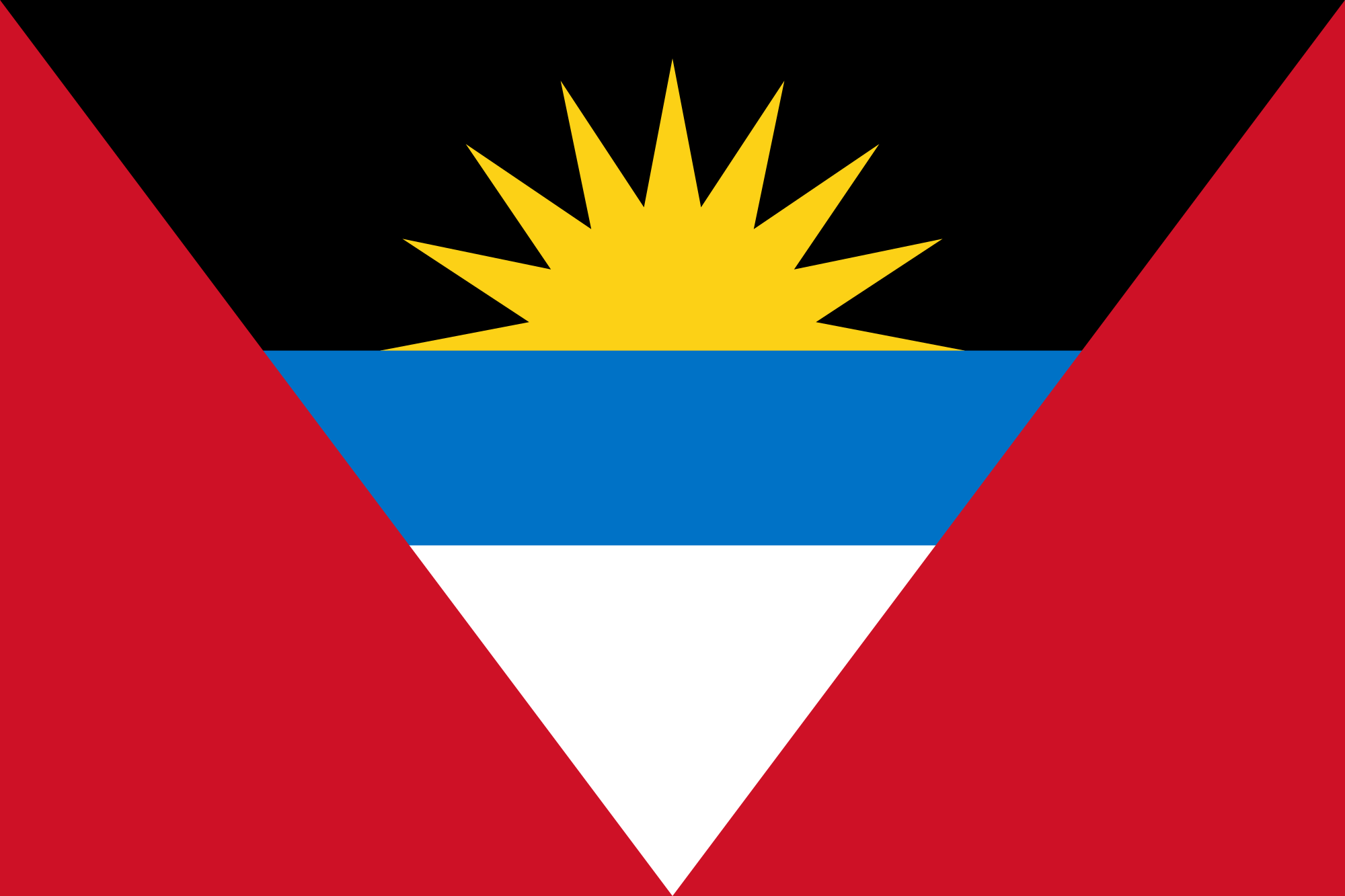
The national flag of Antigua and Barbuda consists of a large central black isosceles triangle edged in yellow, dividing the field into two right triangles: the upper one red and the lower one blue, with a rising yellow sun in the black triangle.[14] It was designed and adopted on 27 February 1967 to commemorate the achievement of self-government from British colonial rule.[15] The red represents the lifeblood of the slave forefathers and the dynamism of the people; black symbolizes the soil of the islands and the African heritage of the population; blue signifies hope and the surrounding sea; white evokes the sandy beaches; the golden sun with seven points denotes the dawn of a new era; and the inverted "V" shape in the triangle's edges stands for victory.[14] [16] The coat of arms features a shield with a black background bearing a rising golden sun above blue and white wavy lines representing the sea and beaches, flanked by a yucca plant on the right and a sugarcane stalk on the left.[17] Above the shield sits a heraldic helmet topped by a pineapple, symbolizing the renowned Antigua Black Pineapple variety once cultivated extensively on the islands.[18] On either side of the shield stand a fallow deer and an Antiguan racer snake, while below lies a scroll inscribed with the national motto "Each endeavouring, all achieving," composed by James H. Carrott.[15] Designed by Gordon Christopher, it was officially granted on 16 February 1967.[18] The elements collectively emphasize the nation's agricultural history, natural endowments, African roots via the black field, and collective aspiration for progress.[17] The national anthem, "Fair Antigua, We Salute Thee," was written by Novelle Hamilton Richards with music composed by Walter Garnet Picart Chambers in 1966 and formally adopted upon independence in 1981.[19] Its lyrics pledge commitment to safeguarding the land and building a nation through unity and service, reflecting themes of resilience and patriotism rooted in the post-slavery and decolonization experience.[20] These symbols encapsulate Antigua and Barbuda's national identity, forged from a history of African enslavement under British plantation colonialism, emancipation in 1834, and political independence achieved on 1 November 1981.[14] The recurrent motifs of sun, sea, and African heritage underscore a cultural synthesis of West African traditions, British administrative legacies, and indigenous natural elements, prioritizing self-determination and economic self-reliance over colonial dependencies.[21] Public displays during Independence Day celebrations on 1 November reinforce this identity, fostering communal pride in overcoming historical subjugation to assert sovereignty.[22]Geography
Location, terrain, and islands
Antigua and Barbuda occupies a position in the northern Leeward Islands of the Lesser Antilles archipelago in the eastern Caribbean Sea, situated between the Caribbean Sea and the North Atlantic Ocean, approximately 420 kilometers east-southeast of Puerto Rico.[1] The country's central geographic coordinates are approximately 17°07′N 61°51′W.[1] It spans a total land area of 442.6 square kilometers, consisting primarily of the islands of Antigua, Barbuda, and the smaller uninhabited Redonda.[23] Antigua, the principal island, covers 280 square kilometers and measures about 23 kilometers in length by 18 kilometers in width, characterized by low-lying limestone and coral formations with some volcanic outcrops, particularly in the southwest where the Shekerley Mountains rise.[24] The terrain is predominantly flat to undulating plains suitable for agriculture historically, interspersed with hilly areas and fringed by reefs along much of the 153-kilometer coastline.[23] Higher elevations include Boggy Peak, reaching 402 meters, the nation's highest point.[25] Barbuda, located 48 kilometers north of Antigua, comprises 161 square kilometers of mostly flat coral limestone terrain, featuring extensive pink-sand beaches, mangrove swamps, and the expansive Codrington Lagoon, which occupies much of the island's interior and supports unique ecosystems.[23] The island's topography includes low rounded hills in the northeast Highlands, peaking around 300 meters, with minimal surface water due to porous limestone bedrock.[26] Redonda, a tiny 1.3-square-kilometer volcanic islet 40 kilometers southeast of Antigua, presents rugged, steep cliffs rising sharply to 296 meters, historically exploited for guano deposits, rendering its barren, rocky surface largely inhospitable to human settlement but vital for seabird colonies.[27] The overall archipelago's geology reflects limestone-dominated lowlands overlaid on ancient volcanic foundations, contributing to limited freshwater resources and vulnerability to erosion and sea-level rise.[28]Climate patterns
Antigua and Barbuda experiences a tropical maritime climate characterized by consistent warmth, high humidity, and minimal seasonal temperature variation, moderated by persistent easterly trade winds.[29] Average annual temperatures range from 24°C (75°F) in January to 29°C (84°F) in July, with daytime highs typically between 27°C and 31°C (81°F to 88°F) and lows rarely falling below 23°C (73°F).[30] Over the year, temperatures vary narrowly from 23°C to 30°C (74°F to 87°F), seldom exceeding 32°C (89°F) or dropping under 22°C (71°F), due to the islands' low elevation and oceanic influence.[31] The climate divides into a dry season from December to April, featuring lower humidity, clearer skies, and reduced rainfall, and a wet season from May to November, marked by increased cloud cover, humidity, and precipitation.[29] Annual rainfall averages 1,000 to 1,150 mm (39 to 45 inches), with the wet season accounting for the majority, peaking in October at around 196 mm (7.7 inches) monthly, while dry season months see as little as 40-60 mm (1.6-2.4 inches). Rainfall is higher in Antigua's interior hills and Barbuda's elevated areas compared to coastal plains, influenced by orographic effects from trade winds.[32] Hurricane season aligns with the wet period, spanning June to November, exposing the islands to tropical storms and cyclones originating in the Atlantic, with historical impacts including Hurricane Irma in 2017, which caused widespread devastation on Barbuda.[33] Trade winds from the northeast prevail year-round at 15-25 km/h (9-15 mph), providing natural cooling but occasionally strengthening during passages of cold fronts in the dry season.[31] Long-term patterns show stable warmth with rainfall variability tied to El Niño-Southern Oscillation cycles, though recent decades indicate slight increases in extreme precipitation events.[34]Natural resources and environmental realities
Antigua and Barbuda possesses negligible exploitable natural resources, with its economy relying primarily on tourism enabled by a pleasant tropical climate rather than extractive industries.[1] Minor mineral deposits include limestone, barite, building stone, and clay, primarily on Barbuda, but these contribute minimally to GDP.[35] Agricultural land constitutes 20.5% of total area, with 9% arable for crops such as cotton, vegetables, and fruits, though output is constrained by poor soil quality and limited freshwater availability.[1] Forest cover and fisheries provide additional resources, supporting small-scale logging and marine capture, but overfishing risks deplete coastal stocks.[35][36] The nation's environmental profile is dominated by acute water scarcity, ranking among the Caribbean's most water-stressed states with renewable freshwater resources at approximately 566 cubic meters per capita annually, below the global stress threshold of 1,000 m³.[37] Demand exceeds supply due to high tourism inflows, aging infrastructure, and erratic rainfall, exacerbating risks of shortages during dry seasons.[37] Ecosystems feature coral reefs, wetlands, beaches, and fringing forests, which buffer against erosion but face degradation from coastal development and sedimentation.[38] As low-lying coral and limestone islands, Antigua and Barbuda confront heightened vulnerability to tropical cyclones, with hurricanes causing recurrent damage to infrastructure and agriculture; notable events include Hurricane Irma in 2017, which devastated Barbuda's housing and mangroves.[39] A drying trend has intensified droughts, the second-most pressing hazard after storms, reducing groundwater recharge and agricultural yields.[40] Rising sea levels, projected at 0.3-1 meter by 2100 under various scenarios, threaten 10-20% of land area through inundation and salinization, particularly impacting Barbuda's low-elevation Codrington Lagoon and Antigua's coastal aquifers.[41][42] These pressures, compounded by limited adaptive capacity in a tourism-reliant economy, underscore causal dependencies on regional weather patterns and global emissions, though local resilience measures like mangrove restoration show empirical benefits in storm mitigation.[43][42]History
Pre-Columbian settlements
The earliest human settlements in Antigua and Barbuda date to the Archaic Age, with evidence of occupation on Antigua from approximately 2900 BC at sites like Twenty Hill in Parham, followed by more substantial habitation at Jolly Beach around 1775 BC.[44] These Archaic peoples, often associated with Ortoiroid or Siboney cultures originating from mainland South America or Trinidad, were primarily hunter-gatherers who exploited coastal resources, as indicated by extensive shell middens containing queen conch (Lobatus gigas) and other mollusks along southern beaches.[45] On Barbuda, similar Archaic Age activity is documented from circa 3000 BC to 500 BC, focused on seasonal marine exploitation rather than permanent villages.[46] During the subsequent Ceramic Age, beginning around 500 BC, migrants affiliated with the Saladoid culture—linked to Arawakan-speaking groups from northeastern South America—established more sedentary settlements across the islands, introducing pottery, slash-and-burn agriculture (including manioc and maize), and intensified fishing and shellfish gathering.[47] Archaeological sites on Antigua, such as Mill Reef (post-Saladoid phase) and Doigs, yield characteristic Saladoid ceramics with incised and zoned decorations, along with shell tools, ornaments, and evidence of lapidary work using local materials like jasper and shell for beads and pendants dated 250–500 AD.[48][49] Permanent Ceramic Age villages on Barbuda emerged around 100 BC, reflecting adaptation to the island's flatter terrain and mangroves through conch exploitation and small-scale farming.[45] By the late Ceramic Age (circa 500–1500 AD), post-Saladoid or Troumassoid influences, associated with Carib-speaking groups, appear in the archaeological record, marked by coarser pottery and possible shifts in settlement patterns toward coastal defenses amid inter-island raiding.[50] These later groups maintained economies centered on marine harvesting, with sites like Elliot's and Royall's on Antigua showing specialized manufacturing of ornamental items from shell and stone.[49] Overall, pre-Columbian populations remained small and dispersed, with no evidence of large-scale urbanization, relying on interconnected networks for trade in goods like ceramics and beads across the Lesser Antilles.[51]Colonization, slavery, and plantation economy
The British established the first permanent settlement on Antigua in 1632 under Edward Warner, son of Sir Thomas Warner, who had been granted rights to colonize the Leeward Islands.[52] Initial economic activities centered on tobacco and indigo cultivation using indentured European laborers, but these proved insufficiently profitable, prompting a shift toward large-scale sugar production in the late 17th century.[53] The island's suitability for sugarcane—due to its soil, climate, and topography—facilitated the rapid expansion of plantations, with the first major estate, Betty's Hope, developed by Christopher Codrington around 1674.[54] Barbuda, colonized shortly after in 1678, was leased to the Codrington family in 1685 by the British Crown for 99 years, serving primarily as a provisioning ground for Antigua's estates through livestock rearing and as a site for breeding enslaved people to supply labor demands.[55] This arrangement underscored the integrated colonial strategy across the islands, where Barbuda's flatter terrain supported cattle and sheep farming to feed plantation workers, while excess slaves were exported to Antigua, with records indicating 135 such transfers between 1779 and 1834 alone.[56] The plantation economy's growth hinged on enslaved African labor, imported in large numbers to meet the intensive demands of sugar cultivation, harvesting, and processing.[57] By the mid-18th century, enslaved people outnumbered free whites by a ratio exceeding 10 to 1, comprising over 90% of the population and enduring conditions marked by extreme physical toil, malnutrition, and disease; one-third of newly arrived slaves died within three years, and on many estates, survival beyond nine years was rare due to overwork and inadequate provisioning.[58] Enslaved individuals performed grueling tasks from dawn to dusk in cane fields and mills, with women and children often integrated into field gangs, while the system's profitability derived from minimal investment in slave welfare, prioritizing output for export to Britain.[54] Sugar monoculture dominated the economy, generating substantial revenue for absentee British owners and local elites through refined products like muscovado and rum, but fostering vulnerability to pests, hurricanes, and price volatility.[59] Plantations operated as self-contained units with windmills for grinding cane, underscoring technological adaptations to maximize efficiency, though the reliance on coerced labor perpetuated social instability, evidenced by recurrent conspiracies and small-scale revolts suppressed harshly by colonial authorities.[60] This model entrenched economic dependence on metropolitan markets, with Antigua emerging as a key Leeward Islands producer by the 18th century peak.[61]British colonial administration
English settlers established the colony of Antigua in 1632, arriving from St. Kitts under a charter granted by King Charles I to develop agricultural enterprises initially focused on tobacco before shifting to sugar production dependent on imported African slaves.[62][63] Local governance began with appointed captains and councils responsible for land distribution, defense against French incursions—such as the 1666 raid—and enforcement of plantation labor systems.[64] Barbuda, settled later, was leased to the Codrington family in 1685 by the Crown for slave breeding to support Antigua's estates, though it primarily served as a provisioning outpost under proprietary control separate from Antigua's direct administration.[65] In 1671, Antigua formed the core of the British Leeward Islands presidency, uniting with St. Kitts, Nevis, and Montserrat under a Governor-in-Chief and Captain-General residing in St. John's, Antigua, who reported to the Board of Trade in London.[66] This structure centralized authority for military defense, trade regulation via the Navigation Acts, and judicial oversight, with local assemblies in each island handling taxation and internal laws, often dominated by planter elites.[67] The administration maintained order through rigorous slave codes, including the 1661 Barbados-derived laws adapted for Antigua, which prescribed harsh punishments for resistance and restricted enslaved mobility to sustain the sugar monoculture that accounted for over 90% of exports by the mid-18th century.[68] The Slavery Abolition Act of 1833, passed by the British Parliament, abolished slavery across the empire, with emancipation proclaimed in Antigua on August 1, 1834, under Governor Sir William Burnett, granting immediate full freedom without the six-year apprenticeship enforced in most other colonies to ease the transition for planters.[69][70] This abrupt change, advocated by local authorities to preempt unrest, compensated owners with £20 million in imperial funds but triggered labor shortages and vagrancy legislation to compel former slaves into plantation work at low wages.[71] Barbuda reverted to Crown administration in 1860 upon expiration of the Codrington lease, integrating more closely with Antigua under the Leeward Islands framework.[64] In 1871, the Leeward Islands were reorganized into a federal colony with the Governor of Antigua exercising presidency over constituent islands until dissolution in 1956, during which period infrastructure like roads and ports received limited imperial investment amid declining sugar viability.[67][64] Legislative councils evolved with nominated and elected members, primarily white planters until post-World War II expansions included Black representatives, reflecting gradual shifts in colonial policy toward self-governance while preserving economic control.[68]Decolonization and independence
Following the end of the Second World War, labor unrest and demands for political reform intensified in Antigua, driven by the Antigua Trades and Labour Union founded in 1939 by Vere Cornwall Bird, who became its president in 1943 and used it to advocate for workers' rights and greater local control over colonial administration.[72] In 1944, limited adult suffrage was introduced, enabling the union-linked Antigua Labour Party (ALP), led by Bird, to gain representation in the legislative council, marking the start of organized pressure for self-government amid broader Caribbean decolonization trends.[73] By 1960, Bird had become the first Chief Minister, consolidating power through electoral victories and negotiations with British authorities for expanded autonomy.[74] Under the West Indies Act of 1967, Antigua achieved associated statehood on February 27, 1967, granting full internal self-government while Britain retained responsibility for defense and foreign affairs; Bird served as the first Premier in this arrangement.[75] Barbudan leaders, wary of Antigua's dominance, sent a delegation to London in December 1967 seeking separate associated status for Barbuda to preserve local land tenure and autonomy, but the request was denied, heightening tensions over resource control and governance disparities. Throughout the 1970s, the ALP government under Bird pursued full independence, supported by regional movements but opposed by some who feared economic vulnerabilities without British oversight; a 1978 referendum proposal was abandoned amid low turnout and Barbudan resistance.[76] Antigua and Barbuda attained independence from Britain on November 1, 1981, becoming a sovereign state within the Commonwealth of Nations with Queen Elizabeth II as head of state and Bird as the first Prime Minister; the transition included ceremonial lowering of the Union Jack and adoption of a new flag emphasizing black, red, white, and blue symbolism for heritage, soil, purity, and seas.[77] Despite celebrations, Barbuda's council chairperson led protests on November 3, 1981, demanding secession due to fears of Antiguan overreach on Barbudan communal lands and development decisions, though no separation occurred.[78] The new constitution established a parliamentary system with Barbuda guaranteed representation in the House of Representatives and a local council, yet underlying disputes over autonomy persisted into post-independence years.[79]Post-independence governance and challenges
Antigua and Barbuda achieved independence from the United Kingdom on November 1, 1981, establishing a parliamentary democracy within the Commonwealth, with the British monarch as head of state represented by a governor-general and the prime minister as head of government.[80] The Antigua Labour Party (ALP), led by Vere Bird, secured victory in the inaugural post-independence elections, initiating a period of ALP dominance that lasted until 2004.[81] This governance structure retained Westminster-style features, including a bicameral parliament with an appointed Senate and an elected House of Representatives, but faced immediate tensions from Barbudan separatist protests starting November 3, 1981, over concerns about land rights and economic disparities with Antigua.[62] Vere Bird served as prime minister from 1981 to 1994, followed by his son Lester Bird until 2004, fostering a political dynasty criticized for entrenching patronage networks and limiting opposition influence.[81] Governance under the Birds was plagued by corruption scandals, including allegations of arms sales to the Medellín Cartel via Israeli weapons routed through Antigua and misuse of public funds, such as a $25,000 diversion from a health-care fund and fraud in a $11 million French loan for airport rehabilitation.[82][83] The country also emerged as a transshipment point for South American cocaine, exacerbating governance credibility issues despite regular elections.[84] In 2004, the United Progressive Party (UPP), under Baldwin Spencer, won power, marking a rare peaceful transfer and introducing reforms to address fiscal mismanagement, though economic vulnerabilities persisted.[62] The ALP regained control in 2014 under Gaston Browne, who has prioritized economic diversification beyond tourism—comprising over 60% of GDP—through citizenship-by-investment programs and infrastructure projects, achieving reported GDP growth of 7.4% in 2018 amid post-recession recovery.[85][81] Challenges endure, including high public debt exceeding 100% of GDP in recent years, vulnerability to hurricanes like Irma in 2017 which devastated Barbuda and reignited autonomy disputes, and ongoing corruption perceptions, with Freedom House noting government graft as a persistent concern despite anti-corruption efforts.[86] Barbudan governance frictions, rooted in communal land tenure clashing with Antiguan development policies, have led to legal battles over post-Irma rebuilding, highlighting federal tensions in the unitary state.[86] Political stability relies on competitive multiparty elections, but dynastic elements and clientelism continue to undermine institutional accountability.[62]Demographics
Population dynamics and ethnic groups
The estimated resident population of Antigua and Barbuda stood at 102,634 in 2024, reflecting a modest increase from 86,295 recorded in the 2011 census conducted by the national Statistics Division.[1] [87] This figure aligns with United Nations projections elaborated by demographic databases, placing the nation among the smaller sovereign states globally, with approximately 94,345 inhabitants as of late 2025.[88] The population density averages 214 persons per square kilometer, concentrated predominantly on Antigua, where urban centers like St. John's account for over half of residents, while Barbuda hosts fewer than 2,000 people and Redonda remains uninhabited.[89] Population growth has averaged 1.1% annually in recent years, driven primarily by net immigration rather than natural increase, as the total fertility rate hovers below replacement level at approximately 1.6 births per woman.[90] [1] Crude birth rates have fluctuated around 12-14 per 1,000 population, while death rates remain low at 5-6 per 1,000, yielding a natural increase insufficient to sustain expansion without inflows.[91] Net migration contributes positively at about 2 migrants per 1,000 residents, fueled by labor demands in tourism and construction from Caribbean nationals and expatriates, offsetting limited domestic youth cohorts amid aging demographics (median age around 32 years).[1] This reliance on immigration underscores vulnerabilities to economic cycles and policy shifts, with historical outflows of skilled workers to North America and Europe partially counterbalanced by return migration and citizenship-by-investment programs. Ethnic composition derives largely from the legacy of African enslavement during the colonial sugar plantation era, with persons of African descent comprising 87.3% of the population per 2011 census estimates.[1] Mixed-race individuals account for 4.7%, reflecting intermarriages among African, European, and other ancestries, while whites (primarily of British or Portuguese origin) form 1.6%, Hispanics 2.7%, and other groups—including East Indians, Lebanese, and Syrians—2.7%, with 0.9% unspecified.[1] These proportions have remained stable, as immigration from similar Caribbean backgrounds reinforces the African-majority demographic without significant dilution, though urban areas exhibit slightly higher diversity due to transient expatriate communities.[92] Census data indicate minimal indigenous remnants, with pre-colonial Siboney and Arawak populations extinct by the 18th century.[1]Languages and linguistic influences
English functions as the de facto official language of Antigua and Barbuda, utilized in governmental proceedings, formal education, legal documents, and media broadcasts, despite the absence of a statutory declaration designating it as such.[93] This reflects the nation's history as a British colony, where English was imposed as the administrative and instructional medium from the 17th century onward.[94] The primary language spoken in daily interactions by the majority of the population—estimated at over 90%—is Antiguan and Barbudan Creole, classified linguistically as Leeward Caribbean English Creole.[95] This creole emerged during the 18th-century plantation era, when enslaved Africans, primarily from West African regions speaking Niger-Congo languages such as Igbo and Akan, adapted English vocabulary to their substrate grammatical structures, resulting in a contact language shaped by unequal power dynamics and demographic ratios favoring Africans on sugar estates.[96] Core features include simplified verb tenses, invariant be for continuous aspect (e.g., "dem a go" for "they are going"), and vowel shifts absent in standard English, with lexical borrowings from African languages evident in terms related to kinship, agriculture, and folklore.[97] Dialectal variations within Antiguan and Barbudan Creole correspond to geographic and social divides, including North Antiguan (prevalent in the capital St. John's area), South Antiguan (rural southeast), and Barbudan (distinct on Barbuda island, with heavier African substrate retention due to isolation).[98] These differences arise from localized slave trade inputs and post-emancipation settlement patterns, with Barbudan exhibiting more conservative phonology, such as retention of syllable-final consonants.[99] Contemporary linguistic influences stem from immigration, particularly from Spanish-speaking Dominican Republic workers since the 1980s, introducing Dominican Spanish loanwords and code-switching in labor contexts, alongside admixtures from Jamaican Patois and Guyanese Creole among expatriate communities.[100][93] Pre-Columbian Arawakan languages from indigenous Siboney and Carib groups left negligible traces, as these were supplanted by European contact and African arrivals by the early 1700s, with no documented living descendants.[101] Formal education systems prioritize standard English, often stigmatizing creole use in schools, which perpetuates diglossia wherein creole dominates informal spheres while English prevails in official ones.[102]Education outcomes and systems
The education system in Antigua and Barbuda is compulsory and free from ages 5 to 16, encompassing early childhood development (ages 0-3), pre-primary (ages 3-5), primary (ages 5-12, lasting 7 years), and secondary levels divided into lower (3 years) and upper (2 years) phases.[103] Primary education emphasizes foundational literacy, numeracy, and basic sciences, while secondary education includes core subjects like mathematics, English, and social studies, with some vocational options.[104] Tertiary institutions include the American University of Antigua (focusing on medicine), University of Health Sciences Antigua, Antigua State College (offering associate degrees in fields like agriculture and electronics), and a campus of the University of the West Indies providing undergraduate and postgraduate programs.[104][105] Enrollment rates reflect strong access at lower levels but variability in progression. Net primary enrollment stood at 95.7% in 2018, while secondary gross enrollment reached 120.9% in the same year, exceeding 100% due to delayed entries and repetitions.[106] Tertiary gross enrollment remains lower at 24.8%, indicating limited higher education participation relative to regional peers.[107] Adult literacy, defined as the ability to read and write a short simple statement, is reported at 99% for those aged 15 and above, based on 2001 census data, with near parity between males (98.4%) and females (99.4%).[108] The country has not participated in international assessments like PISA, limiting direct comparisons of cognitive skills in reading, math, and science.[109] Persistent challenges undermine outcomes despite high reported metrics. Teacher shortages and inadequate professional development affect instructional quality, with many educators lacking specialized training in modern pedagogies.[110] Infrastructure vulnerabilities, exacerbated by hurricanes, disrupt schooling, as seen in post-Irma repairs to secondary facilities.[111] Low completion rates at upper secondary and inefficiencies in programs like school meals (covering only select schools) highlight resource constraints and uneven equity, particularly in rural Barbuda.[112] Government efforts, including expansions via the Second Basic Education Project, have improved access but not fully addressed quality gaps tied to funding and teacher retention.[111]Religious composition and societal role
Christianity predominates in Antigua and Barbuda, with Protestants comprising the majority according to the 2011 census, the most recent available comprehensive data. Protestants account for 68.3% of the population, including Anglicans (17.6%), Seventh-day Adventists (12.4%), Pentecostals (12.2%), Moravians (8.3%), Methodists (5.6%), Wesleyans (4.5%), Church of God adherents (3.5%), and Baptists (3.1%).[113] Roman Catholics represent 8.2%, other Christians 5.5%, with smaller groups including Rastafarians (0.5%) and others (0.6%); 4.8% report no religion, and 12.1% unspecified.[113] Although Antigua and Barbuda is a secular state, Christianity exerts significant influence on societal norms and cultural practices, rooted in the islands' colonial history under British rule where the Anglican Church held prominence.[114] The Antigua Christian Council, representing major denominations covering over 70% of the population, engages with the government on policy matters, including social welfare and moral issues, fostering collaboration on community initiatives.[115] Churches play active roles in education, healthcare, and disaster response, with many operating schools and providing charitable services that complement state efforts. Religious observance manifests in national holidays like Good Friday and Easter, which draw widespread participation and reinforce communal bonds.[1] Despite high Christian affiliation, surveys indicate varying levels of active practice, with challenges like secular influences and moral complacency noted among observers.[116] The constitution guarantees religious freedom, allowing minority faiths to register for tax exemptions and property ownership, though Protestant dominance shapes the public religious landscape.[117]Government and politics
Constitutional framework and monarchy
Antigua and Barbuda functions as a constitutional monarchy under the Constitution enacted on 31 July 1981 and effective from 1 November 1981, marking the nation's independence from the United Kingdom.[118][119] The document establishes the state as sovereign and democratic, vesting supreme legislative authority in Parliament while outlining the separation of powers among the executive, legislature, and judiciary, alongside protections for fundamental rights such as liberty, property, and freedom of expression subject to public order limitations.[120] The monarchy integrates into this framework as the symbolic head of state, with royal prerogatives exercised vicariously to maintain democratic accountability rather than direct governance. The head of state is the Monarch of Antigua and Barbuda, a hereditary office currently held by King Charles III, who also reigns over 14 other Commonwealth realms.[121] The Sovereign's domestic role remains ceremonial, devoid of personal discretion in executive or legislative matters, as constitutional provisions mandate actions on the binding advice of elected officials to prevent monarchical interference in policy.[122] This arrangement reflects the Westminster system's adaptation to post-colonial contexts, where residual Crown powers—such as reserving bills for royal assent or declaring emergencies—exist theoretically but have not been invoked independently since independence, underscoring the system's reliance on parliamentary sovereignty.[123] The Governor-General serves as the monarch's representative, appointed by the Sovereign upon the Prime Minister's recommendation for an indefinite term unless removed on similar advice.[124] This officeholder, Sir Rodney Williams since 14 August 2014, performs constitutional duties including granting royal assent to bills (effective upon signature without veto power), summoning or proroguing Parliament, appointing the Prime Minister from the House of Representatives' majority leader, and dissolving the legislature for elections every five years or earlier if the government loses confidence.[125][122] In practice, these functions are advisory and non-partisan, with the Governor-General lacking independent authority to dismiss ministries or alter fiscal policy, thereby preserving the executive's dominance under the cabinet's collective responsibility to Parliament.[124] Amendments to the constitution require a two-thirds majority in both houses of Parliament for entrenched clauses like those on the monarchy or fundamental rights, ensuring stability while allowing evolution through democratic means rather than royal decree.[126] Debates on republicanism have surfaced periodically, driven by calls to localize headship amid regional trends, but no formal referendum or alteration has occurred, maintaining the framework's continuity with British-derived institutions despite critiques of its symbolic ties to colonial history.[126]Executive and legislative branches
The executive authority of Antigua and Barbuda is formally vested in the British monarch, King Charles III, and exercised on the monarch's behalf by the Governor-General, who acts primarily in accordance with the advice of the Prime Minister.[127] The Governor-General, currently Sir Rodney Williams since 2014, holds ceremonial powers including appointing the Prime Minister, dissolving Parliament, and giving assent to legislation, but these are typically guided by constitutional conventions and the Prime Minister's recommendations.[128] The Prime Minister, Gaston Browne since 2014, leads the executive as the head of government and commands the confidence of the House of Representatives; the Prime Minister appoints the Cabinet, comprising ministers drawn from members of Parliament, to direct policy and administration.[125] The legislative branch operates through a bicameral Parliament consisting of the Senate as the upper house and the House of Representatives as the lower house, with a maximum term of five years.[129] The House of Representatives comprises 19 members: 17 elected by first-past-the-post in single-member constituencies, the Attorney General as an ex-officio member, and the Speaker, who may be elected from within or outside the elected members.[129] Bills, including those for money and taxation, are primarily introduced in the House, which holds primary legislative initiative, while the Senate reviews and can amend or reject non-money bills.[121] The Senate includes 17 appointed members selected by the Governor-General under constitutional provisions: ten on the advice of the Prime Minister, four on the advice of the Leader of the Opposition, one on the advice of the Barbuda Council, one from persons distinguished in public life, and one on the Prime Minister's advice from the business or social community.[130] Senators serve five-year terms unless Parliament dissolves earlier, and the Senate's role emphasizes review and representation of specific interests, including those from Barbuda, though its appointed nature limits direct public accountability compared to the elected House.[131] Parliament convenes at least once annually, with the Governor-General delivering the Speech from the Throne outlining government priorities, and joint sittings possible for specific purposes like budget debates.[132]Electoral system and political parties
Antigua and Barbuda employs a first-past-the-post electoral system for its House of Representatives, consisting of 17 single-member constituencies delineated by the Antigua and Barbuda Electoral Commission (ABEC).[133] Voters elect one representative per constituency by simple plurality, with universal suffrage granted to citizens aged 18 and older; candidates must be at least 21 years old and possess Antiguan and Barbudan citizenship.[134] General elections occur at least every five years, though the Prime Minister may advise dissolution of Parliament earlier, as occurred prior to the January 18, 2023, poll.[135] The ABEC oversees voter registration, polling, and result tabulation to maintain process integrity.[136] The political landscape features a two-party dominant system, with the Antigua and Barbuda Labour Party (ABLP) and the United Progressive Party (UPP) alternating governance since independence. The ABLP, historically rooted in labor movements and aligned with centre-left policies emphasizing economic development and social welfare, has governed since 2014 under Prime Minister Gaston Browne.[137] The UPP, a coalition formed in 2004 from centre-right and moderate factions, prioritizes anti-corruption reforms, fiscal prudence, and opposition to perceived ABLP patronage networks.[86] In Barbuda, the Barbuda People's Movement (BPM) advocates for greater island autonomy and environmental protections, contesting the two Barbudan constituencies.[138] In the 2023 general election, the ABLP secured a narrow majority with 9 seats, followed by the UPP with 6 and the BPM with 1, reflecting voter concerns over economic recovery post-hurricanes and COVID-19 alongside entrenched incumbency advantages.[135] A subsequent by-election in St. Philip's South on January 14, 2025, bolstered the ABLP's hold, increasing its seats to 10 amid criticisms of gerrymandering and campaign finance opacity from opposition and observers.[139] Smaller parties like the Democratic National Alliance participate but rarely win seats, underscoring the system's tendency toward major-party consolidation.[86]Administrative structure
Antigua and Barbuda operates as a unitary state with administrative divisions consisting of six parishes on the main island of Antigua and two dependencies, Barbuda and Redonda.[140] The parishes—Saint George, Saint John, Saint Mary, Saint Paul, Saint Peter, and Saint Philip—serve primarily as electoral and census units rather than entities with significant self-governing powers, and each is overseen by appointed administrators under the central government's Ministry of National Security and Immigration.[141] These divisions trace origins to colonial-era groupings, with boundaries formalized post-independence in 1981 to facilitate land management and local services like waste collection and road maintenance, though implementation remains centralized without elected parish councils.[140] Barbuda, the larger dependency covering approximately 160 square kilometers, enjoys partial autonomy through the Barbuda Council, a locally elected body established under the Barbuda (Local Government) Act of 1976, which handles internal affairs such as land use and basic infrastructure but remains subordinate to the national parliament in Saint John's for fiscal and legislative matters.[142] This arrangement has sparked ongoing tensions, as the central government has periodically sought to curtail the council's influence, including over communal land ownership systems dating to 1870s emancipation grants, amid disputes exacerbated by Hurricane Irma's 2017 devastation that highlighted resource allocation imbalances.[142] Redonda, a small uninhabited volcanic island of about 1.3 square kilometers located 40 kilometers southeast of Antigua, lacks separate administration and functions as a dependency annexed to the Saint John parish, primarily managed for environmental conservation through national designations like the 2023 Redonda Ecosystem Reserve under the Department of Environment.[143] Overall, local governance emphasizes central oversight, with no robust devolution of taxing or regulatory authority to parishes or dependencies, reflecting the nation's small scale (population around 100,000 as of 2021 estimates) and reliance on national budgeting for services.[144] This structure supports efficient resource distribution but has drawn criticism for limiting Barbuda's self-determination, as evidenced by 2023 public calls from Barbudan leaders for greater fiscal independence amid reconstruction delays.[142]Corruption, accountability, and rule of law
Antigua and Barbuda ranks 37th out of 142 countries in the World Justice Project's Rule of Law Index for 2024, with an overall score of 0.64 on a 0-1 scale, reflecting improvements in absence of corruption and other factors compared to prior years.[145] The country's control of corruption score stood at 0.33 on the World Bank's -2.5 to 2.5 scale in 2023, up slightly from 0.31 in 2022, placing it in the 62nd percentile globally, indicating moderate performance relative to peers.[146] Despite these metrics, reports from the U.S. Department of State highlight widespread perceptions of government corruption endorsed at high levels, including bribery of officials by criminal groups and irregularities in public procurement.[147] The Citizenship by Investment (CBI) program, a key revenue source, has faced scrutiny for corruption risks, including inadequate due diligence leading to approvals for individuals linked to fraud or illicit activities, such as an Indian billionaire wanted for a $2 billion bank fraud who obtained citizenship in 2018.[148] In May 2025, a U.S. corruption probe revealed a list of 186 diplomatic passports issued, including 25 to foreign nationals with questionable eligibility, raising concerns over misuse for evading sanctions or facilitating illicit finance.[149] Historical cases, such as the 1987 runway renovation scandal involving political-financial corruption and the 2009 Allen Stanford Ponzi scheme tied to local banking licenses, underscore persistent vulnerabilities in oversight of investment-driven schemes.[150][83] Judicial independence is constitutionally enshrined under the common law system, with the government generally respecting impartiality, though magistrates' appointments by the Attorney General introduce potential executive influence.[151][152] Accountability mechanisms include the independent Office of the Auditor General, mandated to audit government accounts annually and report to Parliament, alongside parliamentary oversight of executive actions.[153] Recent responses to scandals, such as the October 2025 vehicle procurement irregularities involving unauthorized deals and missing assets, prompted Cabinet-approved Treasury restructuring into specialized units for financial controls and recovery efforts.[154] However, Freedom House notes ongoing concerns with corruption impeding equitable governance, particularly in public sector accountability.[86]Economy
Macroeconomic indicators and growth drivers
Antigua and Barbuda's nominal gross domestic product reached 2.22 billion USD in 2024, yielding a per capita GDP of 23,726 USD, positioning it among the higher-income small island developing states in the Caribbean. Real GDP growth accelerated to an estimated 4.2% in 2023 from pandemic lows, with IMF projections indicating 6.1% expansion in 2024 amid sustained recovery. Inflation, measured by average consumer prices, stood at 3.5% in recent assessments, while public sector debt hovered at 76.3% of GDP in 2023, reflecting fiscal strains from prior crises including natural disasters and COVID-19 impacts. The current account deficit narrowed to 181 million USD in 2024, equivalent to roughly 8% of GDP, financed partly through foreign investment inflows.| Macroeconomic Indicator | Recent Value | Year | Source |
|---|---|---|---|
| Real GDP Growth (annual %) | 4.2% (est.) | 2023 | [155] |
| Real GDP Growth Projection | 6.1% | 2024 | [156] |
| Inflation (avg. consumer prices, %) | 3.5% | Recent | [157] |
| Public Debt (% of GDP) | 76.3% | 2023 | [158] |
| Current Account Balance | -181 million USD | 2024 | [159] |
Tourism sector performance
Tourism constitutes the backbone of Antigua and Barbuda's economy, accounting for approximately 60% of gross domestic product (GDP) and supporting over 12,000 jobs, or about one-third of the workforce.[160][161] The sector's performance has historically driven economic expansion, with visitor exports generating XCD 2,876.8 million in 2023 alone.[162] Prior to the COVID-19 pandemic, stay-over arrivals reached around 301,000 in 2019, bolstered by the islands' beaches, yachting facilities, and all-inclusive resorts.[163] The COVID-19 pandemic inflicted severe damage, with international travel restrictions implemented in March 2020 leading to an 18% contraction in overall GDP and near-total halt in tourism activity.[164][165] Recovery commenced in 2022, fueled by eased global restrictions and targeted marketing, yielding GDP growth of 8.5% that year, largely from tourism rebound and construction.[166] By 2023, growth moderated to 5.7%, with sustained tourism inflows.[166] In 2024, the sector achieved record highs, with 330,281 stay-over visitors—a surge beyond pre-pandemic levels—and 823,955 cruise passengers, contributing to total arrivals exceeding 1.1 million.[167][168] January to June alone saw 176,665 stay-overs, up 15% year-over-year, with June marking a 42% monthly increase.[169] Hotel occupancy surpassed 2019 figures, reflecting robust demand from markets like the United States and United Kingdom.[167] Projections indicate stay-over arrivals could reach 1.19 million by 2028, assuming continued infrastructure investments and diversification into eco-tourism.[170] Despite gains, vulnerabilities persist, including exposure to hurricanes and climate variability, which have periodically disrupted operations, as seen in past events like Hurricane Irma in 2017.[156] Overreliance on seasonal high-end visitors and competition within the Caribbean underscore needs for resilience measures, such as enhanced air connectivity and sustainable practices, to mitigate external shocks.[36]| Year | Stay-Over Arrivals | Total Visitor Arrivals (incl. Cruise) | GDP Growth Contribution from Tourism |
|---|---|---|---|
| 2019 | ~301,000 | N/A | Baseline pre-COVID |
| 2020 | Sharp decline | Minimal due to lockdowns | -18% overall GDP contraction |
| 2023 | Recovery phase | N/A | 5.7% national growth |
| 2024 | 330,281 | >1.1 million | Record highs, exceeding 2019 |
Financial services and offshore activities
Antigua and Barbuda established its offshore financial sector in the early 1980s through legislation enabling international banking licenses and offshore company formations, positioning the nation as a jurisdiction for non-resident financial activities such as trusts, insurance, and restricted banking services.[171][172] The Financial Services Regulatory Commission (FSRC), created in 2007, serves as the primary regulator, licensing entities under frameworks that emphasize capital adequacy, fit-and-proper tests, and ongoing supervision to mitigate risks like money laundering.[173] The International Banking Act of 2016 consolidated prior regulations into a unified regime, distinguishing Class A banks (offering comprehensive services to residents and non-residents) from Class B banks (limited to offshore clients with no local deposit-taking).[174] As of August 14, 2025, the FSRC directory lists several licensed international banks, including NIBank Ltd. (formerly North International Bank) and entities like those operating from London House in St. John's, though the overall number of offshore institutions has contracted from historical highs due to post-2008 global pressures for enhanced due diligence and information exchange.[175][176] Offshore activities contribute to the services-dominated economy, where the sector broadly accounts for approximately 81% of GDP, but direct attribution to financial services remains modest compared to tourism's 60% share, reflecting a shift from expansion in the 1980s-1990s to contraction amid international scrutiny.[177][178] Reforms following scandals, notably the 2009 collapse of R. Allen Stanford's Ponzi scheme—which exploited regulatory gaps in Antigua-based operations—led to stricter licensing and audits, reducing the sector's scale but improving credibility.[83] On the international front, Antigua and Barbuda has aligned with global standards, achieving compliance with 36 of the 40 Financial Action Task Force (FATF) recommendations by January 2025 and signing the OECD's Multilateral BEPS Convention in June 2025 to curb base erosion and profit shifting.[179][180] As a Caribbean Financial Action Task Force (CFATF) member, it conducts national risk assessments and participates in automatic exchange of information under the Common Reporting Standard, aiding removal from prior watchlists while sustaining limited offshore appeal for legitimate asset protection and privacy.[181][182]Agriculture, fisheries, and diversification efforts
Agriculture in Antigua and Barbuda contributes minimally to the national economy, accounting for approximately 1.94% of GDP in 2023, a decline from higher historical levels due to constraints such as limited arable land, water scarcity, and labor shortages.[183] The sector focuses primarily on domestic production of vegetables, fruits, and livestock, with cotton cultivation having diminished significantly since the mid-20th century. Food imports constitute about 85% of consumption, underscoring heavy reliance on external supplies from the United States and other regions, exacerbated by vulnerability to climate events like hurricanes.[184] The fisheries subsector, comprising roughly half of agricultural value added, generates around 1% of GDP and supports local food security through artisanal capture of finfish, Caribbean spiny lobster (Panulirus argus), and queen conch (Lobatus gigas). In 2005, total capture production reached 2,999 metric tons valued at US$15.9 million, with lobster exports directed mainly to Martinique and Guadeloupe, while conch harvesting remains largely subsistence-oriented in Barbuda. Regulations include minimum size limits for conch (shells over 180 mm, meat over 225 g) to prevent overexploitation, though systematic catch data collection is inconsistent.[185][186][187] Diversification initiatives emphasize enhancing agricultural and fisheries productivity to reduce import dependence and bolster resilience. The Ministry of Agriculture, Lands, Fisheries and the Blue Economy's Agricultural Vision 2030 targets increasing the sector's GDP share to 5% through expanded cultivation at sites like Diamonds Estate, rainwater harvesting, soil conservation, and subsidized access to land and inputs for small-scale farmers.[188][189] Efforts in the blue economy include fisheries research collaborations and adherence to the WTO Agreement on Fisheries Subsidies, accepted in April 2025, to promote sustainable practices and economic opportunities for fisherfolk.[190] These measures aim to address systemic vulnerabilities but face challenges from environmental pressures and limited scale.[191]Public finance, debt, and policy critiques
Antigua and Barbuda's public finances feature a narrow revenue base dominated by value-added taxes, customs duties, and proceeds from the Citizenship by Investment (CBI) program, which contributed significantly to fiscal inflows amid post-pandemic recovery. In fiscal year 2024, total budgeted revenue reached approximately $1.43 billion East Caribbean dollars (XCD), primarily from indirect taxes on tourism and imports, while recurrent and development expenditures were projected to yield an overall deficit of $80.2 million XCD, or 1.25% of GDP. Government expenditure as a share of GDP stood at 18.92% in 2024, down from 20.71% in 2022, reflecting efforts to contain public sector wages and debt servicing costs that consume a substantial portion of outlays.[192][193] Public debt levels have hovered at elevated thresholds, averaging 87.1% of GDP over the decade ending 2023, before easing to 76.3% that year due to economic rebound and fiscal consolidation. Total public sector debt stock reached about $1,570 million USD in 2023, with external components comprising roughly 42.85% of the total, financed through multilateral lenders and bilateral creditors vulnerable to global interest rate fluctuations. The national debt totaled 4.03 billion XCD in 2024, underscoring ongoing pressures from disaster reconstruction—such as Hurricane Irma's 2017 impacts—and revenue shortfalls during the COVID-19 downturn, which spiked borrowing needs.[158][194][195][196] Policy critiques from bodies like the International Monetary Fund (IMF) and Eastern Caribbean Central Bank (ECCB) emphasize the fragility of this fiscal framework, marked by chronic deficits and insufficient buffers against exogenous shocks like climate events, which have repeatedly eroded resilience despite CBI-driven inflows. The IMF's 2025 Article IV consultation highlighted tax revenues falling short of the government's own fiscal resilience guidelines—targeting 20% of GDP—and lagging peer small island economies, attributing this to exemptions, evasion, and overdependence on volatile non-tax sources rather than structural reforms like property tax enforcement. Debt sustainability remains precarious, with analysts noting a multi-decade pattern of high indebtedness unresolved by ad hoc measures, including CBI expansions that risk reputational damage without rigorous vetting, as evidenced by calls for threshold hikes to $200,000 minimum investments.[197][198][199][200] Fiscal performance showed primary balance improvement to 4.6% of GDP in 2024, bolstered by indirect tax hikes yielding 1% of GDP and one-off gains, yet the IMF urges sustained primary surpluses targeting 3-5% annually to stabilize debt below 60% of GDP per ECCB benchmarks, critiquing delays in pension reforms and public enterprise rationalization that perpetuate inefficiencies. Broader policy shortcomings include inadequate diversification from tourism-CBI reliance, exposing the economy to global slowdowns, with recommendations for expenditure-led austerity over revenue boosts alone to avoid stifling growth projected at 6% for 2025 under the $1.47 billion XCD budget.[201][202][203]Foreign relations and security
International organizations and alliances
Antigua and Barbuda maintains active membership in numerous multilateral organizations, emphasizing regional cooperation, economic integration, and global diplomacy as a small island developing state.[204] These affiliations facilitate access to development aid, trade frameworks, and collective security arrangements amid vulnerabilities to climate change and economic shocks.[205]| Organization | Membership Date | Purpose/Role |
|---|---|---|
| United Nations | 11 November 1981 | Global governance, peacekeeping, and advocacy for small island states on sustainable development.[206] |
| Commonwealth of Nations | 1 November 1981 | Post-colonial ties, democratic standards, and technical assistance in governance and trade.[208] |
| Caribbean Community (CARICOM) | 4 July 1974 | Regional economic integration, free trade, and coordinated foreign policy among 15 Caribbean nations.[75] |
| Organisation of Eastern Caribbean States (OECS) | 18 June 1981 (founding member via Treaty of Basseterre) | Deeper supranational cooperation in economic policy, currency union (Eastern Caribbean Dollar), and disaster response among nine eastern Caribbean territories.[209] |
| Organization of American States (OAS) | 1981 | Hemispheric security, democracy promotion, and human rights in the Americas.[204] |
| World Trade Organization (WTO) | 1 January 1995 (GATT observer since 30 March 1987) | Multilateral trade rules, dispute settlement, and market access for exports like tourism services.[211] |
| Regional Security System (RSS) | 1982 (founding via St. John's Memorandum) | Collective defense and law enforcement cooperation against transnational threats like drug trafficking in the eastern Caribbean.[212] |
Bilateral relations with key powers
Antigua and Barbuda maintains diplomatic relations with the United States, established in 1981 following independence from the United Kingdom.[204] The U.S. supports Antigua and Barbuda's efforts to broaden its economic base and elevate living standards through bilateral engagement.[204] Trade data for July 2025 indicate U.S. exports to Antigua and Barbuda reached $27.4 million, primarily in goods, while imports from the nation totaled $663,000, yielding a U.S. trade surplus of $26.7 million.[219] The countries partner under the U.S.-Caribbean Partnership to Address the Climate Crisis (PACC 2030), focusing on resilience against environmental threats.[204] Antigua and Barbuda operates an embassy in Washington, D.C., underscoring the relationship's institutional framework.[220] Ties with the United Kingdom trace to colonial rule initiated in 1632 for Antigua, persisting through federation and independence in 1981.[221] The British High Commission in St. John's facilitates ongoing diplomatic, trade, and investment links.[221] A bilateral investment treaty signed in 1987 promotes reciprocal protections for investors.[222] In August 2021, the nations formalized a maritime boundary agreement to delineate exclusive economic zones.[223] UK exports to Antigua and Barbuda amounted to £53 million over the four quarters ending Q1 2025, up 47.2% from the prior period.[224] Trade missions, such as the March 2024 UK-Antigua and Barbuda event, aim to expand opportunities in sectors like services and manufacturing.[225] Relations with China have expanded significantly since diplomatic recognition, with cooperative momentum evident in 2021 infrastructure and trade projects.[226] In August 2025, Prime Minister Gaston Browne and Chinese officials signed an Economic and Technical Cooperation Agreement, incorporating a $14 million grant for development initiatives and a feasibility study on blue economy prospects.[227] A mutual visa exemption policy took effect on May 11, 2024, easing people-to-people exchanges.[228] During a January 2024 meeting, President Xi Jinping pledged deepened collaboration in trade, infrastructure, climate adaptation, and new energy technologies.[229] Prime Minister Browne has described the partnership as among the closest between a large and small nation, crediting China for poverty alleviation aid, including post-2018 contributions.[230] Canada and Antigua and Barbuda established bilateral relations in 1981, emphasizing shared Commonwealth membership and regional cooperation.[231] The nations collaborate via institutions like the Caribbean Development Bank, where Canada provides funding for economic projects.[231] A social security agreement facilitates coordination on benefits for citizens working across borders.[232] Merchandise trade totaled $9.9 million in 2017, with Canada exporting machinery, vehicles, and food products while importing beverages and apparel.[233] In January 2025, High Commissioner Brenda Wills visited to explore enhanced partnerships in trade and diplomacy.[234]Defense capabilities and regional security
The Antigua and Barbuda Defence Force (ABDF) maintains a small standing force primarily tasked with territorial defense, maritime patrol, disaster response, and support to internal law enforcement, consisting of the Antigua and Barbuda Regiment (infantry-focused), a modest Coast Guard for coastal surveillance, and a limited Air Wing equipped with light utility aircraft for reconnaissance and transport.[1] Its equipment inventory is constrained to small arms such as rifles and machine guns, patrol vessels for the Coast Guard, and no heavy armor, artillery, or advanced air defense systems, reflecting the nation's emphasis on low-intensity operations rather than conventional warfare.[1][235] Military expenditure for fiscal year 2025 is allocated at 35,502,561 Eastern Caribbean dollars (approximately 13.1 million USD), representing under 1% of GDP and prioritizing maintenance, training, and basic sustainment over expansion.[236] This modest budget underscores the ABDF's dependence on external assistance for equipment upgrades and specialized capabilities, with historical reliance on donors like the United States for training through programs such as International Military Education and Training (IMET).[80] The force's small scale limits independent power projection, focusing instead on deterrence against smuggling, illegal fishing, and natural disasters common to small island states. In regional security, Antigua and Barbuda participates in the Regional Security System (RSS), a multilateral framework among Eastern Caribbean nations for coordinated responses to transnational threats including narcotics trafficking, arms smuggling, and humanitarian crises.[217] As an RSS member since its founding via the 1992 Treaty of Dickenson Bay, the country contributes personnel to joint exercises and operations, such as maritime interdictions and border patrols, while benefiting from shared intelligence and rapid deployment mechanisms. This involvement aligns with broader Caribbean Community (CARICOM) efforts to address non-traditional security challenges, though the ABDF's role remains supportive due to capacity constraints, often necessitating augmentation by larger partners like the United States Coast Guard or British forces during escalations.[80] Overall, the nation's defense posture prioritizes alliance-based deterrence over self-reliance, given geographic vulnerabilities to external pressures like drug routes and climate-induced instability.[235]Citizenship by investment program
Antigua and Barbuda established its Citizenship by Investment (CBI) program in 2013 to attract foreign direct investment and stimulate economic growth amid limited domestic resources.[238][239] The program allows qualifying investors to obtain full citizenship and a passport through non-refundable contributions or approved investments, without requiring prior residency, language proficiency, or renunciation of other nationalities.[240][241] Participants must undergo mandatory due diligence checks, including background investigations by international agencies, and applicants from high-risk nationalities such as those from Afghanistan, Iran, North Korea, Somalia, Sudan, and Yemen are ineligible.[242][240] Investment options include a minimum non-refundable contribution of $230,000 to the National Development Fund for a single applicant or family of up to four (increased from $100,000 in August 2024 to align with regional standards and enhance program integrity), or $300,000 in government-approved real estate held for five years.[238][243] Alternative routes involve $230,000 to the University of the West Indies Fund or a $1.5 million business investment creating jobs.[240] Additional government and processing fees apply, totaling around $30,000–$50,000 per application, with processing times averaging 3–6 months.[244] Citizenship is lifelong and hereditary for minor children, but new citizens must visit Antigua and Barbuda for at least five days within the first five years.[245] The program grants access to an Antiguan passport, ranked 22nd globally in 2025 with visa-free or visa-on-arrival entry to 144 destinations, including the Schengen Area, UK, and Hong Kong, enhancing mobility for investors from restricted nationalities.[246] It has generated significant revenue—over $1 billion in pledges by 2023—funding infrastructure and tourism while positioning Antigua and Barbuda as a competitive Caribbean CBI option, though critics note dependency on opaque foreign capital flows.[247] Security implications arise from potential misuse, as CBI schemes can enable money laundering or sanctions evasion if due diligence fails, prompting EU scrutiny and visa restrictions on Caribbean passports in 2023 after revelations of sales to high-risk individuals.[248] The Financial Action Task Force has highlighted risks in such programs, including inadequate verification leading to criminal infiltration, though Antigua and Barbuda mandates independent audits and enhanced checks via firms like Refinitiv.[249] In response to international pressure, the government joined a 2024 Caribbean memorandum to standardize minimum investments at $200,000 and strengthen information-sharing on applicants, aiming to mitigate national security vulnerabilities from unvetted citizenship grants.[240][250]Society and culture
Social structure and family values
Antigua and Barbuda's social structure reflects a predominantly Afro-Caribbean population, comprising about 91% black residents and 4.4% mixed-race individuals, shaped by historical legacies of slavery and colonialism that fostered creole family formations centered on matrifocal lineages.[251] These families emphasize maternal authority and women's economic independence, with strong traditions of female labor participation outside the home, though patriarchal elements persist in inheritance and decision-making.[21] Extended kin networks provide mutual support, particularly in child-rearing and resource sharing, amid an average household size of 2.8 persons as recorded in the 2011 census.[252] Social stratification includes a small white upper class with minimal creolization and a broader working-class base influenced by tourism and services, where class mobility is limited by economic dependencies but reinforced by community ties.[21] Family values prioritize childbearing and lineage continuity, with bearing or fathering children held in high regard and the traditional two-parent nuclear family serving as the cultural ideal, though matrifocal arrangements and "visiting" unions—informal male-female partnerships without cohabitation—are common adaptations from historical patterns.[253] [254] Married couples typically establish independent households while accommodating needy relatives, reflecting a balance between nuclear autonomy and extended obligations.[254] The society maintains conservative norms rooted in Christianity, which dominates religious life and discourages practices diverging from traditional heterosexual family units, contributing to a family-oriented culture that values stability and communal child-rearing.[253] Marriage rates remain elevated, reaching 21.7 per 1,000 population in 2011, signaling cultural endorsement of formal unions, while divorce rates are comparatively low at approximately 0.82 to 1.2 per 1,000, below regional Caribbean averages despite public perceptions of frequency influenced by visible separations in small communities.[255] [256] [257] Gender roles exhibit duality: women achieve parity in education and health access, with high female workforce participation, yet face vertical discrimination in leadership and lingering stereotypes that reinforce male breadwinner expectations in formal families.[258] Reforms to bastardy and family laws since the 1980s, including the Status of Children Act, have aimed to equalize parental responsibilities, reducing gender hierarchies in illegitimacy disputes while preserving Christian-influenced ideals of paternal duty.[259] [260] Overall, these values sustain social cohesion in a tourism-dependent economy, where family networks buffer against vulnerabilities like unemployment or migration.[261]Cuisine and daily life
Antiguan and Barbudan cuisine reflects a fusion of West African, British colonial, and indigenous Caribbean influences, stemming from English settlement in 1632 on Antigua and 1685 on Barbuda, alongside African slavery that introduced staples like okra and cornmeal preparations.[262] Common ingredients include seafood such as conch and fish, salted meats, root vegetables like yams and sweet potatoes, eggplant, spinach, and tropical fruits, with rice and macaroni as frequent sides.[262] The national dish, fungee and pepperpot, consists of fungee—a cornmeal porridge boiled with okra and shaped into balls, akin to polenta—and pepperpot, a thick stew of salted pork or beef with vegetables including spinach, okra, aubergine, squash, and yams, often vegetable-based in variations.[263] [262] Breakfast staples feature saltfish and chop-up, sautéed salted codfish paired with mashed vegetables such as peppers, onions, tomatoes, eggplant, spinach, and okra, highlighting resourcefulness in preserving proteins during colonial times.[263] Ducana, a sweeter dish, involves grated sweet potatoes mixed with coconut, sugar, flour, coconut milk, raisins, ginger, and nutmeg, wrapped in banana leaves and boiled as dumplings or pudding, often served alongside savory items.[263] Street foods like johnny cakes—fried dough—and roti wraps with curried meats or seafood underscore the portable, communal eating habits influenced by regional Caribbean exchanges.[263] Daily life in Antigua and Barbuda centers on family as the societal cornerstone, with extended kin often residing nearby to foster community ties, though married couples typically maintain independent households while accommodating needy relatives.[264] [254] Employment predominantly revolves around tourism, which accounts for nearly 60% of GDP and shapes routines with early shifts in hospitality, fishing, or retail services, amid an 18% poverty rate as of 2016 that rises to 24.3% for children and affects access to stable livelihoods.[178] [265] Family meals, prepared communally with local dishes, punctuate days, followed by evening leisure emphasizing outdoor activities like beach visits and water sports on the islands' 365 beaches.[266] Socioeconomic challenges, including 5% indigence and economic volatility from tourism dependency, contrast with a laid-back "island time" ethos, where routines incorporate church attendance, cricket watching, and informal gatherings, though low-wage service jobs limit upward mobility for many households. [267] Gender roles align broadly with Western norms but adapt locally, with women often balancing home duties and workforce participation in a services-driven economy.[21]Sports achievements and national pride
Cricket dominates the sporting landscape in Antigua and Barbuda, where it functions as the de facto national sport and a primary vehicle for collective identity. With a population under 100,000, the nation has disproportionately contributed elite talent to the West Indies cricket team, including Sir Vivian Richards, born in Antigua on March 7, 1952, and acclaimed as one of cricket's premier batsmen for his aggressive style and key roles in West Indies' victories during the 1970s and 1980s. Richards' legacy, encompassing records like the fastest Test century at the time (56 balls in 1986), instills enduring national pride, with the Sir Vivian Richards Cricket Ground in St. John's serving as a venue for international fixtures that draw fervent crowds and symbolize communal resilience. The sport's matches often evoke widespread unity, channeling historical underdog narratives into shared triumphs that transcend daily divisions.[268][269][270] Athletics has yielded notable but medal-less international results, highlighted by Brendan Christian's fourth-place finish in the men's 200 meters at the 2008 Beijing Olympics, marking the country's strongest Olympic showing. Participation in events like the NACAC Championships underscores ongoing efforts to build depth, though systemic resource constraints limit podium finishes against larger competitors. Sailing complements cricket's prominence through Antigua Sailing Week, inaugurated in 1968 as a modest regatta by local hoteliers and now a premier global event featuring over 100 yachts annually, which affirms the islands' maritime heritage and competitive prowess while generating economic spillovers that reinforce civic esteem.[271][272][273][274] Football, netball, basketball, and emerging disciplines like boxing sustain broader engagement, with Antiguan boxers securing six gold medals at the 2023 Caribbean Championships, signaling potential in combat sports. Annual National Sports Awards, such as the 2024 edition honoring figures across cricket, sailing, and bodybuilding, formalize recognition of these feats, embedding sports into the fabric of national aspiration amid a context where athletic success counters geographic isolation and fiscal limitations.[275][276][277]Media, arts, and cultural preservation
The media sector in Antigua and Barbuda encompasses print, broadcast, and digital outlets, with two primary daily newspapers, the Daily Observer and Antigua Sun, both published from St. John's and offering online editions.[278] Radio remains dominant due to high listenership, featuring stations like Observer Radio and ZDK, while television includes state-owned ABS TV and private channels such as Channel 10; internet penetration supports growing online news sites like the Antigua Chronicle.[279][280] Press freedom is constitutionally protected and generally respected by the government, with criminal defamation decriminalized in 2015, though sedition laws under the Undesirable Publications Act can limit critical reporting on national security matters.[281][282] Arts in Antigua and Barbuda draw from African, British, and Caribbean influences, emphasizing music genres like calypso and soca, which animate annual events such as Antigua Carnival in July, featuring steelpan bands and masquerades.[283] Literary output includes works by authors like Jamaica Kincaid (born in Antigua) and local initiatives like the Wadadli Pen Challenge, fostering short fiction since 2004 amid challenges of limited publishing infrastructure.[284] Visual and performing arts gain visibility through Antigua and Barbuda Art Week, held annually from late November—such as the 2025 edition from November 26 to December 2—showcasing over 50 artists in painting, sculpture, fashion, and live performances at venues like Redcliffe Quay and Hodges Bay Resort.[285][286] Cultural preservation efforts focus on safeguarding intangible heritage like obeah traditions, benna folk songs, and Creole dialects, alongside tangible sites including Nelson’s Dockyard, a UNESCO World Heritage-listed 18th-century naval base on Antigua.[287] The Department of Culture honors contributors in music, dance, drama, visual arts, film, and literature through awards, while festivals such as Carnival and the Barbuda Annual Summer Carnival in August reinforce communal traditions against modernization pressures.[288][22] Challenges persist in documenting oral histories and protecting sites from tourism development, with initiatives like heritage education programs aiming to integrate preservation into national identity amid demographic shifts.[289]Controversies and debates
Governance and corruption allegations
Antigua and Barbuda operates as a unitary parliamentary representative democratic monarchy, with King Charles III serving as the ceremonial head of state, represented locally by a governor-general, currently Sir Rodney Williams.[122] The prime minister, Gaston Browne since 2014, holds executive power as head of government, leading the Labour Party in a multiparty system.[147] The bicameral Parliament consists of an elected House of Representatives (17 members) and an appointed Senate (17 members), with elections held every five years under a first-past-the-post system.[121] Local government includes administrative units but lacks significant autonomy, concentrating power at the national level.[123] Governance faces persistent challenges from allegations of corruption, particularly in public procurement and the citizenship by investment program, which generates substantial revenue but invites risks of due diligence lapses.[147] Historical scandals under the Bird family's long rule (pre-2004) involved accusations of bribery and abuse of office, contributing to a legacy of impunity.[290] [83] Under Browne's administration, a 2025 vehicle procurement controversy exposed unauthorized deals leading to over US$1 million in losses, prompting the prime minister to admit "endemic corruption" in public service segments and initiate fund recovery via a People's Restitution Fund.[291] Opposition demands for independent inquiries highlighted concerns over accountability, with claims that such incidents undermine investor confidence.[292] The citizenship by investment scheme has drawn international scrutiny for potential misuse, including grants to individuals with fraud allegations, such as an Indian billionaire wanted for a US$2 billion bank scam who obtained Antiguan citizenship in 2018 despite red flags.[148] A 2025 U.S. probe revealed a list of 186 diplomatic passports issued, 25 to foreign nationals with questionable eligibility, fueling fears of corruption in passport distribution.[149] U.S. federal investigations into Browne alleged a network involving family businesses and undervalued asset sales, though related subpoenas were quashed by courts in June 2025.[293] [294] Government reports note pursuit of some cases, but public and media discontent persists over inadequate probes into high-level misconduct.[151] Perceptions of corruption remain moderate, with U.S. State Department assessments indicating bribery in police and public sectors, though internal investigations occur.[295] The program's structure, reliant on opaque investment thresholds (e.g., US$100,000 donations or real estate), amplifies vulnerabilities to illicit finance, as noted in FATF/OECD warnings on citizenship-by-investment schemes enabling money laundering pre-crime.[249] Reforms, including enhanced vetting, have been promised, but empirical outcomes lag, with no major convictions of senior officials reported.[296]Environmental management and development trade-offs
Antigua and Barbuda, as a small island developing state, grapples with acute trade-offs between economic development—primarily driven by tourism, which accounts for over 60% of GDP—and environmental preservation amid limited land and freshwater resources. Coastal development for resorts and infrastructure exacerbates erosion and habitat loss, as sand extraction from beaches for construction has diminished natural barriers, threatening the very shorelines that attract visitors. Coral reefs, which buffer against wave energy and support fisheries, have undergone significant degradation over the past four decades due to sedimentation from land-based pollution, unsustainable fishing, and episodic bleaching events linked to warmer seas.[297][298][299] In Barbuda, these tensions intensified following Hurricane Irma in September 2017, which destroyed 95% of structures and inflicted over $220 million in damage, prompting debates over rapid reconstruction for economic recovery versus ecological safeguards. The government advanced projects like an international airstrip and luxury resorts to boost tourism and foreign investment, arguing they create jobs and resilience, but critics, including local residents, highlighted inadequate environmental impact assessments and risks to unique ecosystems such as the frigatebird colony and mangroves. In February 2024, the UK Privy Council upheld residents' rights to challenge the Barbuda airstrip construction, citing procedural flaws in land use approvals that prioritized development over communal ownership and biodiversity. Such disputes reflect broader causal dynamics: unchecked coastal builds accelerate erosion during storms, reducing reef protection and long-term tourism viability, while delays in development perpetuate economic stagnation in a nation where unemployment hovers around 11%.[300][301][302] Government policies aim to mitigate these conflicts through frameworks like the National Physical Development Plan and multi-stakeholder environmental strategies emphasizing climate adaptation and waste reuse, including initiatives to combat land degradation via pollution controls and wastewater recycling. Participation in blue economy efforts, such as WTO fisheries subsidy reforms, seeks sustainable marine resource use, yet implementation lags due to resource constraints and post-disaster pressures favoring quick economic rebounds. Empirical data underscore the stakes: plastic pollution alone could erode tourism revenues through marine debris deterring visitors, while reef loss heightens vulnerability to erosion, potentially costing billions in adaptive infrastructure over decades. Balancing these requires prioritizing verifiable impact studies over expedited FDI, as hasty developments post-Irma have invited accusations of insufficient environmental due diligence from sources across the spectrum, though government proponents emphasize job creation in a tourism-reliant economy.[303][304][305]Human rights and individual liberties
The Constitution of Antigua and Barbuda, enacted upon independence in 1981, guarantees fundamental rights including protections against arbitrary deprivation of life or liberty, freedom of expression, conscience and religion, assembly and association, and equality before the law.[282] These provisions align with common law traditions inherited from British colonial rule, emphasizing individual liberties within a parliamentary democracy. The government generally respects these rights, with no credible reports of significant abuses such as torture, arbitrary arrests, or political imprisonment in recent years.[282] Independent elections occur regularly, allowing citizens to choose representatives, though concerns persist regarding government corruption's indirect erosion of public trust in institutions.[281] Freedom of expression, including for the press, is constitutionally protected and largely upheld, with media outlets operating without prior censorship. Criminal defamation was decriminalized in 2015, reducing risks of judicial harassment for journalists.[281] However, remnants of colonial-era sedition laws under the Sedition and Undesirable Publications Act can criminalize content deemed seditious, potentially chilling criticism of authorities, though prosecutions are rare.[281] Freedom of assembly and association is respected, enabling trade unions and civil society groups to function, with collective bargaining rights enshrined in law for workers. Religious freedom is robust, with no state religion and protections for practice and conversion; Christianity predominates, but minority faiths face no systemic barriers.[306] In 2022, the High Court struck down sections of the Sexual Offences Act criminalizing "buggery" and "serious indecency," decriminalizing consensual same-sex conduct between adults and marking a judicial shift from prior prohibitions carrying up to 15 years' imprisonment.[307] This ruling, influenced by evolving interpretations of privacy and equality under the constitution, has not led to broader legal recognitions such as same-sex marriage or anti-discrimination protections based on sexual orientation, leaving gaps in employment, housing, and public services.[308] Women's legal status equals that of men, with prohibitions on discrimination and access to equal pay, though enforcement varies; domestic violence laws exist, but underreporting and resource limitations hinder effective prosecution.[151] Child labor is banned under age 16, and forced labor prohibited, with minimal documented violations.[282] Judicial independence supports fair trials, with access to legal aid for serious offenses, though backlogs and limited resources occasionally delay proceedings. Prison conditions meet basic standards without reports of abuse, and the death penalty remains on statute for murder but has not been carried out since 1991.[282] Overall, while structural issues like corruption and socioeconomic disparities—exacerbated by tourism dependency—can undermine equitable access to liberties, Antigua and Barbuda maintains a framework prioritizing individual rights over collective or ideological impositions.[142]Economic policies and dependency risks
The government of Antigua and Barbuda maintains liberal economic policies oriented toward attracting foreign direct investment (FDI) in sectors such as tourism, real estate, and financial services, with no restrictions on foreign ownership or repatriation of profits in most industries.[156] [309] These include tax incentives like exemptions on corporate income for up to 50 years in approved projects and value-added tax rebates for tourism-related investments, aimed at fostering job creation and infrastructure development.[156] Policies also emphasize sustainable growth in marine sectors under a "blue economy" framework, leveraging the country's 111,568 km² exclusive economic zone for fisheries and maritime transport to supplement traditional revenue streams.[36] Despite these measures, the economy exhibits significant dependency risks stemming from its heavy reliance on tourism, which accounts for approximately 60% of GDP and 40% of investment inflows.[178] This concentration exposes the nation to cyclical disruptions, as evidenced by the sharp contraction during the COVID-19 pandemic and historical hurricane damages averaging 40% of GDP since 1989.[310] Structural vulnerabilities are compounded by near-total dependence on imported food and energy, resulting in persistent trade deficits and susceptibility to global commodity price fluctuations.[311] Climate change amplifies these risks, with rising sea levels, intensified storms, and coral reef degradation threatening coastal infrastructure and tourism appeal, given the archipelago's low elevation and exposure as a small island developing state.[310] [312] Efforts to mitigate through diversification into agriculture and light manufacturing have yielded limited results due to geographic constraints and high operational costs, underscoring the causal challenges of scale in remote, resource-poor economies.[156] Public debt, hovering around 90% of GDP in recent years, further heightens fiscal fragility amid external shocks, prompting calls for enhanced resilience via international financing and regional integration.[310]References
- Antigua and Barbuda is a low-lying archipelago with 84,000 people, high tourism, and is one of the most vulnerable states with increasing hurricane activity.
- Oct 2, 2024 · Antigua and Barbuda has experienced a drying trend, with droughts being the most pressing climate hazard after tropical storms and hurricanes.
- Antigua and Barbuda is highly vulnerable to the effects of the climate crisis, being considered among the world's top four most vulnerable countries.
- May 2, 2024 · Vulnerable communities and sectors in Antigua and Barbuda are threatened by the impacts of extreme weather events caused by climate change, ...
- May 21, 2024 · The initiative is funded by the World Bank as part of wider efforts to protect the rich biodiversity of the Caribbean.
- Dec 4, 2024 · Meanwhile, the government expects to collect most of its revenue, which is budgeted at $1.43 billion, from these major tax sources: Antigua and ...
- Member States ; antigua & barbuda. Royal Police Force of Antigua and Barbuda ; Antigua and Barbuda Defence Force ; Barbados. Barbados Police Service ; Barbados ...
- Antigua and Barbuda is a constitutional monarchy with a British-style parliamentary system of government. The reigning British monarch is represented in ...
- The Regional Security System was founded on the premise of strength through unity among its member states. Learn more about what the RSS stands for and why it ...Regional Crime Observatory · Training And Doctrine · Our Directors · About Us
- Jul 3, 2025 · The IOC welcomes Antigua and Barbuda as its 152nd Member State, strengthening global ocean science and governance through Caribbean engagement.