
.svg/232px-Commutativity_of_binary_operations_(without_question_mark).svg.png)


.svg/2000px-Commutativity_of_binary_operations_(without_question_mark).svg.png)
Community hub
Recent from talks
Contribute something
Nothing was collected or created yet.
Commutative property
View on Wikipedia
In mathematics, a binary operation is commutative if changing the order of the operands does not change the result. It is a fundamental property of many binary operations, and many mathematical proofs depend on it. Perhaps most familiar as a property of arithmetic, e.g. "3 + 4 = 4 + 3" or "2 × 5 = 5 × 2", the property can also be used in more advanced settings. The name is needed because there are operations, such as division and subtraction, that do not have it (for example, "3 − 5 ≠ 5 − 3"); such operations are not commutative, and so are referred to as noncommutative operations.
Key Information

.svg)

The idea that simple operations, such as the multiplication and addition of numbers, are commutative was for many centuries implicitly assumed. Thus, this property was not named until the 19th century, when new algebraic structures started to be studied.[1]
Definition
[edit]A binary operation on a set S is commutative if for all .[2] An operation that is not commutative is said to be noncommutative.[3]



One says that x commutes with y or that x and y commute under if[4]

So, an operation is commutative if every two elements commute.[4] An operation is noncommutative if there are two elements such that This does not exclude the possibility that some pairs of elements commute.[3]

Examples
[edit]
Commutative operations
[edit]

- Addition and multiplication are commutative in most number systems, and, in particular, between natural numbers, integers, rational numbers, real numbers and complex numbers. This is also true in every field.[5]
- Addition is commutative in every vector space and in every algebra.[6]
- Union and intersection are commutative operations on sets.[7]
- "And" and "or" are commutative logical operations.[8]
Noncommutative operations
[edit]- Division is noncommutative, since . Subtraction is noncommutative, since . However it is classified more precisely as anti-commutative, since for every and . Exponentiation is noncommutative, since (see Equation xy = yx).[9]
- Some truth functions are noncommutative, since their truth tables are different when one changes the order of the operands.[10] For example, the truth tables for (A ⇒ B) = (¬A ∨ B) and (B ⇒ A) = (A ∨ ¬B) are





A B A ⇒ B B ⇒ A F F T T F T T F T F F T T T T T
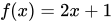
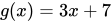
- Function composition is generally noncommutative.[11] For example, if and . Then and
- Matrix multiplication of square matrices of a given dimension is a noncommutative operation, except for matrices. For example:[12]
- The vector product (or cross product) of two vectors in three dimensions is anti-commutative; i.e., .[13]





Commutative structures
[edit]Some types of algebraic structures involve an operation that does not require commutativity. If this operation is commutative for a specific structure, the structure is often said to be commutative. So,
- a commutative semigroup is a semigroup whose operation is commutative;[14]
- a commutative monoid is a monoid whose operation is commutative;[15]
- a commutative group or abelian group is a group whose operation is commutative;[16]
- a commutative ring is a ring whose multiplication is commutative. (Addition in a ring is always commutative.)[17]
However, in the case of algebras, the phrase "commutative algebra" refers only to associative algebras that have a commutative multiplication.[18]
History and etymology
[edit]Records of the implicit use of the commutative property go back to ancient times. The Egyptians used the commutative property of multiplication to simplify computing products.[19] Euclid is known to have assumed the commutative property of multiplication in his book Elements.[20] Formal uses of the commutative property arose in the late 18th and early 19th centuries when mathematicians began to work on a theory of functions. Nowadays, the commutative property is a well-known and basic property used in most branches of mathematics.[2]

The first recorded use of the term commutative was in a memoir by François Servois in 1814, which used the word commutatives when describing functions that have what is now called the commutative property.[21] Commutative is the feminine form of the French adjective commutatif, which is derived from the French noun commutation and the French verb commuter, meaning "to exchange" or "to switch", a cognate of to commute. The term then appeared in English in 1838. in Duncan Gregory's article entitled "On the real nature of symbolical algebra" published in 1840 in the Transactions of the Royal Society of Edinburgh.[22]
See also
[edit]
- Anticommutative property
- Canonical commutation relation (in quantum mechanics)
- Centralizer and normalizer (also called a commutant)
- Commutative diagram
- Commutative (neurophysiology)
- Commutator
- Particle statistics (for commutativity in physics)
- Quasi-commutative property
- Trace monoid
- Commuting probability
Notes
[edit]- ^ Rice 2011, p. 4.
- ^ a b Saracino 2008, p. 11.
- ^ a b Hall 1966, pp. 262–263.
- ^ a b Lovett 2022, p. 12.
- ^ Rosen 2013, See the Appendix I.
- ^ Sterling 2009, p. 248.
- ^ Johnson 2003, p. 642.
- ^ O'Regan 2008, p. 33.
- ^ Posamentier et al. 2013, p. 71.
- ^ Medina et al. 2004, p. 617.
- ^ Tarasov 2008, p. 56.
- ^ Cooke 2014, p. 7.
- ^ Haghighi, Kumar & Mishev 2024, p. 118.
- ^ Grillet 2001, pp. 1–2.
- ^ Grillet 2001, p. 3.
- ^ Gallian 2006, p. 34.
- ^ Gallian 2006, p. 236.
- ^ Tuset 2025, p. 99.
- ^ Gay & Shute 1987, p. 16‐17.
- ^ Barbeau 1968, p. 183. See Book VII, Proposition 5, in David E. Joyce's online edition of Euclid's Elements
- ^ Allaire & Bradley 2002.
- ^ Rice 2011, p. 4; Gregory 1840.
References
[edit]- Allaire, Patricia R.; Bradley, Robert E. (2002). "Symbolical Algebra as a Foundation for Calculus: D. F. Gregory's Contribution". Historia Mathematica. 29 (4): 395–426. doi:10.1006/hmat.2002.2358.
- Barbeau, Alice Mae (1968). A Historical Approach to the Theory of Groups. Vol. 2. University of Wisconsin--Madison.
- Cooke, Richard G. (2014). Infinite Matrices and Sequence Spaces. Dover Publications. ISBN 978-0-486-78083-2.
- Gallian, Joseph (2006). Contemporary Abstract Algebra (6e ed.). Houghton Mifflin. ISBN 0-618-51471-6.
- Gay, Robins R.; Shute, Charles C. D. (1987). The Rhind Mathematical Papyrus: An Ancient Egyptian Text. British Museum. ISBN 0-7141-0944-4.
- Gregory, D. F. (1840). "On the real nature of symbolical algebra". Transactions of the Royal Society of Edinburgh. 14: 208–216.
- Grillet, P. A. (2001). Commutative semigroups. Advances in Mathematics. Vol. 2. Dordrecht: Kluwer Academic Publishers. doi:10.1007/978-1-4757-3389-1. ISBN 0-7923-7067-8. MR 2017849.
- Haghighi, Aliakbar Montazer; Kumar, Abburi Anil; Mishev, Dimitar (2024). Higher Mathematics for Science and Engineering. Springer. ISBN 978-981-99-5431-5.
- Hall, F. M. (1966). An Introduction to Abstract Algebra, Volume 1. New York: Cambridge University Press. MR 0197233.
- Johnson, James L. (2003). Probability and Statistics for Computer Science. John Wiley & Sons. ISBN 978-0-471-32672-4.
- Lovett, Stephen (2022). Abstract Algebra: A First Course. CRC Press. ISBN 978-1-000-60544-0.
- Medina, Jesús; Ojeda-Aciego, Manuel; Valverde, Agustín; Vojtáš, Peter (2004). "Towards Biresiduated Multi-adjoint Logic Programming". In Conejo, Ricardo; Urretavizcaya, Maite; Pérez-de-la-Cruz, José-Luis (eds.). Current Topics in Artificial Intelligence: 10th Conference of the Spanish Association for Artificial Intelligence, CAEPIA 2003, and 5th Conference on Technology Transfer, TTIA 2003, November 12-14, 2003. Lecture Notes in Computer Science. Vol. 3040. San Sebastian, Spain: Springer. doi:10.1007/b98369. ISBN 978-3-540-22218-7.
- O'Regan, Gerard (2008). A brief history of computing. Springer. ISBN 978-1-84800-083-4.
- Posamentier, Alfred S.; Farber, William; Germain-Williams, Terri L.; Paris, Elaine; Thaller, Bernd; Lehmann, Ingmar (2013). 100 Commonly Asked Questions in Math Class. Corwin Press. ISBN 978-1-4522-4308-5.
- Rice, Adrian (2011). "Introduction". In Flood, Raymond; Rice, Adrian; Wilson, Robin (eds.). Mathematics in Victorian Britain. Oxford University Press. ISBN 9780191627941.
- Rosen, Kenneth (2013). Discrete Maths and Its Applications Global Edition. McGraw Hill. ISBN 978-0-07-131501-2.
- Saracino, Dan (2008). Abstract Algebra: A First Course (2nd ed.). Waveland Press Inc.
- Sterling, Mary J. (2009). Linear Algebra For Dummies. John Wiley & Sons. ISBN 978-0-470-43090-3.
- Tarasov, Vasily (2008). Quantum Mechanics of Non-Hamiltonian and Dissipative Systems. Vol. 7 (1st ed.). Elsevier. ISBN 978-0-08-055971-1.
- Tuset, Lars (2025). Abstract Algebra via Numbers. Cham: Springer. doi:10.1007/978-3-031-74623-9. ISBN 978-3-031-74622-2. MR 4886847.
Commutative property
View on GrokipediaFundamentals
Definition
The commutative property is a fundamental characteristic of certain binary operations in mathematics, where a binary operation is defined as a function that takes two elements from a given set and produces a single element within that same set as output.[9] This property specifically states that interchanging the order of the two input elements, or operands, does not alter the result of the operation.[9] In everyday arithmetic, commutativity manifests intuitively through operations like addition and multiplication, allowing users to rearrange numbers freely to streamline computations—for instance, calculating totals or products without concern for sequence.[10] This flexibility simplifies mental math and problem-solving in practical scenarios, such as tallying quantities or scaling measurements, by emphasizing the operation's symmetry over rigid ordering.[10] While the commutative property is a universal feature in familiar school-level mathematics, it does not hold for all operations in more advanced mathematical contexts, where order can significantly impact outcomes.[11]Formal Statement
The commutative property is formally defined for a binary operation on a set. Specifically, let be a set and a binary operation on . The operation is commutative if [12][13] The universal quantifier in this statement indicates that the equality must hold universally for every ordered pair of elements with , without exception, thereby applying the property exhaustively to the entire set .[14][15] This equality asserts that the output of the operation, which is an element of , is identical regardless of the order in which the operands and are applied, reflecting a symmetry in the operation's behavior.[12] The property may fail to hold if the operation is not a binary operation on , for instance, when is not closed under (meaning for some ), or if, despite closure, there exist such that .[12][15]Examples
Commutative Operations
The commutative property is exemplified by the addition of real numbers, where for all , . This equality is a fundamental axiom in the field structure of the real numbers, ensuring that the order of summands does not affect the result. A proof sketch relies on the axiomatic definition: the real numbers form an ordered field where addition satisfies commutativity directly as part of the field axioms (A2), alongside associativity and the existence of identities and inverses; in constructive realizations like Dedekind cuts, commutativity emerges from the corresponding property in the rational numbers, where cuts and coincide since rational addition commutes.[16] Simple algebraic verification confirms this: consider ; by the field's additive inverse and cancellation laws, this difference is zero, affirming equality. Multiplication of real numbers also obeys the commutative property: for all , . This is another field axiom (M2), applicable universally, including cases involving zero where (derived from the multiplicative identity and additive inverse axioms) and negative numbers, as multiplication distributes over addition and inherits commutativity from the field's structure. Verification through manipulation shows , leveraging the field's properties without contradiction. For instance, with negatives, , consistent with the sign rules embedded in the axioms.[16] In Euclidean space , vector addition is commutative, defined component-wise: for vectors and , , since real addition commutes in each coordinate./03%3A_Vector_Spaces_and_Metric_Spaces/3.05%3A_Vector_Spaces._The_Space_C._Euclidean_Spaces) This holds for any dimension, simplifying computations like parallelogram law formations where order-independent sums yield the same resultant vector. A related instance arises in exponentiation with positive integer exponents and the same nonzero base: for and positive integers , , where the multiplication of powers commutes due to the underlying commutative multiplication in the repeated factors defining the exponents.[17] This property is limited to positive integer exponents to avoid issues with fractional or negative powers, which may not preserve the structure in all cases, but verifies through expansion: both sides equal ( times), reordered freely by multiplication's commutativity.Noncommutative Operations
Subtraction on the set of real numbers is a binary operation that is not commutative, meaning that for real numbers and , in general. For instance, , but . Division on the set of nonzero real numbers is another binary operation that fails to be commutative, as except in special cases such as when . An example is , whereas .- https://chem.libretexts.org/Bookshelves/Inorganic_Chemistry/Online_Dictionary_of_Crystallography_(IUCr_Commission)/01%3A_Fundamental_Crystallography/1.10%3A_Binary_Operation Matrix multiplication provides a classic example of noncommutativity in linear algebra. For square matrices over the real numbers, the product does not generally equal . Consider the 2×2 matrices Computing the products yields Since , matrix multiplication is not commutative./02%3A_Matrix_Arithmetic/2.02%3A_Matrix_Multiplication) Function composition, denoted by , is also noncommutative as an operation on functions. For functions and , typically differs from . Take and ; then , but .[18] The noncommutativity of these operations highlights the importance of order in sequences of applications, such as successive transformations in geometry or computations in algorithms, where reversing the order can yield entirely different results—contrasting with commutative operations like addition./02%3A_Introduction_to_Groups/2.02%3A_Binary_Operation)Commutative Algebraic Structures
Rings
In abstract algebra, a ring is a set equipped with two binary operations, addition and multiplication, such that forms an abelian group, multiplication is associative, and multiplication distributes over addition on both sides. Specifically, for all , the distributive laws hold: and .[19] A commutative ring is a ring where multiplication additionally satisfies the commutative property: for all , .[19] This commutativity simplifies many structural properties, such as the behavior of ideals, which are subsets closed under addition and under multiplication by any ring element.[20] In commutative rings, all ideals are two-sided by default, unlike in noncommutative settings.[21] The integers form a commutative ring under the standard addition and multiplication operations, with 0 as the additive identity and every integer having an additive inverse. Similarly, the ring of polynomials over the real numbers is a commutative ring, where addition and multiplication are defined polynomial-wise, and the zero polynomial serves as the additive identity.[22] Units in a commutative ring are elements such that there exists with , assuming the ring has a multiplicative identity 1; for instance, are the units in .[19] Every field is a commutative ring, since fields require commutative multiplication along with every nonzero element having a multiplicative inverse, but the converse does not hold—for example, is a commutative ring without being a field, as most elements lack multiplicative inverses within the ring.[23] Commutative ring theory plays a foundational role in modern algebra, underpinning areas like algebraic geometry and number theory through the study of ideals and modules.Groups and Monoids
A monoid consists of a set equipped with a binary operation that is associative, meaning for all , and an identity element such that for all .[24] A commutative monoid is a monoid in which the operation is also commutative, satisfying for all .[25] A group extends the structure of a monoid by requiring that every element has a two-sided inverse such that .[26] An abelian group, also known as a commutative group, is a group where the operation satisfies commutativity for all elements: [27] This property distinguishes abelian groups from non-abelian ones, where the order of operation matters. Classic examples illustrate these concepts. The additive group of integers forms an abelian group, with identity 0 and inverses given by negation, since addition commutes: for all .[28] In contrast, the general linear group , consisting of all invertible matrices over the reals under matrix multiplication, is non-abelian for , as matrix multiplication generally does not commute.[29] A key feature in group theory is the commutator subgroup , defined as the subgroup generated by all commutators for .[30] In an abelian group, every commutator equals the identity, so , rendering the group abelian if and only if its commutator subgroup is trivial. This trivial commutator simplifies the study of symmetries in abelian groups, particularly in representation theory, where all irreducible representations are one-dimensional, facilitating analysis of group actions on vector spaces.[31]Historical Development
Etymology
The term "commutative" derives from the Latin commūtātīvus, an adjective formed from commūtāre, meaning "to exchange" or "to change mutually," emphasizing the idea of interchangeability between elements.[32] This Latin root entered mathematical terminology through French, where commuter means "to switch" or "to substitute," combined with the suffix -ative, which denotes a tendency or relational quality.[33] The word's adoption into English mathematical discourse occurred in the 19th century, with the earliest recorded use of "commutative law" appearing in 1841 in Duncan F. Gregory's Examples of the Processes of the Differential and Integral Calculus.[34] The first mathematical application of the term "commutative" is attributed to François-Joseph Servois in his 1814 memoir Essai sur une nouvelle méthode d'exposition des principes du calcul différentiel, where he described properties of operators, including those of addition and multiplication, as commutatives.[35] In contrast to related terms like "associative," which stems from the Latin associātus meaning "joined together," "commutative" specifically highlights the mutual exchange without altering the result.Early Uses and Formalization
In ancient Egypt, circa 2000 BCE, mathematicians implicitly employed the commutative property during multiplication operations, particularly in practical calculations for areas and volumes as documented in texts like the Rhind Mathematical Papyrus. This approach allowed factors to be rearranged freely—such as treating length and width interchangeably in rectangular area computations—without altering the resulting product, streamlining computations in a base-10 system augmented by doubling and halving techniques.[36] Greek mathematics advanced this implicit understanding, with Euclid's Elements (circa 300 BCE) assuming commutativity in the context of geometric proportions and number theory, though without explicit declaration as a standalone axiom. In Book VII, Proposition 16, Euclid demonstrates the interchangeability of multiplicand and multiplier using the theory of proportions, effectively proving that the product remains unchanged regardless of order, a result derived from additive commutativity and ratio equivalences like . This geometric framing integrated the property into proportional reasoning, influencing subsequent Euclidean derivations.[37] The 19th century marked the formalization of the commutative property amid the rise of abstract algebra. Mathematicians like Richard Dedekind and Leopold Kronecker developed rigorous treatments of algebraic number fields and ideals, assuming commutativity in these ring-like structures.[38] William Rowan Hamilton contributed to this evolution through his explorations of algebraic systems, including commutative cases in his early work on linear algebra and dynamics, though his later quaternions highlighted noncommutative alternatives, prompting deeper scrutiny of the property's scope.[39] These efforts shifted focus from concrete arithmetic to abstract axiomatic frameworks, laying groundwork for modern algebra. Around 1900, David Hilbert advanced the role of commutativity in ring theory through his foundational work on invariant theory and the basis theorem, which established finite generation for ideals in polynomial rings over fields—structures inherently commutative—emphasizing their utility in algebraic geometry and number theory.[38] This period solidified commutative rings as a central object of study, bridging 19th-century developments with emerging abstract methods. Post-1930s, the commutative property gained a universal axiomatic footing in the framework of set theory and universal algebra, particularly through Garrett Birkhoff's 1935 treatise On the Structure of Abstract Algebras, which axiomatized algebraic varieties and incorporated commutativity as a key relational property across diverse structures like groups and rings. This integration within Zermelo-Fraenkel set theory ensured the property's consistency in foundational mathematics, enabling its application in broader categorical and logical contexts without reliance on specific numerical interpretations.[40]References
- https://en.wiktionary.org/wiki/commutative