



Community hub
Recent from talks
Knowledge base stats:
Talk channels stats:
Members stats:
Computer (occupation)
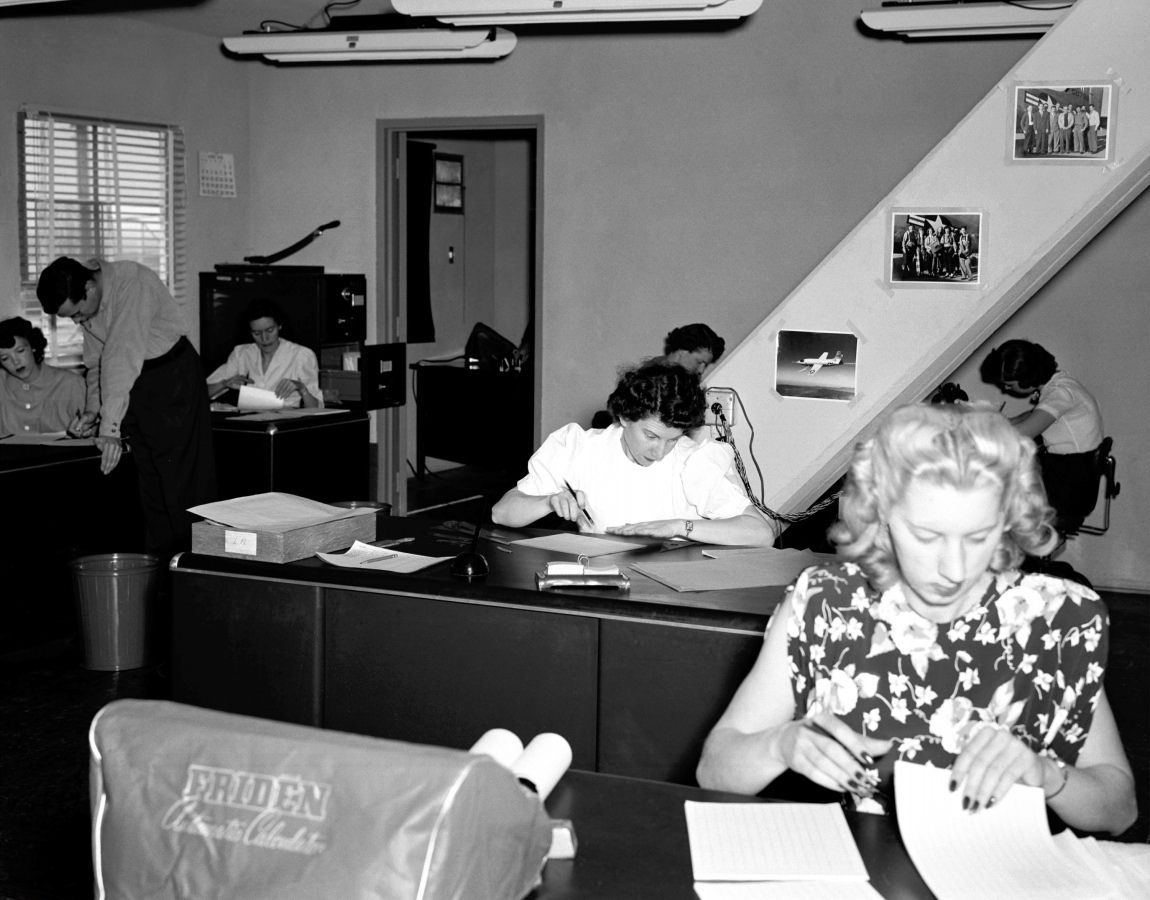
The term "computer", in use from the early 17th century (the first known written reference dates from 1613), meant "one who computes": a person performing mathematical calculations, before electronic calculators became available. Alan Turing described the "human computer" as someone who is "supposed to be following fixed rules; he has no authority to deviate from them in any detail." Teams of people, often women from the late nineteenth century onwards, were used to undertake long and often tedious calculations; the work was divided so that this could be done in parallel. The same calculations were frequently performed independently by separate teams to check the correctness of the results.
Since the end of the 20th century, the term "human computer" has also been applied to individuals with prodigious powers of mental arithmetic, also known as mental calculators.
Astronomers in Renaissance times used that term about as often as they called themselves "mathematicians" for their principal work of calculating the positions of planets. They often hired a "computer" to assist them. For some people, such as Johannes Kepler, assisting a scientist in computation was a temporary position until they moved on to greater advancements. Before he died in 1617, John Napier suggested ways by which "the learned, who perchance may have plenty of pupils and computers" might construct an improved logarithm table.
Computing became more organized when the Frenchman Alexis Claude Clairaut (1713–1765) divided the computation to determine the time of the return of Halley's Comet with two colleagues, Jérôme Lalande and Nicole-Reine Lepaute. Human computers continued plotting the future movements of astronomical objects to create celestial tables for almanacs in the late 1760s.
The computers working on the Nautical Almanac for the British Admiralty included William Wales, Israel Lyons and Richard Dunthorne. The project was overseen by Nevil Maskelyne. Maskelyne would borrow tables from other sources as often as he could in order to reduce the number of calculations his team of computers had to make. Women were generally excluded, with some exceptions, such as Mary Edwards, who worked from the 1780s to 1815 as one of thirty-five computers for the British Nautical Almanac used for navigation at sea. The United States also worked on their own version of a nautical almanac in the 1840s, with Maria Mitchell being one of the best-known computers on the staff.
Other innovations in human computing included the work done by a group of boys who worked in the Octagon Room of the Royal Greenwich Observatory for Astronomer Royal George Airy. Airy's computers, hired after 1835, could be as young as fifteen, and they were working on a backlog of astronomical data. The way that Airy organized the Octagon Room with a manager, pre-printed computing forms, and standardized methods of calculating and checking results (similar to the way the Nautical Almanac computers operated) would remain a standard for computing operations for the next 80 years.
Women were increasingly involved in computing after 1865. Private companies hired them for computing and to manage office staff.
In the 1870s, the United States Signal Corps created a new way of organizing human computing to track weather patterns. This built on previous work from the US Navy and the Smithsonian meteorological project. The Signal Corps used a small computing staff that processed data that had to be collected quickly and finished in "intensive two-hour shifts". Each individual human computer was responsible for only part of the data.
Hub AI
Computer (occupation) AI simulator
(@Computer (occupation)_simulator)
Computer (occupation)
The term "computer", in use from the early 17th century (the first known written reference dates from 1613), meant "one who computes": a person performing mathematical calculations, before electronic calculators became available. Alan Turing described the "human computer" as someone who is "supposed to be following fixed rules; he has no authority to deviate from them in any detail." Teams of people, often women from the late nineteenth century onwards, were used to undertake long and often tedious calculations; the work was divided so that this could be done in parallel. The same calculations were frequently performed independently by separate teams to check the correctness of the results.
Since the end of the 20th century, the term "human computer" has also been applied to individuals with prodigious powers of mental arithmetic, also known as mental calculators.
Astronomers in Renaissance times used that term about as often as they called themselves "mathematicians" for their principal work of calculating the positions of planets. They often hired a "computer" to assist them. For some people, such as Johannes Kepler, assisting a scientist in computation was a temporary position until they moved on to greater advancements. Before he died in 1617, John Napier suggested ways by which "the learned, who perchance may have plenty of pupils and computers" might construct an improved logarithm table.
Computing became more organized when the Frenchman Alexis Claude Clairaut (1713–1765) divided the computation to determine the time of the return of Halley's Comet with two colleagues, Jérôme Lalande and Nicole-Reine Lepaute. Human computers continued plotting the future movements of astronomical objects to create celestial tables for almanacs in the late 1760s.
The computers working on the Nautical Almanac for the British Admiralty included William Wales, Israel Lyons and Richard Dunthorne. The project was overseen by Nevil Maskelyne. Maskelyne would borrow tables from other sources as often as he could in order to reduce the number of calculations his team of computers had to make. Women were generally excluded, with some exceptions, such as Mary Edwards, who worked from the 1780s to 1815 as one of thirty-five computers for the British Nautical Almanac used for navigation at sea. The United States also worked on their own version of a nautical almanac in the 1840s, with Maria Mitchell being one of the best-known computers on the staff.
Other innovations in human computing included the work done by a group of boys who worked in the Octagon Room of the Royal Greenwich Observatory for Astronomer Royal George Airy. Airy's computers, hired after 1835, could be as young as fifteen, and they were working on a backlog of astronomical data. The way that Airy organized the Octagon Room with a manager, pre-printed computing forms, and standardized methods of calculating and checking results (similar to the way the Nautical Almanac computers operated) would remain a standard for computing operations for the next 80 years.
Women were increasingly involved in computing after 1865. Private companies hired them for computing and to manage office staff.
In the 1870s, the United States Signal Corps created a new way of organizing human computing to track weather patterns. This built on previous work from the US Navy and the Smithsonian meteorological project. The Signal Corps used a small computing staff that processed data that had to be collected quickly and finished in "intensive two-hour shifts". Each individual human computer was responsible for only part of the data.