


Community hub
Recent from talks
Contribute something
Nothing was collected or created yet.
Congressional Record
View on Wikipedia
| Frequency | Daily (when Congress is in session); bound volumes at end of each session |
|---|---|
| Publisher | United States Government Publishing Office |
| First issue | 1873 |
| Country | United States |
| Language | English |
| Website | www |


The Congressional Record is the official record of the proceedings and debates of the United States Congress, published by the United States Government Publishing Office and issued when Congress is in session. The Congressional Record Index is updated daily online and published monthly. At the end of a session of Congress, the daily editions are compiled into bound volumes that constitute the permanent edition.[1] Chapter 9 of Title 44 of the United States Code authorizes publication of the Congressional Record.
The Congressional Record consists of four sections: the House section, the Senate section, the Extensions of Remarks, and, since the 1940s, the Daily Digest.[2][3] At the back of each daily issue is the Daily Digest, which summarizes the day's floor and committee activities and serves as a table of contents for each issue. The House and Senate sections contain proceedings for the separate chambers of Congress.
A section of the Congressional Record titled Extensions of Remarks contains speeches, tributes and other extraneous words that were not uttered during open proceedings of the full Senate or of the full House of Representatives. Witnesses in committee hearings are often asked to submit their complete testimony "for the record" and only deliver a summary of it in person. The full statement will then appear in a printed volume of the hearing identified as "Statements for the Record". In years past, this particular section of the Congressional Record was called the "Appendix".[4] While members of either body may insert material into Extensions of Remarks, Senators rarely do so.[5] The overwhelming majority of what is found there is entered at the request of Members of the House of Representatives. From a legal standpoint, most materials in the Congressional Record are classified as secondary authority, as part of a statute's legislative history.[citation needed]
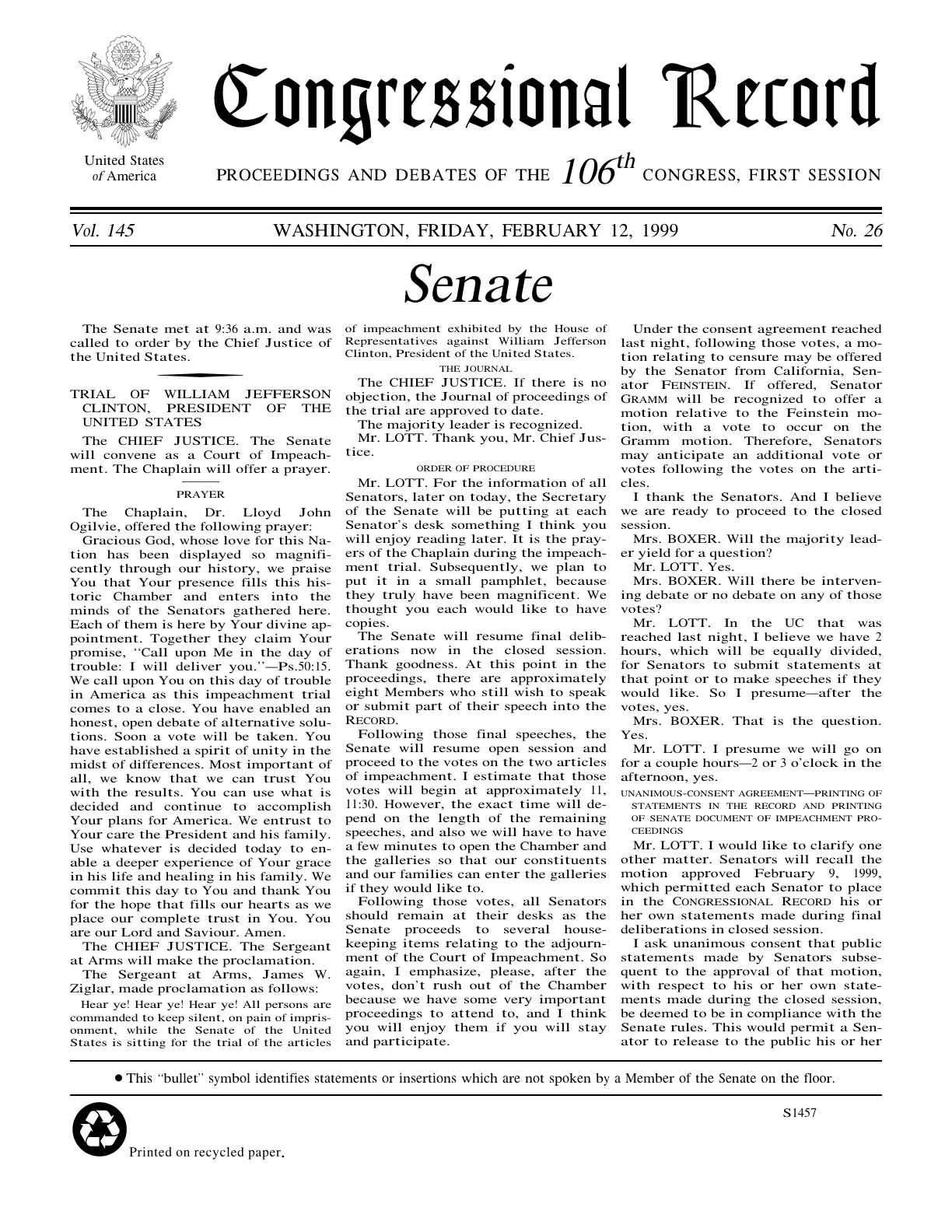
By custom and rules of each house, members also frequently "revise and extend" their remarks made on the floor before the debates are published in the Congressional Record. Therefore, for many years, speeches that were not delivered in Congress appeared in the Congressional Record, including in the sections purporting to be verbatim reports of debates.[6] In recent years, however, these revised remarks have been preceded by a "bullet" symbol or, more recently and currently, printed in a typeface discernibly different from that used to report words spoken by members.
The Congressional Record is publicly available for records before 1875 via the Library of Congress' American Memory Century of Lawmaking website,[7] and since 1989 via Congress.gov (which replaced the THOMAS database in 2016).[8] Thanks to a partnership between GPO and the Library of Congress, digital versions of the bound editions are available on govinfo.gov for 1873 to 2001 (Volumes 1-147) and 2005 to 2015 (Volumes 151-161).[9] Govinfo.gov also provides access to digital versions of the daily edition from 1994 (Volume 140) to the present.[10]
History
[edit]In early United States history, there was no record of Congressional debates. The contemporary British Parliament from which Congress drew its tradition was a highly secretive body, and publishing parliamentary proceedings in Britain did not become legal until 1771.[11] The Constitution, in Article I, Section 5, requires Congress to keep a journal of its proceedings, but both the House Journal and the Senate Journal include only a bare record of actions and votes rather than records of debates.[12] In the first twenty years, Congress made frequent use of secret sessions. Beginning with the War of 1812, public sessions became commonplace.[11]
In the early 1800s, political reporting was dominated by National Intelligencer, the first newspaper of Washington, D.C. Newspapers with reporters in the chamber regularly published floor statements in their reports. Joseph Gales and William Seaton, the editors of the Intelligencer, became regular fixtures in the House and Senate chambers.[13]
In 1824, Gales and Seaton began publishing the Register of Debates, the first series of publications containing congressional debates. The Register of Debates contains summaries of "leading debates and incidents" of the period rather than a verbatim debate transcript.[14] From 1834 to 1856, Gale and Seaton retroactively compiled the Annals of Congress, covering congressional debates from 1789 to 1824 using primarily newspaper accounts.[15]
When Andrew Jackson's Democrats came into power in congress around 1830, Gales and Seaton's popularity declined due to their differing views with the administration. The new printing partnership of Francis Preston Blair and John Cook Rives founded the Congressional Globe in 1833 with President Jackson's support. In 1837, Register of Debates ceased publication.[13]
In 1851, the Congressional Globe began publishing near-verbatim reports of debates thanks to the publication's heavy use of stenographers.[16][13]
The Congressional Record was first published in 1873[7] under the oversight of Senate Secretary George Congdon Gorham.[17]
See also
[edit]- Federal Register, the official daily publication for rules, proposed rules, and notices of US federal agencies and organizations
- Hansard, British and Commonwealth parliamentary record
- United States House Journal
- United States Senate Journal
References
[edit]- ^ "44 U.S. Code Chapter 9 - CONGRESSIONAL RECORD". LII / Legal Information Institute.
- ^ "Congressional Record". Senate.gov. United States Senate. Retrieved October 30, 2025.
- ^ "Daily Digest". Senate.gov. United States Senate. Retrieved October 30, 2025.
- ^ "Congressional Glossary". The Center on Congress Indiana University Bloomington. Archived from the original on July 19, 2015. Retrieved July 17, 2015.
- ^ McKinney, R.J. "An Overview of the Congressional Record and Its Predecessor Publications: A Research Guide". Law Librarians’ Society of Washington, D.C. (LLSDC). Retrieved October 30, 2025.
- ^ Jenks, Paul; Hall, Will; Peake, Dan (December 16, 2005). "On the Floor, In Congress". CongressLine. GalleryWatch. Archived from the original on July 21, 2015. Retrieved October 14, 2020.
- ^ a b "A Century of Lawmaking for a New Nation". Library of Congress. May 1, 2003. Retrieved July 17, 2015.
- ^ "About the Congressional Record". Library of Congress. Retrieved October 14, 2020.
- ^ "About the Congressional Record (Bound Edition)". U.S. Government Information. Retrieved October 14, 2020.
- ^ "About the Congressional Record". U.S. Government Information. Retrieved October 14, 2020.
- ^ a b Forte, David; Spalding, Matthew; Meese, Edwin (2014). The Heritage Guide to the Constitution: Fully Revised Second Edition (2nd ed.). Simon and Schuster. ISBN 9781621573524.
- ^ Handler, Nicholas (May 2019). "Rediscovering the Journal Clause: The Lost History of Legislative Constitutional Interpretation". University of Pennsylvania Journal of Constitutional Law. 21: 1255–1294.
- ^ a b c "U.S. Senate: Reporters of Debate and the Congressional Record". www.senate.gov. Retrieved November 16, 2023.
- ^ "Register of Debates | Debates of Congress | Articles and Essays | A Century of Lawmaking for a New Nation: U.S. Congressional Documents and Debates 1774-1875 | Digital Collections | Library of Congress". Library of Congress, Washington, D.C. 20540 USA. Retrieved November 16, 2023.
- ^ "Annals of Congress | Debates of Congress | Articles and Essays | A Century of Lawmaking for a New Nation: U.S. Congressional Documents and Debates 1774-1875 | Digital Collections | Library of Congress". Library of Congress, Washington, D.C. 20540 USA. Retrieved November 16, 2023.
- ^ "Congressional Globe | Debates of Congress | Articles and Essays | A Century of Lawmaking for a New Nation: U.S. Congressional Documents and Debates 1774-1875 | Digital Collections | Library of Congress". Library of Congress, Washington, D.C. 20540 USA. Retrieved November 16, 2023.
- ^ "George C. Gorham, Secretary of the Senate, 1868–1879". senate.gov. United States Senate. Retrieved October 29, 2025.
External links
[edit]
- Search Congressional Record (starting from 1927) via congress.gov
- Congressional Record Bound Edition (from 1873) via govinfo.gov
- Congressional Record Daily Edition (from 1994) via govinfo.gov
- Congressional Record Index (from 1983) via govinfo.gov
- Overview of the Congressional Record and Its Predecessor Publications: A Research Guide
- Sessions of Congress and Corresponding Debate Record Volume Numbers
- Find Congressional Record in a Depository Library
- Sources for the Congressional Record: Free and Commercial for people with access to libraries
- U.S. Congressional Documents and Debates, 1774-1875, containing the Annals of Congress, Register of Debates, Congressional Globe, and Congressional Record, hosted by the Library of Congress
- Congressional Record for the 43rd-114th Congresses: Parsed Speeches and Phrase Counts (plain text speeches from Daily and Bound Editions, 43rd to 111th and 97th to 114th Congresses respectively)
Congressional Record
View on GrokipediaHistory
Predecessors and Origins
Prior to the establishment of an official record, congressional proceedings from 1789 onward were documented informally through newspaper reports by accredited correspondents, who provided summaries rather than verbatim accounts of debates and actions.[9] These early efforts, lacking systematic oversight, often resulted in incomplete or selective coverage dependent on reporters' access and editorial choices.[10] The first major compilation, known as the Annals of Congress, retrospectively covered sessions from the 1st through 18th Congresses (1789–1824) and was assembled by printers Joseph Gales and William W. Seaton between 1834 and 1856.[10] Drawing primarily from newspaper clippings, official journals, and fragmentary manuscripts, the 42-volume set aimed to reconstruct proceedings but remained unofficial, non-contemporaneous, and prone to gaps in verbatim detail.[9] Its popularity underscored a rising need for preserved legislative history amid expanding federal responsibilities. This was followed by the Register of Debates in Congress, published from the 18th Congress, 2nd Session, through the 25th Congress, 1st Session (1824–1837), continuing Gales and Seaton's private enterprise with more focused debate transcripts supplemented by procedural summaries.[11] Still unofficial, it reflected incremental improvements in reporting accuracy as congressional sessions lengthened and public scrutiny intensified. The Congressional Globe, initiated in December 1833 by Francis Preston Blair and John C. Rives as a weekly private venture, marked a shift toward near-verbatim transcription of House and Senate proceedings, spanning from the 23rd Congress to the 42nd (1833–1873).[12][13] Edited initially by Blair and Rives—later by Rives alone and his successors—the publication responded to surging demands for accountability, fueled by Jacksonian-era expansions in suffrage, party competition, and the volume of legislative business, which heightened calls for transparent records of representatives' actions.[12] Partisan distrust, such as Whig skepticism of its pro-Democratic leanings, highlighted its unofficial status yet affirmed its role in standardizing coverage.[12]Establishment and Early Years
The Congressional Record was formally established in 1873 during the 43rd Congress as the official government publication recording the proceedings and debates of the U.S. House and Senate, replacing the privately issued Congressional Globe.[6] This shift to direct congressional control via the Government Printing Office (GPO) aimed to produce a more economical and reliable record, addressing limitations in private publication such as inconsistencies in coverage and cost.[6] The GPO, operational since 1861, assumed responsibility for printing to ensure timeliness and completeness under federal oversight.[14] The inaugural issue was published on March 4, 1873, documenting the special session of the Senate that convened under Vice President Henry Wilson.[15] Subsequent daily editions covered both chambers' activities, organized by session with consecutively numbered pages typically arranged in three columns per page, mirroring the Globe's layout for continuity while prioritizing substantially verbatim transcripts of spoken remarks.[6] [4] Minor editorial revisions were allowed to clarify intent without altering substance, reflecting congressional preferences for polished yet faithful reporting over unedited stenography.[2] Early operations faced logistical hurdles inherent to rapid daily production, including coordinating stenographic reporting from floor proceedings and distributing issues to members and subscribers amid the GPO's expanding workload.[9] The first bound volumes, compiling the full 43rd Congress sessions, were issued in 1875 following the adjournment of the second session on March 3.[16] This permanent edition format enabled archival preservation and indexed access, marking a foundational step in standardizing the Record as an enduring legislative archive.[17]20th-Century Developments
The Congressional Record adapted to rising legislative demands through procedural enhancements in the mid-20th century. In 1947, with the 80th Congress, the Daily Digest was introduced as a summary component at the end of each daily issue, providing an overview of floor actions, committee activities, and legislative status to facilitate reference amid expanding proceedings.[6] This addition addressed the need for efficient navigation as congressional business grew more complex following World War II.[18] During the World War II era, the Record documented intensified congressional activity related to war mobilization and policy, with bound volumes covering the 77th through 79th Congresses (1941–1947) reflecting heightened debates on defense, appropriations, and international affairs.[19] Printing continued under Government Printing Office operations despite wartime constraints, maintaining daily publication to capture verbatim or substantially verbatim accounts of proceedings.[20] In the latter half of the century, the practice of "extensions of remarks" expanded significantly, allowing members—primarily in the House—to insert non-delivered speeches, tributes, and extraneous material into the Record without unanimous consent requirements that applied in the Senate. Beginning systematically in 1967 with the 90th Congress, these insertions were numbered sequentially (e.g., E-prefixed), contributing to volume growth by accommodating longer filibusters, extended debates, and individual member communications outside floor time.[6] This reflected causal pressures from procedural tactics like filibusters and the increasing length of sessions driven by legislative complexity. Overall page volume rose substantially, from approximately 10,000 pages annually around 1900 to over 25,000 by the 1990s, paralleling expansions in congressional workload, bill introductions, and committee hearings.[6] These developments prioritized efficiency and member expression while preserving the Record's role as a comprehensive, if edited, chronicle of proceedings.[21]Purpose and Legal Role
Statutory Basis and Official Status
The Congressional Record is authorized and governed by Chapter 9 of Title 44 of the United States Code, specifically sections 901 through 907, which mandate its publication as the substantially complete account of congressional proceedings and debates. These provisions require the Joint Committee on Printing to oversee the Record's arrangement, style, contents, and indexes, including semimonthly indexes during sessions and a comprehensive index at session's end.[22] Publication occurs daily when either chamber of Congress is in session, ensuring timely dissemination of legislative activities.[1] The Government Publishing Office (GPO) has served as the official printer since the Record's establishment in 1873, replacing earlier private arrangements to centralize and standardize federal printing under congressional control.[23] This statutory framework positions the Record as the presumptively official chronicle of Congress, distinct from the constitutional journals of the House and Senate, which record procedural votes but not debates.[21] While not a literal verbatim transcript—due to historical constraints on real-time stenography before modern audio technology—the Record must constitute a "substantially verbatim" account under House Rule XIV, clause 9, with analogous Senate precedents requiring faithful representation of spoken remarks.[24] This standard accommodates minor editorial adjustments for clarity while preserving substantive content, reflecting a pragmatic balance between exhaustive transparency and feasible production in an era without instantaneous recording.[12] In legal contexts, the Record holds evidentiary weight as prima facie evidence of proceedings and statements made on the floor, admissible in courts absent contradictory proof from official journals or other authenticated sources.[6] This status underscores its role in upholding public accountability, as Congress intended a reliable, accessible record for historical, interpretive, and judicial reference without the infeasibility of unedited raw transcripts.[9]Core Functions in Congressional Operations
The Congressional Record documents the daily proceedings of the House and Senate, including substantially verbatim transcripts of floor debates, recorded votes on legislation, introductions of bills and resolutions, and referrals to committees.[1] It also incorporates official communications, such as messages from the President, and notices of committee actions, providing a comprehensive account of legislative business conducted during sessions.[2] Published each morning following the previous day's activities, this record enables members to reference specific prior statements or actions in real-time during ongoing deliberations, supporting procedural continuity and informed debate.[2] In operational terms, the Record plays a key role in tracking the progression of legislation through its indexed "History of Bills" sections, which compile chronological summaries of introductions, amendments, debates, and dispositions for each measure, allowing congressional staff and members to verify stages of advancement and precedents.[25] This function aids internal accountability by creating an auditable trail of decisions, distinct from informal notes or electronic logs, and facilitates causal analysis of how floor discussions influence subsequent votes or modifications.[2] The Record differs fundamentally from the House and Senate Journals, which, as mandated by Article I, Section 5 of the U.S. Constitution, record only formal actions such as yeas and nays on votes, quorum calls, and procedural motions without capturing debate content or explanatory remarks.[26] Whereas Journals serve as the minimal official logs required for constitutional compliance, the Record's inclusion of contextual debates preserves the substantive rationale behind actions, enhancing operational utility for resolving disputes over intent or sequence in legislative processes.[12] This distinction underscores the Record's value in historical preservation, ensuring long-term access to the full evidentiary basis of congressional operations beyond bare procedural tallies.[2]Content and Structure
Components of Daily Issues
Each daily issue of the Congressional Record comprises four primary sections: Senate proceedings, House proceedings, Extensions of Remarks, and the Daily Digest, distinguished by page prefixes "S," "H," "E," and "D," respectively.[2][1] These sections capture the chronological sequence of floor activities in each chamber, with proceedings reflecting speeches, debates, and actions as they occurred during the session.[1] The Senate section details the chamber's proceedings, including motions, votes, and attributed statements from senators, presented in temporal order to reflect the session's progression.[2][1] Similarly, the House section records analogous activities for the House of Representatives, encompassing roll calls, amendments, and member interventions, also arranged chronologically.[2][1] Both proceedings sections incorporate notices of upcoming hearings and other procedural announcements as delivered.[1] The Extensions of Remarks section allows House members to insert supplemental materials, such as tributes, newsletters, or undelivered statements, which are not part of the live floor debate.[2][1] Positioned at the issue's conclusion, the Daily Digest offers a concise overview of the prior day's legislative business, featuring highlights of Senate and House actions, summaries of committee schedules, and a listing of Extensions of Remarks entries.[1][2] Daily issues are released each morning following sessions when Congress is in session, ensuring timely documentation of events.[1]Editing and Insertion Practices
Members of the House of Representatives may obtain unanimous consent for "leave to revise and extend" their remarks, permitting post-session submission of grammatical, clerical, or stylistic corrections to speeches delivered on the floor, as well as additions of material not originally spoken.[27] Such extensions, which can include extraneous content like constituent correspondence or supplementary data, are printed in the Congressional Record in distinctive type—typically italics—to differentiate them from the substantially verbatim account of proceedings.[27][28] This procedure, rooted in House precedents and clause 8 of Rule XVII, enables members to refine the record for clarity without altering core events, though submissions must occur promptly, often within days of the session to align with daily publication timelines.[29] In the Senate, editing practices are more constrained, allowing only minor corrections for accuracy in remarks, such as typographical errors, while prohibiting substantive revisions or expansions to spoken content.[6] Insertions unrelated to pending business, including additional statements or materials, are instead placed near the end of proceedings under dedicated headings like "Additional Statements," preserving the verbatim integrity of debate while accommodating supplementary documentation.[30] Senate procedures, outlined in standing rules and publication guidelines, require return of manuscripts or proofs in time for inclusion, or else note the member's address without full text if delayed.[24] These allowances across chambers expedite the correction of minor inaccuracies from stenographic reporting, enhancing the record's utility for legislative reference, while permitting controlled expansions that incorporate undelivered but relevant material into the official transcript under House Rule XVII and equivalent Senate protocols.[29][31]Publication Process
Print Production by GPO
The United States Government Publishing Office (GPO) manages the print production of daily editions of the Congressional Record, receiving stenographic transcripts from congressional reporters shortly after floor proceedings conclude. These raw galleys undergo proofreading for accuracy, composition into formatted pages via typesetting software, and final prepress preparation, which accounts for approximately 70% of production costs due to labor-intensive verification and layout adjustments.[32][33] High-speed digital inkjet presses then print the editions overnight, enabling distribution to all Members of Congress and designated federal depository libraries by the following morning when sessions resume.[34][35] This workflow prioritizes rapid turnaround and reliability, with GPO automating elements like page imposition and ink application to reduce paper waste to under 2% and streamline operations since 2020.[36] Distribution extends to public sales through the GPO bookstore and free access via depository programs, supporting legislative reference needs. Annual congressional printing and binding appropriations, funding Record production alongside bills and reports, totaled $82,992,000 in FY2023, reflecting efforts to contain costs amid fluctuating session volumes.[37] GPO's output for the Record yields roughly 25,000 to 30,000 pages per year during active sessions, forming part of broader congressional printing exceeding millions of pages annually when including multiples for hearings and documents.[35][6] Print persists alongside digital formats to preserve the authoritative paper artifact, ensuring long-term archival integrity against potential electronic degradation or access disruptions.[38]Binding and Permanent Editions
The permanent edition of the Congressional Record, compiled from the daily issues, consolidates all proceedings, debates, extensions of remarks, and insertions into a single, authoritative volume per session of Congress, with revisions incorporated to reflect members' final submissions.[39][2] This process involves re-pagination to establish continuous numbering without the daily prefixes (e.g., "H" for House or "S" for Senate), ensuring a unified structure distinct from the provisional dailies.[30] The edition also appends a Daily Digest for each sitting day, summarizing legislative actions, committee reports, and other key events.[30] Published by the Government Publishing Office in red hardcover bindings for archival durability, each volume is divided into multiple parts corresponding to chronological segments of the session, facilitating production and handling of extensive content.[40] Comprehensive indexes—covering subjects, personal and place names, bills, resolutions, reports, and committee hearings—are generated anew for the bound set, enabling precise navigation across thousands of pages per volume.[41] Errata and final corrections identified post-session are integrated, enhancing accuracy over the interim dailies.[39] These bound volumes, available since the Record's establishment for the 43rd Congress (1873–1875), form the official long-term repository of congressional records, with over 150 years of sessions yielding an extensive archive preserved in print and institutional libraries.[21] The process typically concludes one to two years after session adjournment, allowing time for compilation, verification, and indexing amid the volume's scale—often exceeding 10,000 pages per session in recent Congresses.[42] This edition's permanence underscores its role in legal, historical, and scholarly reference, superseding dailies as the definitive source for cited proceedings.[6]Digital Transition and Access
Shift to Electronic Formats
The U.S. Government Publishing Office (GPO) initiated the shift toward electronic dissemination of the Congressional Record with the launch of GPO Access on June 8, 1994, which provided free online access to daily issues alongside print editions, marking the first widespread digital availability of the publication.[43][44] This platform integrated the Record with other congressional materials, enabling public retrieval via the internet and reducing reliance on physical distribution for timely access.[45] Subsequent advancements included the transition to the Federal Digital System (FDsys) in December 2010, which succeeded GPO Access as the official repository and expanded electronic capabilities for the Record, including searchable formats and integration with legislative workflows. GPO systematically digitized historical volumes, culminating in the completion of scans for issues from 1873 to 1890 by January 2018, thereby creating a comprehensive electronic archive spanning the publication's entire history.[14][46] These changes were propelled by advancements in digital technology and internet infrastructure, which facilitated cost efficiencies through substantial reductions in print runs—such as those for the Record—and enhanced dissemination to a broader audience beyond congressional facilities and depository libraries.[47][33] The move addressed growing demands for remote, instantaneous access while curbing expenses associated with printing and physical storage, though print editions persisted for official records.[48]Current Platforms and Archival Digitization
The Congressional Record is primarily accessible via Congress.gov, the official legislative information system of the Library of Congress, which superseded the THOMAS system in 2016 and offers full-text searchable daily editions from the 103rd Congress (1993–1994) onward in HTML, PDF, and XML formats.[21] GovInfo.gov, managed by the U.S. Government Publishing Office (GPO), complements this by providing downloadable PDFs of both daily issues and bound editions, ensuring preservation of the official printed record.[49] These platforms enable keyword searches, browsing by date, and access to indices, enhancing public usability for legislative proceedings.[2] The GPO completed digitization of the historical Congressional Record, culminating in the public release of volumes from 1873 to 1890 on GovInfo.gov, thereby making the full archive—from its inception in 1873—available online at no cost.[14] This effort integrates scanned pages with optical character recognition for searchability, though older volumes may retain some limitations in accuracy due to print quality variations.[49] Congress.gov further supports advanced access through its public API, allowing programmatic retrieval of Record data in structured XML for integration into research tools and applications.[50] Mobile-specific developments included a Library of Congress iPad app launched in 2012 for browsing editions from 1995, which facilitated on-the-go access but was retired from the App Store in February 2023 to prioritize web-based enhancements.[51][52]