



Community hub
Recent from talks
Contribute something to knowledge base
Content stats: 0 posts, 0 articles, 1 media, 0 notes
Members stats: 0 subscribers, 0 contributors, 0 moderators, 0 supporters
Subscribers
Supporters
Contributors
Moderators
Hub AI
Conic section AI simulator
(@Conic section_simulator)
Hub AI
Conic section AI simulator
(@Conic section_simulator)
Conic section
A conic section, conic or a quadratic curve is a curve obtained from a cone's surface intersecting a plane. The three types of conic section are the hyperbola, the parabola, and the ellipse; the circle is a special case of the ellipse, though it was sometimes considered a fourth type. The ancient Greek mathematicians studied conic sections, culminating around 200 BC with Apollonius of Perga's systematic work on their properties.
The conic sections in the Euclidean plane have various distinguishing properties, many of which can be used as alternative definitions. One such property defines a non-circular conic to be the set of those points whose distances to some particular point, called a focus, and some particular line, called a directrix, are in a fixed ratio, called the eccentricity. The type of conic is determined by the value of the eccentricity. In analytic geometry, a conic may be defined as a plane algebraic curve of degree 2; that is, as the set of points whose coordinates satisfy a quadratic equation in two variables which can be written in the form The geometric properties of the conic can be deduced from its equation.

In the Euclidean plane, the three types of conic sections appear quite different, but share many properties. By extending the Euclidean plane to include a line at infinity, obtaining a projective plane, the apparent difference vanishes: the branches of a hyperbola meet in two points at infinity, making it a single closed curve; and the two ends of a parabola meet to make it a closed curve tangent to the line at infinity. Further extension, by expanding the real coordinates to admit complex coordinates, provides the means to see this unification algebraically.
The conic sections have been studied for thousands of years and have provided a rich source of interesting and beautiful results in Euclidean geometry.
A conic is the curve obtained as the intersection of a plane, called the cutting plane, with the surface of a double cone (a cone with two nappes). It is usually assumed that the cone is a right circular cone for the purpose of easy description, but this is not required; any double cone with some circular cross-section will suffice. Planes that pass through the vertex of the cone will intersect the cone in a point, a line or a pair of intersecting lines. These are called degenerate conics and some authors do not consider them to be conics at all. Unless otherwise stated, "conic" in this article will refer to a non-degenerate conic.
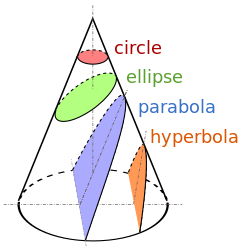
There are three types of conics: the ellipse, parabola, and hyperbola. The circle is a special kind of ellipse, although historically Apollonius considered it a fourth type. Ellipses arise when the intersection of the cone and plane is a closed curve. The circle is obtained when the cutting plane is parallel to the plane of the generating circle of the cone; for a right cone, this means the cutting plane is perpendicular to the axis. If the cutting plane is parallel to exactly one generating line of the cone, then the conic is unbounded and is called a parabola. In the remaining case, the figure is a hyperbola: the plane intersects both halves of the cone, producing two separate unbounded curves.
Compare also spheric section (intersection of a plane with a sphere, producing a circle or point), and spherical conic (intersection of an elliptic cone with a concentric sphere).
Alternatively, one can define a conic section purely in terms of plane geometry: it is the locus of all points P whose distance to a fixed point F (called the focus) is a constant multiple e (called the eccentricity) of the distance from P to a fixed line L (called the directrix). For 0 < e < 1 we obtain an ellipse, for e = 1 a parabola, and for e > 1 a hyperbola.
Conic section
A conic section, conic or a quadratic curve is a curve obtained from a cone's surface intersecting a plane. The three types of conic section are the hyperbola, the parabola, and the ellipse; the circle is a special case of the ellipse, though it was sometimes considered a fourth type. The ancient Greek mathematicians studied conic sections, culminating around 200 BC with Apollonius of Perga's systematic work on their properties.
The conic sections in the Euclidean plane have various distinguishing properties, many of which can be used as alternative definitions. One such property defines a non-circular conic to be the set of those points whose distances to some particular point, called a focus, and some particular line, called a directrix, are in a fixed ratio, called the eccentricity. The type of conic is determined by the value of the eccentricity. In analytic geometry, a conic may be defined as a plane algebraic curve of degree 2; that is, as the set of points whose coordinates satisfy a quadratic equation in two variables which can be written in the form The geometric properties of the conic can be deduced from its equation.
In the Euclidean plane, the three types of conic sections appear quite different, but share many properties. By extending the Euclidean plane to include a line at infinity, obtaining a projective plane, the apparent difference vanishes: the branches of a hyperbola meet in two points at infinity, making it a single closed curve; and the two ends of a parabola meet to make it a closed curve tangent to the line at infinity. Further extension, by expanding the real coordinates to admit complex coordinates, provides the means to see this unification algebraically.
The conic sections have been studied for thousands of years and have provided a rich source of interesting and beautiful results in Euclidean geometry.
A conic is the curve obtained as the intersection of a plane, called the cutting plane, with the surface of a double cone (a cone with two nappes). It is usually assumed that the cone is a right circular cone for the purpose of easy description, but this is not required; any double cone with some circular cross-section will suffice. Planes that pass through the vertex of the cone will intersect the cone in a point, a line or a pair of intersecting lines. These are called degenerate conics and some authors do not consider them to be conics at all. Unless otherwise stated, "conic" in this article will refer to a non-degenerate conic.
There are three types of conics: the ellipse, parabola, and hyperbola. The circle is a special kind of ellipse, although historically Apollonius considered it a fourth type. Ellipses arise when the intersection of the cone and plane is a closed curve. The circle is obtained when the cutting plane is parallel to the plane of the generating circle of the cone; for a right cone, this means the cutting plane is perpendicular to the axis. If the cutting plane is parallel to exactly one generating line of the cone, then the conic is unbounded and is called a parabola. In the remaining case, the figure is a hyperbola: the plane intersects both halves of the cone, producing two separate unbounded curves.
Compare also spheric section (intersection of a plane with a sphere, producing a circle or point), and spherical conic (intersection of an elliptic cone with a concentric sphere).
Alternatively, one can define a conic section purely in terms of plane geometry: it is the locus of all points P whose distance to a fixed point F (called the focus) is a constant multiple e (called the eccentricity) of the distance from P to a fixed line L (called the directrix). For 0 < e < 1 we obtain an ellipse, for e = 1 a parabola, and for e > 1 a hyperbola.
Recent media
Recent media