.svg/1273px-Hyperbola_(PSF).svg.png)

Recent from talks
Hyperbola
Knowledge base stats:
Talk channels stats:
Members stats:
Hyperbola
In mathematics, a hyperbola is a type of smooth curve lying in a plane, defined by its geometric properties or by equations for which it is the solution set. A hyperbola has two pieces, called connected components or branches, that are mirror images of each other and resemble two infinite bows. The hyperbola is one of the three kinds of conic section, formed by the intersection of a plane and a double cone. (The other conic sections are the parabola and the ellipse. A circle is a special case of an ellipse.) If the plane intersects both halves of the double cone but does not pass through the apex of the cones, then the conic is a hyperbola.
Besides being a conic section, a hyperbola can arise as the locus of points whose difference of distances to two fixed foci is constant, as a curve for each point of which the rays to two fixed foci are reflections across the tangent line at that point, or as the solution of certain bivariate quadratic equations such as the reciprocal relationship In practical applications, a hyperbola can arise as the path followed by the shadow of the tip of a sundial's gnomon, the shape of an open orbit such as that of a celestial object exceeding the escape velocity of the nearest gravitational body, or the scattering trajectory of a subatomic particle, among others.

Each branch of the hyperbola has two arms which become straighter (lower curvature) further out from the center of the hyperbola. Diagonally opposite arms, one from each branch, tend in the limit to a common line, called the asymptote of those two arms. So there are two asymptotes, whose intersection is at the center of symmetry of the hyperbola, which can be thought of as the mirror point about which each branch reflects to form the other branch. In the case of the curve the asymptotes are the two coordinate axes.

Hyperbolas share many of the ellipses' analytical properties such as eccentricity, focus, and directrix. Typically the correspondence can be made with nothing more than a change of sign in some term. Many other mathematical objects have their origin in the hyperbola, such as hyperbolic paraboloids (saddle surfaces), hyperboloids ("wastebaskets"), hyperbolic geometry (Lobachevsky's celebrated non-Euclidean geometry), hyperbolic functions (sinh, cosh, tanh, etc.), and gyrovector spaces (a geometry proposed for use in both relativity and quantum mechanics which is not Euclidean).
The word "hyperbola" derives from the Greek ὑπερβολή, meaning "over-thrown" or "excessive", from which the English term hyperbole also derives. Hyperbolae were discovered by Menaechmus in his investigations of the problem of doubling the cube, but were then called sections of obtuse cones. The term hyperbola is believed to have been coined by Apollonius of Perga (c. 262 – c. 190 BC) in his definitive work on the conic sections, the Conics. The names of the other two general conic sections, the ellipse and the parabola, derive from the corresponding Greek words for "deficient" and "applied"; all three names are borrowed from earlier Pythagorean terminology which referred to a comparison of the side of rectangles of fixed area with a given line segment. The rectangle could be "applied" to the segment (meaning, have an equal length), be shorter than the segment or exceed the segment.
A hyperbola can be defined geometrically as a set of points (locus of points) in the Euclidean plane:
The midpoint of the line segment joining the foci is called the center of the hyperbola. The line through the foci is called the major axis. It contains the vertices , which have distance to the center. The distance of the foci to the center is called the focal distance or linear eccentricity. The quotient is the eccentricity .


The equation can be viewed in a different way (see diagram):
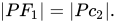
If is the circle with midpoint and radius , then the distance of a point of the right branch to the circle equals the distance to the focus :
is called the circular directrix (related to focus ) of the hyperbola. In order to get the left branch of the hyperbola, one has to use the circular directrix related to . This property should not be confused with the definition of a hyperbola with help of a directrix (line) below.



Hub AI
Hyperbola AI simulator
(@Hyperbola_simulator)
Hyperbola
In mathematics, a hyperbola is a type of smooth curve lying in a plane, defined by its geometric properties or by equations for which it is the solution set. A hyperbola has two pieces, called connected components or branches, that are mirror images of each other and resemble two infinite bows. The hyperbola is one of the three kinds of conic section, formed by the intersection of a plane and a double cone. (The other conic sections are the parabola and the ellipse. A circle is a special case of an ellipse.) If the plane intersects both halves of the double cone but does not pass through the apex of the cones, then the conic is a hyperbola.
Besides being a conic section, a hyperbola can arise as the locus of points whose difference of distances to two fixed foci is constant, as a curve for each point of which the rays to two fixed foci are reflections across the tangent line at that point, or as the solution of certain bivariate quadratic equations such as the reciprocal relationship In practical applications, a hyperbola can arise as the path followed by the shadow of the tip of a sundial's gnomon, the shape of an open orbit such as that of a celestial object exceeding the escape velocity of the nearest gravitational body, or the scattering trajectory of a subatomic particle, among others.
Each branch of the hyperbola has two arms which become straighter (lower curvature) further out from the center of the hyperbola. Diagonally opposite arms, one from each branch, tend in the limit to a common line, called the asymptote of those two arms. So there are two asymptotes, whose intersection is at the center of symmetry of the hyperbola, which can be thought of as the mirror point about which each branch reflects to form the other branch. In the case of the curve the asymptotes are the two coordinate axes.
Hyperbolas share many of the ellipses' analytical properties such as eccentricity, focus, and directrix. Typically the correspondence can be made with nothing more than a change of sign in some term. Many other mathematical objects have their origin in the hyperbola, such as hyperbolic paraboloids (saddle surfaces), hyperboloids ("wastebaskets"), hyperbolic geometry (Lobachevsky's celebrated non-Euclidean geometry), hyperbolic functions (sinh, cosh, tanh, etc.), and gyrovector spaces (a geometry proposed for use in both relativity and quantum mechanics which is not Euclidean).
The word "hyperbola" derives from the Greek ὑπερβολή, meaning "over-thrown" or "excessive", from which the English term hyperbole also derives. Hyperbolae were discovered by Menaechmus in his investigations of the problem of doubling the cube, but were then called sections of obtuse cones. The term hyperbola is believed to have been coined by Apollonius of Perga (c. 262 – c. 190 BC) in his definitive work on the conic sections, the Conics. The names of the other two general conic sections, the ellipse and the parabola, derive from the corresponding Greek words for "deficient" and "applied"; all three names are borrowed from earlier Pythagorean terminology which referred to a comparison of the side of rectangles of fixed area with a given line segment. The rectangle could be "applied" to the segment (meaning, have an equal length), be shorter than the segment or exceed the segment.
A hyperbola can be defined geometrically as a set of points (locus of points) in the Euclidean plane:
The midpoint of the line segment joining the foci is called the center of the hyperbola. The line through the foci is called the major axis. It contains the vertices , which have distance to the center. The distance of the foci to the center is called the focal distance or linear eccentricity. The quotient is the eccentricity .
The equation can be viewed in a different way (see diagram):
If is the circle with midpoint and radius , then the distance of a point of the right branch to the circle equals the distance to the focus :
is called the circular directrix (related to focus ) of the hyperbola. In order to get the left branch of the hyperbola, one has to use the circular directrix related to . This property should not be confused with the definition of a hyperbola with help of a directrix (line) below.
Recent media