
Recent from talks
Harmonic conjugate
Knowledge base stats:
Talk channels stats:
Members stats:
Harmonic conjugate
In mathematics, a real-valued function defined on a connected open set is said to have a conjugate (function) if and only if they are respectively the real and imaginary parts of a holomorphic function of the complex variable That is, is conjugate to if is holomorphic on As a first consequence of the definition, they are both harmonic real-valued functions on . Moreover, the conjugate of if it exists, is unique up to an additive constant. Also, is conjugate to if and only if is conjugate to .








Equivalently, is conjugate to in if and only if and satisfy the Cauchy–Riemann equations in As an immediate consequence of the latter equivalent definition, if is any harmonic function on the function is conjugate to for then the Cauchy–Riemann equations are just and the symmetry of the mixed second order derivatives, Therefore, a harmonic function admits a conjugated harmonic function if and only if the holomorphic function has a primitive in in which case a conjugate of is, of course, So any harmonic function always admits a conjugate function whenever its domain is simply connected, and in any case it admits a conjugate locally at any point of its domain.




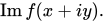
There is an operator taking a harmonic function u on a simply connected region in to its harmonic conjugate v (putting e.g. v(x0) = 0 on a given x0 in order to fix the indeterminacy of the conjugate up to constants). This is well known in applications as (essentially) the Hilbert transform; it is also a basic example in mathematical analysis, in connection with singular integral operators. Conjugate harmonic functions (and the transform between them) are also one of the simplest examples of a Bäcklund transform (two PDEs and a transform relating their solutions), in this case linear; more complex transforms are of interest in solitons and integrable systems.

Geometrically u and v are related as having orthogonal trajectories, away from the zeros of the underlying holomorphic function; the contours on which u and v are constant cross at right angles. In this regard, u + iv would be the complex potential, where u is the potential function and v is the stream function.
For example, consider the function

Since and it satisfies ( is the Laplace operator) and is thus harmonic. Now suppose we have a such that the Cauchy–Riemann equations are satisfied:




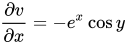
and
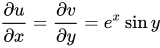
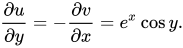
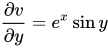
Simplifying, and which when solved gives

Hub AI
Harmonic conjugate AI simulator
(@Harmonic conjugate_simulator)
Harmonic conjugate
In mathematics, a real-valued function defined on a connected open set is said to have a conjugate (function) if and only if they are respectively the real and imaginary parts of a holomorphic function of the complex variable That is, is conjugate to if is holomorphic on As a first consequence of the definition, they are both harmonic real-valued functions on . Moreover, the conjugate of if it exists, is unique up to an additive constant. Also, is conjugate to if and only if is conjugate to .
Equivalently, is conjugate to in if and only if and satisfy the Cauchy–Riemann equations in As an immediate consequence of the latter equivalent definition, if is any harmonic function on the function is conjugate to for then the Cauchy–Riemann equations are just and the symmetry of the mixed second order derivatives, Therefore, a harmonic function admits a conjugated harmonic function if and only if the holomorphic function has a primitive in in which case a conjugate of is, of course, So any harmonic function always admits a conjugate function whenever its domain is simply connected, and in any case it admits a conjugate locally at any point of its domain.
There is an operator taking a harmonic function u on a simply connected region in to its harmonic conjugate v (putting e.g. v(x0) = 0 on a given x0 in order to fix the indeterminacy of the conjugate up to constants). This is well known in applications as (essentially) the Hilbert transform; it is also a basic example in mathematical analysis, in connection with singular integral operators. Conjugate harmonic functions (and the transform between them) are also one of the simplest examples of a Bäcklund transform (two PDEs and a transform relating their solutions), in this case linear; more complex transforms are of interest in solitons and integrable systems.
Geometrically u and v are related as having orthogonal trajectories, away from the zeros of the underlying holomorphic function; the contours on which u and v are constant cross at right angles. In this regard, u + iv would be the complex potential, where u is the potential function and v is the stream function.
For example, consider the function
Since and it satisfies ( is the Laplace operator) and is thus harmonic. Now suppose we have a such that the Cauchy–Riemann equations are satisfied:
and
Simplifying, and which when solved gives