



Community hub
Recent from talks
Contribute something
Nothing was collected or created yet.
Singular integral
View on WikipediaIn mathematics, singular integrals are central to harmonic analysis and are intimately connected with the study of partial differential equations. Broadly speaking a singular integral is an integral operator

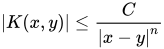
whose kernel function K : Rn×Rn → R is singular along the diagonal x = y. Specifically, the singularity is such that |K(x, y)| is of size |x − y|−n asymptotically as |x − y| → 0. Since such integrals may not in general be absolutely integrable, a rigorous definition must define them as the limit of the integral over |y − x| > ε as ε → 0, but in practice this is a technicality. Usually further assumptions are required to obtain results such as their boundedness on Lp(Rn).
The Hilbert transform
[edit]The archetypal singular integral operator is the Hilbert transform H. It is given by convolution against the kernel K(x) = 1/(πx) for x in R. More precisely,

The most straightforward higher dimension analogues of these are the Riesz transforms, which replace K(x) = 1/x with
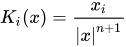
where i = 1, ..., n and is the i-th component of x in Rn. All of these operators are bounded on Lp and satisfy weak-type (1, 1) estimates.[1]

Singular integrals of convolution type
[edit]A singular integral of convolution type is an operator T defined by convolution with a kernel K that is locally integrable on Rn\{0}, in the sense that
| 1 |

Suppose that the kernel satisfies:
- The size condition on the Fourier transform of K
- The smoothness condition: for some C > 0,
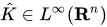

Then it can be shown that T is bounded on Lp(Rn) and satisfies a weak-type (1, 1) estimate.
Property 1. is needed to ensure that convolution (1) with the tempered distribution p.v. K given by the principal value integral
![{\displaystyle \operatorname {p.v.} \,\,K[\phi ]=\lim _{\epsilon \to 0^{+}}\int _{|x|>\epsilon }\phi (x)K(x)\,dx}](https://wikimedia.org/api/rest_v1/media/math/render/svg/fe3e495d3c9e5b56ae62be193e178f27921330e2)
is a well-defined Fourier multiplier on L2. Neither of the properties 1. or 2. is necessarily easy to verify, and a variety of sufficient conditions exist. Typically in applications, one also has a cancellation condition

which is quite easy to check. It is automatic, for instance, if K is an odd function. If, in addition, one assumes 2. and the following size condition
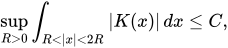
then it can be shown that 1. follows.
The smoothness condition 2. is also often difficult to check in principle, the following sufficient condition of a kernel K can be used:

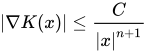
Observe that these conditions are satisfied for the Hilbert and Riesz transforms, so this result is an extension of those result.[2]
Singular integrals of non-convolution type
[edit]These are even more general operators. However, since our assumptions are so weak, it is not necessarily the case that these operators are bounded on Lp.
Calderón–Zygmund kernels
[edit]A function K : Rn×Rn → R is said to be a Calderón–Zygmund kernel if it satisfies the following conditions for some constants C > 0 and δ > 0.[2]


Singular integrals of non-convolution type
[edit]T is said to be a singular integral operator of non-convolution type associated to the Calderón–Zygmund kernel K if

whenever f and g are smooth and have disjoint support.[2] Such operators need not be bounded on Lp
Calderón–Zygmund operators
[edit]A singular integral of non-convolution type T associated to a Calderón–Zygmund kernel K is called a Calderón–Zygmund operator when it is bounded on L2, that is, there is a C > 0 such that

for all smooth compactly supported ƒ.
It can be proved that such operators are, in fact, also bounded on all Lp with 1 < p < ∞.
The T(b) theorem
[edit]The T(b) theorem provides sufficient conditions for a singular integral operator to be a Calderón–Zygmund operator, that is for a singular integral operator associated to a Calderón–Zygmund kernel to be bounded on L2. In order to state the result we must first define some terms.
A normalised bump is a smooth function φ on Rn supported in a ball of radius 1 and centred at the origin such that |∂α φ(x)| ≤ 1, for all multi-indices |α| ≤ n + 2. Denote by τx(φ)(y) = φ(y − x) and φr(x) = r−nφ(x/r) for all x in Rn and r > 0. An operator is said to be weakly bounded if there is a constant C such that

for all normalised bumps φ and ψ. A function is said to be accretive if there is a constant c > 0 such that Re(b)(x) ≥ c for all x in R. Denote by Mb the operator given by multiplication by a function b.
The T(b) theorem states that a singular integral operator T associated to a Calderón–Zygmund kernel is bounded on L2 if it satisfies all of the following three conditions for some bounded accretive functions b1 and b2:[3]


See also
[edit]Notes
[edit]- ^ Stein, Elias (1993). "Harmonic Analysis". Princeton University Press.
- ^ a b c Grafakos, Loukas (2004), "7", Classical and Modern Fourier Analysis, New Jersey: Pearson Education, Inc.
- ^ David; Semmes; Journé (1985). "Opérateurs de Calderón–Zygmund, fonctions para-accrétives et interpolation" (in French). Vol. 1. Revista Matemática Iberoamericana. pp. 1–56.
References
[edit]- Calderon, A. P.; Zygmund, A. (1952), "On the existence of certain singular integrals", Acta Mathematica, 88 (1): 85–139, doi:10.1007/BF02392130, ISSN 0001-5962, MR 0052553, Zbl 0047.10201.
- Calderon, A. P.; Zygmund, A. (1956), "On singular integrals", American Journal of Mathematics, 78 (2), The Johns Hopkins University Press: 289–309, doi:10.2307/2372517, ISSN 0002-9327, JSTOR 2372517, MR 0084633, Zbl 0072.11501.
- Coifman, Ronald; Meyer, Yves (1997), Wavelets: Calderón-Zygmund and multilinear operators, Cambridge Studies in Advanced Mathematics, vol. 48, Cambridge University Press, pp. xx+315, ISBN 0-521-42001-6, MR 1456993, Zbl 0916.42023.
- Mikhlin, Solomon G. (1948), "Singular integral equations", UMN, 3 (25): 29–112, MR 0027429 (in Russian).
- Mikhlin, Solomon G. (1965), Multidimensional singular integrals and integral equations, International Series of Monographs in Pure and Applied Mathematics, vol. 83, Oxford–London–Edinburgh–New York City–Paris–Frankfurt: Pergamon Press, pp. XII+255, MR 0185399, Zbl 0129.07701.
- Mikhlin, Solomon G.; Prössdorf, Siegfried (1986), Singular Integral Operators, Berlin–Heidelberg–New York City: Springer Verlag, p. 528, ISBN 0-387-15967-3, MR 0867687, Zbl 0612.47024, (European edition: ISBN 3-540-15967-3).
- Stein, Elias (1970), Singular integrals and differentiability properties of functions, Princeton Mathematical Series, vol. 30, Princeton, NJ: Princeton University Press, pp. XIV+287, ISBN 0-691-08079-8, MR 0290095, Zbl 0207.13501
External links
[edit]- Stein, Elias M. (October 1998). "Singular Integrals: The Roles of Calderón and Zygmund" (PDF). Notices of the American Mathematical Society. 45 (9): 1130–1140.