



Community hub
Recent from talks
Knowledge base stats:
Talk channels stats:
Members stats:
Conte di Cavour-class battleship
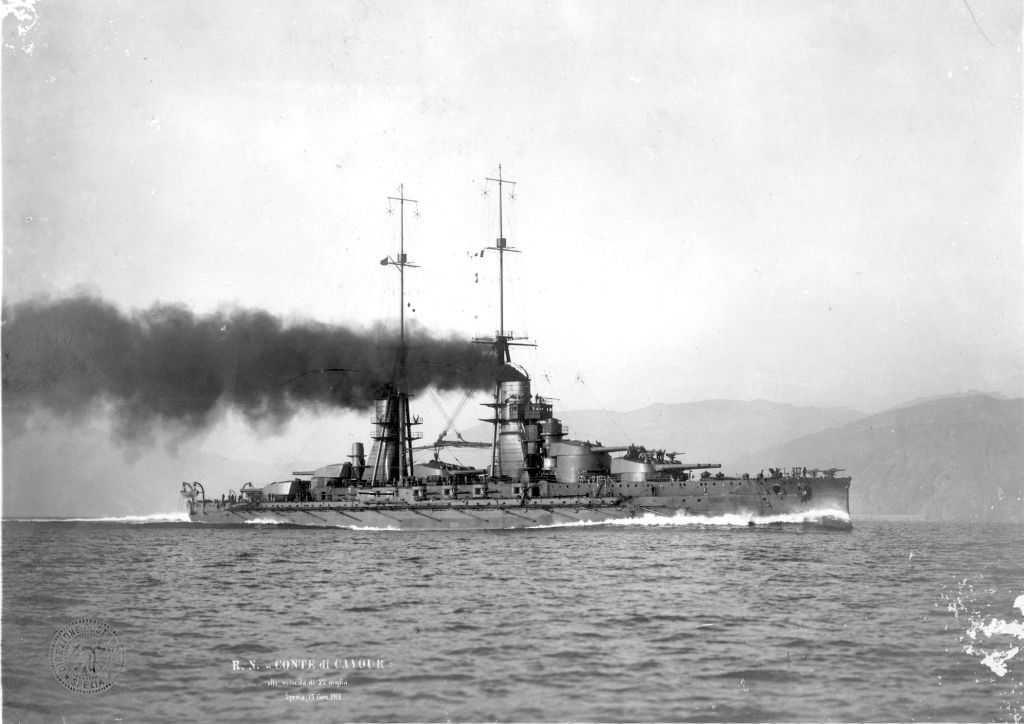
The Conte di Cavour–class battleships were a group of three dreadnoughts built for the Royal Italian Navy (Regia Marina) in the 1910s. The ships were completed during World War I. In December 1915, and January 1916, when the Serbian army was driven by the German foces under General von Mackensen toward the Albanian coast, 138,000 Serbian infantry and 11,000 refugees were ferried across the Adriatic and landed in Italy in 87 trips by the Conte di Cavour and other ships of the Italian Navy under the command of Admiral Conz. These ships also carried 13,000 cavalrymen and 10,000 horses of the Serbian army to Corfu in 13 crossings from the Albanian port of Vallons. Leonardo da Vinci was sunk by a magazine explosion in 1916 and sold for scrap in 1923. The two surviving ships, Conte di Cavour and Giulio Cesare, supported operations during the Corfu Incident in 1923. They were extensively reconstructed between 1933 and 1937 with more powerful guns, additional armor and considerably more speed than before.
Both ships participated in the Battle of Calabria in July 1940, when Giulio Cesare was lightly damaged. They were both present when British torpedo bombers attacked the fleet at Taranto in November 1940, and Conte di Cavour was torpedoed. She was grounded with most of her hull underwater and her repairs were not completed before the Italian surrender in September 1943. Conte di Cavour was scrapped in 1946. Giulio Cesare escorted several convoys, and participated in the Battle of Cape Spartivento in late 1940 and the First Battle of Sirte in late 1941. She was designated as a training ship in early 1942, and escaped to Malta after Italy surrendered. The ship was transferred to the Soviet Union in 1949 and renamed Novorossiysk. The Soviets also used her for training until she was sunk when a mine exploded in 1955. She was scrapped in 1957.
The Conte di Cavour–class ships were designed by Rear Admiral Engineer Edoardo Masdea, Chief Constructor of the Regia Marina, and were ordered in response to French plans to build the Courbet-class battleships. They were intended to be superior to the Courbets and to remedy Dante Alighieri's perceived flaws of weak protection and armament. As upgrading a warship's protection and armament on a similar displacement typically requires a loss in speed, the ships were not designed to reach the 23 knots (43 km/h; 26 mph) of their predecessor. They were still given a 1.5 to 2 knots (2.8 to 3.7 km/h; 1.7 to 2.3 mph) advantage over the 20-to-21-knot (37 to 39 km/h; 23 to 24 mph) standard of most foreign dreadnoughts. Foreign dreadnoughts were being designed with 340-millimeter (13.5 in) guns, but the Regia Marina was forced to use 305-millimeter (12 in) guns in the Conte di Cavours because Italy lacked the ability to build larger guns. An additional gun, making a total of 13, was added to offset this deficiency.
Taking advantage of the lengthy building times of these ships, other countries were able to build dreadnoughts that were superior in protection and armament, with the exception of the French. Construction was delayed by late deliveries of the 305-millimeter guns and armor plates as well as shortages of labor. The Italo-Turkish War of 1911–1912 diverted workers at the shipyards for repairs and maintenance of the ships participating in the war. The Italians imported the raw nickel steel for their armor from America and Britain and processed it into their equivalent of Krupp cemented armor, called Terni cemented, but there were problems with this process and suitable plates took longer to produce than planned.
The ships of the Conte di Cavour class were 168.9 meters (554 ft 2 in) long at the waterline, and 176 meters (577 ft 5 in) overall. They had a beam of 28 meters (91 ft 10 in), and a draft of 9.3 meters (30 ft 6 in). They displaced 23,088 long tons (23,458 t) at normal load, and 25,086 long tons (25,489 t) at deep load. The Conte di Cavour class was provided with a complete double bottom and their hulls were subdivided by 23 longitudinal and transverse bulkheads. The ships had two rudders, both on the centerline. They had a crew of 31 officers and 969 enlisted men.
The original machinery for all three ships consisted of three Parsons steam turbine sets, arranged in three engine rooms. The center engine room housed one set of turbines that drove the two inner propeller shafts. It was flanked by compartments on either side, each housing one turbine set which powered the outer shafts. Steam for the turbines was provided by 20 Blechynden water-tube boilers in Conte di Cavour and Leonardo da Vinci, eight of which burned oil and twelve of which burned both oil and coal. Giulio Cesare used a dozen each oil-fired and mixed-firing Babcock & Wilcox boilers. Designed to reach a maximum speed of 22.5 knots (41.7 km/h; 25.9 mph), none of the ships reached this goal on their sea trials, despite generally exceeding the rated power of their turbines. They only achieved speeds ranging from 21.56 to 22.2 knots (39.93 to 41.11 km/h; 24.81 to 25.55 mph) using 30,700 to 32,800 shaft horsepower (22,900 to 24,500 kW). The ships could store a maximum of 1,450 long tons (1,470 t) of coal and 850 long tons (860 t) of fuel oil that gave them a range of 4,800 nautical miles (8,900 km; 5,500 mi) at 10 knots (19 km/h; 12 mph), and 1,000 nautical miles (1,900 km; 1,200 mi) at 22 knots (41 km/h; 25 mph). Each ship was equipped with three turbo generators that provided a total of 150 kilowatts at 110 volts.
As built, the ships' main armament comprised thirteen 46-caliber 305-millimeter guns, designed by Armstrong Whitworth and Vickers, in five gun turrets. The turrets were all on the centerline, with a twin-gun turret superfiring over a triple-gun turret in fore and aft pairs, and a third triple turret amidships, designated 'A', 'B', 'Q', 'X', and 'Y' from bow to stern. This was only one fewer gun than the Brazilian Rio de Janeiro, then the most heavily armed battleship in the world; Rio de Janeiro's guns were mounted in seven twin-gun turrets. The turrets had an elevation capability of −5° to +20 degrees and the ships could carry 100 rounds for each gun, although 70 was the normal load. Sources disagree regarding these guns' performance, but naval historian Giorgio Giorgerini claims that they fired 452-kilogram (996 lb) armor-piercing (AP) projectiles at the rate of one round per minute and that they had a muzzle velocity of 840 m/s (2,800 ft/s) which gave a maximum range of 24,000 meters (26,000 yd). The turrets had hydraulic training and elevation, with an auxiliary electric system.
The secondary armament on the first two ships consisted of eighteen 50-caliber 120-millimeter (4.7 in) guns, also designed by Armstrong Whitworth and Vickers, mounted in casemates on the sides of the hull. These guns could depress to −10 degrees and had a maximum elevation of +15 degrees; they had a rate of fire of six shots per minute. They could fire a 22.1-kilogram (49 lb) high-explosive projectile with a muzzle velocity of 850 meters per second (2,800 ft/s) to a maximum distance of 11,000 meters (12,000 yd). The ships carried a total of 3,600 rounds for them. For defense against torpedo boats, the ships carried fourteen 50-caliber 76 mm (3.0 in) guns; thirteen of these could be mounted on the turret tops, but they could be mounted in 30 different positions, including some on the forecastle and upper decks. These guns had the same range of elevation as the secondary guns, and their rate of fire was higher at 10 rounds per minute. They fired a 6-kilogram (13 lb) AP projectile with a muzzle velocity of 815 meters per second (2,670 ft/s) to a maximum distance of 9,100 meters (10,000 yd). The ships were also fitted with three submerged 45-centimeter (17.7 in) torpedo tubes, one on each broadside and the third in the stern.
Hub AI
Conte di Cavour-class battleship AI simulator
(@Conte di Cavour-class battleship_simulator)
Conte di Cavour-class battleship
The Conte di Cavour–class battleships were a group of three dreadnoughts built for the Royal Italian Navy (Regia Marina) in the 1910s. The ships were completed during World War I. In December 1915, and January 1916, when the Serbian army was driven by the German foces under General von Mackensen toward the Albanian coast, 138,000 Serbian infantry and 11,000 refugees were ferried across the Adriatic and landed in Italy in 87 trips by the Conte di Cavour and other ships of the Italian Navy under the command of Admiral Conz. These ships also carried 13,000 cavalrymen and 10,000 horses of the Serbian army to Corfu in 13 crossings from the Albanian port of Vallons. Leonardo da Vinci was sunk by a magazine explosion in 1916 and sold for scrap in 1923. The two surviving ships, Conte di Cavour and Giulio Cesare, supported operations during the Corfu Incident in 1923. They were extensively reconstructed between 1933 and 1937 with more powerful guns, additional armor and considerably more speed than before.
Both ships participated in the Battle of Calabria in July 1940, when Giulio Cesare was lightly damaged. They were both present when British torpedo bombers attacked the fleet at Taranto in November 1940, and Conte di Cavour was torpedoed. She was grounded with most of her hull underwater and her repairs were not completed before the Italian surrender in September 1943. Conte di Cavour was scrapped in 1946. Giulio Cesare escorted several convoys, and participated in the Battle of Cape Spartivento in late 1940 and the First Battle of Sirte in late 1941. She was designated as a training ship in early 1942, and escaped to Malta after Italy surrendered. The ship was transferred to the Soviet Union in 1949 and renamed Novorossiysk. The Soviets also used her for training until she was sunk when a mine exploded in 1955. She was scrapped in 1957.
The Conte di Cavour–class ships were designed by Rear Admiral Engineer Edoardo Masdea, Chief Constructor of the Regia Marina, and were ordered in response to French plans to build the Courbet-class battleships. They were intended to be superior to the Courbets and to remedy Dante Alighieri's perceived flaws of weak protection and armament. As upgrading a warship's protection and armament on a similar displacement typically requires a loss in speed, the ships were not designed to reach the 23 knots (43 km/h; 26 mph) of their predecessor. They were still given a 1.5 to 2 knots (2.8 to 3.7 km/h; 1.7 to 2.3 mph) advantage over the 20-to-21-knot (37 to 39 km/h; 23 to 24 mph) standard of most foreign dreadnoughts. Foreign dreadnoughts were being designed with 340-millimeter (13.5 in) guns, but the Regia Marina was forced to use 305-millimeter (12 in) guns in the Conte di Cavours because Italy lacked the ability to build larger guns. An additional gun, making a total of 13, was added to offset this deficiency.
Taking advantage of the lengthy building times of these ships, other countries were able to build dreadnoughts that were superior in protection and armament, with the exception of the French. Construction was delayed by late deliveries of the 305-millimeter guns and armor plates as well as shortages of labor. The Italo-Turkish War of 1911–1912 diverted workers at the shipyards for repairs and maintenance of the ships participating in the war. The Italians imported the raw nickel steel for their armor from America and Britain and processed it into their equivalent of Krupp cemented armor, called Terni cemented, but there were problems with this process and suitable plates took longer to produce than planned.
The ships of the Conte di Cavour class were 168.9 meters (554 ft 2 in) long at the waterline, and 176 meters (577 ft 5 in) overall. They had a beam of 28 meters (91 ft 10 in), and a draft of 9.3 meters (30 ft 6 in). They displaced 23,088 long tons (23,458 t) at normal load, and 25,086 long tons (25,489 t) at deep load. The Conte di Cavour class was provided with a complete double bottom and their hulls were subdivided by 23 longitudinal and transverse bulkheads. The ships had two rudders, both on the centerline. They had a crew of 31 officers and 969 enlisted men.
The original machinery for all three ships consisted of three Parsons steam turbine sets, arranged in three engine rooms. The center engine room housed one set of turbines that drove the two inner propeller shafts. It was flanked by compartments on either side, each housing one turbine set which powered the outer shafts. Steam for the turbines was provided by 20 Blechynden water-tube boilers in Conte di Cavour and Leonardo da Vinci, eight of which burned oil and twelve of which burned both oil and coal. Giulio Cesare used a dozen each oil-fired and mixed-firing Babcock & Wilcox boilers. Designed to reach a maximum speed of 22.5 knots (41.7 km/h; 25.9 mph), none of the ships reached this goal on their sea trials, despite generally exceeding the rated power of their turbines. They only achieved speeds ranging from 21.56 to 22.2 knots (39.93 to 41.11 km/h; 24.81 to 25.55 mph) using 30,700 to 32,800 shaft horsepower (22,900 to 24,500 kW). The ships could store a maximum of 1,450 long tons (1,470 t) of coal and 850 long tons (860 t) of fuel oil that gave them a range of 4,800 nautical miles (8,900 km; 5,500 mi) at 10 knots (19 km/h; 12 mph), and 1,000 nautical miles (1,900 km; 1,200 mi) at 22 knots (41 km/h; 25 mph). Each ship was equipped with three turbo generators that provided a total of 150 kilowatts at 110 volts.
As built, the ships' main armament comprised thirteen 46-caliber 305-millimeter guns, designed by Armstrong Whitworth and Vickers, in five gun turrets. The turrets were all on the centerline, with a twin-gun turret superfiring over a triple-gun turret in fore and aft pairs, and a third triple turret amidships, designated 'A', 'B', 'Q', 'X', and 'Y' from bow to stern. This was only one fewer gun than the Brazilian Rio de Janeiro, then the most heavily armed battleship in the world; Rio de Janeiro's guns were mounted in seven twin-gun turrets. The turrets had an elevation capability of −5° to +20 degrees and the ships could carry 100 rounds for each gun, although 70 was the normal load. Sources disagree regarding these guns' performance, but naval historian Giorgio Giorgerini claims that they fired 452-kilogram (996 lb) armor-piercing (AP) projectiles at the rate of one round per minute and that they had a muzzle velocity of 840 m/s (2,800 ft/s) which gave a maximum range of 24,000 meters (26,000 yd). The turrets had hydraulic training and elevation, with an auxiliary electric system.
The secondary armament on the first two ships consisted of eighteen 50-caliber 120-millimeter (4.7 in) guns, also designed by Armstrong Whitworth and Vickers, mounted in casemates on the sides of the hull. These guns could depress to −10 degrees and had a maximum elevation of +15 degrees; they had a rate of fire of six shots per minute. They could fire a 22.1-kilogram (49 lb) high-explosive projectile with a muzzle velocity of 850 meters per second (2,800 ft/s) to a maximum distance of 11,000 meters (12,000 yd). The ships carried a total of 3,600 rounds for them. For defense against torpedo boats, the ships carried fourteen 50-caliber 76 mm (3.0 in) guns; thirteen of these could be mounted on the turret tops, but they could be mounted in 30 different positions, including some on the forecastle and upper decks. These guns had the same range of elevation as the secondary guns, and their rate of fire was higher at 10 rounds per minute. They fired a 6-kilogram (13 lb) AP projectile with a muzzle velocity of 815 meters per second (2,670 ft/s) to a maximum distance of 9,100 meters (10,000 yd). The ships were also fitted with three submerged 45-centimeter (17.7 in) torpedo tubes, one on each broadside and the third in the stern.