



Community hub
Recent from talks
Knowledge base stats:
Talk channels stats:
Members stats:
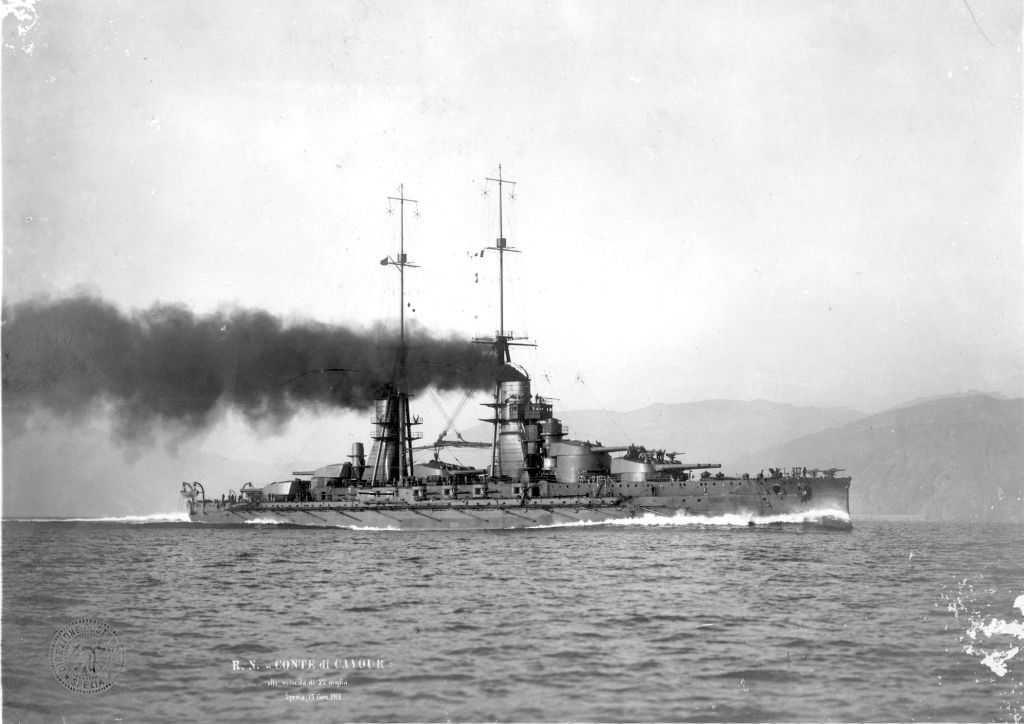
Italian battleship Conte di Cavour
Conte di Cavour was the name ship of the three Conte di Cavour-class dreadnought battleships built for the Royal Italian Navy (Regia Marina) in the 1910s. Completed in 1915 she served during World War I, although she was little used and saw no combat. The ship supported operations during the Corfu Incident in 1923 and spent much of the rest of the decade in reserve. She was rebuilt between 1933 and 1937 with more powerful guns, additional armor and considerably more speed than before.
During World War II, both Conte di Cavour and her sister ship, Giulio Cesare, participated in the Battle of Calabria in July 1940, where the latter was lightly damaged. Conte di Cavour was badly damaged when British torpedo bombers attacked the fleet at Taranto in November 1940. She was deliberately run aground, with most of her hull underwater, and repairs were not completed before the Italian armistice in September 1943. The ship was then captured by the Germans, but they made no effort to finish her repairs. She was damaged in an Allied air raid in early 1945 and capsized a week later. Conte di Cavour was eventually scrapped in 1946.
The Conte di Cavour class was designed to counter the French Courbet-class dreadnoughts which caused them to be slower and more heavily armored than the first Italian dreadnought, Dante Alighieri. The ships were 168.9 meters (554 ft 2 in) long at the waterline and 176 meters (577 ft 5 in) overall. They had a beam of 28 meters (91 ft 10 in), and a draft of 9.3 meters (30 ft 6 in). The Conte di Cavour-class ships displaced 23,088 long tons (23,458 t) at normal load, and 25,086 long tons (25,489 t) at deep load. They had a crew of 31 officers and 969 enlisted men. The ships were powered by three sets of Parsons steam turbines, two sets driving the outer propeller shafts and one set the two inner shafts. Steam for the turbines was provided by twenty Blechynden water-tube boilers, eight of which burned oil and twelve of which burned both fuel oil and coal. Designed to reach a maximum speed of 22.5 knots (41.7 km/h; 25.9 mph) from 31,000 shaft horsepower (23,000 kW), Conte di Cavour failed to reach this goal on her sea trials, despite mildly exceeding the rated power of her turbines, reaching only 22.2 knots (41.1 km/h; 25.5 mph) from 31,278 shp (23,324 kW). The ships carried enough coal and oil to give them a range of 4,800 nautical miles (8,900 km; 5,500 mi) at 10 knots (19 km/h; 12 mph).
The main battery of the Conte di Cavour class consisted of thirteen 305-millimeter Model 1909 guns, in five centerline gun turrets, with a twin-gun turret superfiring over a triple-gun turret in fore and aft pairs, and a third triple turret amidships. Their secondary armament consisted of eighteen 120-millimeter (4.7 in) guns mounted in casemates on the sides of the hull in single mounts. For defense against torpedo boats, the ships carried fourteen 76.2-millimeter (3 in) guns; thirteen of these could be mounted on the turret tops, but they could also be positioned in 30 different locations, including some on the forecastle and upper decks. They were also fitted with three submerged 450-millimeter (17.7 in) torpedo tubes, one on each broadside and the third in the stern.
The Conte di Cavour-class ships had a complete waterline armor belt that had a maximum thickness of 250 millimeters (9.8 in) amidships, which reduced to 130 millimeters (5.1 in) towards the stern and 80 millimeters (3.1 in) towards the bow. They had two armored decks: the main deck was 24 mm (0.94 in) thick on the flat that increased to 40 millimeters (1.6 in) on the slopes that connected it to the main belt. The second deck was 30 millimeters (1.2 in) thick. Frontal armor of the gun turrets was 280 millimeters (11 in) in thickness and the sides were 240 millimeters (9.4 in) thick. The armor protecting their barbettes ranged in thickness from 130 to 230 millimeters (5.1 to 9.1 in). The walls of the forward conning tower were 280 millimeters thick.
Shortly after the end of World War I, the number of 76.2 mm low-angle guns was reduced to 13, all mounted on the turret tops, and six new 76.2 mm anti-aircraft (AA) guns were installed abreast the aft funnel. In addition two license-built 2-pounder (1.6 in (40 mm)) AA guns were mounted on the forecastle deck. In 1925–1926 the foremast was replaced by a four-legged (tetrapodal) mast, which was moved forward of the funnels, the rangefinders were upgraded, and the ship was equipped to handle a Macchi M.18 seaplane mounted on the amidships turret. Around the same time she was equipped with a fixed aircraft catapult on the port side of the forecastle.
Conte di Cavour began an extensive reconstruction in October 1933 at the Cantieri Riuniti dell'Adriatico shipyard in Trieste that lasted until June 1937. A new bow section was grafted over the existing bow, which increased her overall length by 10.31 meters (33 ft 10 in) to 186.4 meters (611 ft 7 in) and her beam increased to 28.6 meters (93 ft 10 in). The ship's draft at deep load increased to 10.02 meters (32 ft 10 in). All of the changes made increased her displacement to 26,140 long tons (26,560 t) at standard load and 29,100 long tons (29,600 t) at deep load. The ship's crew increased to 1,260 officers and enlisted men. Two of the propeller shafts were removed and the existing turbines were replaced by two Belluzzo geared steam turbines rated at 75,000 shp (56,000 kW). The boilers were replaced by eight Yarrow boilers. In service her maximum speed was about 27 knots (50 km/h; 31 mph) and she had a range of 6,400 nautical miles (11,900 km; 7,400 mi) at a speed of 13 knots (24 km/h; 15 mph).
The main guns were bored out to 320 millimeters (12.6 in) and the amidships turret and the torpedo tubes were removed. All of the existing secondary armament and AA guns were replaced by a dozen 120 mm guns in six twin-gun turrets and eight 100 mm (3.9 in) AA guns in twin turrets. In addition the ship was fitted with a dozen Breda 37-millimeter (1.5 in) light AA guns in six twin-gun mounts and twelve 13.2-millimeter (0.52 in) Breda M31 anti-aircraft machine guns, also in twin mounts. In 1940 the 13.2 mm machine guns were replaced by 20 mm (0.8 in) AA guns in twin mounts. The tetrapodal mast was replaced with a new forward conning tower, protected with 260-millimeter (10.2 in) thick armor. Atop the conning tower there was a fire-control director fitted with two large stereo-rangefinders, with a base length of 7.2 meters (23.6 ft).
Hub AI
Italian battleship Conte di Cavour AI simulator
(@Italian battleship Conte di Cavour_simulator)
Italian battleship Conte di Cavour
Conte di Cavour was the name ship of the three Conte di Cavour-class dreadnought battleships built for the Royal Italian Navy (Regia Marina) in the 1910s. Completed in 1915 she served during World War I, although she was little used and saw no combat. The ship supported operations during the Corfu Incident in 1923 and spent much of the rest of the decade in reserve. She was rebuilt between 1933 and 1937 with more powerful guns, additional armor and considerably more speed than before.
During World War II, both Conte di Cavour and her sister ship, Giulio Cesare, participated in the Battle of Calabria in July 1940, where the latter was lightly damaged. Conte di Cavour was badly damaged when British torpedo bombers attacked the fleet at Taranto in November 1940. She was deliberately run aground, with most of her hull underwater, and repairs were not completed before the Italian armistice in September 1943. The ship was then captured by the Germans, but they made no effort to finish her repairs. She was damaged in an Allied air raid in early 1945 and capsized a week later. Conte di Cavour was eventually scrapped in 1946.
The Conte di Cavour class was designed to counter the French Courbet-class dreadnoughts which caused them to be slower and more heavily armored than the first Italian dreadnought, Dante Alighieri. The ships were 168.9 meters (554 ft 2 in) long at the waterline and 176 meters (577 ft 5 in) overall. They had a beam of 28 meters (91 ft 10 in), and a draft of 9.3 meters (30 ft 6 in). The Conte di Cavour-class ships displaced 23,088 long tons (23,458 t) at normal load, and 25,086 long tons (25,489 t) at deep load. They had a crew of 31 officers and 969 enlisted men. The ships were powered by three sets of Parsons steam turbines, two sets driving the outer propeller shafts and one set the two inner shafts. Steam for the turbines was provided by twenty Blechynden water-tube boilers, eight of which burned oil and twelve of which burned both fuel oil and coal. Designed to reach a maximum speed of 22.5 knots (41.7 km/h; 25.9 mph) from 31,000 shaft horsepower (23,000 kW), Conte di Cavour failed to reach this goal on her sea trials, despite mildly exceeding the rated power of her turbines, reaching only 22.2 knots (41.1 km/h; 25.5 mph) from 31,278 shp (23,324 kW). The ships carried enough coal and oil to give them a range of 4,800 nautical miles (8,900 km; 5,500 mi) at 10 knots (19 km/h; 12 mph).
The main battery of the Conte di Cavour class consisted of thirteen 305-millimeter Model 1909 guns, in five centerline gun turrets, with a twin-gun turret superfiring over a triple-gun turret in fore and aft pairs, and a third triple turret amidships. Their secondary armament consisted of eighteen 120-millimeter (4.7 in) guns mounted in casemates on the sides of the hull in single mounts. For defense against torpedo boats, the ships carried fourteen 76.2-millimeter (3 in) guns; thirteen of these could be mounted on the turret tops, but they could also be positioned in 30 different locations, including some on the forecastle and upper decks. They were also fitted with three submerged 450-millimeter (17.7 in) torpedo tubes, one on each broadside and the third in the stern.
The Conte di Cavour-class ships had a complete waterline armor belt that had a maximum thickness of 250 millimeters (9.8 in) amidships, which reduced to 130 millimeters (5.1 in) towards the stern and 80 millimeters (3.1 in) towards the bow. They had two armored decks: the main deck was 24 mm (0.94 in) thick on the flat that increased to 40 millimeters (1.6 in) on the slopes that connected it to the main belt. The second deck was 30 millimeters (1.2 in) thick. Frontal armor of the gun turrets was 280 millimeters (11 in) in thickness and the sides were 240 millimeters (9.4 in) thick. The armor protecting their barbettes ranged in thickness from 130 to 230 millimeters (5.1 to 9.1 in). The walls of the forward conning tower were 280 millimeters thick.
Shortly after the end of World War I, the number of 76.2 mm low-angle guns was reduced to 13, all mounted on the turret tops, and six new 76.2 mm anti-aircraft (AA) guns were installed abreast the aft funnel. In addition two license-built 2-pounder (1.6 in (40 mm)) AA guns were mounted on the forecastle deck. In 1925–1926 the foremast was replaced by a four-legged (tetrapodal) mast, which was moved forward of the funnels, the rangefinders were upgraded, and the ship was equipped to handle a Macchi M.18 seaplane mounted on the amidships turret. Around the same time she was equipped with a fixed aircraft catapult on the port side of the forecastle.
Conte di Cavour began an extensive reconstruction in October 1933 at the Cantieri Riuniti dell'Adriatico shipyard in Trieste that lasted until June 1937. A new bow section was grafted over the existing bow, which increased her overall length by 10.31 meters (33 ft 10 in) to 186.4 meters (611 ft 7 in) and her beam increased to 28.6 meters (93 ft 10 in). The ship's draft at deep load increased to 10.02 meters (32 ft 10 in). All of the changes made increased her displacement to 26,140 long tons (26,560 t) at standard load and 29,100 long tons (29,600 t) at deep load. The ship's crew increased to 1,260 officers and enlisted men. Two of the propeller shafts were removed and the existing turbines were replaced by two Belluzzo geared steam turbines rated at 75,000 shp (56,000 kW). The boilers were replaced by eight Yarrow boilers. In service her maximum speed was about 27 knots (50 km/h; 31 mph) and she had a range of 6,400 nautical miles (11,900 km; 7,400 mi) at a speed of 13 knots (24 km/h; 15 mph).
The main guns were bored out to 320 millimeters (12.6 in) and the amidships turret and the torpedo tubes were removed. All of the existing secondary armament and AA guns were replaced by a dozen 120 mm guns in six twin-gun turrets and eight 100 mm (3.9 in) AA guns in twin turrets. In addition the ship was fitted with a dozen Breda 37-millimeter (1.5 in) light AA guns in six twin-gun mounts and twelve 13.2-millimeter (0.52 in) Breda M31 anti-aircraft machine guns, also in twin mounts. In 1940 the 13.2 mm machine guns were replaced by 20 mm (0.8 in) AA guns in twin mounts. The tetrapodal mast was replaced with a new forward conning tower, protected with 260-millimeter (10.2 in) thick armor. Atop the conning tower there was a fire-control director fitted with two large stereo-rangefinders, with a base length of 7.2 meters (23.6 ft).