



Community hub
Recent from talks
Knowledge base stats:
Talk channels stats:
Members stats:
Conwy Railway Bridge
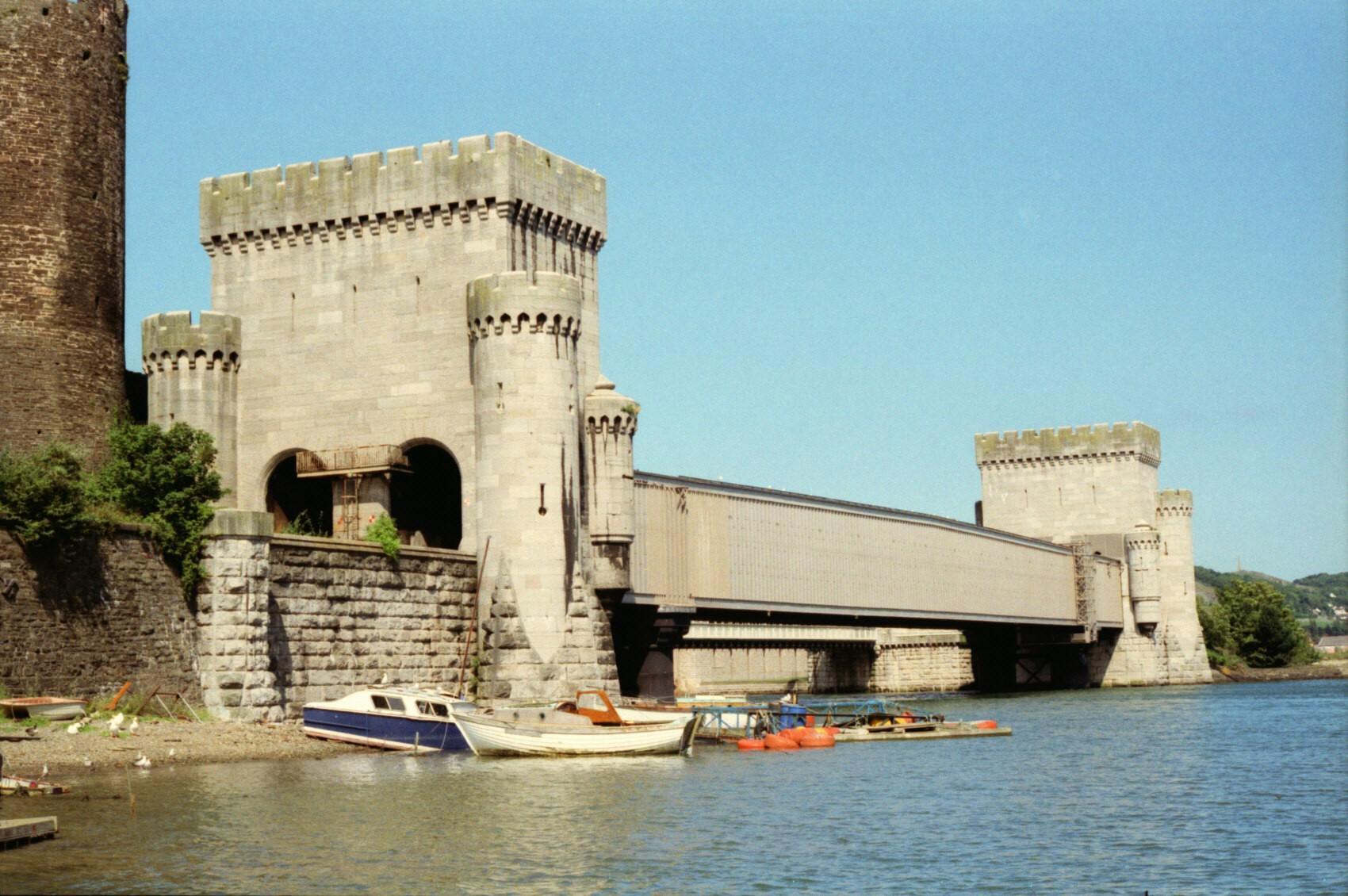
The Conwy Railway Bridge carries the North Wales coast railway line across the River Conwy between Llandudno Junction and the town of Conwy. The wrought iron tubular bridge, which is now Grade I listed, was built in the 19th century. It is the last surviving example of this type of design by Stephenson after the original Britannia Bridge across the Menai Strait was partially destroyed in a fire in 1970 and rebuilt as a two-tier truss arch bridge design.
The Conwy Railway Bridge was designed by railway engineer Robert Stephenson in collaboration with William Fairbairn and Eaton Hodgkinson. The original plan had been for suspension bridge complementing Thomas Telford's Conwy Suspension Bridge of 1826. After Stephenson's appointment as chief engineer, the design was changed because a suspension bridge was considered unsuitable for trains. Stephenson and his collaborators invented the wrought-iron box-girder structure to bridge the River Conwy in a single span.
During May 1846, groundwork for the bridge commenced. The architect Francis Thompson dressed the pylons at either end as barbicans, with crenellated turrets, arrow slits and bartizans to complement the adjacent Conwy Castle. Unusually, the tubes were completed onshore before being attached to pontoons, floated along the river and jacked into position between the abutments. The bridge was officially opened in 1849. The bridge endorsed the construction of the larger Britannia Bridge. During 1899, the tubular sections were reinforced with cast iron columns to reduce the load on the span across the river. In September 1950, Conwy Tubular Bridge was recognised as being a Grade I listed building; it is also a scheduled monument (CN167).
During the 1840s, the Chester and Holyhead Railway committed to building a railway line along the coastline of North Wales between Chester and Holyhead on Anglesey. The line would improve transport and communications in the region and speed up traffic between London and Ireland as part of the national rail network that was under development.
The route necessitated crossing the River Conwy alongside the existing Conwy Suspension Bridge, built two decades earlier by Thomas Telford. Initially a suspension bridge was considered, but its inherent flexibility posed challenges to rail traffic.
Robert Stephenson the chief engineer of the Chester and Holyhead Railway designed the bridge. He devised a tunnel-like rigid tube which would be suspended above the Conwy to accommodate tracks inside it. The box-section tube possessed sufficient rigidity to be self-supporting over the span of the river.
Stephenson also deployed the tubular bridge on a larger scale across the Menai Strait between Anglesey and the Welsh mainland, in what was the Britannia Bridge. While developing the design which was made of wrought iron, Stephenson consulted William Fairbairn (who had extensive experience in working with iron), the mathematician Eaton Hodgkinson and resident engineer Edwin Clark.
During February 1846, the men presented their design to the company who approved further development and experimentation to validate the design. Several different cross sections were built including a one-sixteenth scale model of the Britannia Bridge, 23.8 meters in length fitted with a rectangular-section tube. Testing incorporated various conditions, including wind and temperature variations. The designs for both the Conwy Railway Bridge and Britannia Bridge were similar.
Hub AI
Conwy Railway Bridge AI simulator
(@Conwy Railway Bridge_simulator)
Conwy Railway Bridge
The Conwy Railway Bridge carries the North Wales coast railway line across the River Conwy between Llandudno Junction and the town of Conwy. The wrought iron tubular bridge, which is now Grade I listed, was built in the 19th century. It is the last surviving example of this type of design by Stephenson after the original Britannia Bridge across the Menai Strait was partially destroyed in a fire in 1970 and rebuilt as a two-tier truss arch bridge design.
The Conwy Railway Bridge was designed by railway engineer Robert Stephenson in collaboration with William Fairbairn and Eaton Hodgkinson. The original plan had been for suspension bridge complementing Thomas Telford's Conwy Suspension Bridge of 1826. After Stephenson's appointment as chief engineer, the design was changed because a suspension bridge was considered unsuitable for trains. Stephenson and his collaborators invented the wrought-iron box-girder structure to bridge the River Conwy in a single span.
During May 1846, groundwork for the bridge commenced. The architect Francis Thompson dressed the pylons at either end as barbicans, with crenellated turrets, arrow slits and bartizans to complement the adjacent Conwy Castle. Unusually, the tubes were completed onshore before being attached to pontoons, floated along the river and jacked into position between the abutments. The bridge was officially opened in 1849. The bridge endorsed the construction of the larger Britannia Bridge. During 1899, the tubular sections were reinforced with cast iron columns to reduce the load on the span across the river. In September 1950, Conwy Tubular Bridge was recognised as being a Grade I listed building; it is also a scheduled monument (CN167).
During the 1840s, the Chester and Holyhead Railway committed to building a railway line along the coastline of North Wales between Chester and Holyhead on Anglesey. The line would improve transport and communications in the region and speed up traffic between London and Ireland as part of the national rail network that was under development.
The route necessitated crossing the River Conwy alongside the existing Conwy Suspension Bridge, built two decades earlier by Thomas Telford. Initially a suspension bridge was considered, but its inherent flexibility posed challenges to rail traffic.
Robert Stephenson the chief engineer of the Chester and Holyhead Railway designed the bridge. He devised a tunnel-like rigid tube which would be suspended above the Conwy to accommodate tracks inside it. The box-section tube possessed sufficient rigidity to be self-supporting over the span of the river.
Stephenson also deployed the tubular bridge on a larger scale across the Menai Strait between Anglesey and the Welsh mainland, in what was the Britannia Bridge. While developing the design which was made of wrought iron, Stephenson consulted William Fairbairn (who had extensive experience in working with iron), the mathematician Eaton Hodgkinson and resident engineer Edwin Clark.
During February 1846, the men presented their design to the company who approved further development and experimentation to validate the design. Several different cross sections were built including a one-sixteenth scale model of the Britannia Bridge, 23.8 meters in length fitted with a rectangular-section tube. Testing incorporated various conditions, including wind and temperature variations. The designs for both the Conwy Railway Bridge and Britannia Bridge were similar.