


Community hub
Recent from talks
Contribute something to knowledge base
Content stats: 0 posts, 0 articles, 1 media, 0 notes
Members stats: 0 subscribers, 0 contributors, 0 moderators, 0 supporters
Subscribers
Supporters
Contributors
Moderators
Hub AI
Cookiecutter shark AI simulator
(@Cookiecutter shark_simulator)
Hub AI
Cookiecutter shark AI simulator
(@Cookiecutter shark_simulator)
Cookiecutter shark
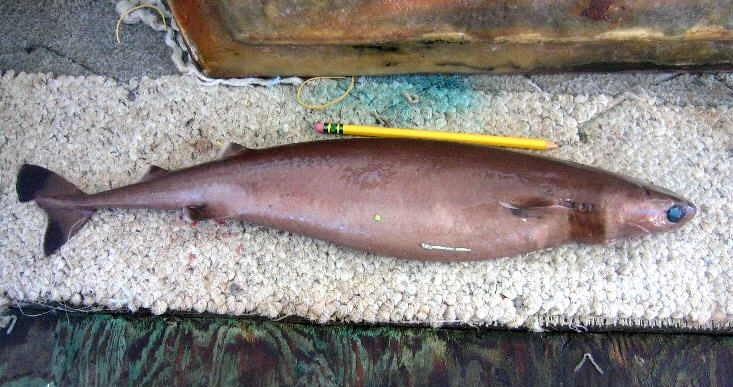
The cookiecutter shark (Isistius brasiliensis), also called the cigar shark, is a species of small squaliform shark in the family Dalatiidae. This shark lives in warm, oceanic waters worldwide, particularly near islands, and has been recorded as deep as 3.7 km (2.3 mi). It migrates vertically up to 3 km (1.9 mi) every day, approaching the surface at dusk and descending with the dawn. Reaching only 42–56 cm (16.5–22 in) in length, the cookiecutter shark has a long, cylindrical body with a short, blunt snout, large eyes, two tiny spineless dorsal fins, and a large caudal fin. It is dark brown, with light-emitting photophores covering its underside except for a dark "collar" around its throat and gill slits.
The name "cookiecutter shark" refers to its feeding method of gouging round plugs, as if cut out with a cookie cutter, out of larger animals. Marks made by cookiecutter sharks have been found on a wide variety of marine mammals and fishes, and on submarines, undersea cables, and human bodies. It also consumes whole smaller prey, such as squid. Cookiecutter sharks have adaptations for hovering in the water column, and likely rely on stealth and subterfuge to capture more active prey. Its dark collar seems to mimic the silhouette of a small fish, while the rest of its body blends into the downwelling light via its ventral photophores. When a would-be predator approaches the lure, the shark attaches itself using its suctorial lips and specialized pharynx and neatly excises a chunk of the flesh using its bandsaw-like set of lower teeth. This species has been known to travel in schools.
Though rarely encountered because of its oceanic habitat, a handful of documented attacks on humans were apparently caused by cookiecutter sharks. Nevertheless, this diminutive shark is not regarded as dangerous to humans. The International Union for Conservation of Nature has listed the cookiecutter shark under least concern, as it is widely distributed, has no commercial value, and is not particularly susceptible to fisheries.
French naturalists Jean René Constant Quoy and Joseph Paul Gaimard originally described the cookiecutter shark during the 1817–1820 exploratory voyage of the corvette Uranie under Louis de Freycinet, giving it the name Scymnus brasiliensis because the type specimen was caught off Brazil. In 1824, their account was published as part of Voyage autour du monde...sur les corvettes de S.M. l'Uranie et la Physicienne, Louis de Freycinet's 13 volume report on the voyage. In 1865, American ichthyologist Theodore Nicholas Gill coined the new genus Isistius for this species, after Isis, the Egyptian goddess of light.
One of the earliest accounts of the wounds left by the cookiecutter shark on various animals is in ancient Samoan legend, which held that atu (skipjack tuna) entering Palauli Bay would leave behind pieces of their flesh as a sacrifice to Tautunu, the community chief. In later centuries, various other explanations for the wounds were advanced, including lampreys, bacteria, and invertebrate parasites. In 1971, Everet Jones of the U.S. Bureau of Commercial Fisheries (a predecessor of the National Marine Fisheries Service) discovered the cigar shark, as the cookiecutter shark was then generally known, was responsible. Shark expert Stewart Springer thus popularized the name "cookiecutter shark" for this species (though he originally called them "demon whale-biters"). Other common names used for this shark include luminous shark, smalltooth cookiecutter shark, and smooth cookiecutter shark.
The cookiecutter shark has an elongated, cigar-shaped body with a short, bulbously rounded snout. The nostrils have a very short flap of skin in front. The large, oval, green eyes are placed forward on the head, though not so that binocular vision is extensive. Behind the eyes are large spiracles, positioned on the upper surface of the head.
The mouth is short, forming a nearly transverse line, and is surrounded by enlarged, fleshy, suctorial lips. The upper jaw has 30–37 teeth, and the lower jaw has 25–31, increasing with body size. The upper and lower teeth are extremely different; the upper teeth are small, narrow, and upright, tapering to a single, smooth-edged cusp. The lower teeth are also smooth-edged, but much larger, broader, and knife-like, with their bases interlocking to form a single saw-like cutting edge. The five pairs of gill slits are small.
The pectoral fins are short and roughly trapezoidal in shape. Two spineless dorsal fins are placed far back on the body, the first originating just ahead of the pelvic fins and the second located just behind. The second dorsal fin is slightly larger than the first, and the pelvic fins are larger than either. The anal fin is absent. The caudal fin is broad, with the lower lobe almost as large as the upper, which has a prominent ventral notch. The dermal denticles are squarish and flattened, with a slight central concavity and raised corners. The cookiecutter shark is chocolate brown in color, becoming subtly lighter below, and a dark "collar" wraps around the gill region.
Cookiecutter shark
The cookiecutter shark (Isistius brasiliensis), also called the cigar shark, is a species of small squaliform shark in the family Dalatiidae. This shark lives in warm, oceanic waters worldwide, particularly near islands, and has been recorded as deep as 3.7 km (2.3 mi). It migrates vertically up to 3 km (1.9 mi) every day, approaching the surface at dusk and descending with the dawn. Reaching only 42–56 cm (16.5–22 in) in length, the cookiecutter shark has a long, cylindrical body with a short, blunt snout, large eyes, two tiny spineless dorsal fins, and a large caudal fin. It is dark brown, with light-emitting photophores covering its underside except for a dark "collar" around its throat and gill slits.
The name "cookiecutter shark" refers to its feeding method of gouging round plugs, as if cut out with a cookie cutter, out of larger animals. Marks made by cookiecutter sharks have been found on a wide variety of marine mammals and fishes, and on submarines, undersea cables, and human bodies. It also consumes whole smaller prey, such as squid. Cookiecutter sharks have adaptations for hovering in the water column, and likely rely on stealth and subterfuge to capture more active prey. Its dark collar seems to mimic the silhouette of a small fish, while the rest of its body blends into the downwelling light via its ventral photophores. When a would-be predator approaches the lure, the shark attaches itself using its suctorial lips and specialized pharynx and neatly excises a chunk of the flesh using its bandsaw-like set of lower teeth. This species has been known to travel in schools.
Though rarely encountered because of its oceanic habitat, a handful of documented attacks on humans were apparently caused by cookiecutter sharks. Nevertheless, this diminutive shark is not regarded as dangerous to humans. The International Union for Conservation of Nature has listed the cookiecutter shark under least concern, as it is widely distributed, has no commercial value, and is not particularly susceptible to fisheries.
French naturalists Jean René Constant Quoy and Joseph Paul Gaimard originally described the cookiecutter shark during the 1817–1820 exploratory voyage of the corvette Uranie under Louis de Freycinet, giving it the name Scymnus brasiliensis because the type specimen was caught off Brazil. In 1824, their account was published as part of Voyage autour du monde...sur les corvettes de S.M. l'Uranie et la Physicienne, Louis de Freycinet's 13 volume report on the voyage. In 1865, American ichthyologist Theodore Nicholas Gill coined the new genus Isistius for this species, after Isis, the Egyptian goddess of light.
One of the earliest accounts of the wounds left by the cookiecutter shark on various animals is in ancient Samoan legend, which held that atu (skipjack tuna) entering Palauli Bay would leave behind pieces of their flesh as a sacrifice to Tautunu, the community chief. In later centuries, various other explanations for the wounds were advanced, including lampreys, bacteria, and invertebrate parasites. In 1971, Everet Jones of the U.S. Bureau of Commercial Fisheries (a predecessor of the National Marine Fisheries Service) discovered the cigar shark, as the cookiecutter shark was then generally known, was responsible. Shark expert Stewart Springer thus popularized the name "cookiecutter shark" for this species (though he originally called them "demon whale-biters"). Other common names used for this shark include luminous shark, smalltooth cookiecutter shark, and smooth cookiecutter shark.
The cookiecutter shark has an elongated, cigar-shaped body with a short, bulbously rounded snout. The nostrils have a very short flap of skin in front. The large, oval, green eyes are placed forward on the head, though not so that binocular vision is extensive. Behind the eyes are large spiracles, positioned on the upper surface of the head.
The mouth is short, forming a nearly transverse line, and is surrounded by enlarged, fleshy, suctorial lips. The upper jaw has 30–37 teeth, and the lower jaw has 25–31, increasing with body size. The upper and lower teeth are extremely different; the upper teeth are small, narrow, and upright, tapering to a single, smooth-edged cusp. The lower teeth are also smooth-edged, but much larger, broader, and knife-like, with their bases interlocking to form a single saw-like cutting edge. The five pairs of gill slits are small.
The pectoral fins are short and roughly trapezoidal in shape. Two spineless dorsal fins are placed far back on the body, the first originating just ahead of the pelvic fins and the second located just behind. The second dorsal fin is slightly larger than the first, and the pelvic fins are larger than either. The anal fin is absent. The caudal fin is broad, with the lower lobe almost as large as the upper, which has a prominent ventral notch. The dermal denticles are squarish and flattened, with a slight central concavity and raised corners. The cookiecutter shark is chocolate brown in color, becoming subtly lighter below, and a dark "collar" wraps around the gill region.
Recent media
Recent media