Hubbry Logo
Symplectic vector spaceSymplectic vector spaceMain
Open search
Symplectic vector space
Community hub
Symplectic vector space
logo
7 pages, 0 posts
0 subscribers
Be the first to start a discussion here.
Symplectic vector space
from Wikipedia

In mathematics, a symplectic vector space is a vector space over a field (for example the real numbers ) equipped with a symplectic bilinear form.

A symplectic bilinear form is a mapping that is

Bilinear
Linear in each argument separately;
Alternating
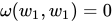
holds for all ; and
Non-degenerate
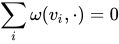
for all implies that .

If the underlying field has characteristic not 2, alternation is equivalent to skew-symmetry. If the characteristic is 2, the skew-symmetry is implied by, but does not imply alternation. In this case every symplectic form is a symmetric form, but not vice versa.

Working in a fixed basis, can be represented by a matrix. The conditions above are equivalent to this matrix being skew-symmetric, nonsingular, and hollow (all diagonal entries are zero). This should not be confused with a symplectic matrix, which represents a symplectic transformation of the space. If is finite-dimensional, then its dimension must necessarily be even since every skew-symmetric, hollow matrix of odd size has determinant zero. Notice that the condition that the matrix be hollow is not redundant if the characteristic of the field is 2. A symplectic form behaves quite differently from a symmetric form, for example, the scalar product on Euclidean vector spaces.

Standard symplectic space

[edit]

The standard symplectic space is with the symplectic form given by a nonsingular, skew-symmetric matrix. Typically is chosen to be the block matrix

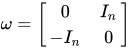
where In is the n × n identity matrix. In terms of basis vectors (x1, ..., xn, y1, ..., yn):
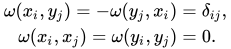
A modified version of the Gram–Schmidt process shows that any finite-dimensional symplectic vector space has a basis such that takes this form, often called a Darboux basis or symplectic basis.

Sketch of process:

Start with an arbitrary basis , and represent the dual of each basis vector by the dual basis: . This gives us a matrix with entries . Solve for its null space. Now for any in the null space, we have , so the null space gives us the degenerate subspace .

Now arbitrarily pick a complementary such that , and let be a basis of . Since , and , WLOG . Now scale so that . Then define for each of . Iterate.


Notice that this method applies for symplectic vector space over any field, not just the field of real numbers.

Case of real or complex field:

When the space is over the field of real numbers, then we can modify the modified Gram-Schmidt process as follows: Start the same way. Let be an orthonormal basis (with respect to the usual inner product on ) of . Since , and , WLOG . Now multiply by a sign, so that . Then define for each of , then scale each so that it has norm one. Iterate.

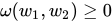
Similarly, for the field of complex numbers, we may choose a unitary basis. This proves the spectral theory of antisymmetric matrices.

Lagrangian form

[edit]

There is another way to interpret this standard symplectic form. Since the model space R2n used above carries much canonical structure which might easily lead to misinterpretation, we will use "anonymous" vector spaces instead. Let V be a real vector space of dimension n and V its dual space. Now consider the direct sum W = VV of these spaces equipped with the following form:

Now choose any basis (v1, ..., vn) of V and consider its dual basis
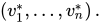
We can interpret the basis vectors as lying in W if we write xi = (vi, 0) and yi = (0, vi). Taken together, these form a complete basis of W,

The form ω defined here can be shown to have the same properties as in the beginning of this section. On the other hand, every symplectic structure is isomorphic to one of the form VV. The subspace V is not unique, and a choice of subspace V is called a polarization. The subspaces that give such an isomorphism are called Lagrangian subspaces or simply Lagrangians.

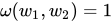
Explicitly, given a Lagrangian subspace as defined below, then a choice of basis (x1, ..., xn) defines a dual basis for a complement, by ω(xi, yj) = δij.

Analogy with complex structures

[edit]

Just as every symplectic structure is isomorphic to one of the form VV, every complex structure on a vector space is isomorphic to one of the form VV. Using these structures, the tangent bundle of an n-manifold, considered as a 2n-manifold, has an almost complex structure, and the cotangent bundle of an n-manifold, considered as a 2n-manifold, has a symplectic structure: T(TM)p = Tp(M) ⊕ (Tp(M)).

The complex analog to a Lagrangian subspace is a real subspace, a subspace whose complexification is the whole space: W = VJ V. As can be seen from the standard symplectic form above, every symplectic form on R2n is isomorphic to the imaginary part of the standard complex (Hermitian) inner product on Cn (with the convention of the first argument being anti-linear).

Volume form

[edit]

Let ω be an alternating bilinear form on an n-dimensional real vector space V, ω ∈ Λ2(V). Then ω is non-degenerate if and only if n is even and ωn/2 = ω ∧ ... ∧ ω is a volume form. A volume form on a n-dimensional vector space V is a non-zero multiple of the n-form e1 ∧ ... ∧ en where e1, e2, ..., en is a basis of V.

For the standard basis defined in the previous section, we have

By reordering, one can write

Authors variously define ωn or (−1)n/2ωn as the standard volume form. An occasional factor of n! may also appear, depending on whether the definition of the alternating product contains a factor of n! or not. The volume form defines an orientation on the symplectic vector space (V, ω).

Symplectic map

[edit]

Suppose that (V, ω) and (W, ρ) are symplectic vector spaces. Then a linear map f : VW is called a symplectic map if the pullback preserves the symplectic form, i.e. fρ = ω, where the pullback form is defined by (fρ)(u, v) = ρ(f(u), f(v)). Symplectic maps are volume- and orientation-preserving.

Symplectic group

[edit]

If V = W, then a symplectic map is called a linear symplectic transformation of V. In particular, in this case one has that ω(f(u), f(v)) = ω(u, v), and so the linear transformation f preserves the symplectic form. The set of all symplectic transformations forms a group and in particular a Lie group, called the symplectic group and denoted by Sp(V) or sometimes Sp(V, ω). In matrix form symplectic transformations are given by symplectic matrices.

Subspaces

[edit]

Let W be a linear subspace of V. Define the symplectic complement of W to be the subspace

The symplectic complement satisfies:
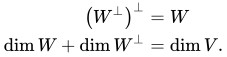
However, unlike orthogonal complements, WW need not be 0. We distinguish four cases:

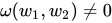
  • W is symplectic if WW = {0}. This is true if and only if ω restricts to a nondegenerate form on W. A symplectic subspace with the restricted form is a symplectic vector space in its own right.
  • W is isotropic if WW. This is true if and only if ω restricts to 0 on W. Any one-dimensional subspace is isotropic.
  • W is coisotropic if WW. W is coisotropic if and only if ω descends to a nondegenerate form on the quotient space W/W. Equivalently W is coisotropic if and only if W is isotropic. Any codimension-one subspace is coisotropic.
  • W is Lagrangian if W = W. A subspace is Lagrangian if and only if it is both isotropic and coisotropic. In a finite-dimensional vector space, a Lagrangian subspace is an isotropic one whose dimension is half that of V. Every isotropic subspace can be extended to a Lagrangian one.

Referring to the canonical vector space R2n above,

  • the subspace spanned by {x1, y1} is symplectic
  • the subspace spanned by {x1, x2} is isotropic
  • the subspace spanned by {x1, x2, ..., xn, y1} is coisotropic
  • the subspace spanned by {x1, x2, ..., xn} is Lagrangian.

The complement operation exchanges isotropic and coisotropic subspaces of complementary dimensions. In particular, any line is complemented to a hyperplane that contains it, then complemented back.

All nonzero vectors are the same, in that any two nonzero vectors are related by a linear symplectic transformation of V. That is, the only symplectic invariant of a vector is it being nonzero. Similarly, given vectors , if , then there exists a symplectic transformation that maps to . That is, the only symplectic invariant of an ordered pair of vectors is its symplectic area.[1]

Heisenberg group

[edit]

A Heisenberg group can be defined for any symplectic vector space, and this is the typical way that Heisenberg groups arise.

A vector space can be thought of as a commutative Lie group (under addition), or equivalently as a commutative Lie algebra, meaning with trivial Lie bracket. The Heisenberg group is a central extension of such a commutative Lie group/algebra: the symplectic form defines the commutation, analogously to the canonical commutation relations (CCR), and a Darboux basis corresponds to canonical coordinates – in physics terms, to momentum operators and position operators.

Indeed, by the Stone–von Neumann theorem, every representation satisfying the CCR (every representation of the Heisenberg group) is of this form, or more properly unitarily conjugate to the standard one.

Further, the group algebra of (the dual to) a vector space is the symmetric algebra, and the group algebra of the Heisenberg group (of the dual) is the Weyl algebra: one can think of the central extension as corresponding to quantization or deformation.

Formally, the symmetric algebra of a vector space V over a field F is the group algebra of the dual, Sym(V) := F[V], and the Weyl algebra is the group algebra of the (dual) Heisenberg group W(V) = F[H(V)]. Since passing to group algebras is a contravariant functor, the central extension map H(V) → V becomes an inclusion Sym(V) → W(V).

See also

[edit]

References

[edit]
Revisions and contributorsEdit on WikipediaRead on Wikipedia
from Grokipedia
A symplectic vector space is a pair (V,ω)(V, \omega), where VV is a finite-dimensional over the real numbers R\mathbb{R} and ω:V×VR\omega: V \times V \to \mathbb{R} is a non-degenerate skew-symmetric , called the symplectic form. This form satisfies ω(u,v)=ω(v,u)\omega(u, v) = -\omega(v, u) for all u,vVu, v \in V, and non-degeneracy means that if ω(u,v)=0\omega(u, v) = 0 for all vVv \in V, then u=0u = 0. Consequently, the of VV must be even, say dimV=2n\dim V = 2n for some positive nn, as the symplectic form induces a non-degenerate pairing that pairs the space with itself in a way. Symplectic vector spaces form the algebraic cornerstone of symplectic geometry, providing the linear model for phase spaces in classical Hamiltonian mechanics, where positions and momenta are coordinated via the symplectic form to preserve the structure of dynamical systems. Key structural features include the existence of a Darboux basis {e1,,en,f1,,fn}\{e_1, \dots, e_n, f_1, \dots, f_n\} such that ω(ei,ej)=ω(fi,fj)=0\omega(e_i, e_j) = \omega(f_i, f_j) = 0 and ω(ei,fj)=δij\omega(e_i, f_j) = \delta_{ij}, which standardizes the form to the canonical matrix J=(0InIn0)J = \begin{pmatrix} 0 & I_n \\ -I_n & 0 \end{pmatrix}. All symplectic vector spaces of the same dimension are symplectomorphic, meaning there exists a linear isomorphism preserving the symplectic form, underscoring their uniformity. Subspaces of a symplectic vector space VV are classified by their interaction with ω\omega: an isotropic subspace SS satisfies SSω={vVω(v,s)=0 sS}S \subseteq S^\omega = \{v \in V \mid \omega(v, s) = 0 \ \forall s \in S\}; a Lagrangian subspace is maximal isotropic with dimS=n\dim S = n; a coisotropic subspace has SωSS^\omega \subseteq S; and a symplectic subspace restricts ω\omega to a non-degenerate form on itself. The group of linear symplectomorphisms, denoted Sp(2n,R)Sp(2n, \mathbb{R}), consists of invertible maps A:VVA: V \to V such that ω(Au,Av)=ω(u,v)\omega(Au, Av) = \omega(u, v) for all u,vVu, v \in V, and it plays a central role in preserving the symplectic structure under transformations. These elements extend to broader contexts, such as cotangent bundles in mechanics, where the canonical symplectic form facilitates the formulation of Hamiltonian vector fields and Poisson brackets.

Definition and Properties

Symplectic Form

A symplectic vector space is a finite-dimensional vector space VV over the real numbers R\mathbb{R} equipped with a symplectic form ω:V×VR\omega: V \times V \to \mathbb{R}, which is a bilinear map satisfying two key properties: skew-symmetry, meaning ω(u,v)=ω(v,u)\omega(u, v) = -\omega(v, u) for all u,vVu, v \in V, and non-degeneracy, meaning that if ω(u,v)=0\omega(u, v) = 0 for all vVv \in V, then u=0u = 0. This non-degeneracy condition ensures that ω\omega induces a natural isomorphism between VV and its dual space VV^*, establishing a perfect pairing. The skew-symmetry of ω\omega over the real field implies that the dimension of VV must be even; if dimV\dim V were odd, the form would necessarily be degenerate, as the determinant of the associated skew-symmetric matrix would vanish. Thus, dimV=2n\dim V = 2n for some positive integer nn, where nn represents the number of degrees of freedom in the underlying physical interpretation from classical mechanics. In a suitable basis of VR2nV \cong \mathbb{R}^{2n}, the symplectic form admits a standard : ω(u,v)=uTJv\omega(u, v) = u^T J v, where JJ is the block-diagonal J=(0InIn0),J = \begin{pmatrix} 0 & I_n \\ -I_n & 0 \end{pmatrix}, with InI_n denoting the n×nn \times n . This representation highlights the form's structure, with the superdiagonal blocks consisting of +1+1 entries (via InI_n) and the subdiagonal blocks of 1-1 entries (via In-I_n). The concept of the symplectic vector space formalizes the linear structure underlying phase spaces in , serving as the infinitesimal model for symplectic manifolds. The term "symplectic" itself was coined by in 1939, as a direct Greek calque of "complex" to describe the associated linear group, replacing earlier nomenclature like "Abelian linear group."

Key Properties

A symplectic vector space (V,ω)(V, \omega) is equipped with a bilinear form ω:V×VR\omega: V \times V \to \mathbb{R} that satisfies the alternating property, meaning ω(v,v)=0\omega(v, v) = 0 for all vVv \in V. This condition implies skew-symmetry, ω(u,v)=ω(v,u)\omega(u, v) = -\omega(v, u) for all u,vVu, v \in V, distinguishing the symplectic form from symmetric or other bilinear forms. Non-degeneracy requires that the linear map vω(v,)v \mapsto \omega(v, \cdot) is an isomorphism from VV to its dual space VV^*, ensuring that if ω(v,w)=0\omega(v, w) = 0 for all wVw \in V, then v=0v = 0. This property implies that VV must be even-dimensional, say dimV=2n\dim V = 2n, and the symplectic form induces a natural orientation on VV via the Liouville volume form ωnn!\frac{\omega^n}{n!}. Every symplectic vector space admits a symplectic basis {e1,,en,f1,,fn}\{e_1, \dots, e_n, f_1, \dots, f_n\} such that ω(ei,fj)=δij\omega(e_i, f_j) = \delta_{ij} and ω(ei,ej)=ω(fi,fj)=0\omega(e_i, e_j) = \omega(f_i, f_j) = 0 for all i,ji, j. This basis canonicalizes the form, allowing representation in a standard block-diagonal structure. The symplectic form induces a natural volume element on VV, given by the nn-fold wedge product ωnn!,\frac{\omega^n}{n!}, which is non-vanishing and defines a volume up to sign, reflecting the oriented structure of the space. The symplectic structure is compatible with linear automorphisms, preserved precisely by symplectomorphisms—linear maps ϕ:VV\phi: V \to V satisfying ω(ϕ(u),ϕ(v))=ω(u,v)\omega(\phi(u), \phi(v)) = \omega(u, v) for all u,vVu, v \in V. This preservation ensures that the intrinsic properties of ω\omega remain invariant under such transformations.

Canonical Realization

Standard Symplectic Space

The standard symplectic vector space is constructed on the V=R2nV = \mathbb{R}^{2n} equipped with the symplectic form ω0:V×VR\omega_0: V \times V \to \mathbb{R} defined by ω0(x,y)=i=1n(xiyn+ixn+iyi)\omega_0(x, y) = \sum_{i=1}^n (x_i y_{n+i} - x_{n+i} y_i) for x=(x1,,xn,xn+1,,x2n)x = (x_1, \dots, x_n, x_{n+1}, \dots, x_{2n}) and y=(y1,,yn,yn+1,,y2n)y = (y_1, \dots, y_n, y_{n+1}, \dots, y_{2n}). This can equivalently be expressed in matrix notation as ω0(x,y)=xTJy\omega_0(x, y) = x^T J y, where J=(0InIn0)J = \begin{pmatrix} 0 & I_n \\ -I_n & 0 \end{pmatrix} and InI_n is the n×nn \times n . The non-degeneracy of ω0\omega_0 ensures that VV forms a symplectic vector space, providing a prototypical model for the . In coordinates adapted to this structure, a symplectic basis for VV consists of position-momentum pairs {q1,,qn,p1,,pn}\{q_1, \dots, q_n, p_1, \dots, p_n\}, where the first nn basis vectors correspond to positions and the latter nn to momenta. With respect to this basis, the symplectic form takes the explicit values ω0(qi,qj)=0\omega_0(q_i, q_j) = 0, ω0(pi,pj)=0\omega_0(p_i, p_j) = 0, and ω0(qi,pj)=δij\omega_0(q_i, p_j) = \delta_{ij}. This basis reflects the canonical pairing in the construction, facilitating computations in symplectic linear algebra. Adapting differential notation to the linear setting, the form ω0\omega_0 can be written as ω0=i=1ndqidpi\omega_0 = \sum_{i=1}^n dq_i \wedge dp_i, where dqidq_i and dpidp_i are the dual basis elements corresponding to the symplectic basis. This expression highlights the wedge product structure, analogous to the volume-preserving aspect in higher-dimensional contexts, though here it remains a constant on the . Every finite-dimensional symplectic vector space (E,ω)(E, \omega) of dimension 2n2n is symplectomorphic to the standard one (R2n,ω0)(\mathbb{R}^{2n}, \omega_0) via a linear that preserves the symplectic form. This universality underscores the standard space's role as a representative, allowing abstract properties to be studied concretely in coordinates. For n=1n=1, the standard symplectic space is R2\mathbb{R}^2 with ω0((x1,x2),(y1,y2))=x1y2x2y1\omega_0((x_1, x_2), (y_1, y_2)) = x_1 y_2 - x_2 y_1, which coincides with the signed area form on the plane. This case models the of a single classical particle, where coordinates (q,p)(q, p) represent position and momentum, and ω0\omega_0 encodes the structure fundamental to .

Darboux Theorem

The linear Darboux theorem asserts that for any symplectic vector space (V,ω)(V, \omega) over R\mathbb{R} of finite dimension 2n2n, there exists a basis {e1,,en,f1,,fn}\{e_1, \dots, e_n, f_1, \dots, f_n\}, called a symplectic basis, such that ω(ei,ej)=0=ω(fi,fj)\omega(e_i, e_j) = 0 = \omega(f_i, f_j) for all i,ji, j and ω(ei,fj)=δij\omega(e_i, f_j) = \delta_{ij} for the Kronecker delta δij\delta_{ij}. This basis induces a linear symplectomorphism from (V,ω)(V, \omega) to the standard symplectic space (R2n,ω0)(\mathbb{R}^{2n}, \omega_0), where ω0=i=1ndxidyi\omega_0 = \sum_{i=1}^n dx_i \wedge dy_i. The proof proceeds by induction on nn. For the base case n=1n=1, select any nonzero e1Ve_1 \in V; non-degeneracy ensures there exists f1Vf_1 \in V with ω(e1,f1)0\omega(e_1, f_1) \neq 0, which can be normalized to ω(e1,f1)=1\omega(e_1, f_1) = 1. For the inductive step, assume the result holds for 2(n1)2(n-1). Let [W](/page/W)[W](/page/W) be the span of {e1,,en1,f1,,fn1}\{e_1, \dots, e_{n-1}, f_1, \dots, f_{n-1}\}, a symplectic subspace of 2(n1)2(n-1). The symplectic complement WωW^\omega is a symplectic subspace of 2. Choose a nonzero enWωe_n \in W^\omega; then select fnWωf_n \in W^\omega such that ω(en,fn)=1\omega(e_n, f_n) = 1, which is possible by non-degeneracy of ω\omega on WωW^\omega. This ensures ω(en,ei)=0=ω(en,fi)\omega(e_n, e_i) = 0 = \omega(e_n, f_i), ω(fn,ei)=0=ω(fn,fi)\omega(f_n, e_i) = 0 = \omega(f_n, f_i) for i<ni < n, and linear independence. This extends the basis to 2n2n. A key consequence is that all symplectic vector spaces of the same even dimension 2n2n are symplectomorphic via linear maps, implying no symplectic invariants exist beyond the dimension itself. The theorem's linear case originated in the late 19th century, rooted in Henri Poincaré's foundational work on invariant integrals and area-preserving transformations in the 1880s, with Gaston Darboux formalizing the canonical form for linear structures in 1882 as part of solving Pfaff's problem on differential forms; this predates Élie Cartan's extensions to manifolds in the 1920s using exterior calculus. The Darboux theorem also underpins the Williamson normal form for quadratic Hamiltonians in linear symplectic algebra: for a quadratic form H(x)=12x,AxH(x) = \frac{1}{2} \langle x, A x \rangle on (V,ω)(V, \omega) with symmetric AA, there exists a symplectic basis in which HH decomposes into n+n_+ positive squares, nn_- negative squares, and n0n_0 hyperbolic terms 12(qi2pi2)\frac{1}{2}(q_i^2 - p_i^2), where n++n+2n0=2nn_+ + n_- + 2n_0 = 2n and the signature is determined by the inertia indices.

Symplectic Transformations

Symplectic Maps

In a symplectic vector space (V,ω)(V, \omega), a linear map ϕ:VV\phi: V \to V is called a symplectic map if it preserves the symplectic form, that is, ω(ϕ(u),ϕ(v))=ω(u,v)\omega(\phi(u), \phi(v)) = \omega(u, v) for all u,vVu, v \in V. This preservation ensures that ϕ\phi acts as an automorphism of the bilinear form ω\omega, maintaining the symplectic structure of the space. An equivalent matrix formulation arises when choosing a Darboux basis for VV, in which ω\omega is represented by the block matrix J=(0InIn0)J = \begin{pmatrix} 0 & I_n \\ -I_n & 0 \end{pmatrix}, where InI_n is the n×nn \times n identity matrix. In this basis, the matrix MM representing ϕ\phi satisfies MTJM=JM^T J M = J. This condition directly implies that ϕ\phi preserves ω\omega as a skew-symmetric bilinear map. Symplectic maps possess several key properties. They are invertible, as the preservation of the non-degenerate form ω\omega implies that ϕ\phi is injective, and hence bijective on finite-dimensional spaces. Additionally, detϕ=1\det \phi = 1, which means symplectic maps preserve the Liouville volume form ωnn!\frac{\omega^n}{n!} and are thus volume-preserving transformations. This determinant condition also ensures that they are orientation-preserving. Representative examples illustrate these maps in standard settings. In the phase space R2\mathbb{R}^2 with ω=dqdp\omega = dq \wedge dp, rotations given by the matrix (cosθsinθsinθcosθ)\begin{pmatrix} \cos \theta & -\sin \theta \\ \sin \theta & \cos \theta \end{pmatrix} preserve ω\omega and thus qualify as symplectic. Shear maps in canonical coordinates, such as (q,p)(q+ap,p)(q, p) \mapsto (q + a p, p) for a constant aRa \in \mathbb{R}, also preserve ω\omega and represent simple canonical transformations. Symplectic maps play a fundamental role in Hamiltonian dynamics, where the time-tt flow of a quadratic Hamiltonian, linearized at an equilibrium, yields a linear symplectic transformation on the tangent space. Such flows maintain the symplectic structure, reflecting the conservation laws inherent in Hamiltonian systems.

Symplectic Group

The symplectic group Sp(2n,R)\mathrm{Sp}(2n, \mathbb{R}) consists of all 2n×2n2n \times 2n real matrices AGL(2n,R)A \in \mathrm{GL}(2n, \mathbb{R}) satisfying ATJA=JA^T J A = J, where J=(0InIn0)J = \begin{pmatrix} 0 & I_n \\ -I_n & 0 \end{pmatrix} is the standard symplectic matrix, with InI_n the n×nn \times n identity matrix. This condition ensures that elements of the group preserve the standard symplectic form ω0\omega_0 on R2n\mathbb{R}^{2n}, making Sp(2n,R)\mathrm{Sp}(2n, \mathbb{R}) the automorphism group of the symplectic vector space (R2n,ω0)(\mathbb{R}^{2n}, \omega_0). Symplectic maps, as linear transformations preserving the symplectic form, are precisely the elements of this group. As a Lie group, Sp(2n,R)\mathrm{Sp}(2n, \mathbb{R}) has dimension n(2n+1)n(2n+1), reflecting the number of independent parameters needed to specify matrices satisfying the defining relation after accounting for symmetries. It is non-compact, but admits compact subgroups such as the unitary symplectic group USp(2n)=Sp(2n,C)U(2n)\mathrm{USp}(2n) = \mathrm{Sp}(2n, \mathbb{C}) \cap \mathrm{U}(2n), which serves as the compact real form of the complex symplectic Lie algebra sp(2n,C)\mathfrak{sp}(2n, \mathbb{C}). The group is generated by transvections, which act as shears along symplectic hyperplanes, and rotations within the canonical 2×2 blocks of the symplectic basis. In terms of representations, the fundamental representation of Sp(2n,R)\mathrm{Sp}(2n, \mathbb{R}) is its defining action on R2n\mathbb{R}^{2n}, which is irreducible and preserves the symplectic structure. Every element has determinant 1, so Sp(2n,R)\mathrm{Sp}(2n, \mathbb{R}) embeds as a subgroup of SL(2n,R)\mathrm{SL}(2n, \mathbb{R}). The name "symplectic group" was coined by in 1939, drawing from the Greek root for "interwoven" to distinguish it from complex linear groups while highlighting its role among the classical groups alongside orthogonal and unitary groups.

Subspace Classifications

Isotropic Subspaces

In a symplectic vector space (V,ω)(V, \omega) of finite dimension 2n2n over R\mathbb{R}, a subspace WVW \subseteq V is isotropic if ω(u,v)=0\omega(u, v) = 0 for all u,vWu, v \in W. Equivalently, WWW \subseteq W^\perp, where the symplectic orthogonal complement is defined as W={vVω(u,v)=0 uW}W^\perp = \{ v \in V \mid \omega(u, v) = 0 \ \forall \, u \in W \}. The dimension of an isotropic subspace satisfies dimWn\dim W \leq n. This bound arises because dimW+dimW=2n\dim W + \dim W^\perp = 2n for any subspace WW, and the inclusion WWW \subseteq W^\perp implies dimWdimW\dim W \leq \dim W^\perp, so dimWn\dim W \leq n. A subspace WW is coisotropic if WWW^\perp \subseteq W, which is the dual condition to being isotropic and yields the complementary dimension bound dimWn\dim W \geq n. The notions of isotropic and coisotropic subspaces are interchanged under the orthogonal complement operation, as the complement of an isotropic subspace of dimension knk \leq n is coisotropic of dimension 2nkn2n - k \geq n. In the standard symplectic vector space (R2n,ω0)(\mathbb{R}^{2n}, \omega_0) where ω0=i=1ndxidyi\omega_0 = \sum_{i=1}^n dx_i \wedge dy_i, the subspace of position coordinates spanned by {/x1,,/xk}\{ \partial/\partial x_1, \dots, \partial/\partial x_k \} for knk \leq n is isotropic, as the symplectic form vanishes identically on it. Similarly, the momentum subspace spanned by {/y1,,/yk}\{ \partial/\partial y_1, \dots, \partial/\partial y_k \} for knk \leq n is isotropic. The symplectic orthogonal complement operation is an involution, satisfying (W)=W(W^\perp)^\perp = W for any subspace WVW \subseteq V, a consequence of the non-degeneracy of ω\omega. For a general subspace WW, the space VV decomposes as a direct sum V=WWV = W \oplus W^\perp if and only if WW is a symplectic subspace (i.e., the restriction of ω\omega to WW is non-degenerate, or equivalently WW={0}W \cap W^\perp = \{0\}).

Lagrangian Subspaces

In a symplectic vector space (V,ω)(V, \omega) of even dimension $2noverover\mathbb{R},aLagrangiansubspace, a **Lagrangian subspace** L \subseteq Visdefinedasasubspacesatisfyingis defined as a subspace satisfyingL = L^\perp,where, where L^\perp = { v \in V \mid \omega(v, w) = 0 \ \forall w \in L }denotesthesymplecticorthogonalcomplementofdenotes the symplectic orthogonal complement ofL.[](https://web.williams.edu/Mathematics/it3/texts/sympgeo.pdf)Thisconditionimpliesthat.[](https://web.williams.edu/Mathematics/it3/texts/symp_geo.pdf) This condition implies that \omegavanishesidenticallyonvanishes identically onL \times L,making, making Lisotropic,whiletheequalityisotropic, while the equalityL = L^\perp$ ensures maximality. Equivalently, a Lagrangian subspace is characterized as an isotropic subspace of dimension exactly nn, the midpoint of dimV\dim V. Such subspaces exist in every symplectic vector space and play a central role in symplectic reductions and decompositions, as they represent the largest possible null sets for the symplectic form. Representative examples include the position subspace {p=0}R2n\{p = 0\} \subseteq \mathbb{R}^{2n} equipped with the standard symplectic form ω=i=1ndqidpi\omega = \sum_{i=1}^n dq_i \wedge dp_i, which has dimension nn and satisfies ωL×L=0\omega|_{L \times L} = 0. In the linear model of a cotangent bundle TRnR2nT^* \mathbb{R}^n \cong \mathbb{R}^{2n}, the zero section (corresponding to the position subspace) and the graph of a closed linear 1-form (i.e., a linear functional \alpha: \mathbb{R}^n \to \mathbb{R}^n^* such that dα=0d\alpha = 0, which is exact) are Lagrangian. Two Lagrangian subspaces L,MVL, M \subseteq V are said to be transverse if LM={0}L \cap M = \{0\}, which is equivalent to L+M=VL + M = V given their dimensions. In this case, VV decomposes as a direct sum V=LMV = L \oplus M, providing a symplectic basis adapted to the pair (e.g., extending bases of LL and MM yields a Darboux basis for VV). The Maslov index provides an invariant for paths of Lagrangian subspaces in the Lagrangian Grassmannian Λ(n)\Lambda(n), the space of nn-dimensional subspaces of R2n\mathbb{R}^{2n}. For a smooth path Λ:[a,b]Λ(n)\Lambda: [a,b] \to \Lambda(n) relative to a fixed reference Lagrangian VV, the linear Maslov index μ(Λ,V)\mu(\Lambda, V) is the signed count of crossings with the codimension-1 strata of the Maslov cycle Σ(V)\Sigma(V), where Σ(V)\Sigma(V) consists of Lagrangians intersecting VV nontrivially; regular crossings contribute ±1\pm 1 based on the sign of the crossing form. This index, originally due to Maslov and interpreted geometrically by Arnold, detects topological changes along the path, such as dimension jumps in intersections with VV.

Induced Structures

Volume Form

In a symplectic vector space (V,ω)(V, \omega) of dimension $2n,thesymplecticform, the symplectic form \omegainducesanaturalvolumeformthroughitsinduces a natural volume form through itsnthexteriorpower.Specifically,thevolumeelementisgivenby-th exterior power. Specifically, the volume element is given by \mathrm{vol} = \frac{\omega^n}{n!}, which is a non-vanishing &#36;2n-form on VV. This construction arises because ω\omega is a closed, non-degenerate 2-form, and raising it to the top power yields a top-degree differential form that serves as the Liouville volume form, up to normalization by the factorial to align with standard conventions in coordinates. The non-degeneracy of ω\omega ensures that ωn0\omega^n \neq 0 everywhere on VV, implying that vol\mathrm{vol} is indeed a volume form without zeros. In a Darboux basis adapted to ω\omega, this volume form corresponds to the standard Lebesgue measure on the underlying real vector space, providing a canonical way to integrate over VV. For instance, on the standard symplectic space R2n\mathbb{R}^{2n} with coordinates (q1,,qn,p1,,pn)(q_1, \dots, q_n, p_1, \dots, p_n) and ω=i=1ndqidpi\omega = \sum_{i=1}^n \mathrm{d}q_i \wedge \mathrm{d}p_i, the induced volume form is vol=dq1dqndp1dpn\mathrm{vol} = \mathrm{d}q_1 \wedge \cdots \wedge \mathrm{d}q_n \wedge \mathrm{d}p_1 \wedge \cdots \wedge \mathrm{d}p_n, representing the phase space volume in classical mechanics. Symplectic linear maps, which preserve ω\omega, also preserve this volume form, as the pullback satisfies ϕω=ω\phi^* \omega = \omega, hence ϕ(ωn/n!)=ωn/n!\phi^* (\omega^n / n!) = \omega^n / n!. This volume preservation is the linear analog of Liouville's theorem, ensuring that the Lebesgue measure induced by vol\mathrm{vol} is invariant under the action of the symplectic group. Moreover, if AA is a matrix representing a symplectic transformation, then det(A)=1\det(A) = 1, which directly follows from the preservation of ω\omega and confirms the volume-preserving property. The volume form ωn\omega^n further defines a canonical orientation on VV, compatible with the symplectic structure. In the standard realization, this orientation is specified by requiring that the Pfaffian Pf(J)>0\mathrm{Pf}(J) > 0, where JJ is the skew-symmetric matrix associated to ω\omega in an adapted basis; since Pf(J)2=det(J)=1\mathrm{Pf}(J)^2 = \det(J) = 1, the positive sign selects the standard orientation aligning with ωn\omega^n. This ensures that vol\mathrm{vol} is positively oriented, providing a consistent choice across all symplectomorphic spaces.

Compatibility with Complex Structures

A compatible complex structure on a symplectic vector space (V,ω)(V, \omega) is a linear J:VVJ: V \to V satisfying J2=IdVJ^2 = -\mathrm{Id}_V and ω(Ju,Jv)=ω(u,v)\omega(Ju, Jv) = \omega(u, v) for all u,vVu, v \in V, ensuring JJ preserves the symplectic form. Additionally, JJ is called ω\omega-tamed if ω(u,Ju)>0\omega(u, Ju) > 0 for all nonzero uVu \in V, which induces a positive definite inner product g(u,v)=ω(u,Jv)g(u, v) = \omega(u, Jv). This construction establishes an analogy between symplectic and complex structures: just as a complex structure equips VV with multiplication by ii, the pair (ω,J)(\omega, J) transforms ω\omega into the imaginary part of a Hermitian form h(u,v)=g(u,v)iω(u,v)h(u, v) = g(u, v) - i \omega(u, v), where h(Ju,v)=ih(u,v)h(Ju, v) = i h(u, v). The triple (V,ω,J)(V, \omega, J) with gg positive definite forms a linear Kähler structure, analogous to Kähler manifolds but restricted to vector spaces. In coordinates on the standard symplectic space R2n\mathbb{R}^{2n} with the ω0=k=1ndxk[](/page/Wedge)dyk\omega_0 = \sum_{k=1}^n dx_k [\wedge](/page/Wedge) dy_k, a compatible JJ acts as J(xk)=ykJ(\partial_{x_k}) = \partial_{y_k} and J(yk)=xkJ(\partial_{y_k}) = -\partial_{x_k}, identifying VCnV \cong \mathbb{C}^n where ω0\omega_0 corresponds to the imaginary part of the standard Hermitian inner product z,w=zkwk\langle z, w \rangle = \sum z_k \overline{w_k}. Compatible almost complex structures always exist on any symplectic vector space and can be chosen such that the induced metric gg is diagonalized in a suitable basis; on vector spaces, such JJ defines a true complex structure without additional integrability conditions. Not every symplectic vector space is inherently Kähler, as this requires selecting a compatible JJ and verifying the positive definiteness of gg; however, such structures exist on any even-dimensional symplectic space. This compatibility underscores linear parallels to , where symplectic forms interplay with complex structures to decompose spaces, though the emphasis here remains on finite-dimensional vector spaces without .

Associated Groups

Heisenberg Group

The Heisenberg group H2n+1H_{2n+1} associated with a symplectic vector space (V,ω)(V, \omega) of dimension 2n2n over R\mathbb{R} is the nilpotent with underlying manifold V×RV \times \mathbb{R} and multiplication given by (x,t)(y,s)=(x+y,t+s+12ω(x,y))(x, t) \cdot (y, s) = (x + y, t + s + \frac{1}{2} \omega(x, y)) for x,yVx, y \in V and t,sRt, s \in \mathbb{R}. This structure makes H2n+1H_{2n+1} a central extension 0RH2n+1V00 \to \mathbb{R} \to H_{2n+1} \to V \to 0, where is {(0,t)tR}\{ (0, t) \mid t \in \mathbb{R} \} and the VV is abelianized by the symplectic form ω\omega, which serves as the 2-cocycle in the extension. The group is simply connected and 2-step , with the derived contained in . Irreducible unitary representations of H2n+1H_{2n+1} are realized via the Schrödinger representation on the Hilbert space L2(Rn)L^2(\mathbb{R}^n), where elements act as π(q,p,t)ψ(r)=eiteip(r+q/2)ψ(r+q)\pi(q, p, t) \psi(r) = e^{i t} e^{i p \cdot (r + q/2)} \psi(r + q) in adapted coordinates x=(q,p)x = (q, p) with q,pRnq, p \in \mathbb{R}^n, ensuring unitarity through the Plancherel theorem. Equivalent representations are related by the symplectic Fourier transform, which interchanges position and momentum variables while preserving the unitary structure. The Stone–von Neumann theorem in its linear form asserts that, up to unitary equivalence, there is a unique irreducible unitary representation of H2n+1H_{2n+1} on a separable Hilbert space, corresponding to the Schrödinger model; this uniqueness holds for the canonical central character χ(t)=eit\chi(t) = e^{i t}. For n=1n=1, the 3-dimensional H3H_3 admits a faithful as the group of upper-triangular 3×33 \times 3 matrices (1ac01b001),\begin{pmatrix} 1 & a & c \\ 0 & 1 & b \\ 0 & 0 & 1 \end{pmatrix},
Add your contribution
Related Hubs
User Avatar
No comments yet.