

Recent from talks
Cottrell atmosphere
Knowledge base stats:
Talk channels stats:
Members stats:
Cottrell atmosphere
In materials science, the concept of the Cottrell atmosphere was introduced by A. H. Cottrell and B. A. Bilby in 1949 to explain how dislocations are pinned in some metals by boron, carbon, or nitrogen interstitials.
Cottrell atmospheres occur in body-centered cubic (BCC) and face-centered cubic (FCC) materials,[citation needed] such as iron or nickel, with small impurity atoms, such as boron, carbon, or nitrogen. As these interstitial atoms distort the lattice slightly, there will be an associated residual stress field surrounding the interstitial. This stress field can be relaxed by the interstitial atom diffusing towards a dislocation, which contains a small gap at its core (as it is a more open structure). Once the atom has diffused into the dislocation core, the atom will stay and the dislocation can be considered pinned. Typically only one interstitial atom is required per lattice plane of the dislocation for there to be a Cottrell atmosphere. The collection of solute atoms around the dislocation core due to this process is the Cottrell atmosphere.
The collection of solute atoms at the dislocation relieves the stresses associated with the dislocation, which lowers the energy of the dislocation's presence. Thus, moving the dislocation out of this Cottrell atmosphere constitutes an increase in energy, so it is not favorable for the dislocation to move forward in the crystal. As a result, the dislocation is effectively pinned by the Cottrell atmosphere.
Once a dislocation has become pinned, a large force is required to unpin the dislocation prior the yielding, thus at room temperature, the dislocation will not get unpinned. This produces an observed upper yield point in a stress–strain graph. Beyond the upper yield point, the pinned dislocation will act as Frank–Read source to generate new dislocations that are not pinned. These dislocations are free to move in the crystal, which results in a subsequent lower yield point, and the material will deform in a more plastic manner.
Leaving the sample to age, by holding it at room temperature for a few hours, enables the carbon atoms to rediffuse back to dislocation cores, resulting in a return of the upper yield point.
Cottrell atmospheres lead to formation of Lüders bands and large forces for deep drawing and forming large sheets, making them a hindrance to manufacture. Some steels are designed to remove the Cottrell atmosphere effect by removing all the interstitial atoms. Steels such as interstitial free steel are decarburized and small quantities of titanium are added to remove nitrogen.
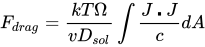
The Cottrell atmosphere also has important consequences for material behavior at high homologous temperatures, i.e. when the material is experiencing creep conditions. Moving a dislocation with an associated Cottrell atmosphere introduces viscous drag, an effective frictional force that makes moving the dislocation more difficult (and thus slowing plastic deformation). This drag force can be expressed according to the equation:
,
Hub AI
Cottrell atmosphere AI simulator
(@Cottrell atmosphere_simulator)
Cottrell atmosphere
In materials science, the concept of the Cottrell atmosphere was introduced by A. H. Cottrell and B. A. Bilby in 1949 to explain how dislocations are pinned in some metals by boron, carbon, or nitrogen interstitials.
Cottrell atmospheres occur in body-centered cubic (BCC) and face-centered cubic (FCC) materials,[citation needed] such as iron or nickel, with small impurity atoms, such as boron, carbon, or nitrogen. As these interstitial atoms distort the lattice slightly, there will be an associated residual stress field surrounding the interstitial. This stress field can be relaxed by the interstitial atom diffusing towards a dislocation, which contains a small gap at its core (as it is a more open structure). Once the atom has diffused into the dislocation core, the atom will stay and the dislocation can be considered pinned. Typically only one interstitial atom is required per lattice plane of the dislocation for there to be a Cottrell atmosphere. The collection of solute atoms around the dislocation core due to this process is the Cottrell atmosphere.
The collection of solute atoms at the dislocation relieves the stresses associated with the dislocation, which lowers the energy of the dislocation's presence. Thus, moving the dislocation out of this Cottrell atmosphere constitutes an increase in energy, so it is not favorable for the dislocation to move forward in the crystal. As a result, the dislocation is effectively pinned by the Cottrell atmosphere.
Once a dislocation has become pinned, a large force is required to unpin the dislocation prior the yielding, thus at room temperature, the dislocation will not get unpinned. This produces an observed upper yield point in a stress–strain graph. Beyond the upper yield point, the pinned dislocation will act as Frank–Read source to generate new dislocations that are not pinned. These dislocations are free to move in the crystal, which results in a subsequent lower yield point, and the material will deform in a more plastic manner.
Leaving the sample to age, by holding it at room temperature for a few hours, enables the carbon atoms to rediffuse back to dislocation cores, resulting in a return of the upper yield point.
Cottrell atmospheres lead to formation of Lüders bands and large forces for deep drawing and forming large sheets, making them a hindrance to manufacture. Some steels are designed to remove the Cottrell atmosphere effect by removing all the interstitial atoms. Steels such as interstitial free steel are decarburized and small quantities of titanium are added to remove nitrogen.
The Cottrell atmosphere also has important consequences for material behavior at high homologous temperatures, i.e. when the material is experiencing creep conditions. Moving a dislocation with an associated Cottrell atmosphere introduces viscous drag, an effective frictional force that makes moving the dislocation more difficult (and thus slowing plastic deformation). This drag force can be expressed according to the equation:
,
Recent media