
Recent from talks
Council of Ministers (Spain)
Knowledge base stats:
Talk channels stats:
Members stats:
Council of Ministers (Spain)
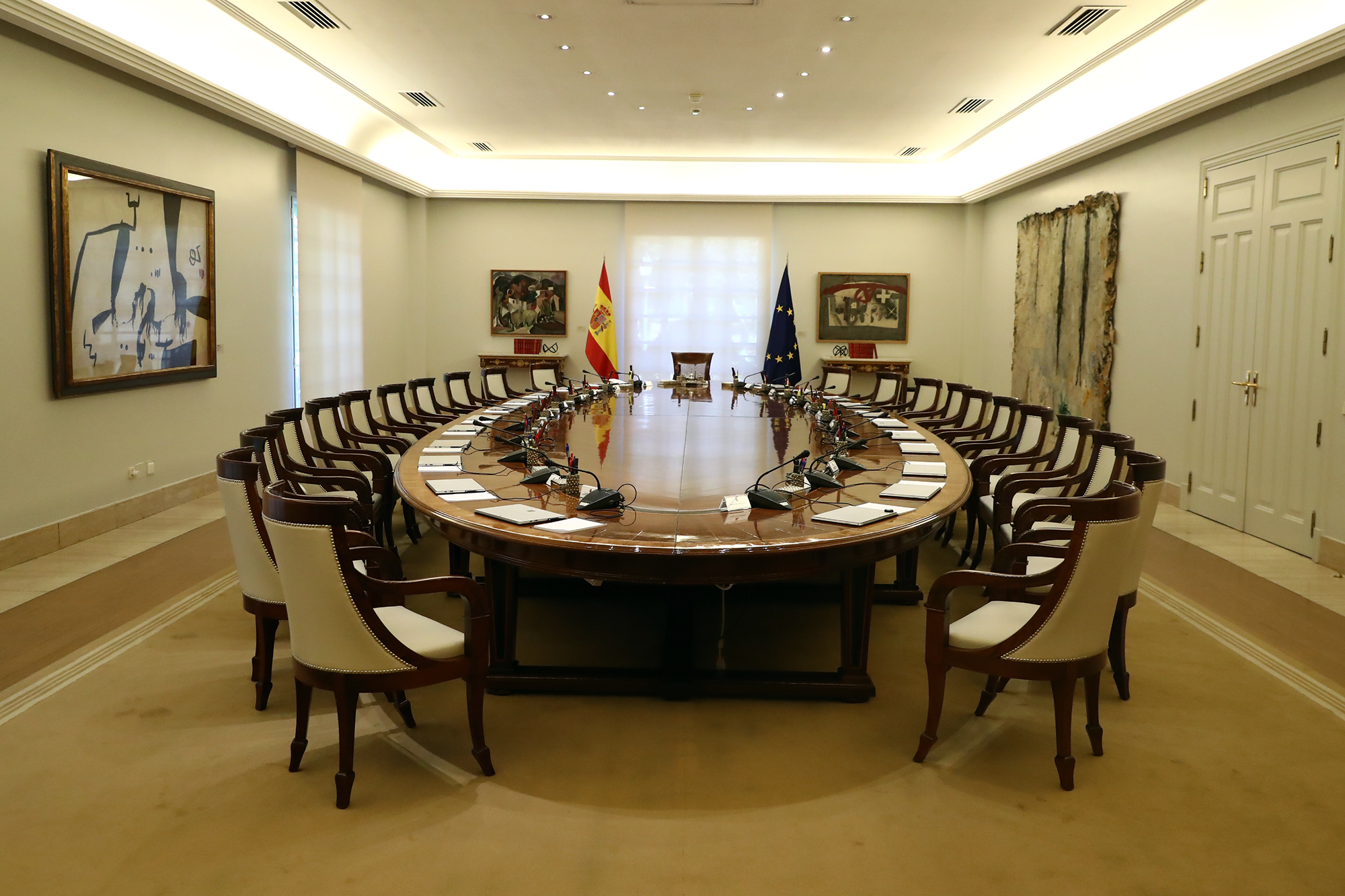
The Council of Ministers (Spanish: Consejo de Ministros) is the main collective decision-making body of the Government of Spain, and it is exclusively composed of the Prime Minister, the deputy prime ministers and the ministers (22 as of 2024). Junior or deputy ministers such as the Secretaries of State are not members of the Council (although according to the Constitution they could be, if the Government Act included them, a constitutional provision that until today has not been used). The Monarch may also chair the Council when needed on the invitation of the Prime Minister.
The ministers are proposed by the Prime Minister and formally appointed by the King. There is no requirement for the Prime Minister nor the ministers to be MPs. The ministers are the heads of a ministerial department and receive the title of "Minister". In addition to the ministers who are the heads of departments, there may be ministers without portfolio, who are entrusted responsibility with for certain government functions.
The Council is the main collective decision-making body of the government and the only one constitutionally recognized, although ministers can also meet through other government bodies, such as Government Delegated Committees. The Delegated Committees are created by the Council and composed by ministers and secretaries of state which deal with minor issues that may affect more than one ministry.
The Secretary of the Council of Ministers is the Minister of the Presidency. It is regulated by Article 98 of the Spanish Constitution and by article 5 of the Government Act of 1997.
From the beginnings of the modern state and the centralization of power in the monarchs, the government was exercised by them through people of trust. The monarchs trusted them certain subjects and with which they made daily dispatches to deal with these matters. Over time, these trusted people who, on numerous occasions, received the title of ministers, were in conflict with the powers of other ministers and, to resolve these, they made collective meetings between various ministers and the monarchs. The Spanish monarchy has ruled most of its history —depending on the greater or lesser desire of the monarch to delegate its power— through Councils —Council of Castile, Council of the Indies, Council of Aragon, etc.— whose main tasks were those of to administer justice in the name of the monarchs and to advise the Sovereign in his work of government and with these the polysynodial regime was established.
With Charles I this regime reached its peak, especially with the creation of the Council of State in 1526, a council that dealt with the great problems of the monarchy and were their secretaries who had more power, i.e. the called Secretaries of State. The secretariat of the Council of State was unique between 1526 and 1567, double between 1567 and 1706 and unique again since this last year. Exceptionally, between 1630 and 1661 there was a third secretary in charge «of Spain, the Indies and adjacent islands, the coast of Barbary and everything indifferent».
Philip II ruled until 1567 with a single secretary and with two since that date, although he balanced the power between his two Secretaries of State and the other advisors and private secretaries. With the subsequent monarchs —Philip III, Philip IV and Charles II— the figure of the favourite (Spanish: Valido) appeared, a kind of prime minister. It is at this time when the position of secretary of the Dispatch appears.
With Philip V and, by French influence, the Council of Dispatch was created with a few members. This members had the task of advise the monarch in his task of government and that displaced the Council of State in this task. During his reign many of the Secretaries of State and of the Dispatch appeared.
Hub AI
Council of Ministers (Spain) AI simulator
(@Council of Ministers (Spain)_simulator)
Council of Ministers (Spain)
The Council of Ministers (Spanish: Consejo de Ministros) is the main collective decision-making body of the Government of Spain, and it is exclusively composed of the Prime Minister, the deputy prime ministers and the ministers (22 as of 2024). Junior or deputy ministers such as the Secretaries of State are not members of the Council (although according to the Constitution they could be, if the Government Act included them, a constitutional provision that until today has not been used). The Monarch may also chair the Council when needed on the invitation of the Prime Minister.
The ministers are proposed by the Prime Minister and formally appointed by the King. There is no requirement for the Prime Minister nor the ministers to be MPs. The ministers are the heads of a ministerial department and receive the title of "Minister". In addition to the ministers who are the heads of departments, there may be ministers without portfolio, who are entrusted responsibility with for certain government functions.
The Council is the main collective decision-making body of the government and the only one constitutionally recognized, although ministers can also meet through other government bodies, such as Government Delegated Committees. The Delegated Committees are created by the Council and composed by ministers and secretaries of state which deal with minor issues that may affect more than one ministry.
The Secretary of the Council of Ministers is the Minister of the Presidency. It is regulated by Article 98 of the Spanish Constitution and by article 5 of the Government Act of 1997.
From the beginnings of the modern state and the centralization of power in the monarchs, the government was exercised by them through people of trust. The monarchs trusted them certain subjects and with which they made daily dispatches to deal with these matters. Over time, these trusted people who, on numerous occasions, received the title of ministers, were in conflict with the powers of other ministers and, to resolve these, they made collective meetings between various ministers and the monarchs. The Spanish monarchy has ruled most of its history —depending on the greater or lesser desire of the monarch to delegate its power— through Councils —Council of Castile, Council of the Indies, Council of Aragon, etc.— whose main tasks were those of to administer justice in the name of the monarchs and to advise the Sovereign in his work of government and with these the polysynodial regime was established.
With Charles I this regime reached its peak, especially with the creation of the Council of State in 1526, a council that dealt with the great problems of the monarchy and were their secretaries who had more power, i.e. the called Secretaries of State. The secretariat of the Council of State was unique between 1526 and 1567, double between 1567 and 1706 and unique again since this last year. Exceptionally, between 1630 and 1661 there was a third secretary in charge «of Spain, the Indies and adjacent islands, the coast of Barbary and everything indifferent».
Philip II ruled until 1567 with a single secretary and with two since that date, although he balanced the power between his two Secretaries of State and the other advisors and private secretaries. With the subsequent monarchs —Philip III, Philip IV and Charles II— the figure of the favourite (Spanish: Valido) appeared, a kind of prime minister. It is at this time when the position of secretary of the Dispatch appears.
With Philip V and, by French influence, the Council of Dispatch was created with a few members. This members had the task of advise the monarch in his task of government and that displaced the Council of State in this task. During his reign many of the Secretaries of State and of the Dispatch appeared.
Recent media