Hubbry Logo
Piledriver (professional wrestling)Piledriver (professional wrestling)Main
Open search
Piledriver (professional wrestling)
Community hub
Piledriver (professional wrestling)
logo
8 pages, 0 posts
0 subscribers
Be the first to start a discussion here.
Piledriver (professional wrestling)
from Wikipedia
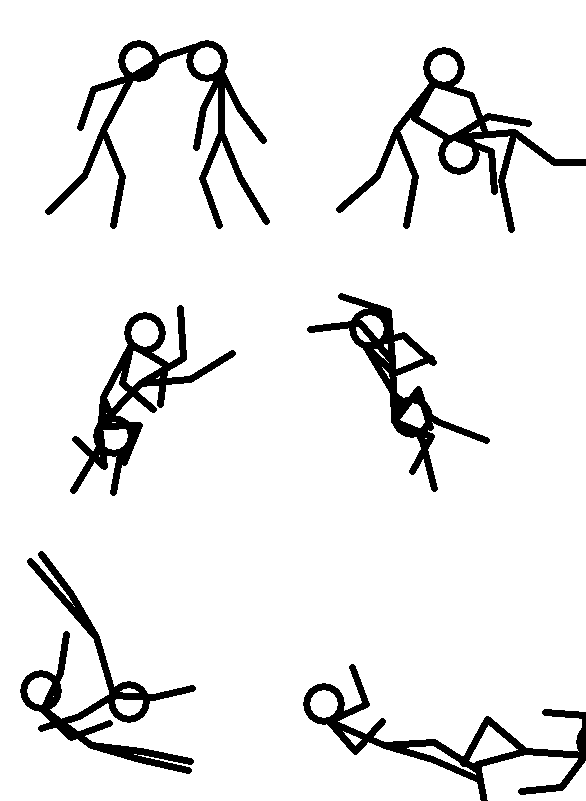
Animation of a piledriver

A piledriver is a professional wrestling driver move in which the wrestler grabs their opponent, turns them upside-down, and drops into a sitting or kneeling position, driving the opponent head-first into the mat.[1] The technique is said to have been innovated by Wild Bill Longson.[2]

The name is taken from a piece of construction equipment, also called a pile driver, that drives countless massive impacts on the top of a large major foundation support, burying it in the ground slowly with each impact. The act of performing a piledriver is called "piledriving". Someone who has recently been the victim of a piledriver is said to have been "piledriven" (e.g. "The wrestler was piledriven into the canvas").

Notable wrestlers who have regularly used a piledriver during their career include Jerry Lawler, Bret Hart, Ray Stevens, Harley Race, Paul Orndorff, Abismo Negro, The Undertaker, Kane, The Brain Busters, Buddy Rogers, Minoru Suzuki, Karl Gotch, Danny Davis, and Kazuchika Okada.

The piledriver is often seen as one of the most dangerous moves in wrestling. The reverse piledriver is directly responsible for shortening the career of Stone Cold Steve Austin when his opponent, Owen Hart, inadvertently botched the move, legitimately injuring Austin's neck at the SummerSlam 1997.[3] Due to this, the move is banned in the WWE with the exceptions of Kane and The Undertaker due to their experience and having already established the Tombstone (kneeling belly-to-belly variant) as a finisher. However, in recent years, certain variations of the piledriver have been allowed to be performed by experienced wrestlers and it is not banned in some other wrestling promotions such as All Elite Wrestling.

Danger and precautions

[edit]
Mike Bennett (left) improperly executing a piledriver on B. J. Whitmer in 2013.[4] Here, Whitmer's head is positioned below Bennett's legs and is unprotected. The impact from the move gave Whitmer a neck injury.

The piledriver is generally considered a dangerous maneuver in wrestling because of the potential impact on the head and compression of the neck. The proper way to execute the move, in most cases, is for the wrestler performing the move to tuck the opponent's head between their legs before falling to the mat (there are variations that are performed differently, as the list below indicates). If done in this manner, the wrestler receiving the move will land with little or no contact made with the mat, and thus not run the risk of injury.[5] If the head is not secured and is protruding from between the wrestler's legs, the wrestler receiving the move risks serious injury and potential paralysis, as they will likely land with the entire weight of their body on the top of their head.[6] Perhaps the most famous example of an injury from an improperly performed piledriver came at the 1997 WWF SummerSlam event. In a match between Owen Hart and Stone Cold Steve Austin, Hart was to perform a reverse piledriver on Austin, who later said that he was not sure if the move was a good idea to perform, as he was unsure if his head could properly be protected. As Austin had feared, Hart botched the move and dropped Austin on top of his head. The impact jammed Austin's neck and left him temporarily paralyzed. He continued and finished the match, but stayed away from the ring for two months to recover from the injury. The physical demands of Austin's standing as one of the top stars in the WWF did not allow much downtime for him to rest and take care of the injury, and as his career progressed, the damage got worse. Austin underwent fusion surgery on his neck in 1999, but it never fully healed. By 2002, Austin's doctors told him that he risked permanent disability if he did not retire, and he finally did so in April 2003.[7]

The piledriver was officially banned in the World Wrestling Federation (WWF, now known as the WWE) in 2000, unless the wrestler has special permission to use the move.[6] In a discussion in 2007, Stephanie McMahon said that only two wrestlers were allowed to use the move, "two of the stronger guys", Undertaker and Kane.[8] In fact, The Undertaker's tombstone piledriver continued to be his finishing move until his retirement in 2020.[9] The piledriver is also banned in many other promotions and certain cities. It is also considered an automatic disqualification in professional wrestling matches held in Tennessee, as the move is banned in that state.[10][unreliable source?] In some promotions in the United Kingdom, the move can result in not only a disqualification, but also a fine.[11] In Mexico, the piledriver (called a martinete) is an automatic disqualification.

Because of the dangers of the piledriver, it is classed as a foul and is illegal in mixed martial arts under the Unified Rules of Mixed Martial Arts.[12]

Variations

[edit]

Aided piledriver

[edit]
Jake O'Reilly (right) Anthony Darko (Left) execute an aided piledriver

Any double-team move in which one wrestler helps another to perform a piledriver on an opponent by pushing down on the opponent's legs for more impact. In a variation of the move, the second wrestler jumps off the turnbuckle while pushing the opponent's feet downward for even more damage; this is well known as a spike piledriver (not to be confused with a one-man spike piledriver).

Argentine piledriver

[edit]

The move is executed from an Argentine backbreaker rack (face up, with the neck and one leg cradled) position. The wrestler pushes the opponent forward while holding the opponent's leg with one arm, and the head with the other arm, and then sits down, driving the opponent head first down to the floor. Super Dragon used this move throughout his career, calling it the Psycho Driver. He also has a cutthroat version (draping one of the opponent's arm across their neck, similarly to the setup of a Cobra Clutch) called Psycho Driver III.

Backflip piledriver

[edit]

The user approaches an opponent from behind and grasps his torso with his legs, similar to a bodyscissors. The user then shifts their weight to suddenly roll backward until they are prone, pulling the opponent behind them so that their neck hits the ground in a fluid motion. An aerial version of this technique was innovated by Manami Toyota as the Victory Star Drop. Due to the high danger of this movement, it is not very common to see.

Back-to-belly piledriver

[edit]
Kazarian performs the back-to belly piledriver

The wrestler bends forward or crouches in front of their opponent, grabs hold of the opponent around the legs and stands up, lifting the opponent upside down facing the wrestler's back. The wrestler then either sits down or drops onto their knees, driving the opponent's head down to the mat. It was invented by Takao Omori as the Axe Guillotine Driver. Hangman Page would executed the move in a kneeling position called the Rite of Passage/Dead Eye, while Genki Horiguchi and later Orange Cassidy use a sitout variation called the Beach Break.

Trent performs Crunchie.

A variation on this, sometimes known as the sunset driver, sees the attacking wrestler hook the opponent's legs underneath their arms while holding the opponent up in the back to belly position. From here, the wrestler drops to their knees, driving the opponent's head into the mat. This move will often see the attacking wrestler hold the move after landing for a rana style pinfall attempt. Trent Beretta calls it the Crunchie.

Over-the-shoulder back-to-belly piledriver

[edit]
CIMA performs Schwein

This move begins with the wrestler facing the opponent. From there, the wrestler will pick up the opponent and place them over their shoulder so that the opponent's head is dangling over the wrestler's back by the waist of the wrestler. The wrestler then holds the opponent in place by holding their leg with one arm and applies a headlock to the opponent with their other arm, bending the opponent across the attacker's back. The wrestler then drops to a seated position, driving the head and upper back of the opponent into the ground. This move was innovated by Mariko Yoshida, who named the move the Air Raid Crash, and was popularized by Fit Finlay, who dubbed it the Celtic Cross, Cima, who uses it as the Schwein, Nova, who called it Kryptonite Krunch, Sheamus who dubs the move White Noise, Tommaso Ciampa uses the move calling it Air Raid Crash, and Taichi as Black Mephisto. A common variation was popularized by Hiromu Takahashi, where he puts his opponents into a Fireman's Carry, before Swinging his opponents into the over-the-shoulder back-to-belly Piledriver, calling it the Time Bomb.

Another variation of the move called the Air Raid Crash Neckbreaker or Reverse Neckbreaker has the wrestler performing the move drop the opponent's head on their knee rather than the ground. Frequently used by Kazuchika Okada, Colt Cabana and Toni Storm.

Pumphandle back-to-belly piledriver

[edit]

The user of this move first starts by putting the opponent into a pumphandle position, then lifting them into the air perpendicular to the ground and upside down, rotating them so that their back is against the chest. The user then proceeds to fall to a seated position, while dropping the opponent onto their head, neck, and/or shoulders. This move was popularized by Super Dragon, who called it Psycho Driver II.

Belly-to-back piledriver

[edit]
Bob Backlund about to perform a belly-to-back piledriver on Don Muraco during a professional wrestling match, circa 1982.

Also known as a Texas, Sit-out, or traditional piledriver, this is the classic and original piledriver technique. From a position in which the opponent is bent forward and the opponent's head is tucked between the attackers thighs in a standing headscissors, the wrestler grabs around the opponent's midsection and lifts so that the opponent is held upside down facing in the same direction as the wrestler, the wrestler then drops to a sitting position with the opponent's head falling between the wrestler's thighs down to the mat.

A Flowing or Snap version of this move exists which sees the wrestler perform this in one quick motion all at once for greater impact. Toni Storm uses this version as a finisher called Storm Zero.

Kneeling belly-to-back piledriver

[edit]

A variation of the piledriver where instead of dropping to a sitting position as in the basic belly-to-back piledriver, the wrestler drops to a kneeling position. It is often referred to as an Inverted Tombstone.

Cradle piledriver

[edit]
Minoru Suzuki performs the cradle piledriver

The cradle piledriver is a variation of standard piledrivers which sees the attacking wrestler grapevine the opponents leg with their arm. The most common of which is similar to a Texas piledriver. This move sees the attacking wrestler, from a position in which the opponent is bent forward against the wrestler's midsection, reach around the opponent's midsection and lifting them so that they are held upside down facing in the same direction as the wrestler, the wrestler then hooks their arms around one leg of the opponent before dropping to a sitting or kneeling position with the opponent's head falling between the wrestler's thighs down to the mat. It was invented by Karl Gotch, known as the Gotch-Style Piledriver and is commonly used by NJPW wrestler Minoru Suzuki (Gotch's protege). It was once used by Jerry Lynn, and Deonna Purrazzo also uses this move, known as the Queen's Gambit.

This variant can be used on other types of piledrivers, including the cradle tombstone piledriver variation: instead of wrapping both of their arms around the opponent's waist, the wrestler wraps one arm around the waist and places their other arm between the opponent's legs, grabbing hold of their other arm. The wrestler then drops down on their knees, driving the opponent down to the mat head-first. This Variation is used by Hiroyoshi Tenzan as the Original TTD (Original Tenzan Tombstone Driver) and he also uses a Sitout Variation called the TTD (Tenzan Tombstone Driver). Kenny Omega also used the move as Signature Maneuver.

Cross-arm piledriver

[edit]

From a position in which the opponent is bent forward against the wrestler's midsection, the attacking wrestler crosses the arms of the opponent between their legs (a double pumphandle) before then lifting the opponent up into a vertical position and driving them down between the attacking wrestler's legs. It is used by SHO as the Shock Arrow.

Double-underhook piledriver

[edit]

Also known as butterfly piledriver and the Tiger Driver '98. In this piledriver, a wrestler will bend their opponent forward, placing the opponent's head between the wrestler's legs, and hooks each of the opponent's arms behind the opponent's back. They then pull back on the opponent's arms lifting them up so that the opponent is held upside down facing in the same direction as the wrestler, the wrestler then drops to a sitting or kneeling position dropping the opponent's head into the mat. The namesake of the move is a tribute to Mitsuharu Misawa, as it's a hybrid of a Tiger Driver and the Tiger Driver '91 (Misawa's innovated and seldom used big match finisher; a double underhook into a kneeling-release neck-first powerbomb). The Tiger Driver '98 was used by ROH legend Jay Briscoe as the Jay-Driller, and is used by former TNA wrestler Josh Alexander as the C4 Spike; and current TNA wrestlers such as Eddie Edwards as one of his signature moves, while Sami Callihan uses this move as the Cactus Driver 97 as a tribute to Mick Foley's "Cactus Jack" persona. AEW commentator Excalibur previously used this in his wrestling career. In a kneeling position, this move was innovated by Jaguar Yokota.

Double-underhook back-to-back piledriver

[edit]
Cheerleader Melissa performing her Kudo Driver (back-to-back double underhook piledriver) finisher on Wesna

Also known as the vertebreaker and the Kudo Driver, this move is executed from a position in which the opponent is standing behind the wrestler, the wrestler underhooks their arms under the opponent's arms. Then the wrestler twists their body around so that the wrestler is facing the ground and the opponent is standing with their back resting against the wrestler's back. Then the wrestler stands while the opponent is in an upside down position while both the opponent and the wrestler's arms are still hooked. The wrestler then drops to a sitting position. Another way to get the opponent into the position is to approach a standing opponent from behind, hook the opponent's arms, bend forward under the opponent, and then rise up, raising the opponent upside down.[13] The move was invented by Megumi Kudo, dubbing it the Kudome Valentine, and is used by various wrestlers such as Homicide, Cheerleader Melissa, Shane Helms, Ryusuke Taguchi and Cody Rhodes.

This technique is extremely dangerous, possibly one of the most dangerous maneuvers in professional wrestling, as the opponent's arms are restrained and their head is not placed between the wrestler's legs, giving them little to post against. It was banned by WWE in April 2003, except for in cases in which the wrestler received special permission to use the move.[14]

Flip piledriver

[edit]
Petey Williams performing the Canadian Destroyer on Brent B
Animation of a flip piledriver

The move, made famous by Petey Williams, also referred to as the Canadian Destroyer, Destroyer, or a sunset flip piledriver, begins in a position in which the opponent is bent forward against the wrestler's midsection. The wrestler then grabs around the opponent's midsection latching onto the opponent's back, with their head to one side of the opponent's hips or between their legs, keeping their legs around the opponent's head. From this position the wrestler pushes off the mat with their legs to flip the opponent over. As both wrestlers flip, the attacking wrestler uses their body weight to land in a seated position driving the opponent's head down to the mat between the wrestler's thighs. Rey Mysterio occasionally uses the move, Bad Bunny used this move during WrestleMania 37 and at Backlash (2023), which was coined by commentators as the Boricua Destroyer. A double underhook variation exists in which the arms of a bent over opponent are placed in a butterfly prior to performing the flip. There is a diving variation from the second rope, Adam Cole uses this move calling it the Panama Sunrise.

According to Petey Williams, the move was suggested to him in 2003 while travelling to an IWA Mid-South show along with Chris Sabin and Truth Martini. Williams and Sabin originally planned to use the move in their match together but decided against it. The next month, Williams debuted the move in a match against Matt Sydal. It was not until 2004, when he debuted for TNA, when he learned that TNA star Amazing Red had performed the move since the 1990s.[15]

Jumping piledriver

[edit]
Adam Pearce performs the spike piledriver

Also known as a spike piledriver or stiff piledriver and is performed in the same way as a basic piledriver, however the wrestler will jump in the air before dropping down to the sitting position for more impact. This move was used as the finisher of WWE Hall of Famer Paul Orndorff.

Package piledriver

[edit]
Kevin Steen executing his package piledriver finisher on Tyson Dux

A package piledriver is almost the same as a basic belly-to-back piledriver, but instead of grabbing the waist of the opponent, the wrestler puts their arms underneath the opponent's arms and grabs their legs by the knees. The wrestler then stands up, lifting the opponent until they are upside down, and drops to a sitting position with the opponent's head between their thighs. A version of this move also exist that can be performed without underhooking the arms of the opponent.

There is also an inverted version of the move in which an attacking wrestler reaches between an opponent's legs with one arm and reaches around that opponent's back from the same side with their other arm before lifting their opponent upside down into a belly-to-belly position. The attacker then grabs the opponent's legs by the knees, jumps up, then drops to a sitting position with the opponent's head between their thighs. Aja Kong innovated the move. This move was popularized by Kevin Steen during his time on the independent circuit. It is used by Chase Owens as Package Driver. Another notable user is Shane Taylor. Pentagón Jr. uses the package piledriver as the Fear Factor.[16]

Pulling piledriver

[edit]

Also known as a stump piledriver and Cactus Driver (after Cactus Jack, one of Mick Foley's alter egos), this is a variation of piledriver where, instead of wrapping their arms around the opponent's waist, a wrestler grabs onto the back of the waistband of an opponent's tights to lift them upside down before dropping into a sitting position. Mick Foley was famous for have used this move which he called the Stump Puller.

Reverse piledriver

[edit]

Also known as a belly-to-belly piledriver, a wrestler faces an opponent and grabs the opponent's waist and turns them upside-down, holding them belly-to-belly against their torso. The wrestler then jumps up and drops down to a sitting position, driving the opponent's head down to the mat between the wrestler's thighs. This move was best remembered as being used by Owen Hart as a finisher.

The wrestler may also place the opponent over their shoulder and fall to a seated position, driving the opponent's head to the mat between their thighs. This move is often known by the name Fire Thunder, or Fire Thunder Driver as named by Mr. Gannosuke. Bam Bam Bigelow and Rikishi used this move as a signature move, calling it the Greetings from Asbury Park and the Rikishi Driver respectively. WALTER/Gunther has used this move mainly on the independent circuit. Former AEW wrestler Rey Fénix also uses this move as a finisher calling it the Fénix Driver/Fire Driver/Fire Thunder Driver which sees him sometimes transition into the move from a reverse suplex lift or fireman's carry. Havok of TNA uses this move which was later dubbed the Sick Driver when portraying her Jessicka character.

Kneeling reverse piledriver

[edit]
The Undertaker performs the Tombstone Piledriver (a.k.a. reverse kneeling piledriver)on Ric Flair.

The wrestler first stands facing an opponent and places their stronger arm between the opponent's legs and their weaker arm on the opponent's opposite shoulder. The wrestler then lifts the opponent onto their stronger shoulder, turning them upside-down, similar to a scoop slam lift. The opponent is then lowered while being held so that the opponent's head is hanging between the standing wrestler's knees. The wrestler then falls or jumps to their knees, driving the opponent's head into the mat. The move was innovated by Karl Gotch, but the move was first utilized by Andre The Giant in the 1970s, before it was popularized by The Undertaker and was later used by his (kayfabe) brother Kane. However, contrary to the popular belief, the name tombstone predates Undertaker's debut and has been used since at least 1972.[17] Other famous practitioners include Dynamite Kid, Satoru Sayama, Don Muraco, Matt Riddle (during his independent circuit wrestling), Owen Hart, and Kazuchika Okada. An over the shoulder of the version of this move also exists and was used by The Undertaker early in his career. Masakatsu Funaki uses a variation of the move, known as the Hybrid Blaster, where he places one of the opponent's arms in a hammerlock before delivering the piledriver. Kyle Fletcher also uses that hammerlock variant called Grimstone. Kris Statlander, Kota Ibushi, Konosuke Takeshita, "Hangman" Adam Page, Mariah May and Xia Brookside also use a cradle variant.

Pumphandle reverse piledriver

[edit]

This variation sees an attacking wrestler first lock an opponent in the pumphandle hold before then using the hold to raise the opponent up over the shoulder of the attacking wrestler. From here the attacking wrestler brings the opponent down into the belly-to-belly position before then sitting down for a reverse piledriver with the opponent's head impacting the mat between the legs of the attacking wrestler. CM Punk used this during the indies as the Punk-Handle Piledriver.

Rope-assisted piledriver

[edit]

This version sees an attacking wrestler place the opponent on an elevated surface, usually the ropes/turnbuckle/ring apron, while the opponent is bent forward against the wrestler's midsection. The attacking wrestler next draws the opponent away from the elevated surface leaving the opponent's waist over the elevated surface (i.e. ring ropes), making them the only thing other than the wrestler keeping the opponent off the ground. The attacking wrestler then grabs the top rope while pushing off the mat with their legs simultaneously like a see-saw so that the opponent is forced to dive forward onto his/her head with extra force due to the height of which they were dropped. Innovated by Independent Wrestler, Rocky Rage, as The Ebola Driver in 2014. Popularized by MJF as the Heat Seeker.

Scoop side piledriver

[edit]

Facing the opponent, the wrestler reaches between the opponent's legs with their right arm and reaches around the opponent's neck from the same side with their left arm. They then lift the opponent up on their chest so that they are facing downwards. The wrestler then moves their left arm from around the opponent's neck to around the opponent's torso. They then turn the opponent so that they are upside down on one side of the wrestler. The wrestler then jumps up and falls down to a sitting position, driving the opponent down to the mat neck and shoulder first. The move was popularized by Hayabusa, who called it H Thunder, and by Mitsuharu Misawa, who called it the Emerald Flowsion.

Scoop slam piledriver

[edit]

Facing their opponent, the wrestler reaches between the opponent's legs with their right arm and reaches around the opponent's neck from the same side with their left arm. They then lift the opponent up and turn them around so that they are held upside down, as in a scoop slam. The wrestler then drops down to their knees, driving the opponent down to the mat neck and shoulder first. There is also a seated version of this move. It was innovated by Taka Michinoku and used by Tennile Dashwood, Nick Aldis, and more.

Vertical suplex piledriver

[edit]

The wrestler applies a front facelock to the opponent and hooks the opponent's near arm over their shoulder and lifts them into a vertical suplex position. They then turn the opponent 180°, force the opponent into the reverse piledriver position, then drop to a sitting position, dropping the opponent on their head. This move was first used by Jushin Thunder Liger on Ultimo Dragon, then the move became popular through use by Scott Steiner, who called it the Steiner Screwdriver. AEW wrestler Brian Cage currently uses the move as the Drill Claw. Tomohiro Ishii briefly used the move in 2013 as the Ishii Driller. Naomichi Marufuji invented a fisherman suplex variation called Pole Shift.

Wheelbarrow piledriver

[edit]

Similar to the wheelbarrow facebuster but instead of dropping their opponent face first, they drop their opponent so that the opponent lands on their upper back and neck between the legs of the wrestler, facing towards them usually resulting in a pin.

See also

[edit]

References

[edit]
Revisions and contributorsEdit on WikipediaRead on Wikipedia
from Grokipedia
The piledriver is a driver move in which a wrestler grabs an opponent around the or upper body, inverts them upside-down, and drops to a sitting, kneeling, or standing position, driving the opponent's head or upper back into the mat. The technique, which derives its name from heavy construction equipment used to drive piles into the ground, is considered one of the most powerful and visually devastating maneuvers in the sport, often used as a finisher to signal the end of a match. Invented in the early 1950s by American wrestler , though some sources suggest the late 1930s or early 1940s, the piledriver gained widespread popularity in the 1950s and 1960s through performers such as and "Nature Boy" Buddy Rogers, who employed the classic version as a signature hold. Over the decades, it evolved into numerous variations, including the Tombstone piledriver (a belly-to-belly reverse version popularized by ), the package piledriver (used by , involving a tucked leg hold for added impact), the spike piledriver (a standing drop emphasizing height and force), and the Canadian Destroyer (a somersaulting front version innovated by ). Notable wrestlers who featured the piledriver as a primary finisher include , , , and Kane, with the move becoming a staple in promotions during the 1970s and 1980s for its dramatic flair and crowd appeal. Despite its iconic status, the piledriver has been controversial due to its high risk of serious injury, particularly to the neck and spine, if the opponent's head is not properly tucked to land on the shoulders or upper back. A pivotal incident occurred at WWE's SummerSlam 1997, when Owen Hart botched a reverse piledriver on Stone Cold Steve Austin, causing temporary paralysis and a bruised spinal cord that contributed to Austin's eventual retirement. Other notable injuries include those sustained by Randy Orton and Cody Rhodes from Kevin Owens' package piledriver in 2024, highlighting ongoing safety risks. In response, WWE banned the move company-wide in 2000, citing concerns over concussions, spinal damage, and the need to discourage fans from attempting it at home, though exceptions were granted for veterans like The Undertaker and Kane. The ban remains in place in WWE, but the piledriver continues to be used in other promotions like AEW and NJPW, where it is performed with protective modifications, and has occasionally appeared in WWE storylines as of 2024.

Definition and Fundamentals

Core Description

In professional wrestling, the piledriver is a driver move in which the performer grasps the opponent, typically by the waist or upper thighs, lifts and inverts them into an upside-down position with the head facing downward, and then drops to a sitting or kneeling posture while driving the opponent's head into the mat. This maneuver emphasizes inversion and a controlled vertical drop, creating a high-impact visual effect central to the theatrical, scripted nature of as entertainment rather than actual combat. Key characteristics include its role as a powerful finisher that builds drama and signals a potential match conclusion, often executed with precision to simulate danger without genuine harm in a choreographed setting. In contrast, piledriver-like actions are prohibited in under rules that ban any hold or maneuver driving an opponent's head or neck into the mat, due to the severe risk of or neck injuries. Within professional matches, it functions as a or finishing technique to heighten audience engagement and storyline tension.

Basic Mechanics

The basic mechanics of the traditional piledriver in involve a coordinated sequence of lifting, inverting, and impacting the opponent in a controlled manner to simulate a devastating blow while prioritizing performer safety. The executing wrestler begins by facing the opponent and securing a firm grip around their or lower body, often bending at the knees to generate lifting power from the legs. This initial hold allows the wrestler to hoist the opponent upward, transitioning their body into an inverted vertical position where the opponent's head points downward toward the mat. Once inverted, the executing wrestler positions the opponent's head between their thighs for stability, with hands typically clasping the opponent's thighs, waist, or underarms to maintain the inversion and prevent uncontrolled flailing. The wrestler then drops to a seated or kneeling position on the mat, driving the opponent's head and upper shoulders directly into the through a controlled descent. This final phase relies on the opponent's to tuck their and distribute the landing across the upper body rather than solely the head, ensuring the move's execution emphasizes interdependence and kinaesthetic awareness between performers. For safety during training or live performances, practitioners often practice with spotters or on softer surfaces to refine control before full-speed execution, highlighting the interdependence required for safe performance.

Historical Context

Origins in Wrestling

The piledriver's conceptual foundations lie in 19th-century catch-as-catch-can wrestling, a style that originated in , , and emphasized unrestricted , , and submission holds known as "hooks" and "stretches" to immobilize opponents. This folk-derived form, which spread to the through immigrant wrestlers and carnival circuits, allowed for innovative techniques that inverted or compressed the body, setting the stage for more dynamic maneuvers in later professional contexts. By the early , is widely credited with innovating the standard piledriver form—lifting an opponent upside down between the legs and driving their head into the mat—making it a signature technique in Midwestern territories. In the and early , as shifted further toward scripted entertainment following , the piledriver solidified its role from a potential contest-ender in semi-legitimate bouts to a theatrical highlight in National Wrestling Alliance-affiliated promotions. This era marked its integration into the performative lexicon, emphasizing dramatic impact over pure submission utility.

Evolution and Popularization

Following , the piledriver gained prominence in American through promotions like the (NWA), where it emerged as a dramatic finishing maneuver designed to thrill audiences with its apparent brutality. Credited to wrestler "Wild" Bill Longson, who refined it during his career in the early 1950s, the move was popularized by stars such as and Buddy Rogers, who incorporated it into high-stakes matches to emphasize dominance and crowd reaction. By the 1950s and 1960s, it had become a reliable "spot" in NWA territories, enhancing storytelling by signaling a match's climactic end and drawing cheers from live crowds in an era when wrestling emphasized athletic spectacle over scripted excess. The 1970s and 1980s marked a significant surge in the piledriver's usage, fueled by the expansion of territorial promotions and the advent of televised wrestling, which amplified its visual impact on national audiences. In regional circuits like Memphis Wrestling, Jerry "The King" Lawler elevated the move to signature status as his primary finisher, most famously employing it against celebrity opponent in a 1982 angle that blurred lines between wrestling and entertainment, captivating viewers and boosting ratings. Other territorial icons, including and , routinely deployed it to punctuate feuds, such as Funk's infamous 1989 assault on NWA champion , solidifying the piledriver as a versatile tool for building tension and heel heat in an era of gritty, character-driven narratives. In the 1980s, the World Wrestling Federation (WWF, now ) played a pivotal role in both popularizing and restricting the piledriver amid growing safety concerns, while rival promotions like (WCW) and (ECW) in the 1990s introduced innovative variations to differentiate their edgier styles. WWF's shift toward mainstream appeal led to informal discouragement of riskier maneuvers, culminating in an official ban by the early 2000s, though revivals occurred through safer iterations like The Undertaker's Tombstone Piledriver, debuting in 1990 as a protected finisher that protected the head during impact. Meanwhile, WCW featured high-profile uses by wrestlers like , whose jumping version added flair but highlighted execution risks, and ECW showcased experimental forms, such as Jerry Lynn's Cradle Piledriver, which integrated hardcore elements and appealed to fans seeking unfiltered intensity during the Monday Night Wars era. Post-2000, heightened awareness of concussions and spinal injuries—exemplified by Stone Cold Steve Austin's career-altering 1997 mishap from Owen Hart's piledriver—prompted a sharp decline in the move's mainstream application, with enforcing a blanket prohibition to mitigate liability and promote wrestler welfare. This shift aligned with broader industry changes toward safer protocols amid lawsuits and medical scrutiny, reducing its frequency in major promotions. However, the piledriver has experienced a resurgence in independent circuits and alternative leagues like (AEW), (NJPW), and (TNA) during the 2010s and 2020s, where wrestlers such as and adapt variations for modern audiences, balancing nostalgia with controlled execution to evoke the move's classic prestige.

Execution Technique

Setup and Positioning

The setup for a piledriver in typically begins with the wrestler the opponent from a standing position, often after securing a front facelock or following a brief lift like a body slam to disorient them. The wrestler bends the opponent forward at the waist, positioning their head snugly between the wrestler's legs to establish a standing headscissors hold, which locks the opponent's upper body in place for control. Inversion of the opponent occurs through a coordinated lift, where the wrestler reaches around the opponent's waist with both arms—frequently using an interlocking S-grip for stability—and drives upward with the legs and core to flip the opponent upside down, aligning their legs vertically while their head remains secured near the . This mechanic relies on from the initial bend and lift to rotate the opponent 180 degrees without excessive strain. Maintaining balance and control during positioning demands a solid stance from the wrestler, with feet spread shoulder-width apart and knees slightly bent to bear the combined weight of both performers, estimated at over 400 pounds in many cases. Hand placement is critical, with the wrestler's palms pressing firmly against the opponent's midsection or inner thighs to guide the inversion and prevent the opponent from twisting free, while the opponent often assists by tucking their chin and gripping the wrestler's legs for mutual safety. Common setups include transitioning from a waist lock in a tie-up or capitalizing on the opponent's return from an Irish whip rebound to swiftly apply the headscissors.

Impact and Finish

The descent phase of the piledriver culminates in a controlled drop by the executing wrestler, who falls to a sitting or kneeling position while gripping the opponent upside down, driving their head into the mat between the wrestler's thighs for maximum simulated force. This phase emphasizes precision to maintain the hold's integrity, with the executor's guiding the without full release. Upon landing, in safe execution, the opponent's head is positioned to make minimal contact with the , cushioned by the executor's thighs and the ring's , while the tuck of the to the chest protects the by ensuring any contact occurs on the top of the head. This dynamic creates the illusion of severe trauma while prioritizing performer safety during the compression. Immediately after the impact, the piledriver often transitions into a pinfall attempt, with the executor maintaining the hold as the begins a three-count to potentially secure victory. Alternatively, it can set up subsequent offense, such as stomps or submissions, exploiting the opponent's momentary vulnerability. To enhance its dramatic effect, the receiving wrestler sells through exaggerated convulsions, grimacing, or limp collapse, underscoring its portrayal as a match-ending "devastator." While generally safe when performed correctly, improper landing in this phase can risk compression injuries.

Risks and Regulations

Potential Hazards

The piledriver maneuver in professional wrestling poses significant risks to the cervical spine due to the axial loading force applied when the recipient's head impacts the mat, potentially causing compression injuries that damage vertebrae or intervertebral discs. This compression can result in fractures, such as burst fractures of the , as seen in cases of improper execution where the hyperextends or bears excessive weight. Additionally, the direct head-to-mat contact often leads to concussions from rapid deceleration and impact trauma to the skull. Secondary risks include dislocations if the recipient's arms are inadequately secured during the drop, allowing unnatural on the joints, and whiplash effects that strain the and surrounding ligaments, potentially causing ligament tears or instability. Over time, repeated exposure to such impacts contributes to long-term neurological damage, including (CTE), a degenerative brain condition linked to cumulative head trauma in wrestlers. studies of professional wrestlers have confirmed CTE pathology, with moves like the piledriver implicated in lawsuits alleging repetitive brain injuries from high-impact finishes. Several factors exacerbate these dangers, including the height of the drop, which amplifies the and of impact on the ; a size mismatch between performer and recipient, complicating control and alignment; and the hardness of the ring mat, particularly in older venues with minimal padding that offers less shock absorption. Real-world incidents highlight these hazards, such as the 1990 WWF match where Marty Jannetty's Rocker Dropper—a reverse piledriver variation—fractured jobber Austin's C4, C5, and C6 vertebrae, resulting in from the shoulders down and a subsequent $26.7 million award. Similarly, in 1997, Owen Hart's botched piledriver on Steve Austin caused a bruised and temporary , underscoring ongoing concerns from such maneuvers in the 1980s and 1990s independent and major promotions where safety standards were less stringent.

Safety Protocols and Bans

In the 1970s, professional wrestling operated with minimal regulations on high-risk maneuvers like the piledriver, reflecting the era's emphasis on hardcore, unscripted brawls in territorial promotions. By the 1990s, growing awareness of injuries prompted partial restrictions in some organizations amid increasing mainstream scrutiny. The turning point came in the late 1990s and early 2000s, particularly after high-profile injuries like Steve Austin's bruised spinal cord from a botched piledriver by Owen Hart at SummerSlam 1997, leading to widespread adoption of safety protocols across the industry. WWE implemented a comprehensive ban on the traditional piledriver in 2000, citing risks of neck compression and paralysis, though the Tombstone variant remained permitted for select performers like due to its controlled execution and established safety record. As of 2025, the ban has been partially lifted for certain wrestlers, such as , who used the package piledriver on in November 2024, resulting in a storyline cervical cord neurapraxia injury. Other major promotions have varied in their approaches; WCW maintained partial restrictions throughout the , allowing the move under supervised conditions but discouraging reckless applications to mitigate injury risks. In contrast, AEW, founded in , permits piledrivers with modifications such as pre-approval for high-risk variations and emphasis on proper technique, as outlined in their 2023 safety guidelines that ban unprotected or inverted forms without oversight. Training protocols in professional wrestling academies focus on for moves like the piledriver, incorporating spotters to positioning, padded rings or mats to cushion impacts, and techniques such as chin tucks and angled drops to prevent direct head contact with the . These measures, refined post-2000, ensure trainees build strength and execution precision under instructor supervision before live performances.

Variations

Aided Piledriver

The aided piledriver is a double-team variation of the piledriver in , in which a second wrestler assists the primary performer by applying additional force to elevate the impact during the inversion and drop. This assistance typically involves pushing down on the opponent's legs or feet—or jumping onto them from an elevated position—to drive the head more forcefully into the mat, distinguishing it from solo executions. In execution, the primary wrestler first secures the opponent in a standard piledriver setup, with the victim's head positioned between their legs and body inverted upward. The partner then intervenes during the lift or drop phase, often by grabbing and pulling downward on the opponent's limbs or leaping from the middle rope to add , thereby increasing the drop height and velocity for a sharper spike. This coordinated effort demands precise timing to avoid mishaps, as the added dynamics can amplify the move's destructive potential. The aided piledriver is primarily utilized in tag team matches to deliver dramatic, high-impact finishes that highlight partnership synergy, though it sees rare application in singles bouts due to the inherent coordination challenges. Notable examples include its employment by The Brain Busters ( and ) during the 1980s Golden Era of wrestling and its modern revival by FTR ( and ) in as a homage to tag team styles. A key trait of the aided piledriver is its ability to heighten the visual spectacle through exaggerated elevation and force, creating a more imposing presentation than unaided versions; however, this enhancement also elevates the risk of severe or spinal injuries if mistimed, aligning with broader concerns over inversion-based maneuvers in regulated promotions.

Argentine Piledriver

The Argentine piledriver is a standing inversion variant of the piledriver in , in which the opponent is held face up across the wrestler's shoulders in an Argentine rack, with one arm cradling the and the other hooking and lifting one of the opponent's legs to secure the inverted position. From this setup, the wrestler drops the opponent forward, driving their head directly into the mat. This technique highlights the performer's upper-body strength and creates a dramatic visual of vulnerability due to the elevated drop height. Execution of the Argentine piledriver typically begins with the wrestler gaining dominant control, such as after a lift, , or from a grounded position, before transitioning the opponent into the rack by sliding one under the and the other behind a leg to hoist them overhead. The wrestler maintains balance while walking or pausing briefly to build tension, then releases by falling forward or simply letting gravity pull the opponent down in a spiking motion onto the crown of the head. Unlike many piledriver forms that incorporate a kneeling or sitting finish with knee cushioning, this version avoids knee contact entirely, depending solely on the ring mat to mitigate impact and heightening its high-risk profile. The move gained prominence as a signature technique in various promotions, often employed for its emphasis on athletic display and crowd-popping intensity. Wrestlers like EZ Money popularized it as a finisher, naming his version the EZ Driver during matches in the early . Its use underscores conceptual balance and precision over brute force, though, like other standing-drop maneuvers, it demands exact execution to prevent serious neck compression or spinal hazards.

Backflip Piledriver

The backflip piledriver is a high-risk aerial variation of the piledriver maneuver in , where the performer secures the opponent in a bodyscissors hold from behind, typically from an elevated position such as the top rope, before executing a backward to drive the opponent's head and neck into the mat. This move distinguishes itself by incorporating rotational dynamics during the descent, amplifying the impact through added momentum from the flip. In execution, the wrestler first positions themselves on the top with the opponent facing away, wrapping their legs around the opponent's midsection in a scissor grip while maintaining control of the head or upper body. The performer then initiates a , rotating over their own body while pulling the opponent downward in an inverted arc, culminating in a kneeling or seated position upon landing to focus the force on the target's neck. This technique demands exceptional balance and core strength to ensure the flip completes smoothly without disrupting the hold, as any misalignment can lead to uncontrolled falls. The rotational generated enhances the visual spectacle and perceived power of the impact compared to standard piledrivers. The backflip piledriver gained prominence through the work of Japanese joshi wrestler , who innovated and popularized it in the 1990s as part of her high-flying arsenal in promotions like . Known as the Victory Star Drop in her repertoire, it was employed by Toyota against formidable opponents to generate crowd excitement through its acrobatic flair, often serving as a signature finisher in intense matches. Its usage extended into the 2000s among other agile performers in international circuits, though it remained rare due to the athletic demands. This move requires advanced gymnastic proficiency, heightening the need for precise timing and opponent cooperation to mitigate risks like cervical hyperextension during the rotation.

Back-to-Belly Piledriver

The back-to-belly piledriver is a variation of the piledriver maneuver in , in which the opponent is inverted upside down with their back positioned against the wrestler's belly before being dropped head-first onto the mat. This orientation positions the opponent facing away from the wrestler, distinguishing it from front-facing versions like the standard piledriver. To execute the back-to-belly piledriver, the wrestler typically starts from behind the opponent by applying a rear waistlock, securing their arms around the opponent's waist. The wrestler then lifts the opponent upward and inverts them over one shoulder, draping their body so the head points downward and the back presses against the wrestler's front. From this position, the wrestler falls backward or drops to their knees in of the ring, driving the opponent's head and shoulders into the canvas with controlled force. This setup allows for variations in height and momentum, often enhancing the move's visual impact when performed from an elevated position. The back-to-belly piledriver is employed less frequently than front-facing piledrivers due to its requirement for precise positioning from behind, which can introduce an element of surprise in matches by catching opponents off-guard during transitions. Notable users include , who utilized it as his finisher "Fade to Black" throughout his career in promotions like TNA Wrestling, and "Hangman" , who performs a kneeling version called the "Deadeye" (also known as "Rite of Passage") in to secure victories against larger opponents. Sheamus employs an over-the-shoulder variation known as the "White Noise" as a signature maneuver to showcase power and control. This variation alters the wrestler's control during the inversion, as the opponent's facing-away posture reduces direct but demands stronger grip on the legs or torso for stability.

Belly-to-Belly Piledriver

The belly-to-belly piledriver, also known as the classic piledriver, is the original version of the piledriver maneuver in , characterized by the opponent being held in an inverted position with their belly facing the wrestler's belly. This positioning allows for enhanced torso-to-torso alignment during the lift. Execution begins with the wrestler securing the opponent in a front facelock, then lifting them vertically upside down with the head between the legs. The wrestler then drops to a or sitting position, using a to absorb and direct the impact, driving the opponent's head first into the while maintaining control over the torso to minimize slippage. This technique integrates seamlessly with chains, often serving as a bridge to subsequent holds. In usage, the belly-to-belly piledriver functions primarily as a transitional move within extended wrestling sequences, favored in technical styles for its versatility in setting up pins or follow-up strikes. Notable examples include Toni Storm's "Storm Zero," a variation employed as a signature maneuver to showcase power and control against larger opponents. Its prevalence in technical wrestling stems from the move's ability to maintain match flow without abrupt halts, as seen in matches emphasizing transitions. The key distinguishing element is the increased body contact via the front-facing hold, which affords superior leverage and stability compared to rear-oriented variations, enabling wrestlers to adjust mid-execution for safety or emphasis.

Cradle Piledriver

The cradle piledriver is a variation of the piledriver in where the attacking wrestler grapevines the opponent's leg with their arm during the inversion to secure additional restraint. This setup differs from the cross-arm piledriver, which involves crossing the opponent's arms rather than cradling the leg. The technique was innovated by , a pioneer of strong style wrestling in , who incorporated it into his arsenal to emphasize control and punishing impacts. To execute the cradle piledriver, the wrestler begins with the opponent bent forward against their midsection, reaches around the upper torso to grapevine the near , and lifts the opponent upside down with their head facing toward the wrestler and positioned between the legs. The wrestler then falls backward or to a seated position, driving the opponent's head into the mat while maintaining the leg lock to prevent escape or mitigation of the impact. This execution highlights the move's focus on both the head drop and the pre-impact immobilization. The cradle piledriver is often employed as a submission-style finisher due to its restraining hold, which can transition into a pin or force a tap-out from the pressure on the leg and neck. It gained prominence in Japanese strong style promotions through Gotch's influence and was popularized in North American wrestling by , who used it as his signature move during his ECW tenure in the late 1990s and early 2000s, notably in high-profile rivalries like his series against for the World Television Championship. Other wrestlers, such as in modern promotions, have adopted it for its visual brutality and effectiveness in storytelling matches. A key unique feature of the cradle piledriver is its enhanced restriction of the opponent's movement before the drop, allowing the wrestler to control the setup more securely than in basic piledrivers and amplifying the psychological intimidation factor. Like other piledrivers, it carries risks of leg strain from the grapevine mechanism, potentially exacerbating injuries detailed in broader discussions of move hazards.

Cross-Arm Piledriver

The cross-arm piledriver is a variation of the piledriver in where the attacking wrestler crosses the opponent's arms across their chest, securing them in a straightjacket-like hold to restrict movement and enhance control during the lift. This setup differs from standard piledrivers by incorporating the crossed arms, which are typically held in place by the wrestler's hands or body to maintain the position throughout the maneuver. The hold emphasizes pressure on the opponent's upper body, creating a visually intense setup that simulates restraint and vulnerability. To execute the cross-arm piledriver, the wrestler begins by positioning the opponent bent forward against their midsection, often from a front facelock. The opponent's arms are then crossed over their chest and locked by the wrestler, who lifts them vertically upside down while maintaining the arm hold to apply additional pressure. The wrestler drops to a sitting or kneeling position, driving the opponent's head into the mat, with the crossed arms preventing any cushioning from the hands. This inversion with crossed arm pressure adds to the maneuver, intensifying the impact on the neck and shoulders. The cross-arm piledriver is employed to heighten match intensity, particularly in scenarios requiring a display of dominance or in hardcore-style bouts where added strain amplifies the move's dramatic effect. It enhances visual strain on the upper body, making the opponent's predicament appear more precarious and heightening audience tension. Wrestlers like SHO in have popularized a package variant known as the Shock Arrow, using it as a finisher to secure victories in high-stakes matches. Due to the torque applied to the , this variation carries elevated risks of , as detailed in discussions of potential hazards in piledriver techniques.

Double-Underhook Piledriver

The double-underhook piledriver is a high-impact finishing move in , distinguished by the performer securing both of the opponent's arms in underhooks behind the head, hooking them tightly under the wrestler's own armpits for maximum control and leverage during the setup. This variation emphasizes arm restraint to prevent the opponent from breaking free, allowing for a more secure and elevated lift compared to standard piledrivers that rely solely on a facelock or single-arm hold. Innovated by Japanese wrestling legend , it evolved from a botched attempt and became a staple in strong-style promotions, often signaling a match's decisive moment due to its devastating potential. To execute the double-underhook piledriver, the wrestler first positions the opponent in a bent-over stance or lifts them into a setup, with the opponent's head facing downward between the wrestler's legs. As the lift begins, the performer transitions midair by reaching under the opponent's arms to lock in the double grip, inverting the body fully so the head points toward the mat. The wrestler then drops to a seated or kneeling position, spiking the opponent's head and directly into the for intense impact, which heightens the move's risk to the cervical area. This technique maximizes lift height through the leverage provided by the underhook hold, enabling a fluid inversion and drop that showcases the performer's power. Popularized as the Tiger Driver '98 by Misawa in during the late 1990s, the move has been adopted sparingly in modern wrestling due to its hazardous nature, with performers like using it as a rare "super finisher" in high-stakes matches before retiring it from his arsenal in 2024. It is particularly associated with power-based performers in Japanese and independent circuits, where the secure double underhook facilitates execution by larger wrestlers demonstrating strength and dominance, though its infrequency underscores ongoing concerns in the industry. Unlike cross-arm variations that emphasize chest compression, the double-underhook version prioritizes arm-locked elevation for a cleaner, more vertical drop.

Flip Piledriver

The flip piledriver, also known as the Canadian Destroyer, is a high-impact maneuver classified as a forward-flipping variant of the piledriver, where the attacking wrestler performs a while driving the opponent's head into the mat. To execute the move, the wrestler begins from a standing position by bending the opponent forward and securing their head in a front facelock or under the arm, then grasping the opponent's waist for leverage; with a burst of momentum, the wrestler jumps forward, tucking their body into a front flip () that carries both performers over, culminating in the attacker landing on their back while spiking the opponent's inverted head and shoulders downward into the canvas. This forward rotation adds explosive drive and visual flair, distinguishing it from static piledrivers by incorporating aerial inversion for increased speed and impact. The technique demands exceptional athleticism, precise timing, and trust between participants, making it a staple for aerial specialists and high-flyers rather than power-based wrestlers; its rarity stems from the physical complexity and elevated risk of or spinal if the flip misaligns. Originating in the late 1990s and innovated by as a running variation, it was independently developed and popularized by in 2003 during his early appearances, later becoming a signature in (TNA) where Williams used it to win two X Division Championships between 2004 and 2006. Notable modern users include Penta El Zero Miedo, , and , who have adapted it into their repertoires for dramatic spots in promotions like (AEW).

Jumping Piledriver

The jumping piledriver is a variation of the traditional piledriver in , where the performer adds a vertical leap during the execution to increase the move's impact velocity upon landing. This enhances the force delivered to the opponent's head and neck, making it a more explosive maneuver than the standard drop. To execute the jumping piledriver, the wrestler first secures the opponent in an inverted position, typically by bending them forward and draping their head between the legs while gripping the waist or thighs for control. From this setup, the performer bends their knees and jumps upward, using the from the leap to drive the opponent's headfirst into the upon descent, often landing in a seated or position. This technique requires precise timing and athleticism to maintain balance and avoid botches that could injure both participants. The jumping piledriver is commonly employed as a high-impact finisher in athletic or high-flying matches, where its added elevation amplifies the visual drama and perceived danger, heightening audience engagement. Wrestlers like popularized this version in regional promotions during the 1970s and 1980s, using it to emphasize devastating power in intense rivalries. Its rarity in major promotions stems from concerns, but it remains a staple in independent circuits for showcasing explosive athleticism.

Package Piledriver

The Package Piledriver is a specialized variation of the piledriver maneuver in , characterized by folding the opponent's legs tightly against their chest to secure them in a compact, bundled position resembling a wrapped package. This hold immobilizes the opponent by tucking their knees toward their body while their head is positioned between the wrestler's thighs in an inverted stance. To execute the Package Piledriver, the wrestler first lifts the opponent upside down, then reaches under their knees to lock hands together, folding the legs snugly against the and often trapping the arms for added security. The performer then falls backward to a seated position on the mat, delivering a precise, compact inversion drop that drives the opponent's head directly into the canvas. This technique's distinguishing feature is its tightly bundled form, which minimizes the opponent's ability to shift or counter during the lift, enhancing the wrestler's control throughout the motion. The Package Piledriver is commonly used as a high-impact finisher, particularly by wrestlers like , who employed it extensively on the independent circuit to overpower foes and has since introduced it in major promotions such as . As of 2025, Owens continues to use it selectively in , with notable applications against and highlighting its risks. Its secure packaging allows performers to maintain dominance and execute the drop with stability, even in intense matches. Like other piledriver variants, it briefly risks leg compression alongside potential cervical strain from the inversion.

Pulling Piledriver

The pulling piledriver is a variation of the piledriver maneuver in , characterized by the wrestler grabbing the opponent's legs and pulling them downward to force the body into an inverted position, rather than relying on an upward lift. This action drives the opponent's head into the mat while the wrestler drops to a or seated position, emphasizing a forward momentum generated by the pull itself. Execution typically begins from a grounded stance, such as after the opponent is bent forward or attempting an escape, where the wrestler secures a front facelock or leg hold and yanks the legs sharply to initiate the inversion and subsequent impact. From a standing position, the performer may transition into the pull after bending the opponent at the waist, using body weight and leverage to create the driving force without a full vertical hoist. This method allows for quick application in fluid exchanges, making it suitable as a counter to evasion attempts or within chain wrestling sequences. The pulling piledriver's reactive nature sets it apart from more proactive variants, as it capitalizes on the opponent's positioning rather than requiring the wrestler to generate lift from scratch, often resulting in a more controlled yet forceful delivery. Wrestler popularized a version known as the stump-puller piledriver during his Cactus Jack persona in the 1990s, employing it as a signature hardcore-style move in promotions like WCW and ECW. This pulling action can impose momentum-based strains on the and spine due to the sudden inversion.

Reverse Piledriver

The reverse piledriver is a high-impact variation of the piledriver performed in , characterized by an inversion initiated from a rear position where the opponent faces away from the attacker. In this setup, the wrestler's back is exposed to the opponent during the lift, distinguishing it from forward-facing piledrivers. Execution begins with the wrestler approaching the opponent from behind and underhooking both arms to secure control. The attacker then twists the opponent into an inverted position, with their head aimed downward toward the and body aligned parallel to the wrestler's , before dropping to a seated stance to drive the head and neck into the canvas. This maneuver demands precise timing to mitigate injury risks, particularly to the cervical spine due to the rear exposure and forceful impact. Commonly utilized as a match-ender in heel-oriented storylines, the reverse piledriver's surprise element from the rear approach makes it ideal for ambush tactics, allowing antagonists to capitalize on an opponent's distraction. Notable performers include , , and , who integrated it into their arsenals to convey dominance and finality, though its inherent dangers led to a ban in the early . The move's unique orientation provides an altered visual perspective, emphasizing the opponent's vulnerability and enhancing narrative tension in bouts.

Rope-Assisted Piledriver

The rope-assisted piledriver is a variation of the piledriver in that incorporates the ring ropes to provide leverage, momentum, and enhanced impact during execution. This method uses the ropes to bounce the opponent or aid in the lift and inversion, distinguishing it from standard piledrivers by integrating the ring environment for a more fluid and forceful delivery. Execution typically begins with the wrestler whipping the opponent into the ropes, capitalizing on their rebound to quickly transition into the hold. As the opponent bounces back, the attacker catches them around the waist, inverts their body head-down, and employs a see-saw motion with the ropes—either by pulling against the tension or using the elastic rebound—to drive the opponent's head and shoulders into the mat. An alternative setup positions the opponent on an elevated surface like the ropes, , or , from which the wrestler lifts and drops them while leveraging the ropes for additional height and speed. A standing variation may involve the wrestler rolling or jumping toward the rebounding opponent to secure the position and complete the spike. This variation is commonly utilized in corner spots to generate high energy and crowd reaction, as the environmental integration allows for rapid setup in fast-paced sequences. Its distinguishing feature lies in the ropes' role in accelerating the process, enabling seamless chaining with other maneuvers while amplifying the move's visual and physical intensity. Wrestlers like MJF have popularized it as a finisher called the Heat Seeker, emphasizing its simplicity and effectiveness in decisive moments.

Scoop Side Piledriver

The scoop side piledriver is a driver maneuver that involves scooping the opponent laterally from the side into an inverted position before driving their head into the mat. This variant emphasizes a side-entry lift, distinguishing it from more direct frontal approaches in traditional piledrivers. It is particularly associated with high-impact styles in Japanese and wrestling, where the inversion heightens the visual drama and perceived danger of the drop. To execute the scoop side piledriver, the wrestler positions themselves beside the standing or grounded opponent, inserting one arm (typically the right) between the opponent's legs for underarm support while clasping the far or with the other arm to secure a lateral scoop grip. The wrestler then lifts the opponent off the ground in a sideways motion, rotating them to a vertical upside-down stance with the head downward and legs upward. Finally, the wrestler falls backward or to a seated position, spiking the opponent's head-first into the while protecting the head in to minimize risk. This technique requires significant strength for the lateral lift and precise control during the drop to ensure . The move's utility lies in its seamless integration with side-oriented holds, such as transitioning from a or abdominal stretch, allowing wrestlers to chain it into offensive sequences without repositioning. Japanese wrestler popularized a version known as the H Thunder, employing it as a signature finisher in matches during the to emphasize his high-flying and hard-hitting persona. What sets the scoop side piledriver apart is its oblique angle of attack, which introduces asymmetry and surprise to an opponent's defense, enabling creative variations like spinning lifts or elevated setups from the ropes for added flair in athletic performances.

Scoop Slam Piledriver

The scoop slam piledriver, also known as the Michinoku Driver, is a maneuver that combines elements of a scoop slam lift with a subsequent inverted drop to deliver impact to the opponent's head and upper body. In this variation, the wrestler faces the opponent and positions one arm between the opponent's legs while securing the neck with the other arm, mimicking the initial setup of a traditional scoop slam. To execute the move, the performer lifts the opponent upward into a vertical, inverted position—similar to preparing for a slam—but instead of driving them forward onto their back, the wrestler falls backward or sits out sharply, spiking the opponent's head and shoulders into the mat for a piledriver effect. This two-phase motion creates a fluid transition from lift to inversion, emphasizing height and momentum to heighten the visual and physical impact. The technique requires precise timing to avoid excessive strain on the , as the drop targets the upper rather than a full head-first burial. In professional wrestling, the scoop slam piledriver serves as an effective combination technique to control match pacing, often used as a transitional or finishing move to build tension through its dynamic lift and sudden reversal. Innovated and popularized by , including the Michinoku Driver II, which he employed to defeat and capture the inaugural Light Heavyweight Championship in 1997. Wrestlers such as Cesaro have adapted the move in modern contexts, leveraging its versatility for high-impact sequences. The maneuver's dual-phase nature amplifies crowd engagement by simulating a buildup slam that evolves into a decisive piledriver strike.

Vertical Suplex Piledriver

The vertical suplex piledriver is a high-impact variation of the traditional piledriver, distinguished by its integration of a vertical lift that elevates the opponent to a greater height before transitioning into the signature head-first drop, amplifying both the visual drama and the potential force of the maneuver. This added elevation from the suplex phase sets it apart from standard piledrivers, emphasizing the performer's strength and control while building suspense during the setup. In execution, the wrestler begins by securing a front facelock on the opponent and draping their near arm over the shoulder to hoist them into a vertical position, with the opponent's body parallel to the mat and feet elevated. From this stalled suplex hold, the performer rotates or spins the opponent mid-air into an inverted, head-down piledriver setup—often facing away in a reverse orientation—before driving their head and shoulders forcefully into the canvas while dropping to a seated or kneeling position. This fluid transition demands precise timing and athleticism to maintain balance during the spin and ensure a controlled . The move is frequently employed as a power-based finisher or technique in matches requiring displays of technical prowess and raw strength, particularly in promotions where elevated impacts highlight a wrestler's dominance. popularized a renowned iteration known as the Steiner Screwdriver in WCW during the , using it sparingly due to its intensity and risk, which underscored its role in climactic moments. Modern adaptations, such as Tomohiro Ishii's Ishii-Driller in , continue to leverage the elevation for emphatic near-falls in hard-hitting bouts.

Wheelbarrow Piledriver

The piledriver is a variant of the piledriver maneuver in , where the performer lifts the opponent into a wheelbarrow hold—positioning them face down with legs elevated and arms supporting on the —before inverting and dropping them head-first to the . This setup contrasts with stationary piledrivers by incorporating mobility, allowing the performer to walk briefly while carrying the opponent, which heightens the athletic display and builds tension before the impact. To execute the move, the wrestler approaches from behind, secures the opponent's legs by hooking under the knees or thighs, and hoists the lower body upward while the opponent remains prone, often scrambling to maintain balance. The performer then transitions by sitting out or falling backward, tucking the opponent's head between their legs to drive the crown of the head into the mat upon landing, typically in a seated position for added force. A variation, the half nelson wheelbarrow driver, incorporates an arm lock for greater control during the lift and drop. Due to its demands on strength and coordination, the wheelbarrow piledriver is relatively rare and reserved for athletic performers in high-energy matches, emphasizing power and showmanship over routine application. Notable practitioners include Mexican luchador Rey Bucanero, who employs it as the Buca Storm, and fellow luchador Joe Líder, dubbing his version the Líder Storm Driver. has also utilized the wheelbarrow driver in intense exchanges, including counters during title defenses.

Notable Uses

Prominent Wrestlers

Jerry Lawler prominently featured the piledriver as his primary finishing move throughout his dominant run in Memphis wrestling from the 1970s to the 1990s, often employing it to secure victories in high-profile matches and solidify his status as the "King" of the territory. Known for its devastating impact, Lawler's version of the move became a hallmark of his in-ring style, drawing crowds with its execution and contributing to his legacy as a multi-time champion in the promotion. The introduced the Tombstone Piledriver to audiences upon his debut at in 1990, quickly establishing it as a cornerstone of his Deadman persona and a reliable finisher that emphasized his supernatural dominance. Over the subsequent decades, the move evolved into one of professional wrestling's most iconic maneuvers, used consistently by The to conclude major bouts and enhance his undefeated streak narrative. Kane adopted the Tombstone Piledriver as a key element of his arsenal upon his debut in 1997, frequently incorporating it into sequences alongside his signature chokeslam to amplify his monstrous heel character within WWE storylines. This combination of high-impact moves allowed Kane to pay homage to his storyline brother, The Undertaker, while carving out his own reputation for destructive offense during the Attitude Era and beyond. Internationally, Mitsuharu Misawa innovated piledriver variations during his tenure in New Japan Pro-Wrestling (NJPW) as Tiger Mask II in the 1980s and later in All Japan Pro Wrestling (AJPW) through the 2000s, most notably the Tiger Driver—a double underhook powerbomb executed in a piledriver-like fashion that targeted the opponent's neck and upper back. Misawa's adaptation of the technique, debuting the Tiger Driver '91 in 1991, blended elements of traditional piledrivers with powerbomb dynamics, influencing strong-style wrestling and becoming a staple in his matches against top competitors like Toshiaki Kawada and Kenta Kobashi.

Iconic Matches and Incidents

One of the most legendary rivalries in Mid-South Wrestling during the late 1970s featured Jerry "The King" Lawler against "Superstar" Bill Dundee, a feud marked by intense, bloody brawls that often centered around high-impact maneuvers like the piledriver. Their conflict ignited in 1977 when Dundee turned on Lawler, leading to a series of brutal matches that drew massive crowds to the in Memphis. A pivotal moment came in their June 6, 1983, no-disqualification "Loser Leaves Town" match, where after 15 minutes of vicious punches, kicks, and stomping that left both competitors bloodied, Lawler delivered a decisive piledriver to secure the victory and force Dundee out of the territory temporarily. This spot not only intensified their ongoing saga, which spanned decades and included hair vs. car stipulations, but also exemplified the piledriver's role in escalating personal grudges through its dramatic, neck-crushing visual. In the World Wrestling Federation (WWF), The Undertaker's Tombstone Piledriver became an iconic finisher, with its first high-profile execution on a top star occurring during his WWF Championship match against Hulk Hogan at Survivor Series on November 27, 1991. Debuting the previous year at Survivor Series 1990 by eliminating Koko B. Ware with the move, The Undertaker elevated its status in this title bout at the Joe Louis Arena in Detroit, where interference from Ric Flair led to a chair being placed in the ring. The Undertaker then drove Hogan's head into the chair with the Tombstone, pinning him to win his first WWF Championship in a moment that shifted the balance of power in WWF's Hulkamania era and solidified the piledriver variant as a symbol of dominance. The controversial finish sparked immediate controversy, with Hogan later claiming it caused a neck injury, though The Undertaker attributed it to Hogan's positioning rather than mishandling. The piledriver's inherent risks were starkly illustrated in WWF's on August 3, 1997, during an Intercontinental Championship match between and at the Continental Airlines Arena in . Hart attempted a reverse piledriver but botched the execution by dropping Austin on his head from too great a height and without proper tucking, resulting in a bruised and temporary that left Austin unable to move his extremities immediately after the impact. Medical personnel rushed Austin to a , where he was diagnosed with damage that forced him to vacate the title and sidelined him for months, derailing WWF's momentum heading into the . This incident, occurring amid WWF's ban on the move for non-veterans since 1987 following earlier injuries, heightened awareness of its dangers and strained the once-close friendship between Austin and Hart. In modern , (AEW) has embraced riskier maneuvers, with Maxwell Jacob Friedman's (MJF) use of the Tombstone Piledriver at Full Gear on November 19, 2022, reigniting debates about the move's safety post-WWF's longstanding ban. In the main event for the against at the in , MJF countered Moxley's aggression by executing a Tombstone Piledriver on the ring apron—a precarious spot that emphasized the move's brutality—though Moxley kicked out, prolonging the 30-minute war that MJF ultimately won via low blow and submission. This high-stakes application, amid AEW's permissive stance on piledrivers unlike WWE's restrictions, sparked discussions on platforms like Busted Open Radio about balancing spectacle with wrestler welfare, especially after prior incidents like 's 2023 injury from a similar move. MJF's adoption of the Tombstone, often as a heelish callback to forbidden techniques, has helped revive its prominence in contemporary storytelling without the outright prohibitions of past decades.

References

Add your contribution
Related Hubs
User Avatar
No comments yet.