Hubbry Logo
PowerbombPowerbombMain
Open search
Powerbomb
Community hub
Powerbomb
logo
8 pages, 0 posts
0 subscribers
Be the first to start a discussion here.
Powerbomb
Powerbomb
from Wikipedia
Not found
Revisions and contributorsEdit on WikipediaRead on Wikipedia
from Grokipedia
A powerbomb is a throw in which the attacking wrestler lifts the opponent onto their shoulders, with the opponent's legs straddling the attacker's neck or head, before slamming them downward onto their back or the back of their neck against the mat. This move, often employed as a finisher due to its high-impact nature, originated accidentally in the 1930s or 1940s but gained prominence in 1953 when Lou Thesz botched a piledriver on during a match in , , inadvertently creating the powerbomb variation. It quickly spread across North American wrestling territories and to , evolving into a staple technique by the , particularly among performers known for their power. Key wrestlers who popularized the powerbomb include Lou Thesz as its inadvertent inventor, as well as later icons like (who used the Jackknife Powerbomb), , Vader, and Jushin Thunder Liger (with the Liger Bomb). Notable variations encompass the sit-out powerbomb ( by Batista), the elevated Last Ride (by ), and the Emerald Flowsion (by ), each adapting the core mechanics for stylistic or dramatic effect. Despite its popularity, the powerbomb has been associated with significant injury risks, including concussions, spinal damage, and in rare cases, , as seen in the incident involving Droz, who was paralyzed by a botched powerbomb from . Its enduring presence in underscores its role as a symbol of dominance and athletic prowess.

Overview

Definition and Characteristics

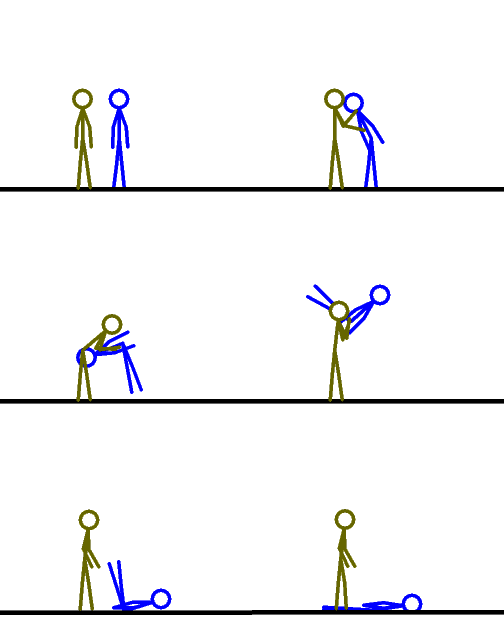
A powerbomb is a throw in which the attacking wrestler lifts the opponent from a standing headscissors position—where the opponent's head is positioned between the attacker's legs—and transitions them to a seated position on the attacker's shoulders, before slamming them down back-first onto the mat or the attacker's knees. This maneuver emphasizes raw power and dominance, distinguishing it as a high-impact technique that showcases the performer's strength through the vertical lift and forceful drop. Key characteristics of the powerbomb include its potential for varied execution, where factors such as the height of the lift, the speed of the descent, and the release angle can intensify the impact on the recipient's back and shoulders. It is typically employed as a signature or finishing move due to its devastating effect, often signaling a climactic phase in a by building tension during the prolonged setup. The move demands substantial upper body and core strength from the performer to hoist and control the opponent's weight, while requiring considerable resilience from the recipient to absorb the forceful landing without . In contexts, the powerbomb's role extends beyond physicality to enhance narrative drama, as the anticipation of often heightens stakes and underscores the aggressor's control. Its barbaric impact primarily targets the opponent's spine, making it a reliable tool for larger performers to assert superiority, though it carries risks of back or strain if not executed with proper technique.

Basic Mechanics

In the standard powerbomb, the attacking wrestler positions the opponent facing the attacker, typically securing them in a standing headscissors hold where the opponent's head is placed between the attacker's legs. The attacker then applies underhooks to the opponent's arms or scoops under their legs to grip and prepare for elevation, hoisting the opponent to shoulder height with their torso across the attacker's shoulders and back against the attacker's chest, legs resting or straddling the shoulders. The lift mechanics rely on explosive leg drive from the attacker, utilizing the , glutes, and hips to generate upward force while maintaining to balance the opponent's weight and prevent tipping. This core engagement ensures controlled elevation without excessive strain, followed by a deliberate descent where the attacker falls backward or sits out to guide the motion safely and avoid uncontrolled drops. Upon release, the recipient impacts the mat on their upper back and shoulders, with the force primarily absorbed through the and to distribute energy and reduce direct spinal compression in properly executed versions. Distinguishing it from similar lifts like the , the powerbomb emphasizes a predominantly vertical hoist to level followed by a forward or downward slam, rather than the suplex's overhead arch and backward trajectory over the attacker's head.

History and Cultural Impact

Origins in Professional Wrestling

The powerbomb originated in North American professional wrestling in the early 1950s, accidentally invented by Lou Thesz during a match against Antonio Rocca on January 8, 1953, in , when a botched piledriver resulted in Rocca landing high on his back in a dramatic slam. The move quickly gained recognition for its high-impact potential and spread across wrestling territories. In , it saw prominent exposure in the 1980s through NWA territories, where —taught the move by Lou Thesz—began using it regularly as part of the Fabulous Freebirds, introducing it to wider U.S. audiences. The technique was standardized as the "powerbomb" by the amid the WWF-WCW boom, distinct from similar throws like the . Its roots trace back to folk wrestling practices in and , where lifts and back drops—seen in styles such as English catch and Japanese sumo—provided foundational mechanics adapted for pro wrestling's dramatic flair. The spread to in the late 1980s and early 1990s, becoming a staple in promotions like (NJPW) through strong-style influences from , blending with high-impact scripted matches.

Evolution and Notable Usage

The powerbomb gained widespread prominence during the WWF's in the late 1990s and early 2000s, as the promotion's globalization efforts amplified its visibility through high-profile television and events, evolving the move with greater emphasis on explosive speed and dramatic height for visual impact. This period saw innovations like elevated setups to heighten the maneuver's spectacle, aligning with the era's shift toward edgier, athletic presentations that captivated international audiences. Concurrently, ECW's hardcore style influenced the powerbomb's adaptation into more hazardous contexts, such as through flaming tables or over the top rope, exemplified by the Dudley Boyz's infamous powerbomb of through two burning tables in 1999, which underscored the move's role in extreme match stipulations. Among notable practitioners, popularized the Batista Bomb—a sitout powerbomb—as his primary finisher from 2005 to 2010, delivering it in over 100 documented instances during his WWE tenure to secure victories in high-stakes bouts and emphasize his dominant persona. Umaga integrated powerbomb elements into his arsenal alongside the Samoan Spike, using the lift-and-slam motion in sequences to transition from striking setups into devastating drops, enhancing his monstrous heel character in WWE storylines from 2006 onward. In Japanese promotions, elevated the powerbomb's intensity within deathmatches, notably executing it onto razor-blade boards during bouts like his 2008 encounter with , where the move's high-risk execution became a hallmark of his hardcore legacy. The powerbomb has significantly shaped match narratives, particularly in title defenses and faction rivalries, as seen in Brock Lesnar's early use of powerbomb precursors that evolved into his F-5 spinning variation, employed to decisively end championship contests and assert supremacy in feuds starting from his 2002 debut. Its perceived danger has led to restrictions in some promotions; , for instance, banned the turnbuckle powerbomb variant in 2020 following botched executions that risked spinal injuries, limiting its use to select performers trained for safe delivery. In faction warfare, the move often symbolized overwhelming force, such as the Dudley Boyz's coordinated powerbombs in ECW and WWF tag team clashes to dismantle opponents and advance territorial dominance. Culturally, the powerbomb marked milestones at major events, including the Attitude Era's controversial 1999 instance where the powerbombed 76-year-old through a table on Raw, sparking debates on excess while boosting the era's rebellious appeal. In the indie scene, adaptations like the pop-up powerbomb have enabled smaller performers to execute it effectively, relying on momentum and partner cooperation rather than raw size, as demonstrated by wrestlers like in promotions such as ROH and NXT during the 2010s.

Execution and Technique

Setup and Positioning

The setup for a powerbomb in professional wrestling commences with positioning the opponent in a standing headscissors (bent forward with their head between the attacker's thighs), usually following a grapple or a stunning move to limit resistance. The attacker then achieves opponent control by grasping around the waist with a secure waistlock, enabling the hoist onto the shoulders where the opponent's torso rests against the chest for stability. This grip is vital for managing the opponent's weight and preventing immediate counters during the preparatory phase. Pre-lift maneuvers often involve bending the opponent forward into the headscissors position, followed by wrapping arms around the abdomen to lock in the waistlock. and dynamics influence the feasibility of this control, as greater disparities demand enhanced attacker strength to safely elevate without losing balance or dropping the opponent prematurely. Environmental factors play a key role in setups, with the ring canvas providing the standard grounded base for seated or prone opponent positioning, while proximity to the ring allows for momentum-assisted variations like apron powerbombs. Standing setups may leverage ropes for rebound momentum, contrasting grounded approaches where the opponent starts lower to the mat. Turnbuckles in corner charges can trap the opponent, facilitating a controlled lift from an elevated starting point. Counter prevention during setup emphasizes techniques like hooking the legs early to block low kicks or escape rolls, combined with a low stance to maintain leverage against pushes or twists. Precise timing of the initial grab exploits the opponent's momentary vulnerability, overpowering resistance through superior grip and explosive power to deter common escapes such as sit-ups.

Performance and Release Options

Once the opponent is positioned vertically inverted on the wrestler's shoulders (head downward), the execution of the powerbomb involves the wrestler falling backward while driving the opponent downward in a controlled manner to land back-first on the mat, with precise timing to achieve visual impact without excessive force that could lead to injury. After securing the waistlock, the wrestler lifts the opponent upward, transitioning to an inverted position with the opponent's against the wrestler's chest and head pointing downward, before executing the fall. This lift and drop sequence emphasizes the wrestler's strength in maintaining balance during the ascent and descent, ensuring the opponent's weight is distributed to maximize the slam's dramatic effect while minimizing risk. Release options during the powerbomb vary based on the intended outcome and follow-up action. In a held pin variation, the wrestler maintains grip on the opponent post-impact to transition directly into a pinfall attempt, often crossing the legs for leverage. Free releases allow the opponent to be dropped without retention, facilitating continued offense such as strikes or grapples, while sit-out or kneeling releases—where the wrestler drops to a seated or knee position—increase pressure on the opponent's lower back for heightened impact. The speed of the powerbomb can be adjusted from a standard deliberate pace, which allows for controlled execution and partner communication, to more explosive drops that emphasize athleticism and surprise. Safety adjustments are critical in both approaches, with the receiving wrestler tucking their chin to the chest to protect the and employing a bridged landing—arching the back slightly upon impact—to distribute force across the shoulders and absorb the bump effectively. Following the impact, the wrestler often transitions seamlessly to a pin, submission hold, or additional strikes like stomps to maintain momentum in the match.

Variations

Underhook and Crucifix Variations

The double underhook powerbomb is a variation of the powerbomb that incorporates greater arm control by hooking both of the opponent's arms behind their back, typically after positioning the opponent's head between the attacker's legs. This setup allows the attacker to lift the opponent to a seated position on their shoulders before slamming them back-first to the mat, often transitioning into a sitout position for added impact. The move enhances leverage during the lift, making it particularly effective against opponents who rely on arm-based counters. A kneeling variation modifies the release by dropping to the knees upon impact, which can drive the opponent's upper back into the mat with a focused knee strike for intensified spinal pressure. Wrestlers such as Ahmed Johnson popularized this technique as the Pearl River Plunge, utilizing the double underhook to secure heavier opponents securely during high-stakes matches. The crucifix powerbomb emphasizes submission-like arm positioning by crossing the opponent's arms over their chest in a manner resembling a hold, while hooking their legs for the lift. The attacker begins with the opponent facing away, drapes them over the shoulders, secures the arms in the crossed position, and falls backward into a sitout powerbomb, often seamlessly transitioning into a pin attempt due to the pinned arm configuration. This variant restricts the opponent's ability to break free mid-air, amplifying vulnerability to follow-up pins or submissions. Professional wrestler , as Razor Ramon, made it iconic as the , a running crucifix powerbomb that showcased explosive power in competition. Sheamus adapted a similar running version as the , leveraging the hold to counter technical grapplers by limiting arm mobility and driving them into the canvas with authoritative slams. The Argentine powerbomb integrates a backbreaker rack setup, where the attacker first hoists the opponent face-up across their shoulders in an Argentine position, securing the head and one leg before spinning and dropping them back-first to the mat. This side-facing lift with a twisting element adds rotational torque to the impact, targeting the midsection and spine simultaneously. The hold's extended duration before the slam heightens the opponent's disorientation, providing strategic control in matches against agile foes. Wrestlers like have employed it as the Rack Bomb, combining the rack's pressure with the powerbomb's downward force for a hybrid offensive maneuver. The straight jacket powerbomb, also referred to as the cobra clutch powerbomb, binds the opponent's arms behind their back in a crossed, locked position akin to a straight jacket restraint, bending them forward before lifting and slamming them to the mat. This arm-binding technique, achieved by crossing the arms over the opponent's neck from behind, severely limits defensive options and exposes the upper body during the drop. The move's restrictive nature makes it ideal for neutralizing technical wrestlers who depend on arm escapes or reversals. (Cesaro) refined it as the Ricola Bomb, using the hold's immobility to execute devastating sitout versions in and bouts. These and variations collectively prioritize grounded leverage and arm immobilization over momentum-driven throws, offering wrestlers enhanced control in close-quarters exchanges against submission specialists or grapplers. By securing the arms, performers like and demonstrated how such holds can transition seamlessly from setup to impact, adapting the standard powerbomb's mechanics for tactical dominance.

Elevated and Projectiles Variations

The elevated powerbomb is a variation of the powerbomb executed from a raised position, such as the top rope or ring apron, which significantly increases the vertical drop distance and impact upon landing. This height amplifies the move's visual drama and force, often resulting in a more devastating effect compared to ground-level executions. A prominent example is The Undertaker's "Last Ride," introduced during his American Badass persona in 2000, where the opponent is hoisted several inches higher—typically 6 to 12 inches above a standard powerbomb—before being forcefully driven back-first into the mat. The superbomb serves as a high-flying iteration of this technique, emphasizing aerial elevation from the top for cruiserweight-style spectacles. The pop-up powerbomb introduces a element by propelling the opponent vertically into the air before catching them across the shoulders and slamming them down mid-descent, creating a fluid, explosive transition. This variation relies on the opponent's momentum and the performer's timing to achieve the upward launch, often without a traditional lift setup. popularized the pop-up powerbomb in , debuting it against at in 2015 to secure a victory and establishing it as a signature high-impact finisher. In the slingshot powerbomb, the performer utilizes the ring ropes to create a effect: with the opponent positioned across the shoulders, their back is bounced off the top rope to generate rebound momentum, propelling them into a subsequent slam onto the mat. This adds a dynamic, rope-assisted propulsion that enhances the move's speed and surprise factor. The running powerbomb incorporates a sprinting approach to build , allowing the performer to charge forward while lifting and dropping the opponent with amplified force from the gained momentum. exemplified this variant by executing a running powerbomb on the Big Show during WWE's Vengeance event in 2003, showcasing its effectiveness against larger opponents. These elevated and projectile variations emphasize a higher risk-reward profile due to the increased physical demands on balance, timing, and impact absorption, making them staples in cruiserweight divisions where agility amplifies their spectacle—such as in matches featuring Will Ospreay's integration of powerbombs into elaborate high spots.

Spinning and Combination Variations

The spinning powerbomb enhances the standard technique by incorporating full rotations during the lift, disorienting the opponent through before the wrestler sits out to drive them into the mat. A notable spin-out variant, the Blue Thunder Bomb, features an additional twist upon release, emphasizing dynamic momentum from the initial setup. This move's rotational element creates visual spectacle and has been popularized by wrestlers such as , who employs it as a high-impact finisher. The powerbomb transitions seamlessly from a vertical suplex hold, where the opponent is lifted upside down, into a forward push and sitout drop akin to a traditional powerbomb, amplifying the impact on the opponent's upper body. Known alternatively as the Orange Crush after its inventor , this combination variation demands precise timing and strength, blending suplex elevation with powerbomb force for greater devastation. Wrestlers like have adapted it in matches, highlighting its role in chaining maneuvers for offensive flow. In the fireman's carry powerbomb, the wrestler hoists the opponent across their shoulders in a position, secures a leg for control, and drops to a seated stance, slamming the opponent's back and head downward while optionally adding a spin or flip for flair. This setup allows for fluid integration with other holds, increasing unpredictability, and has been executed by powerhouses like Vader, whose Vader Bomb variation pulls the opponent over one shoulder for elevated impact. The powerbomb begins with the wrestler facing the opponent, hooking both arms, and whirling them horizontally in mid-air to build rotational momentum before transitioning into a sitout powerbomb slam. This acrobatic entry adds disorientation and athletic display, making it suitable for high-flyers seeking to counter size disadvantages. Performers such as have utilized it effectively, as seen in high-stakes bouts like 2025, where it combines with transitional holds for compounded offense. These spinning and combination variations elevate the powerbomb's core mechanics by introducing rotation and seamless chaining with preparatory holds, fostering unpredictability and visual excitement in . High-flyers often modify them further to emphasize , integrating elements like aerial spins to suit faster-paced styles while maintaining the move's foundational slamming force.

Other Specialized Variations

The Thunder Fire Powerbomb, a regional Japanese variant, involves the wrestler positioning the opponent in a bent-over stance with a standing headscissors, then lifting them onto one while driving a into their back or for an explosive assist before slamming them down in a modified fashion, targeting the upper shoulders and neck for heightened impact. This move, popularized in promotions like (FMW), emphasizes a high-angle drop that amplifies force through the knee-driven lift, making it particularly devastating in hardcore environments. The Powerbomb, also known as the Buckle Bomb, sees the attacker hoist the opponent into a standard powerbomb setup but drive them back-first into the ring's corner padding instead of the mat, often resulting in the opponent rebounding or slumping from the concentrated impact. Frequently employed by wrestlers like , this variation is considered high-risk due to the unforgiving nature of the , which can exacerbate spinal and trauma compared to a flat slam. Under standard rules in major promotions, it is often deemed illegal, and permanently banned it in 2020 following a botched execution by that injured Kairi Sane's shoulder. Multiple or repeated powerbombs involve executing sequential slams without respite, typically in a package variation where the opponent's legs are hooked for added control, allowing the attacker to lift and drop them repeatedly to wear down resilience. This technique was popularized by in WCW during the , who used chains of up to five or more to dominate matches, and later adapted by in as a signature of his brutal style, often delivering two to three in rapid succession for dramatic near-falls. The cumulative force heightens exhaustion and injury potential, distinguishing it from single executions by emphasizing endurance breakdown. The Inverted Powerbomb, a rare and complex maneuver due to its unconventional grip and trajectory, begins with the wrestler facing a bent opponent and securing a gutwrench waistlock to hoist them overhead in an upside-down orientation before falling forward or sitting out to drive them horizontally onto their back or shoulders. Also referred to as an inverted front in some contexts, it demands precise balance to avoid botches, contributing to its infrequent use outside specialty matches. Its rarity stems from the elevated difficulty in maintaining control during the flip, which can lead to awkward landings if mistimed. Among unique aspects of powerbomb adaptations, early hardcore iterations like the sit-out version performed on thinly padded rings over floors—pioneered in FMW by during deathmatches—were effectively banned in mainstream promotions for their extreme risk of spinal fractures and concussions, as the unyielding surface amplified impact without protective give. In , cultural specifics include inverted crucifix variations, where the lift incorporates arm hooks for a cross-like hold before the drop, blending high-flying flair with powerbomb brutality, as seen in independent Mexican circuits. These forms highlight regional emphases on spectacle and danger, often restricted under safer rule sets.

Safety Considerations

Common Injuries and Risks

The powerbomb, a high-impact maneuver involving the lifter hoisting an opponent onto their shoulders before driving them downward onto their back or , poses significant risks primarily due to the axial loading on the spine and potential for improper . Common injuries include spinal compression, which can result in herniated discs or vertebral fractures, as the recipient absorbs the of their body weight upon impact. strains and whiplash are also frequent when the recipient fails to tuck their chin properly, leading to hyperextension and damage. In elevated variations, such as those from the top rope, the increased heightens the risk of concussions from head-first impacts. Historical incidents underscore these dangers. In 1999, Darren Drozdov (Droz) suffered a catastrophic during a botched powerbomb by on , landing awkwardly on his head and resulting in quadriplegia; he retains limited upper-body function but requires a . Similarly, in 2002, Bob Holly () sustained a severe from a powerbomb by , compressing his cervical spine and sidelining him for months. Another notable case occurred in 2015 when delivered a powerbomb to Sting into the at Night of Champions, exacerbating Sting's pre-existing issues and necessitating surgery. Factors that amplify these risks include mismatched body sizes between performers, as seen in Drozdov's case where a slip due to ring conditions contributed to the mishap, inadequate training on spotting and tucking techniques, and executions from elevated positions that exceed safe impact thresholds. In professional wrestling broadly, low back injuries account for 1.2% to 18.6% of total injuries across studies, often tied to slamming maneuvers like the powerbomb. Long-term effects are evident in veterans like , who endured repeated powerbombs—particularly from Vader in WCW matches—and now suffers chronic , muscular degeneration, and neurological issues requiring hip and knee replacements. Foley's career, marked by high-risk spots including multiple powerbomb receptions, has left him with ongoing skeletal damage and limited mobility. These outcomes highlight the cumulative toll, with recipients often developing degenerative conditions from repeated spinal stress.

Training and Prevention Methods

Training protocols for learning the powerbomb emphasize gradual progression to build proficiency while minimizing . Practitioners begin with low-height drills, such as lifting and lowering partners from knee level without full release, gradually increasing elevation as control improves. Spotter assistance is essential during these sessions, with a trained observer positioned to guide the receiver's landing or intervene if balance falters, particularly for elevated variations. Additionally, sessions incorporate thick mat padding or crash pads to cushion impacts, allowing performers to focus on technique without excessive force absorption by the body. Technique adjustments play a critical role in safe execution, prioritizing communication and body positioning. Wrestlers must establish clear verbal cues before to ensure synchronized timing, enabling the receiver to tuck their chin and arch their back for a flat-back landing that distributes force across the upper body rather than concentrating it on the or head. Strength conditioning for and back is foundational, with exercises like planks, Russian twists, and deadlifts recommended to enhance stability during and absorption upon descent, reducing strain on the spine. These adjustments help prevent improper drops that could lead to spinal compression, a common risk in high-impact throws. Promotional guidelines in often incorporate equipment and restrictions to safeguard performers. In independent circuits, crash pads are standard for practicing powerbombs, providing extra cushioning beyond standard ring mats to simulate safe falls during rehearsals. Major promotions enforce internal protocols, such as prohibiting certain high-risk variations without prior approval, to align with overall standards. Rehabilitation following powerbomb-related incidents focuses on restoring spinal alignment and function through . Post-injury protocols typically include minimally invasive procedures like cervical foraminotomy to decompress affected nerves, followed by emphasizing core stabilization and modified low-impact drills. These methods prioritize gradual reintegration to maintain long-term spinal health.

References

Add your contribution
Related Hubs
User Avatar
No comments yet.