


Community hub
Recent from talks
Contribute something to knowledge base
Content stats: 0 posts, 0 articles, 1 media, 0 notes
Members stats: 0 subscribers, 0 contributors, 0 moderators, 0 supporters
Subscribers
Supporters
Contributors
Moderators
Hub AI
Craniometry AI simulator
(@Craniometry_simulator)
Hub AI
Craniometry AI simulator
(@Craniometry_simulator)
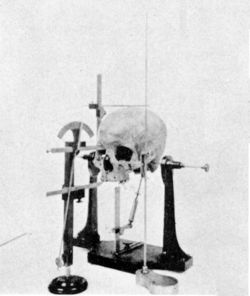
Craniometry
Craniometry is measurement of the cranium (the main part of the skull), usually the human cranium. It is a subset of cephalometry, measurement of the head, which in humans is a subset of anthropometry, measurement of the human body. It is distinct from phrenology, the pseudoscience that tried to link personality and character to head shape, and physiognomy, which tried the same for facial features.
Today, physical and forensic anthropologists use craniometry to study the evolution of human populations, determining the origin of ancient remains such as the Kennewick Man.
There is a rift between forensic and biological anthropologists in the use of race in craniometry, with biological anthropologists attempting to disprove any theory of biological race, compared to how many forensic anthropologists make inquiries based on societally-created racial categories. It was once intensively practised in physical anthropology in the 19th and the first part of the 20th century. Theories attempting to scientifically justify the segregation of society based on race became popular at this time, one of their prominent figures being Georges Vacher de Lapouge (1854–1936), who divided humanity into various, hierarchized, different "races", spanning from the "Aryan white race, dolichocephalic" (from the Ancient Greek kephalê, head, and dolikhos, long and thin), to the "brachycephalic" (short and broad-headed) race. On the other hand, craniometry was also used as evidence against the existence of a "Nordic race" and also by Franz Boas who used the cephalic index to show the influence of environmental factors. Charles Darwin used craniometry and the study of skeletons to demonstrate his theory of evolution first expressed in On the Origin of Species (1859). A few studies claim that forensic anthropologists can correctly identify the perceived social race of an individual with rates from 81-99% accuracy depending on the craniometric data, the number of variables used, the populations, and the type of analysis.
Quite separately, certain artists from the 15th century onward made measurements of heads and skulls with a view to attaining greater accuracy in their representation of those parts of the human frame. Bernard Palissy and Albrecht Dürer were pioneers in such researches.
Swedish professor of anatomy Anders Retzius (1796–1860) first used the cephalic index in physical anthropology to classify ancient human remains found in Europe. He classified brains into three main categories, "dolichocephalic" (from the Ancient Greek kephalê, head, and dolikhos, long and thin), "brachycephalic" (short and broad) and "mesocephalic" (intermediate length and width).
A similar classification was the vertical cephalic index, the categories of which were "chamaecranic" (low-skulled), "orthocranic", (medium high-skulled), and "hypsicranic" (high-skulled).
These terms were then used by Georges Vacher de Lapouge (1854–1936), one of the controversial founders of theories in this area and a theoretician of eugenics, who in L'Aryen et son rôle social (1899 – "The Aryan and his social role") divided humanity into various, hierarchized, different "races", spanning from the "Aryan white race, dolichocephalic", to the "brachycephalic" "mediocre and inert" race, best represented by the population of "France, Spain, Italy, all of Asia, and most of the Slavic countries".
Between these, Vacher de Lapouge identified the "Homo europaeus" (Teutonic, Protestant, etc.), the "Homo alpinus" (Auvergnat, Turkish, etc.), and finally the "Homo mediterraneus" (Napolitano, Andalus, etc.). "Homo africanus" (Congo, Florida) was even excluded from the discussion. Vacher de Lapouge became one of the leading inspirations of Nazi antisemitism and Nazi ideology. His classification was mirrored in William Z. Ripley in The Races of Europe (1899).
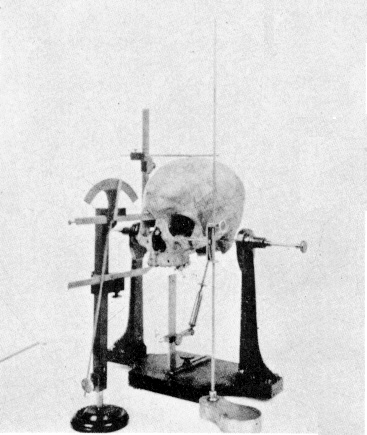
Craniometry
Craniometry is measurement of the cranium (the main part of the skull), usually the human cranium. It is a subset of cephalometry, measurement of the head, which in humans is a subset of anthropometry, measurement of the human body. It is distinct from phrenology, the pseudoscience that tried to link personality and character to head shape, and physiognomy, which tried the same for facial features.
Today, physical and forensic anthropologists use craniometry to study the evolution of human populations, determining the origin of ancient remains such as the Kennewick Man.
There is a rift between forensic and biological anthropologists in the use of race in craniometry, with biological anthropologists attempting to disprove any theory of biological race, compared to how many forensic anthropologists make inquiries based on societally-created racial categories. It was once intensively practised in physical anthropology in the 19th and the first part of the 20th century. Theories attempting to scientifically justify the segregation of society based on race became popular at this time, one of their prominent figures being Georges Vacher de Lapouge (1854–1936), who divided humanity into various, hierarchized, different "races", spanning from the "Aryan white race, dolichocephalic" (from the Ancient Greek kephalê, head, and dolikhos, long and thin), to the "brachycephalic" (short and broad-headed) race. On the other hand, craniometry was also used as evidence against the existence of a "Nordic race" and also by Franz Boas who used the cephalic index to show the influence of environmental factors. Charles Darwin used craniometry and the study of skeletons to demonstrate his theory of evolution first expressed in On the Origin of Species (1859). A few studies claim that forensic anthropologists can correctly identify the perceived social race of an individual with rates from 81-99% accuracy depending on the craniometric data, the number of variables used, the populations, and the type of analysis.
Quite separately, certain artists from the 15th century onward made measurements of heads and skulls with a view to attaining greater accuracy in their representation of those parts of the human frame. Bernard Palissy and Albrecht Dürer were pioneers in such researches.
Swedish professor of anatomy Anders Retzius (1796–1860) first used the cephalic index in physical anthropology to classify ancient human remains found in Europe. He classified brains into three main categories, "dolichocephalic" (from the Ancient Greek kephalê, head, and dolikhos, long and thin), "brachycephalic" (short and broad) and "mesocephalic" (intermediate length and width).
A similar classification was the vertical cephalic index, the categories of which were "chamaecranic" (low-skulled), "orthocranic", (medium high-skulled), and "hypsicranic" (high-skulled).
These terms were then used by Georges Vacher de Lapouge (1854–1936), one of the controversial founders of theories in this area and a theoretician of eugenics, who in L'Aryen et son rôle social (1899 – "The Aryan and his social role") divided humanity into various, hierarchized, different "races", spanning from the "Aryan white race, dolichocephalic", to the "brachycephalic" "mediocre and inert" race, best represented by the population of "France, Spain, Italy, all of Asia, and most of the Slavic countries".
Between these, Vacher de Lapouge identified the "Homo europaeus" (Teutonic, Protestant, etc.), the "Homo alpinus" (Auvergnat, Turkish, etc.), and finally the "Homo mediterraneus" (Napolitano, Andalus, etc.). "Homo africanus" (Congo, Florida) was even excluded from the discussion. Vacher de Lapouge became one of the leading inspirations of Nazi antisemitism and Nazi ideology. His classification was mirrored in William Z. Ripley in The Races of Europe (1899).
Recent media
Recent media