



Community hub
Craniometry
View on Wikipedia | This article has multiple issues. Please help improve it or discuss these issues on the talk page. (Learn how and when to remove these messages)
|


Craniometry is measurement of the cranium (the main part of the skull), usually the human cranium. It is a subset of cephalometry, measurement of the head, which in humans is a subset of anthropometry, measurement of the human body. It is distinct from phrenology, the pseudoscience that tried to link personality and character to head shape, and physiognomy, which tried the same for facial features.
Today, physical and forensic anthropologists use craniometry to study the evolution of human populations, determining the origin of ancient remains such as the Kennewick Man.[1][2][3]
There is a rift between forensic and biological anthropologists in the use of race in craniometry, with biological anthropologists attempting to disprove any theory of biological race, compared to how many forensic anthropologists make inquiries based on societally-created racial categories.[4] It was once intensively practised in physical anthropology in the 19th and the first part of the 20th century. Theories attempting to scientifically justify the segregation of society based on race became popular at this time, one of their prominent figures being Georges Vacher de Lapouge (1854–1936), who divided humanity into various, hierarchized, different "races", spanning from the "Aryan white race, dolichocephalic" (from the Ancient Greek kephalê, head, and dolikhos, long and thin), to the "brachycephalic" (short and broad-headed) race. On the other hand, craniometry was also used as evidence against the existence of a "Nordic race" and also by Franz Boas who used the cephalic index to show the influence of environmental factors. Charles Darwin used craniometry and the study of skeletons to demonstrate his theory of evolution first expressed in On the Origin of Species (1859). A few studies claim that forensic anthropologists can correctly identify the perceived social race of an individual with rates from 81-99% accuracy depending on the craniometric data, the number of variables used, the populations, and the type of analysis.[5][6][7]
Quite separately, certain artists from the 15th century onward made measurements of heads and skulls with a view to attaining greater accuracy in their representation of those parts of the human frame. Bernard Palissy and Albrecht Dürer were pioneers in such researches.[8]
The cephalic index
[edit]Swedish professor of anatomy Anders Retzius (1796–1860) first used the cephalic index in physical anthropology to classify ancient human remains found in Europe. He classified brains into three main categories, "dolichocephalic" (from the Ancient Greek kephalê, head, and dolikhos, long and thin), "brachycephalic" (short and broad) and "mesocephalic" (intermediate length and width).
A similar classification was the vertical cephalic index, the categories of which were "chamaecranic" (low-skulled), "orthocranic", (medium high-skulled), and "hypsicranic" (high-skulled).
These terms were then used by Georges Vacher de Lapouge (1854–1936), one of the controversial founders of theories in this area and a theoretician of eugenics, who in L'Aryen et son rôle social (1899 – "The Aryan and his social role") divided humanity into various, hierarchized, different "races", spanning from the "Aryan white race, dolichocephalic", to the "brachycephalic" "mediocre and inert" race, best represented by the population of "France, Spain, Italy, all of Asia, and most of the Slavic countries".[9]
Between these, Vacher de Lapouge identified the "Homo europaeus" (Teutonic, Protestant, etc.), the "Homo alpinus" (Auvergnat, Turkish, etc.), and finally the "Homo mediterraneus" (Napolitano, Andalus, etc.). "Homo africanus" (Congo, Florida) was even excluded from the discussion. Vacher de Lapouge became one of the leading inspirations of Nazi antisemitism and Nazi ideology.[10] His classification was mirrored in William Z. Ripley in The Races of Europe (1899).
Craniometry and anthropology
[edit]
In 1784, Louis-Jean-Marie Daubenton, who wrote many comparative anatomy memoirs for the Académie française, published the Mémoire sur les différences de la situation du grand trou occipital dans l'homme et dans les animaux (which translates as Memoir on the Different Positions of the Occipital Foramen in Man and Animals).
Six years later, Pieter Camper (1722–1789), distinguished both as an artist and as an anatomist, published some lectures containing an account of his craniometrical methods. These laid the foundation of all subsequent work.[8]
Pieter Camper invented the "facial angle", a measure meant to determine intelligence among various species. According to this technique, a "facial angle" was formed by drawing two lines: one horizontally from the nostril to the ear; and the other perpendicularly from the advancing part of the upper jawbone to the most prominent part of the forehead.
Camper claimed that antique statues presented an angle of 90°, Europeans of 80°, Black people of 70° and the orangutan of 58°, thus displaying a hierarchic view of mankind, based on a decadent conception of history. This scientific research was continued by Étienne Geoffroy Saint-Hilaire (1772–1844) and Paul Broca (1824–1880), founder of the Anthropological Society in 1859 in France.
In 1856, workers found in a limestone quarry the skull of a Neanderthal man, thinking it to be the remains of a bear. They gave the material to amateur naturalist Johann Karl Fuhlrott, who turned the fossils over to anatomist Hermann Schaaffhausen. The discovery was jointly announced in 1857, giving rise to paleoanthropology.
Measurements were first made to compare the skulls of men with those of other animals. This wide comparison constituted the first subdivision of craniometric studies.[8] The artist-anatomist Camper developed a theory to measure the facial angle, for which he is chiefly known in later anthropological literature.
Camper's work followed 18th-century scientific theories. His measurements of facial angle were used to liken the skulls of non-Europeans to those of apes.

"Craniometry" also played a role in the foundation of the United States and the ideologies or racism that would become ingrained in the American psyche. As John Jeffries articulates in The Collision of Culture the Anglo-American hegemony present in America during the eighteenth and nineteenth century helped establish "The American School of Craniometry" which helped establish the American and Western concept of race. As Jeffries points out the rigid establishment of race in eighteenth-century American society came from a new school of sciences which sought to distance Anglo-Saxons from the African American population. The distancing of the African population in American society through craniometry helped greatly in the efforts to scientifically prove they were inferior. The ideologies set forth by this new "American School" of thought were then used to justify maintaining an enslaved population to sustain the increasing number of slave plantations in the American South during the eighteenth and nineteenth centuries.[11]
In the 19th century the names of notable contributors to the literature of craniometry quickly increased in number. While it is impossible to analyse each contribution, or even record a complete list of the names of the authors, notable researchers who used craniometric methods to compare humans to other animals included T. H. Huxley (1825–1895) of England and Paul Broca.[8]
By comparing skeletons of apes to man, Huxley backed up Charles Darwin's theory of evolution and developed the "Pithecometra principle", which stated that man and ape were descended from a common ancestor.
Ernst Haeckel (1834–1919) became famous for his now outdated "recapitulation theory", according to which each individual mirrored the evolution of the whole species during his life. Although outdated, his work contributed then to the examination of human life.
These researches on skulls and skeletons helped liberate 19th-century European science from its ethnocentric biases.[12] In particular, Eugène Dubois' (1858–1940) discovery in 1891 in Indonesia of the "Java Man", the first specimen of Homo erectus to be discovered, demonstrated mankind's deep ancestry outside Europe.
Cranial capacity, races and 19th–20th-century scientific ideas
[edit]Samuel George Morton (1799–1851), one of the inspirers of physical anthropology, collected hundreds of human skulls from all over the world and started trying to find a way to classify them according to some logical criterion. Influenced by the common theories of his time, he claimed that he could judge the intellectual capacity of a race by the cranial capacity (the measure of the volume of the interior of the skull).
After inspecting three mummies from ancient Egyptian catacombs, Morton concluded that Caucasians and other races were already distinct three thousand years ago. Since the Bible indicated that Noah's Ark had washed up on Mount Ararat, only a thousand years ago before this, Morton claimed that Noah's sons could not possibly account for every race on Earth. According to Morton's theory of polygenism, races have been separate since the start.[13]
Morton claimed that he could judge the intellectual capacity of a race by the skull size. A large skull meant a large brain and high intellectual capacity, and a small skull indicated a small brain and decreased intellectual capacity. Morton collected hundreds of human skulls from all over the world. By studying these skulls he claimed that each race had a separate origin. Morton had many skulls from ancient Egypt, and concluded that the ancient Egyptians were not African, but were White. His two major monographs were the Crania Americana (1839), An Inquiry into the Distinctive Characteristics of the Aboriginal Race of America and Crania Aegyptiaca (1844).
Based on craniometry data, Morton claimed in Crania Americana that the Caucasians had the biggest brains, averaging 87 cubic inches, Indians were in the middle with an average of 82 cubic inches and Negroes had the smallest brains with an average of 78 cubic inches.[13]
Stephen Jay Gould (1941–2002), an American paleontologist, evolutionary biologist and historian of science, studied these craniometric works in The Mismeasure of Man (1981) and claimed Samuel Morton had fudged data and "overpacked" the skulls with filler in order to justify his preconceived notions on racial differences. A subsequent study by the anthropologist John Michael found Morton's original data to be more accurate than Gould describes, concluding that "[c]ontrary to Gould's interpretation... Morton's research was conducted with integrity."[14]
In 2011, physical anthropologists at the University of Pennsylvania, which owns Morton's collection, published a study that concluded that almost every detail of Gould's analysis was wrong and that "Morton did not manipulate his data to support his preconceptions, contra Gould." They identified and remeasured half of the skulls used in Morton's reports, finding that in only 2% of cases did Morton's measurements differ significantly from their own and that these errors either were random or gave a larger than accurate volume to African skulls, the reverse of the bias that Gould imputed to Morton.[15]
Morton's followers, particularly Josiah C. Nott and George Gliddon in their monumental tribute to Morton's work, Types of Mankind (1854), carried Morton's ideas further and backed up his findings which supported the notion of polygenism.
Charles Darwin opposed Nott and Glidon in his 1871 The Descent of Man, arguing for a monogenism of the species. Darwin conceived the common origin of all humans (the single-origin hypothesis) as essential for evolutionary theory.
Furthermore, Josiah Nott was the translator of Arthur de Gobineau's An Essay on the Inequality of the Human Races (1853–1855), which is one of the founding works of the group of studies that segregates society based on "race", in contrast to Boulainvilliers' (1658–1722) theory of races. Henri de Boulainvilliers opposed the Français (French people), alleged descendants of the Nordic Franks, and members of the aristocracy, to the Third Estate, considered to be indigenous Gallo-Roman people who were subordinated by the Franks by right of conquest.[clarification needed] Gobineau, meanwhile, made three main divisions between races, based not on colour but on climatic conditions and geographic location, and which privileged the "Aryan" race.
In 1873, Paul Broca (1824–1880) found the same pattern described by Samuel Morton's Crania Americana by weighing brains at autopsy. Other historical studies alleging a Black-White difference in brain size include Bean (1906), Mall, (1909), Pearl, (1934) and Vint (1934).

Furthermore, Georges Vacher de Lapouge's racial classification ("Teutonic", "Alpine" and "Mediterranean") was re-used by William Z. Ripley (1867–1941) in The Races of Europe (1899), who even made a map of Europe according to the alleged cephalic index of its inhabitants.
In Germany, Rudolf Virchow launched a study of craniometry, which gave surprising results according to contemporary theories on the "Aryan race", leading Virchow to denounce the "Nordic mysticism" in the 1885 Anthropology Congress in Karlsruhe.
Josef Kollmann, a collaborator of Virchow, stated in the same congress that the people of Europe, be them German, Italian, English or French, belonged to a "mixture of various races", furthermore declaring that the "results of craniology" led to "struggle against any theory concerning the superiority of this or that European race" on others.[16]
Virchow later rejected measure of skulls as legitimate means of taxonomy. Paul Kretschmer quoted an 1892 discussion with him concerning these criticisms, also citing Aurel von Törok's 1895 work, who basically proclaimed the failure of craniometry.[16]
Craniometry, phrenology and physiognomy
[edit]Craniometry was also used in phrenology, which purported to determine character, personality traits, and criminality on the basis of the shape of the head and thus of the skull. At the turn of the 19th century, Franz Joseph Gall (1758–1822) developed "cranioscopy" (Ancient Greek kranion: skull, scopos: vision), a method to determine the personality and development of mental and moral faculties on the basis of the external shape of the skull.
Cranioscopy was later renamed to phrenology (phrenos: mind, logos: study) by his student Johann Spurzheim (1776–1832), who wrote extensively on the "Drs. Gall and Spurzheim's physiognomical System". Physiognomy claimed a correlation between physical features (especially facial features) and character traits.
It was made famous by Cesare Lombroso (1835–1909), the founder of anthropological criminology, who claimed to be able to scientifically identify links between the nature of a crime and the personality or physical appearance of the offender. The originator of the concept of a "born criminal" and arguing in favor of biological determinism, Lombroso tried to recognize criminals by measurements of their bodies.
He concluded that skull and facial features were clues to genetic criminality, and that these features could be measured with craniometers and calipers with the results developed into quantitative research. A few of the 14 identified traits of a criminal included large jaws, forward projection of jaw, low sloping forehead; high cheekbones, flattened or upturned nose; handle-shaped ears; hawk-like noses or fleshy lips; hard shifty eyes; scanty beard or baldness; insensitivity to pain; long arms, and so on.
Criticisms and revival of past cranial theories in the 20th century
[edit]
After being a main influence of US white nationalists, William Ripley's The Races of Europe (1899) was eventually rewritten in 1939, just before World War II, by Harvard physical anthropologist Carleton S. Coon.[citation needed]
J. Philippe Rushton, psychologist, head of the Pioneer Fund, an organization founded in 1937 to promote eugenics,[17][18] and author of the controversial work Race, Evolution and Behavior (1995), reanalyzed Gould's retabulation in 1989, and argued that Samuel Morton, in his 1839 book Crania Americana, had shown a pattern of decreasing brain size proceeding from East Asians to Europeans to Africans.
In his 1995 book Race, Evolution, and Behavior, Rushton alleged an average endocranial volume of 1,364 cm3 for East Asians, 1,347 for white caucasians and 1,268 for black Africans. Other similar claims were previously made by Ho et al. (1980), who measured 1,261 brains at autopsy, and Beals et al. (1984), who measured approximately 20,000 skulls, finding the same East Asian → European → African pattern. However, in the same article Beals explicitly warns against using the findings as indicative of racial traits, "If one merely lists such means by geographical region or race, causes of similarity by genogroup and ecotype are hopelessly confounded".[19] Rushton's findings have also been criticized for questionable methodology, such as lumping in African-Americans with equatorial Africans, as people from hot climates generally have slightly smaller crania.[20] Rushton also compared equatorial Africans from the poorest and least educated areas of Africa against Asians from the wealthiest and most educated areas of Asia and areas with colder climates which generally induce larger cranium sizes in evolution.[20] According to Zack Cernovsky, from one of Rushton's own study it emerges that the average cranial capacity for North American blacks is similar to the average for Caucasians from comparable climatic zones.[20][21] Per Cernovsky, people from different climates tend to have minor differences in brain size, but these do not necessarily imply differences in intelligence; for instance, though women tend to have smaller brains than men they also have more neural complexity and loading in certain areas of the brain than men.[22][23]
Modern use
[edit]More direct measurements involve examinations of brains from corpses, or more recently, imaging techniques such as CT[24] or MRI, which can be used on living persons. Such measurements are used in research on neuroscience and intelligence.
Brain volume data and other craniometric data are used in mainstream science to compare modern-day animal species, and to analyze the evolution of the human species.
Measurements of the skull based on specific anatomical reference points are used in both forensic facial reconstruction and portrait sculpture.[citation needed]
In forensic anthropology, cranial measurements can be used to infer the sex[25] and ancestry of an individual.[24]
In archaeology, similarities in cranial measurements have been used as evidence for gene flow events (such as migration) between populations.[26]
See also
[edit]
References
[edit]- ^ Mann, Robert (2015). Berg, Gregory E.; Ta'Ala, Sabrina C. (eds.). The Sagittal Suture as an Indicator of Race and Sex. Biological Affinity in Forensic Identification of Human Skeletal Remains: Beyond Black and White. p. 106. doi:10.1201/b17832. ISBN 978-0-429-24504-6. Retrieved 18 July 2024.
{{cite book}}: CS1 maint: location missing publisher (link) - ^ Gill, George (1998). "Craniofacial Criteria in the Skeletal Attribution of Race". Journal of Anatomy. 194 (1) (2nd ed.). Forensic Osteology: Advances in the Identification of Human Remains: 293–295. doi:10.1046/j.1469-7580.1999.194101532.x. PMC 1467905.
- ^ Bonnichsen v. United States, 367 F.3d 864, 870-872 (9th Circuit 2004).
- ^ Ousley, Stephen (2009). "Understanding Race and Human Variation: Why Forensic Anthropologists are Good at Identifying Race". American Journal of Physical Anthropology. 139 (1): 68–76. doi:10.1002/ajpa.21006. PMID 19226647.
- ^ Mann, Robert (2015). The Sagittal Suture as an Indicator of Race and Sex. Biological Affinity in Forensic Identification of Human Skeletal Remains: Beyond Black and White. p. 111.
{{cite book}}: CS1 maint: location missing publisher (link) - ^ Gill, George (1998). Craniofacial Criteria in the Skeletal Attribution of Race (2nd ed.). Forensic Osteology: Advances in the Identification of Human Remains. p. 305.
{{cite book}}: CS1 maint: location missing publisher (link) - ^ Ousley, Stephen (2009). "Understanding Race and Human Variation: Why Forensic Anthropologists are Good at Identifying Race". American Journal of Physical Anthropology. 139 (1): 71. doi:10.1002/ajpa.21006. PMID 19226647.
- ^ a b c d Duckworth 1911, p. 372.
- ^ Hecht, Jennifer Michael (2003). The end of the soul: scientific modernity, atheism, and anthropology in France. New York: Columbia University Press. p. 171. ISBN 978-0-231-12846-9.
- ^ See Pierre-André Taguieff, La couleur et le sang – Doctrines racistes à la française ("Colour and Blood – doctrines à la française"), Paris, Mille et une nuits, 2002, 203 pages, and La Force du préjugé – Essai sur le racisme et ses doubles, Tel Gallimard, La Découverte, 1987, 644 pages
- ^ Wallace, Michele (1992). Black Popular Culture. Seattle: Bay Press. pp. 156–157. ISBN 978-1-56584-459-9.
- ^ "Cultural Biases Reflected in the Hominid Fossil Record" (history), by Joshua Barbach and Craig Byron, 2005, ArchaeologyInfo.com webpage: ArchaeologyInfo-003 Archived 16 May 2011 at the Wayback Machine.
- ^ a b David Hurst Thomas, Skull Wars Kennewick Man, Archaeology, And The Battle For Native American Identity, 2001, pp. 38 – 41
- ^ Michael, J. S. (1988). "A New Look at Morton's Craniological Research". Current Anthropology. 29 (2): 349–354. doi:10.1086/203646. S2CID 144528631.
- ^ Lewis, Jason E.; DeGusta, D.; Meyer, M.R.; Monge, J.M.; Mann, A.E.; et al. (2011). "The Mismeasure of Science: Stephen Jay Gould versus Samuel George Morton on Skulls and Bias". PLOS Biol. 9 (6) e1001071. doi:10.1371/journal.pbio.1001071. PMC 3110184. PMID 21666803.
- ^ a b Andrea Orsucci, "Ariani, indogermani, stirpi mediterranee: aspetti del dibattito sulle razze europee (1870–1914) Archived 18 December 2012 at archive.today, Cromohs, 1998 (in Italian)
- ^ Saini, Angela (2019). Superior: The Return of Race Science. Beacon Press. p. 64. ISBN 978-0-8070-7691-0.
- ^ Lombardo, Paul A. (2002). "'The American Breed': Nazi Eugenics and the Origins of the Pioneer Fund". Albany Law Review. 65 (3): 743–830. PMID 11998853. SSRN 313820.
- ^ Beals, Kenneth L.; et al. (1984). "Brain Size, Cranial Morphology, Climate, and Time Machines". Current Anthropology. 25 (3): 306. doi:10.1086/203138. JSTOR 2742800. S2CID 86147507.
- ^ a b c Cernovsky, Z. Z. (1997)A critical look at intelligence research, In Fox, D. & Prilleltensky, I. (Eds.) Critical Psychology, London: Sage, ps 121–133.
- ^ Rushton, J. P. (1990). "Race, Brain Size, and Intelligence: A Rejoinder to Cain and Vanderwolf". Personality and Individual Differences. 11 (8): 785–794. doi:10.1016/0191-8869(90)90186-u.
- ^ Insider – The Female Brain, By Ivory E. Welcome, MBA Candidate December 2009
- ^ Cosgrove, KP; Mazure, CM; Staley, JK (October 2007). "Evolving knowledge of sex differences in brain structure, function, and chemistry". Biol. Psychiatry. 62 (8): 847–55. doi:10.1016/j.biopsych.2007.03.001. PMC 2711771. PMID 17544382.
- ^ a b Simmons-Ehrhardt, Terrie L.; Ehrhardt, Christopher J.; Monson, Keith L. (1 December 2019). "Evaluation of the suitability of cranial measurements obtained from surface-rendered CT scans of living people for estimating sex and ancestry". Journal of Forensic Radiology and Imaging. 19 100338. doi:10.1016/j.jofri.2019.100338. ISSN 2212-4780.
- ^ Santos Mota, Matheus Jhonnata; Alves Vieira, Alberto Calson; Silva Lima, Lucas; Sátiro, João Victor Melquiades; de Menezes Neto, Carlos Mathias; Prado Paixão, Patrízia Lisieux; Gonçalves Lopes, Gabriel Pedro; de Azevedo Setton, Lauro Roberto; de Andrade, Carlos Eduardo; Halti Cabral, Richard (1 December 2025). "Enhancing sex determination in forensic anthropology: A comparative analysis of cranial measurements using artificial neural network". Forensic Science International: Reports. 12 100422. doi:10.1016/j.fsir.2025.100422. ISSN 2665-9107.
- ^ McNiven, Ian J. (10 February 2021), McNiven, Ian J.; David, Bruno (eds.), "Coral Sea Cultural Interaction Sphere", The Oxford Handbook of the Archaeology of Indigenous Australia and New Guinea (1 ed.), Oxford University Press, pp. 591–616, doi:10.1093/oxfordhb/9780190095611.013.28, ISBN 978-0-19-009561-1, retrieved 3 October 2025
- ^ Schültke, Elisabeth (May 2009). "Theodor Kocher's craniometer". Neurosurgery. 64 (5). United States: 1001–4, discussion 1004–5. doi:10.1227/01.NEU.0000344003.72056.7F. PMID 19404160.
Sources
[edit]- This article incorporates text from a publication now in the public domain: Duckworth, Wynfrid Laurence Henry (1911). "Craniometry". In Chisholm, Hugh (ed.). Encyclopædia Britannica. Vol. 7 (11th ed.). Cambridge University Press. pp. 372–374.

| International | |
|---|---|
| National | |
| Other | |

Craniometry
View on GrokipediaDefinition and Methods
Core Measurements and Indices
The primary linear measurements in craniometry focus on the calvarial vault and facial skeleton, obtained using spreading or sliding calipers to capture maximum dimensions between defined landmarks. Maximum cranial length (GOL) is the straight-line distance from the glabella (most prominent midline point on the supraorbital margin) to the opisthocranion (most posterior midline point on the occipital bone). Maximum cranial breadth (XCB) measures the greatest width of the skull perpendicular to the midsagittal plane, typically between the euryon points on the parietal bones. Basion-bregma height (BBH) extends from the basion (midpoint on the anterior margin of the foramen magnum) to the bregma (intersection of the coronal and sagittal sutures). These dimensions form the basis for comparative analyses in physical anthropology.[9][10] Derived indices express proportional relationships among these measurements, enabling skull shape classifications independent of absolute size. The cephalic (cranial) index, calculated as (maximum cranial breadth / maximum cranial length) × 100, categorizes crania as dolichocephalic (<75), mesocephalic (75–79.9), or brachycephalic (≥80). The length-height index, or auricular height index, is (basion-bregma height / maximum cranial length) × 100, while the breadth-height index is (basion-bregma height / maximum cranial breadth) × 100; these assess vertical proportions relative to horizontal axes. Facial indices, such as the upper facial index ((nasio-prosthion height / bizygomatic breadth) × 100), extend similar principles to the viscerocranium.[11][12][13] Cranial capacity, a key volumetric measure approximating endocranial volume, is determined directly by filling the cranial cavity with granular material (e.g., mustard seeds or lead shot) and assessing displacement, or indirectly via formulas like the spheroid approximation π/6 × length × breadth × height applied to linear dimensions. Early practitioners, such as Samuel Morton in the 1830s–1840s, relied on seed-filling methods for population comparisons, yielding capacities typically ranging 1,000–1,800 cm³ in adult humans. Modern validations confirm formula-based estimates correlate closely with direct methods, though they may underestimate by 5–10% without adjustments for cranial wall thickness.[14][15]Historical and Modern Techniques
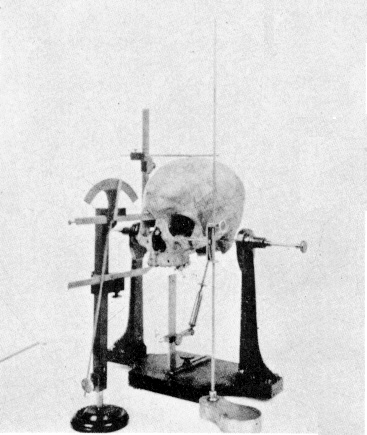
Historical techniques in craniometry primarily utilized manual instruments to acquire linear, angular, and volumetric data from physical skulls. Sliding calipers were employed to measure external dimensions, such as maximum cranial length (from glabella to opisthocranion) and breadth (between euryons), enabling the computation of the cephalic index as (maximum breadth / maximum length) × 100, a ratio introduced by Anders Retzius in 1842.[13][16] Spreading calipers facilitated internal and auricular height measurements by accommodating curved or non-parallel surfaces.[13] Cranial capacity, serving as a proxy for brain volume, was determined through displacement methods, notably by Samuel George Morton, who initially filled skull interiors with white mustard seeds in the 1830s before switching to lead shot for enhanced precision and reduced compressibility errors by the 1840s.[7][17] These approaches relied on standardized anatomical landmarks, like nasion and basion, to ensure reproducibility, though inter-observer variability and material inconsistencies posed challenges.[12] Modern techniques have transitioned to digital and imaging-based methods, supplanting invasive physical handling with non-destructive alternatives. Computed tomography (CT) and cone-beam CT (CBCT) generate high-resolution three-dimensional models for accurate linear and volumetric assessments, with studies confirming equivalence to manual caliper measurements within 0.5 mm for craniofacial dimensions.[18] Magnetic resonance imaging (MRI) complements these by delineating soft tissue interfaces alongside bony structures, facilitating in vivo craniometry without radiation exposure.[19] Three-dimensional surface scanning, via laser or structured light technologies, captures cranial morphology with sub-millimeter precision, enabling geometric morphometric analyses that quantify shape variations beyond traditional indices.[20] These methods enhance data fidelity and allow remote, replicable measurements, as validated in comparisons showing digital tools reduce error margins compared to spreading calipers for complex surfaces.[21] Applications persist in forensic anthropology, evolutionary biology, and clinical orthodontics, prioritizing empirical accuracy over historical assumptions.[22]Historical Development
Eighteenth-Century Foundations
The eighteenth-century foundations of craniometry emerged amid Enlightenment-era efforts to empirically classify human variation through comparative anatomy, with skulls serving as key artifacts due to their durability and perceived reflection of innate differences. Anatomists began systematically collecting and examining crania to discern patterns in morphology, moving beyond qualitative descriptions toward rudimentary quantification. This period marked the transition from descriptive natural history to geometric assessments, influenced by broader interests in physiognomy and species hierarchy.[23] Johann Friedrich Blumenbach, a German physiologist and anthropologist, advanced early cranial comparison in his 1775 doctoral dissertation De Generis Humani Varietate Nativa, where he analyzed a collection of skulls to delineate human varieties. He identified four initial varieties—based on cranial shape, skin color, and other traits—expanding to five in later editions (1781 and 1795), including Caucasian (named after a Georgian female skull he deemed prototypically beautiful), Mongolian, Ethiopian, American, and Malayan. Blumenbach's approach emphasized skull form as a primary indicator of racial divergence within a monogenic species, arguing deviations from the Caucasian ideal resulted from environmental degeneration, though his classifications relied more on visual and proportional assessment than precise metrics.[24][25] Petrus Camper, a Dutch anatomist, introduced the first systematic craniometric tool with his facial angle, developed in lectures delivered on August 1 and 8, 1770, to the Drawing Academy in Amsterdam. Defined as the angle between a line from the forehead's prominent point through the nasal base and a horizontal line along the jaw or auricular axis, it quantified prognathism and facial projection. Camper applied it to profiles from classical Greco-Roman statues (95°–100°), Europeans (around 80°), Orientals and Africans (around 70°), and apes (lower values), positing a continuum from idealized antiquity to "primitive" forms that supported notions of racial and evolutionary gradation. Though published posthumously in 1791 as Über den natürlichen Unterschied der Gesichtszüge, Camper's method provided an objective geometric framework, influencing subsequent anthropometric standardization despite later critiques of landmark subjectivity.[26][27]Nineteenth-Century Expansion and Key Figures
In the nineteenth century, craniometry transitioned from sporadic observations to a systematic quantitative discipline within emerging physical anthropology, fueled by debates over human origins, polygenism, and racial hierarchies amid European colonial expansion and American ethnological inquiries. Practitioners amassed large skull collections—often numbering in the hundreds or thousands—and refined measurement techniques, such as filling crania with lead shot or mustard seeds to estimate internal capacity in cubic inches, alongside caliper assessments of external dimensions. This expansion institutionalized craniometry in medical curricula and scientific societies, positioning it as a purported empirical tool for delineating fixed human varieties, though later methodological critiques would challenge interpretive assumptions.[23] A pivotal figure was American physician Samuel George Morton (1799–1851), who began assembling a collection of over 1,000 crania around 1830, sourcing them from global donors including missionaries and explorers. In his 1839 monograph Crania Americana, Morton reported average cranial capacities of 87 cubic inches for Caucasians, 82 for Indigenous Americans, 78 for Africans, and 75 for Australians, interpreting these as evidence of innate intellectual hierarchies and polygenic origins of races rather than environmental adaptation. He refined volume estimation by packing skulls with clean, uniform lead shot (later mustard seeds for consistency), yielding data that subsequent reanalyses in 2018 confirmed as arithmetically accurate without the unconscious biases alleged by critics like Stephen Jay Gould, though debates persist on causal inferences from capacity alone. Morton's work influenced transatlantic racial science, including endorsements from Louis Agassiz, and his collection endures at the University of Pennsylvania Museum.[3][28] In Europe, Swedish anatomist Anders Retzius (1796–1860) advanced craniometry by introducing the cephalic index in the 1840s, defined as (maximum skull breadth divided by maximum length) multiplied by 100, to classify crania into dolichocephalic (long-headed, index <75), mesocephalic (75–80), and brachycephalic (short-headed, >80) forms. Retzius applied this metric initially to prehistoric Scandinavian remains, positing it as a stable racial marker traceable across populations, which facilitated mappings of supposed Aryan migrations and distinctions between Nordic and Mediterranean types. His index gained traction for its simplicity and reproducibility, enabling field anthropologists to measure living subjects via head calipers, though it overlooked sexual dimorphism and age-related plasticity in skull shape.[29] Paul Broca (1824–1880), a French surgeon and founder of the Société d'Anthropologie de Paris in 1859, spearheaded the Parisian school's rigorous craniometric program, emphasizing statistical aggregation of thousands of measurements from diverse global samples to infer evolutionary and intellectual gradients. Broca's team dissected and cataloged crania from Parisian hospitals, military collections, and colonial acquisitions, correlating not only capacity but also asymmetry, suture patterns, and orbital indices with cognitive faculties, while arguing that frontal lobe development outweighed sheer volume. By the 1860s, Broca's instruments and protocols standardized craniometry across laboratories, producing datasets that reinforced hierarchies—such as larger capacities in Europeans versus non-Europeans—but prioritized morphological form as a causal proxy for brain efficiency over simplistic volumetric claims. His society's bulletins disseminated these findings, embedding craniometry in French anthropology until the early twentieth century.[30][31]Applications in Physical Anthropology
Racial Typology via Cephalic Index
The cephalic index (CI), defined as the ratio of maximum skull breadth to maximum skull length multiplied by 100, emerged as a primary tool for racial classification in 19th-century physical anthropology, particularly for distinguishing European population groups. Swedish anatomist Anders Retzius developed the metric in the 1840s to analyze skulls from Scandinavian dolmens, categorizing them into dolichocephalic (long-headed, CI < 75) and brachycephalic (broad-headed, CI > 80) forms, with the former linked to ancient Nordic inhabitants and the latter to subsequent Alpine or Asiatic migrations.[32] Retzius's approach treated head shape as a fixed hereditary marker of racial origin, influencing typological schemes that mapped cephalic variation onto ethnic distributions.[33] This framework gained prominence through William Z. Ripley's The Races of Europe (1899), which synthesized thousands of measurements from military conscripts and civilians to delineate three European races via cephalic index gradients. Ripley identified the Teutonic or Nordic race as predominantly dolichocephalic (average CI 72–76 in Scandinavia and northern Germany), the Mediterranean race as similarly long-headed but differentiated by stature and pigmentation (CI ≈76–78 in southern Europe), and the Alpine race as brachycephalic (CI 80–85 in central highlands like the Alps and Pyrenees).[34] His isopleth maps depicted a clinal increase in brachycephaly from north to south and east, correlating higher indices with shorter stature and rounder facial features as composite racial traits.[35] Empirical data underpinning these typologies derived from large-scale anthropometric surveys, revealing statistically significant population differences; for instance, northern European conscripts averaged CI values below 75, while central and eastern groups exceeded 80, with minimal overlap in extremes.[34] Ashkenazi Jewish populations exhibited consistently brachycephalic indices around 81.5–83, interpreted by contemporaries as evidence of distinct racial admixture.[36] Such findings supported typologists' view of cephalic index as a reliable proxy for racial purity and migration history, though the metric's emphasis on breadth overlooked longitudinal skull variations and potential plastic responses to nutrition or binding practices.[37] Proponents like Ripley argued that these index distributions aligned with linguistic, cultural, and historical boundaries, positing cephalic form as causal in shaping societal traits, from martial prowess in dolichocephalic north to sedentary agriculture in brachycephalic interiors.[34] Despite methodological advances in data collection—standardizing living head measurements over dry skulls—the typology assumed discrete categories amid continuous variation, a simplification later challenged but rooted in observable averages confirmed across datasets.[38]Cranial Capacity and Population Comparisons
Cranial capacity, the internal volume of the skull enclosing the brain, is typically measured in cubic centimeters (cm³) and serves as a proxy for brain size in craniometric studies. Historical methods included filling skulls with lead shot or mustard seeds, as pioneered by Samuel George Morton in the 19th century, while modern techniques employ magnetic resonance imaging (MRI), autopsy dissections, and external head circumference estimates. These approaches have yielded consistent population-level differences, with East Asians averaging the highest capacities, followed by Europeans, and sub-Saharan Africans the lowest, patterns persisting across measurement modalities after controlling for body size.[39][40] Morton's 1839 dataset, derived from over 1,000 skulls using seed displacement, reported averages of approximately 1,426 cm³ for Caucasians, 1,378 cm³ for Mongolians (East Asians), and 1,277 cm³ for Negroes (sub-Saharan Africans), with differences attributed to innate variation rather than cranial deformation. Subsequent 19th- and early 20th-century studies, including those by Robert Bennett Bean and Aleš Hrdlička, corroborated these rankings through similar volumetric techniques on thousands of specimens. Aggregated analyses of such data, spanning from 1759 onward, confirm Europeans averaging larger capacities than Africans by 100–150 cm³, with East Asians exceeding Europeans by 10–20 cm³ on average.[41][39] Contemporary evidence from MRI scans and endocranial casts reinforces these findings. A meta-analysis of MRI studies by Rushton and Ankney (2009) reported average brain volumes of 1,364 cm³ for East Asians, 1,347 cm³ for Europeans, and 1,267 cm³ for Africans, with a within-study correlation of 0.44 between brain size and intelligence quotients (IQ). External head measurements from military and civilian samples, such as International Labour Office data, yield similar disparities: East Asian males at 1,460 cm³, European males at 1,440 cm³, and African males at 1,370 cm³. Autopsy records from over 20,000 brains, compiled by Ho et al. (1980) and others, show parallel gradients, with racial differences holding after adjustments for height and weight.[42][43][5]| Population Group | Average Cranial Capacity (cm³, males) | Measurement Methods | Source |
|---|---|---|---|
| East Asians | 1,364–1,460 | MRI, external, autopsy | [40] [41] |
| Europeans | 1,347–1,440 | MRI, external, autopsy | [42] [43] |
| Sub-Saharan Africans | 1,267–1,370 | MRI, external, autopsy | [42] [41] |