



Community hub
Recent from talks
Knowledge base stats:
Talk channels stats:
Members stats:
Cricothyrotomy
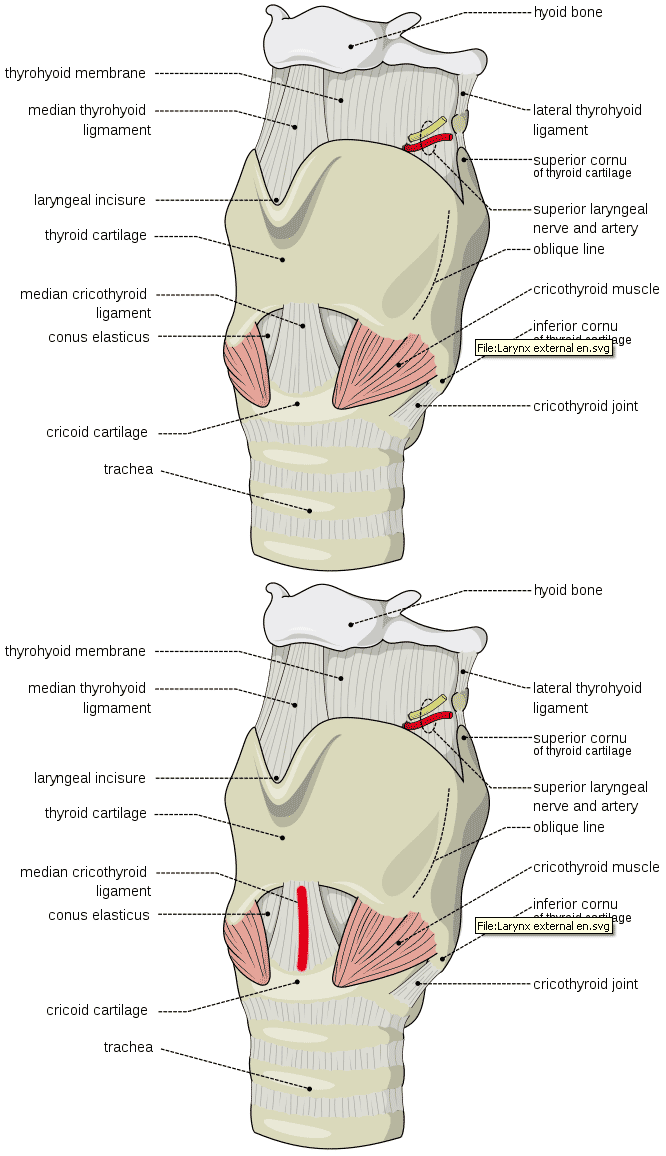
A cricothyrotomy (also called cricothyroidotomy or laryngotomy) is a medical procedure where an opening is created through the cricothyroid membrane to establish a patent airway during emergency airway management. Cricothyrotomy is primarily performed as the last step in airway management algorithms in cases where an airway cannot be established by other means of nasal or oral tracheal intubation. These situations, often referred to as "cannot intubate, cannot ventilate" (CICV) or "cannot intubate, cannot oxygenate" (CICO), are commonly seen as a result of airway obstruction, angioedema, trauma, burns, or abnormal anatomy.
Multiple types of cricothyrotomy may be considered for emergency surgical airway management, including surgical cricothyrotomy and needle cricothyrotomy. Surgical cricothyrotomy is performed by inserting a large-bore tube through an opening in the cricothyroid membrane created via incision or using the Seldinger technique. Needle cricothyrotomy is performed by inserting a catheter through the cricothyroid membrane and connecting it to a ventilation bag or a high-pressure oxygen source in a process called transtracheal jet ventilation. Various cricothyrotomy techniques have been portrayed in popular media but should only be performed by trained medical professionals.
Although alternative surgical techniques for securing an emergency airway exist, including tracheotomy, current guidelines recommend the use of surgical cricothyrotomy as the preferred method. Due to the importance of establishing an airway, there are few contraindications to performing the procedure. Although complications from cricothyrotomy are possible, including failure to secure the patient's airway and bleeding, studies suggest that the rate of complications is lower than tracheostomy when performed in airway emergencies.
While cricothyrotomy may be life-saving in extreme circumstances, this technique is only intended to be used temporarily until an alternative method can be used for long-term ventilatory support.
Cricothyrotomy is one option for obtaining an invasive/surgical airway, which is used as the last resort in emergency airway algorithms for both pediatric and adult patients. When surgical airway management is required, surgical cricothyrotomy is recommended as the first-line method for obtaining an emergency airway in adult patients. Due to anatomic differences in neonates and young children, needle cricothyrotomy is recommended for these patients.
Use of cricothyrotomy is indicated in any "cannot intubate, cannot ventilate" (CICV) or "cannot intubate, cannot oxygenate" (CICO) situation, typically after other techniques of tracheal intubation have been attempted through oropharyngeal or nasopharyngeal routes. Once a CICV or CICO situation is identified, a surgical airway is indicated and should be performed as quickly as possible by a trained clinician.
Some common causes of CICV and CICO scenarios include:
In the event of a "cannot intubate, cannot ventilate" (CICV) or "cannot intubate, cannot oxygenate" (CICO), establishing an airway is essential. Therefore, there are few contraindications to performing an emergency cricothyrotomy.
Hub AI
Cricothyrotomy AI simulator
(@Cricothyrotomy_simulator)
Cricothyrotomy
A cricothyrotomy (also called cricothyroidotomy or laryngotomy) is a medical procedure where an opening is created through the cricothyroid membrane to establish a patent airway during emergency airway management. Cricothyrotomy is primarily performed as the last step in airway management algorithms in cases where an airway cannot be established by other means of nasal or oral tracheal intubation. These situations, often referred to as "cannot intubate, cannot ventilate" (CICV) or "cannot intubate, cannot oxygenate" (CICO), are commonly seen as a result of airway obstruction, angioedema, trauma, burns, or abnormal anatomy.
Multiple types of cricothyrotomy may be considered for emergency surgical airway management, including surgical cricothyrotomy and needle cricothyrotomy. Surgical cricothyrotomy is performed by inserting a large-bore tube through an opening in the cricothyroid membrane created via incision or using the Seldinger technique. Needle cricothyrotomy is performed by inserting a catheter through the cricothyroid membrane and connecting it to a ventilation bag or a high-pressure oxygen source in a process called transtracheal jet ventilation. Various cricothyrotomy techniques have been portrayed in popular media but should only be performed by trained medical professionals.
Although alternative surgical techniques for securing an emergency airway exist, including tracheotomy, current guidelines recommend the use of surgical cricothyrotomy as the preferred method. Due to the importance of establishing an airway, there are few contraindications to performing the procedure. Although complications from cricothyrotomy are possible, including failure to secure the patient's airway and bleeding, studies suggest that the rate of complications is lower than tracheostomy when performed in airway emergencies.
While cricothyrotomy may be life-saving in extreme circumstances, this technique is only intended to be used temporarily until an alternative method can be used for long-term ventilatory support.
Cricothyrotomy is one option for obtaining an invasive/surgical airway, which is used as the last resort in emergency airway algorithms for both pediatric and adult patients. When surgical airway management is required, surgical cricothyrotomy is recommended as the first-line method for obtaining an emergency airway in adult patients. Due to anatomic differences in neonates and young children, needle cricothyrotomy is recommended for these patients.
Use of cricothyrotomy is indicated in any "cannot intubate, cannot ventilate" (CICV) or "cannot intubate, cannot oxygenate" (CICO) situation, typically after other techniques of tracheal intubation have been attempted through oropharyngeal or nasopharyngeal routes. Once a CICV or CICO situation is identified, a surgical airway is indicated and should be performed as quickly as possible by a trained clinician.
Some common causes of CICV and CICO scenarios include:
In the event of a "cannot intubate, cannot ventilate" (CICV) or "cannot intubate, cannot oxygenate" (CICO), establishing an airway is essential. Therefore, there are few contraindications to performing an emergency cricothyrotomy.