
Recent from talks
Tracheotomy
Knowledge base stats:
Talk channels stats:
Members stats:
Tracheotomy
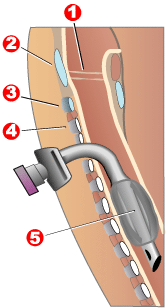
Tracheotomy (/ˌtreɪkiˈɒtəmi/, UK also /ˌtræki-/), or tracheostomy, is a surgical airway management procedure which consists of making an incision on the front of the neck to open a direct airway to the trachea. The resulting stoma (hole) can serve independently as an airway or as a site for a tracheal tube (or tracheostomy tube) to be inserted; this tube allows a person to breathe without the use of the nose or mouth.
The etymology of the word tracheotomy comes from two Greek words: the root tom- (from Greek τομή tomḗ) meaning "to cut", and the word trachea (from Greek τραχεία tracheía). The word tracheostomy, including the root stom- (from Greek στόμα stóma) meaning "mouth", refers to the making of a semi-permanent or permanent opening and to the opening itself. Some sources offer different definitions of the above terms. Part of the ambiguity is due to the uncertainty of the intended permanence of the stoma (hole) at the time it is created.
There are four main reasons why someone would receive a tracheotomy:
In the acute (short term) setting, indications for tracheotomy include such conditions as severe facial trauma, tumors of the head and neck (e.g., cancers, branchial cleft cysts), and acute angioedema (swelling) and inflammation of the head and neck. In the context of failed tracheal intubation, either tracheotomy or cricothyrotomy may be performed.[citation needed]
In the chronic (long-term) setting, indications for tracheotomy include the need for long-term mechanical ventilation and tracheal toilet (e.g., comatose patients, extensive surgery involving the head and neck). Tracheotomy may result in a significant reduction in the administration of sedatives and vasopressors, as well as the duration of stay in the intensive care unit (ICU).
In extreme cases, the procedure may be indicated as a treatment for severe obstructive sleep apnea (OSA) seen in patients intolerant of continuous positive airway pressure (CPAP) therapy. The reason tracheostomy works well for OSA is that it is the only surgical procedure that completely bypasses the upper airway. This procedure was commonly performed for obstructive sleep apnea until the 1980s, when other procedures such as the uvulopalatopharyngoplasty, genioglossus advancement, and maxillomandibular advancement surgeries were described as alternative surgical modalities for OSA.
If prolonged ventilation is required, tracheostomy is usually considered. The timing of this procedure is dependent on the clinical situation and an individual's preference. An international multicenter study in 2000 determined that the median time between starting mechanical ventilation and receiving a tracheostomy was 11 days. Although the definition varies depending on hospital and provider, early tracheostomy can be considered to be less than 10 days (2 to 14 days) and late tracheostomy to be 10 days or more.
Biphasic cuirass ventilation is a form of non-invasive mechanical ventilation that can — in a small subset of cases — allow people to avoid a tracheostomy.
Hub AI
Tracheotomy AI simulator
(@Tracheotomy_simulator)
Tracheotomy
Tracheotomy (/ˌtreɪkiˈɒtəmi/, UK also /ˌtræki-/), or tracheostomy, is a surgical airway management procedure which consists of making an incision on the front of the neck to open a direct airway to the trachea. The resulting stoma (hole) can serve independently as an airway or as a site for a tracheal tube (or tracheostomy tube) to be inserted; this tube allows a person to breathe without the use of the nose or mouth.
The etymology of the word tracheotomy comes from two Greek words: the root tom- (from Greek τομή tomḗ) meaning "to cut", and the word trachea (from Greek τραχεία tracheía). The word tracheostomy, including the root stom- (from Greek στόμα stóma) meaning "mouth", refers to the making of a semi-permanent or permanent opening and to the opening itself. Some sources offer different definitions of the above terms. Part of the ambiguity is due to the uncertainty of the intended permanence of the stoma (hole) at the time it is created.
There are four main reasons why someone would receive a tracheotomy:
In the acute (short term) setting, indications for tracheotomy include such conditions as severe facial trauma, tumors of the head and neck (e.g., cancers, branchial cleft cysts), and acute angioedema (swelling) and inflammation of the head and neck. In the context of failed tracheal intubation, either tracheotomy or cricothyrotomy may be performed.[citation needed]
In the chronic (long-term) setting, indications for tracheotomy include the need for long-term mechanical ventilation and tracheal toilet (e.g., comatose patients, extensive surgery involving the head and neck). Tracheotomy may result in a significant reduction in the administration of sedatives and vasopressors, as well as the duration of stay in the intensive care unit (ICU).
In extreme cases, the procedure may be indicated as a treatment for severe obstructive sleep apnea (OSA) seen in patients intolerant of continuous positive airway pressure (CPAP) therapy. The reason tracheostomy works well for OSA is that it is the only surgical procedure that completely bypasses the upper airway. This procedure was commonly performed for obstructive sleep apnea until the 1980s, when other procedures such as the uvulopalatopharyngoplasty, genioglossus advancement, and maxillomandibular advancement surgeries were described as alternative surgical modalities for OSA.
If prolonged ventilation is required, tracheostomy is usually considered. The timing of this procedure is dependent on the clinical situation and an individual's preference. An international multicenter study in 2000 determined that the median time between starting mechanical ventilation and receiving a tracheostomy was 11 days. Although the definition varies depending on hospital and provider, early tracheostomy can be considered to be less than 10 days (2 to 14 days) and late tracheostomy to be 10 days or more.
Biphasic cuirass ventilation is a form of non-invasive mechanical ventilation that can — in a small subset of cases — allow people to avoid a tracheostomy.
Recent media